


Tylenol Newborn Dosage: What Parents Must Know Before Dosing

For babies under 12 weeks, Tylenol should never be given without direct pediatrician guidance, and any rectal temperature of 100.4°F (38°C) or higher needs immediate medical evaluation rather than home treatment. If you're awake at 2 AM with a fussy newborn in your arms and a thermometer in the other hand, the safest move is to pause, check the age threshold, and call for medical advice instead of guessing a dose.
Table of Contents
The 2 AM Question Every New Parent Faces
A parent stands in a dark nursery, one hand on a warm forehead and the other on a bottle of infant acetaminophen, trying to decide whether this is the moment to give medicine. That is the exact point where fear pushes for a quick answer, but babies under 12 weeks should not receive acetaminophen without a pediatrician's direct instruction. For newborns in that age group, a 100.4°F (38°C) rectal temperature means immediate medical evaluation, not home treatment Blueberry Pediatrics.
Why the safe answer is often no medicine yet
Newborns are not just smaller versions of older babies. In the first weeks of life, a fever can signal a serious infection, so the first job is finding out why the temperature is high, not covering it up with a dose that could delay care TYLENOL safety guidance. Standard charts leave the youngest babies out of routine home dosing tables for that reason and tell caregivers to consult a clinician instead Infant Tylenol dosage chart explanation.
Practical rule: if your baby is under 12 weeks and has a fever, call for medical help first. Do not try to solve it with a bottle and a syringe.
That difference matters because a crying newborn does not always need medication, but a feverish newborn always deserves careful attention. A lot of parents expect a dosage chart to solve the problem, yet the safest answer at this age is usually a triage question, not a milliliter calculation.
New parents often want a number they can trust right away. Newborn care does not work that way, because the smallest babies need a clinician to decide whether acetaminophen is appropriate before any dose is given. If you want a broader explanation of how acetaminophen is handled in children, the acetaminophen dosing overview can help frame the safety rules, but it does not replace a call for a baby under 12 weeks.
What you should do instead of guessing
If your baby is under 12 weeks, keep the thermometer reading, your baby's exact age, and your last feeding time ready before you call. If a clinician tells you to give acetaminophen, follow their dosing instructions exactly. If they tell you to go in, treat that as the right next step, not an overreaction.
How Weight-Based Dosing Works
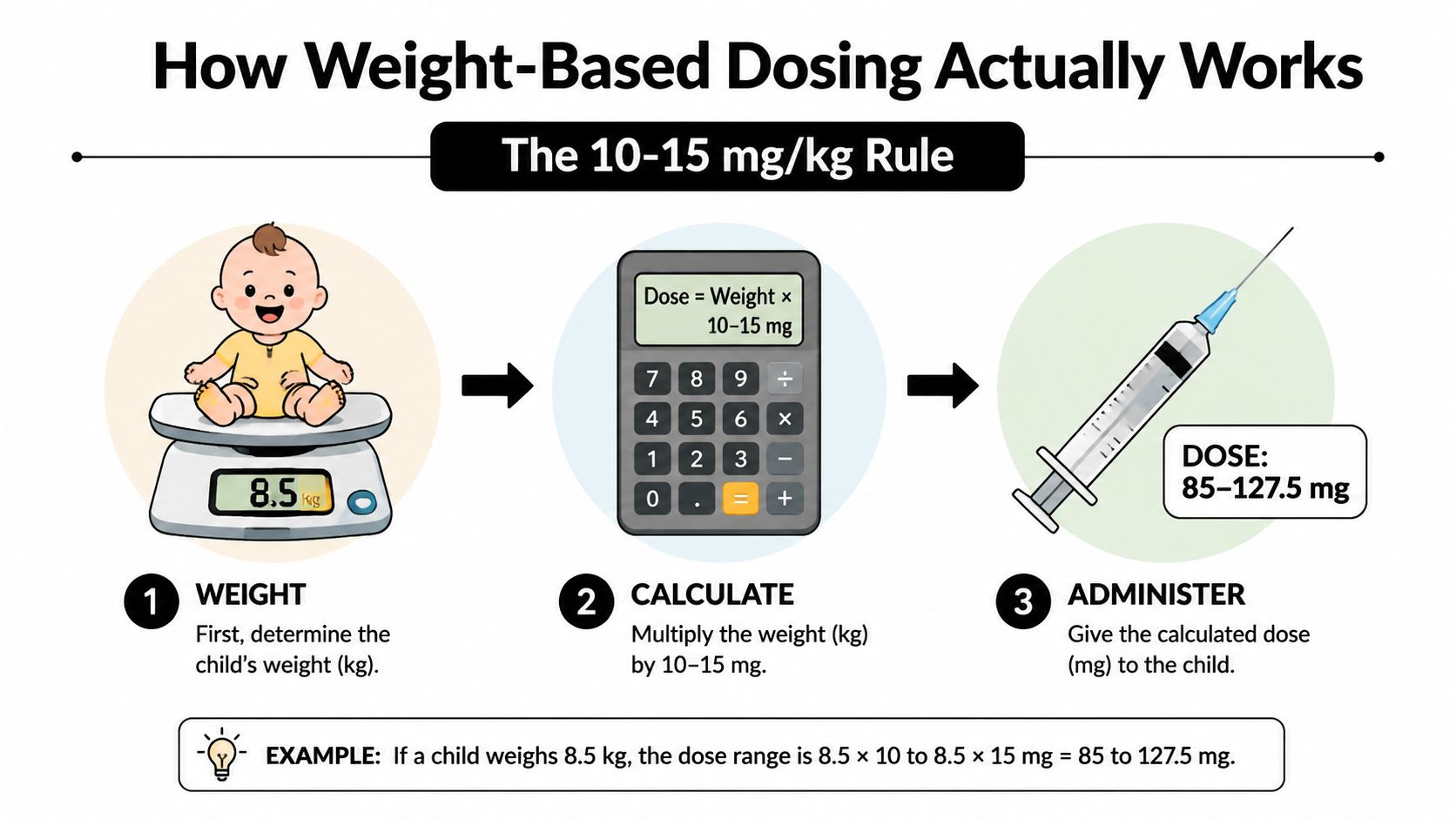
The core rule for pediatric acetaminophen is 10 to 15 mg per kilogram per dose, repeated every 4 to 6 hours as needed, with no more than 5 doses in 24 hours. That number set is the reason weight matters more than age. It gives a closer fit than a guess based on size alone.
Why weight beats age for accuracy
A baby who weighs 4 kg and a baby who weighs 7 kg should not get the same amount. The right dose follows body weight because medication exposure tracks size and maturity, not just the number of weeks since birth. Older infant charts then start showing measured liquid amounts like 1 mL, 1.25 mL, or 1.5 mL, while the youngest babies are still handled separately with clinician guidance.
Ordering a suit is a useful comparison. A small frame does not fit well in an oversized coat, and a newborn does not fit well into a dosing chart meant for older babies. Weight-based dosing is the pediatric version of tailoring.
A simple way to understand the math
If a clinician tells you to use acetaminophen, the calculation starts with your baby's weight in kilograms. The dose range is 10 to 15 mg per kilogram, and the exact amount depends on the product concentration and the clinician's instructions. That is why the label and the syringe matter just as much as the math.
Useful habit: write the weight down before medicine is ever discussed. Sleep-deprived parents make fewer mistakes when the number is already on paper.
For a trusted medication-safety refresher, keep this acetaminophen reference bookmarked on your phone, but always defer to your pediatrician for a newborn.
The spacing matters too. The usual interval is every 4 to 6 hours, and the total daily limit stays at 5 doses in 24 hours. That helps prevent accidental stacking when more than one adult is helping overnight.
Why Newborns Under 12 Weeks Are Treated Differently
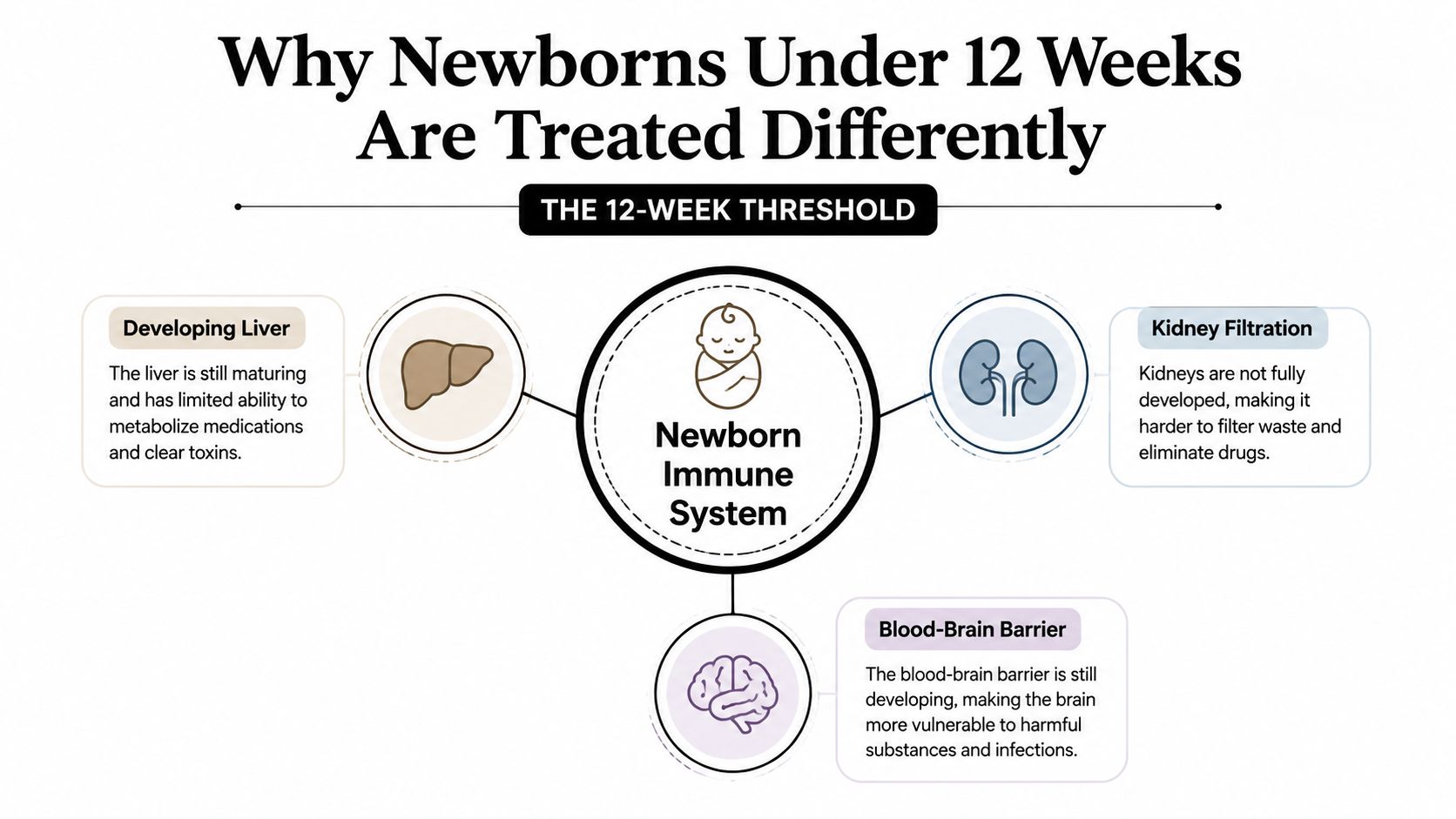
A baby who is only a few weeks old does not handle medicine the same way an older infant does. The body is still learning how to process acetaminophen, and the immune system is still young enough that a fever can mean more than “just a fever.” That is why newborns stay in a separate category, and why pediatric and manufacturer guidance tells parents to call a doctor instead of reaching for a routine home dose TYLENOL infant safety guidance.
What the age cutoff is really protecting
Fever in the first 12 weeks can signal a serious infection that needs prompt evaluation. In this age group, the priority is finding out why the fever is there, not merely lowering it. The medicine itself is not the only concern, because giving it too early can blur the picture and slow the diagnosis of something dangerous HealthyChildren acetaminophen guidance.
That is why consumer dosing charts treat the youngest babies differently. For the 0 to 3 months range, they do not give a routine home dose, they tell parents to consult a pediatrician. Some charts even place babies as small as 6 to 11 pounds into that same call-a-doctor group, and Canadian TYLENOL guidance labels babies under 12 lb / under 5.5 kg as “talk to a doctor” Healthline infant Tylenol dosage chart. The smallest babies are left out on purpose, because a standard chart cannot account for all the safety questions that come with early infancy.
Why this feels harder than it sounds
A crying newborn makes parents want to act immediately. A warm forehead or a baby who will not settle can feel urgent in the middle of the night, and that instinct comes from care, not carelessness. The safer move is to check the temperature, note feeding and wet diapers, and involve a clinician before giving any medicine.
For neonates, acetaminophen dosing is more specialized and depends on weight, gestational age, and postnatal age, not a simple age chart Medscape neonatal acetaminophen dosing. That level of detail belongs with a clinician because premature babies and full-term newborns do not clear medicine in the same way.
The part many charts leave out
Some search results answer “how much?” before they answer “should I give any at all?” For a newborn, that order is backward. The more important question is whether the baby needs medical evaluation first, because fever in this age window is handled differently from the soothing aches and fevers parents expect in older infants. If your baby is under 12 weeks, guesswork is the wrong tool, and so is reaching for a medicine chart meant for older babies.
For parents sorting through pain relief options later on, a separate guide on safe infant fever medicine choices can help clarify why different ages are treated differently. For a newborn, though, the starting point is still the pediatrician.
Newborn Dosing Versus Older Infant Dosing
A baby can look tiny in either stage, but medication rules change quickly in those first weeks. A newborn lives in a clinician-guided zone. Once a baby is older, standard weight-based charts are more likely to apply, which is why the youngest babies are often left out of routine dosing tables.
Newborn vs Older Infant Acetaminophen Protocols
Factor | Newborns (0-12 Weeks) | Older Infants (12+ Weeks) |
|---|---|---|
Dosing authority | Pediatrician directs use | Standard weight-based guidance is commonly used |
Routine home dose | Not given from routine charts | Weight-based dose may be given as directed |
Dose framework | Individualized, often based on weight and maturity | 10 to 15 mg/kg per dose |
Timing between doses | Set by clinician, can vary in neonates | Typically every 4 to 6 hours as needed |
Daily limit | Clinician-specific for neonates | No more than 5 doses in 24 hours |
Fever approach | Immediate medical evaluation if 100.4°F (38°C) or higher rectally | Fever still deserves medical guidance, but the home-dosing pathway is broader |
A newborn is not just a smaller version of an older infant. The body clears medicine differently, and that is why a chart made for older babies can be misleading in the first weeks of life. For parents, that means the safest path is usually not to estimate, but to pause and ask for guidance.
Why preterm babies need even more caution
Premature babies can need longer spacing between doses because their bodies clear medicine more slowly. Neonatal references describe schedules that change with gestational age and postnatal age, including intervals such as q6-8h in the earliest days of life and longer intervals in more premature neonates. That is not the kind of detail to improvise at home.
Bottom line: once babies pass the newborn window, guidance becomes more standardized. Before that, the safest answer is often a phone call, not a dose.
If you are comparing fever reducers for an older baby later on, keep in mind that acetaminophen and ibuprofen are not interchangeable in early infancy. For a broader comparison, see this ibuprofen guide, but do not use it to make a newborn dosing decision.
What changes as your baby grows
Leaving the newborn period is more than a calendar change. It means moving from specialist-guided dosing to the more familiar pediatric weight charts used for older infants. That is why many charts stop short of giving a routine dose for the youngest babies, even while they list measured liquid amounts for older infants.
Common Dosing Mistakes Parents Make
The riskiest Tylenol mistakes usually happen when parents are exhausted, rushed, or trying to help quickly. A crying baby can make the bottle seem like the fastest answer, but speed does not protect a newborn from a dosing error.
The shortcuts that create risk
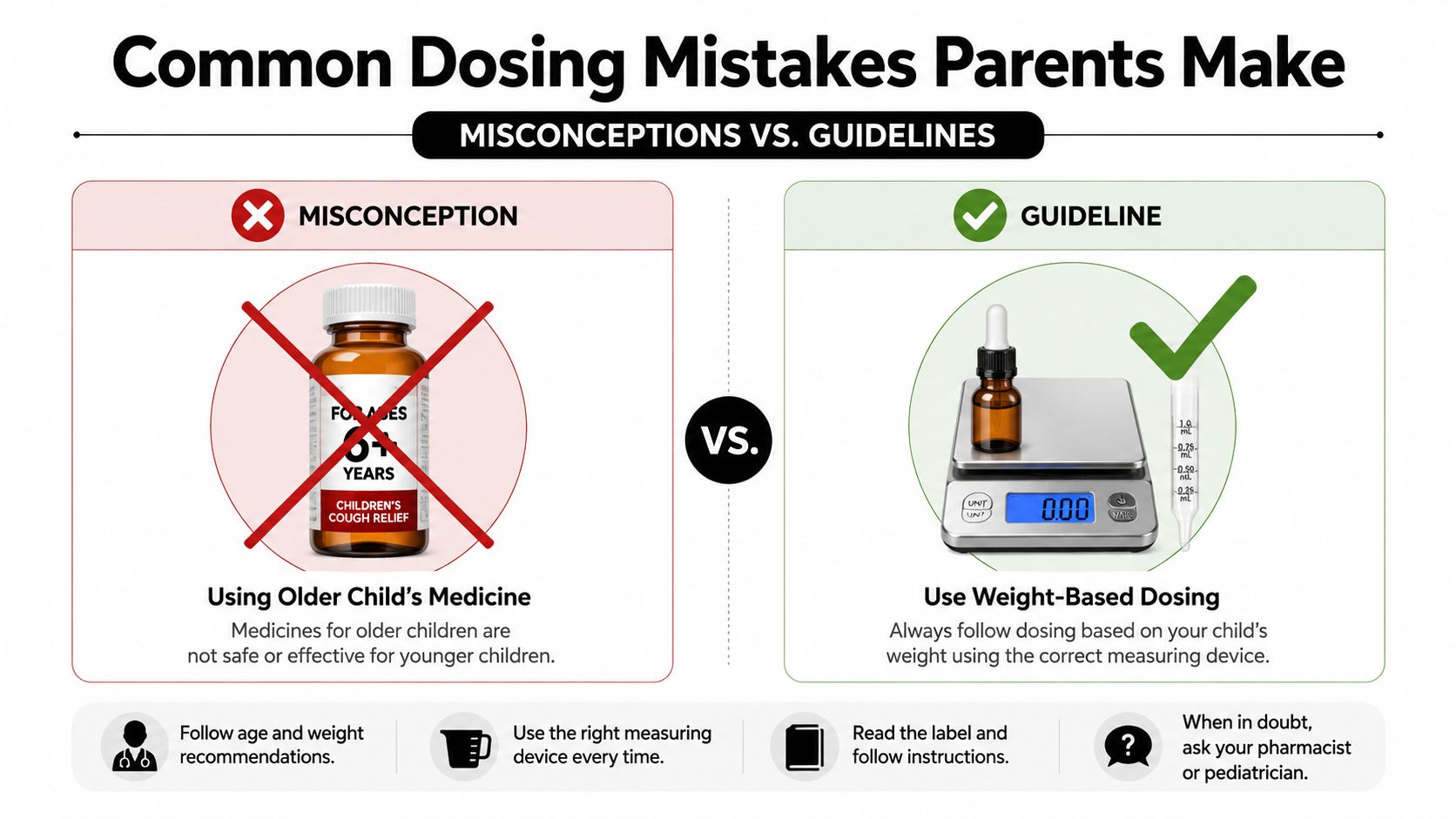
Using a sibling's dose: A dose that fits an older child can be too much for a newborn, even when the babies look close in size.
Guessing from age alone: Age can help with screening, but newborn dosing needs medical guidance, not rough estimates from a chart meant for older infants.
Mixing up products: Infant acetaminophen, children's acetaminophen, and cold medicines can differ in concentration and active ingredients.
Double-dosing across caregivers: One parent gives medicine at midnight, another repeats it at 2 AM because nobody wrote it down.
Giving medicine before evaluation: Comfort matters, but a fever in a newborn needs the same caution every time.
Why the bottle label matters more than memory
Acetaminophen appears in more than one over-the-counter product, so it is easy to stack doses without realizing it. Careful measuring and written records help prevent that kind of mistake, especially when more than one adult is awake and trying to soothe the same baby. For a broader reminder about product mix-ups, this over-the-counter pain reliever guide can help you spot confusing labels.
Write the time, amount, and product name every time. Memory is not a dosing system.
A syringe is safer than a kitchen spoon, and the bottle's concentration matters each time you use it. A small measurement change can mean a very different amount of medicine for a tiny infant, which is why careful reading matters more than guessing from a half-remembered dose.
A calmer way to respond
If you are staring at a bottle with a worried baby in your arms, stop and check three things first. Ask whether your baby is under 12 weeks, whether there is a fever, and whether a pediatrician has already told you to use acetaminophen. That pause can keep a stressful night from turning into a medication error.
For another practical reminder about avoiding product mix-ups, keep the guide above handy, but do not use any generic chart in place of newborn-specific medical advice.
When to Call the Pediatrician and When to Go to the ER
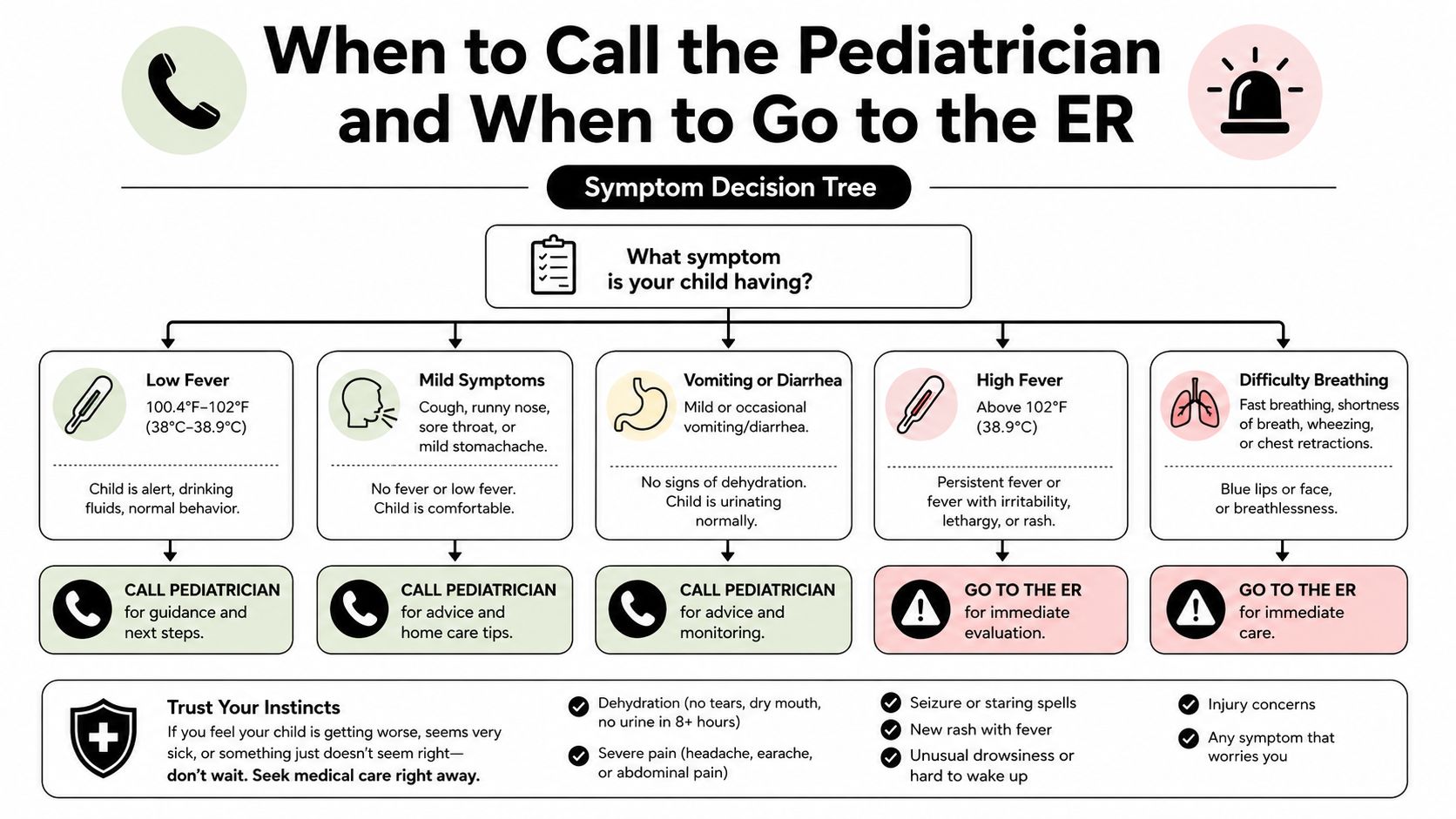
A newborn's first safety question is not whether the baby seems fussy or sleepy. It is whether the baby is under 12 weeks and has a fever. A rectal temperature of 100.4°F (38°C) or higher in that age group needs immediate medical evaluation.
Start with the age and temperature checkpoint
If your baby is under 12 weeks and has that fever reading, call right away or go where your pediatrician directs you. If you are not sure whether the temperature was taken the right way, do not wait to see whether it drops on its own. Newborn fever can move quickly, and time spent watching at home can delay the care a young baby may need.
Have the right information ready
Before you call, gather the details a nurse or pediatrician will ask for.
Exact age: Know the baby's age in days or weeks, not just “newborn.”
Exact weight: Clinicians need this if dosing is discussed.
Temperature reading: Say whether it was rectal and what the number was.
Last feeding time: Feeding changes help show how the baby is doing overall.
Any medication already given: Include time, product name, and amount.
Know what pushes care toward emergency evaluation
If your baby is hard to wake, feeding poorly, breathing oddly, or has a rash plus fever, do not wait for a callback. Those changes need urgent attention even if you have not given any medicine yet. The key question is not whether Tylenol would help a little. It is whether the baby needs a clinician to check the cause now.
Practical rule: when a newborn has fever, your job is to move the baby toward medical assessment, not to keep troubleshooting at home.
If you call and feel rushed, repeat the temperature, the age, and the fact that the baby is under 12 weeks. Clear, direct information helps the clinician make the safest recommendation.
Your Newborn Medication Safety Checklist
A late-night fever, a crying baby, and a bottle of medicine can make any parent want a fast answer. For a newborn, the safer answer is a short checklist, because guessing a dose is not the same as treating the cause.
Keep these rules close
Never dose under 12 weeks without a doctor: Newborns in this age range are treated differently because standard dosing charts usually leave them out.
Use weight-based dosing only when a clinician approves it: When acetaminophen is used for a baby who is old enough for routine dosing, the usual framework is 10 to 15 mg/kg per dose.
Respect the timing: Doses are usually spaced every 4 to 6 hours, with no more than 5 doses in 24 hours.
Write down every dose: Keep the time, amount, and product name in one place so you do not have to rely on memory at 3 AM.
Treat fever in a newborn as urgent: A rectal 100.4°F (38°C) reading in the first 12 weeks needs immediate evaluation.
A dosing chart for an older infant is like a road map with landmarks filled in. A newborn does not get that same map, because the margin for error is much smaller and the right next step is often a clinician's guidance, not a guess.
Keep the right contacts ready
Save your pediatrician's after-hours number in your phone, not buried in paperwork. Know where your nearest emergency care is, and keep poison control available if any medication mistake happens. If you are ever unsure whether a dose was too much, call immediately rather than waiting for symptoms to appear.
The calmest thing I can tell worried parents is simple. You do not need to memorize every detail tonight. You do need to remember that newborns are a special category, fever can be serious, and a careful phone call is always better than a guessed dose.
If you want more clear, parent-friendly medication guidance like this, visit River of Life for practical health resources written to help families make calmer, safer decisions at home. When you are up in the middle of the night and unsure what is normal, having a trustworthy place to start can make all the difference.