


Newborn Dose of Tylenol: A Parent's Safety Guide

It's 2 a.m., your newborn is hot, fussy, and won't settle, and you're staring at a bottle of Tylenol wondering how many milliliters to give. For a baby in the first 12 weeks of life, the safest answer is often not a dose at all. Call the doctor before giving acetaminophen at home, because fever in that age group needs medical evaluation, not guesswork, and the right dose depends on the cause of illness, not just the number on a scale (AAP guidance for acetaminophen in young children).
Parents ask for a newborn dose of Tylenol because they want relief fast. That instinct is understandable, but newborn care has a different safety threshold than care for older infants. A careful, doctor-directed approach protects a baby whose liver and medication-clearance systems are still immature, and it keeps you from treating a fever at home when the right move is urgent evaluation.
Table of Contents
Why Newborn Tylenol Is Not a Simple Question
A newborn can look miserable for reasons that have nothing to do with pain, and that is why Tylenol is not the first automatic move in the first 12 weeks. A temperature of 100.4°F (38°C) or higher in a baby under 12 weeks needs immediate medical evaluation, because the concern is the illness behind the fever, not just the symptom. AAP-linked guidance
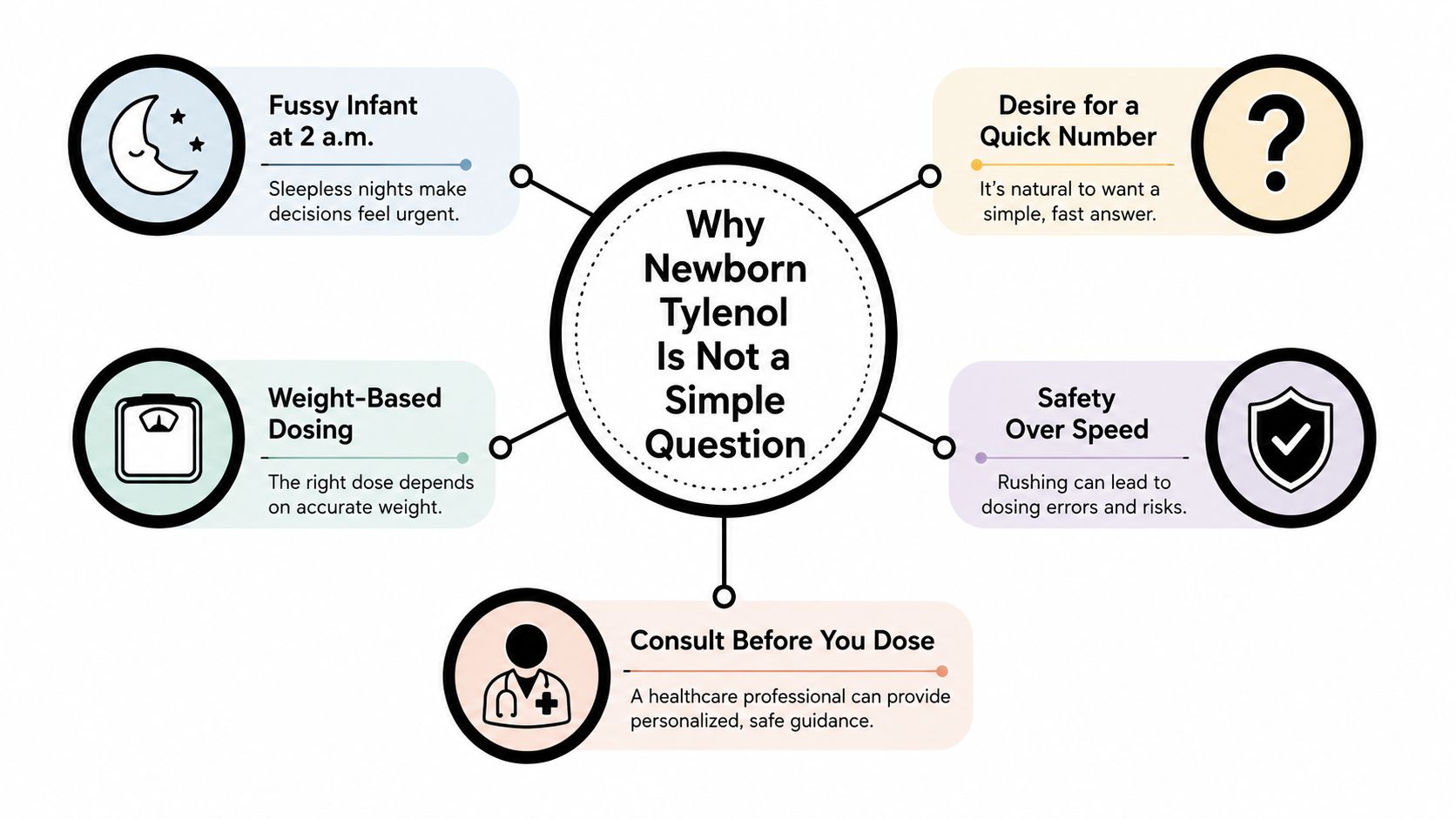
What parents are really deciding at 2 a.m.
The question usually sounds like, “How much Tylenol can I give?” The safer question is, “Is this baby old enough and well enough for acetaminophen at home?” For newborns, those are not the same thing. AAP guidance says acetaminophen should not be given without a doctor's guidance, and the newborn window deserves even more caution. AAP-linked guidance
A fussy baby with no fever may need feeding support, burping, a diaper check, or a call to the pediatrician rather than medication. A baby with fever, poor feeding, limpness, or breathing changes needs a clinician's eyes on them first. That difference matters more than speed.
Practical rule. In the first 12 weeks, fever triage comes before dosing.
If you are comparing this with other infant pain medicines, the same safety logic applies across the board. For a broader medication comparison, see the separate discussion of ibuprofen considerations for young children, but do not use that as a substitute for newborn-specific advice.
Why caution is built into newborn guidance
Newborn livers and medication-clearance systems are immature, so the margin for error is smaller than it is later in infancy. That is why many consumer charts stop at “consult your pediatrician” for the newborn range, even when older infant charts list milliliters. This is not overcaution for its own sake. It is a safety boundary that reflects how young babies process medicine and how often fever signals something that needs workup, not symptom masking.
The rest of this guide follows that safety-first logic. When a dose is appropriate, the numbers matter. When a dose is not appropriate, the right action is to call, not calculate.
Age and Weight Rules for Newborn Acetaminophen
A newborn should not get acetaminophen at home unless a clinician has already said it is appropriate. The first question is age, not the chart. Babies under 12 weeks should not be treated at home for fever with acetaminophen without medical guidance (AAP guidance). If your baby is in that window and has a fever, the safest next step is to call, not calculate.
A baby's weight still matters, but only after that first decision is made. Weight helps determine the size of a safe dose once a pediatrician approves use, and it is also the reason bottle labels and dosing charts have to match the medicine in your hand. For a broader look at how acetaminophen works, see the acetaminophen overview, but newborn dosing is stricter than general infant guidance.
What “newborn” means in practice
In everyday pediatric use, “newborn” usually refers to the first weeks of life, but dosing advice is organized around age bands because the baby's body systems are still maturing. Public charts commonly separate babies into 0 to 3 months, 4 to 11 months, and 12 to 23 months, and the youngest group carries the tightest caution (Canadian dosing guidance). That structure reflects two separate facts. Age tells you how ready the baby is for home treatment, and weight tells you what dose may be appropriate if a clinician has already said to use acetaminophen.
For a baby in the newborn period, have these details ready before you call the pediatrician:
Birth weight: It gives the clinician a baseline.
Current weight: Dosing is weight-based once use is approved.
Temperature reading: The exact number, method, and time matter.
Last feeding: Poor intake changes how urgent the call is.
Other symptoms: Lethargy, rash, vomiting, or breathing changes all matter.
Practical rule: if you do not know the baby's current weight, do not estimate.
Where weight-based charts start to matter
Weight-based charts can start to look specific even in the youngest age bands, but that does not mean home dosing is automatically appropriate. The chart is a dosing tool, not permission to treat. In the Canadian dosing chart, examples include 0.5 mL for 0 to 3 months at 6 to 11 lb, 1.0 mL for 4 to 11 months, and 1.5 mL for 12 to 23 months (Canadian dosing guidance). Those numbers show how closely acetaminophen volume is tied to size, but the age boundary still comes first for newborns.
If you are standing in the pharmacy aisle or staring at the bottle at 2 a.m., use this order: age, symptoms, clinician guidance, then weight and concentration. Under 12 weeks, call first. If a clinician says acetaminophen is appropriate, then the dose can be matched to the baby's current weight and the bottle concentration without guessing.
Reading a Tylenol Dosing Chart Correctly
A Tylenol chart can look straightforward until an old post sends you to the wrong bottle strength. For newborns, that mistake matters. Current liquid acetaminophen for infants and children uses a single strength of 160 mg per 5 mL, while older concentrated infant products used a different amount per volume. If you are comparing a chart to the bottle in your hand, concentration comes first, not the age column.
The chart only works if the bottle matches it
Read the label before you read the age range. If the bottle does not say 160 mg per 5 mL, stop there and do not try to force the chart to fit. A dosing chart is only useful when the product strength matches the chart exactly, and the smallest babies still need clinician guidance before any home dose is given.
Newborn Tylenol Dose by Age and Weight (160 mg / 5 mL) | ||||
|---|---|---|---|---|
Age | Weight Range | Typical Dose | Repeat Interval | Max in 24 Hours |
0 to 3 months | 6 to 11 lb | 0.5 mL in the Canadian chart, or clinician-directed weight-based volumes in other pediatric charts | Every 4 to 6 hours | No more than 5 doses |
4 to 11 months | Varies by chart | 1.0 mL in the Canadian chart | Every 4 to 6 hours | No more than 5 doses |
12 to 23 months | Varies by chart | 1.5 mL in the Canadian chart | Every 4 to 6 hours | No more than 5 doses |
That table is useful for checking whether the numbers make sense, but it does not mean a newborn should be dosed at home without medical direction. For a baby in the first 12 weeks, the chart is a reference after a clinician has told you acetaminophen is appropriate.
How to spot outdated advice fast
Outdated advice often shows the concentrated infant liquid, or it quotes a volume that no longer matches the bottle on the shelf. That is where parents get into trouble. A small change in concentration changes the volume you draw up, so a screenshot from social media can give the wrong answer even when the active ingredient is the same.
Practical rule: match the bottle concentration to the chart concentration before you look at the milliliters.
If the label and the chart do not line up, stop and call the pharmacist or pediatrician. That pause is safer than guessing, especially for a newborn where the margin for error is small.
How to Measure and Give the Dose Safely
Tiny volumes are where careful parents get tripped up, because a newborn dose can be small enough that a spoon or a casual pour turns into a real risk. The safest workflow starts before the medicine touches the syringe. Check the label, confirm the concentration, and make sure you're using the dosing syringe that came with the product, not a kitchen spoon or a tool from another bottle (Tylenol safety guidance).
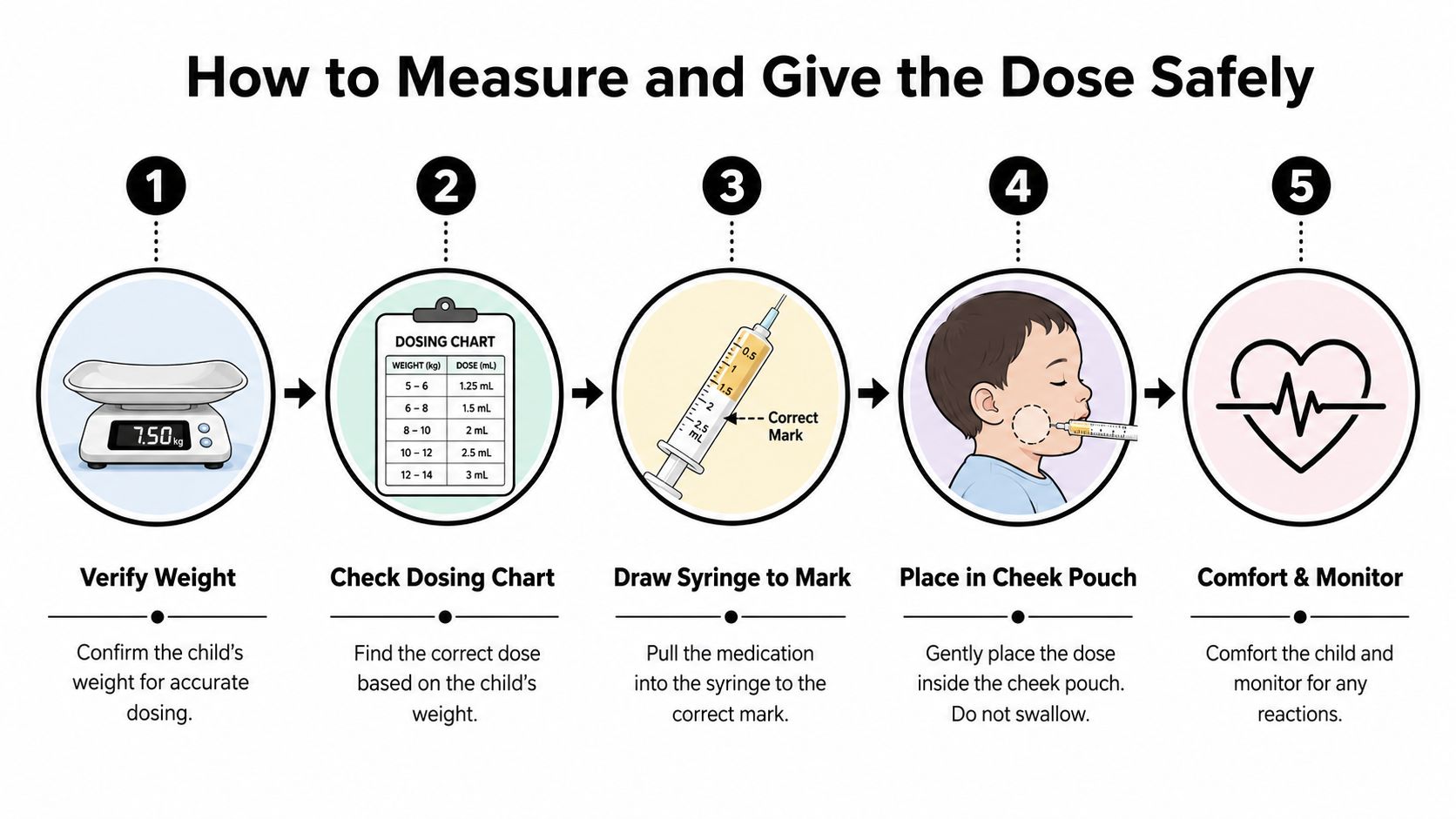
A calm bedside routine
Start by washing your hands and confirming the exact milliliter amount your clinician gave you. Draw the liquid to the marked line on the syringe, then check it at eye level so the meniscus isn't fooling you. If the plunger sits between marks, don't guess upward or downward, ask for clarification before giving the dose.
Position the baby semi-upright, then guide the syringe to the inner cheek pouch rather than aiming straight back. That helps the infant swallow slowly and reduces the chance of choking or immediate spit-out. A gentle pace works better than trying to get the whole dose in at once.
Use the included syringe only: It's calibrated for the bottle.
Read milliliters, not milligrams: Different units cause real errors.
Keep a dose log: Time, amount, and reason help prevent duplicates.
Store the bottle immediately after use: That keeps it out of reach and out of sight.
What to do if the baby spits up
If a baby spits up or refuses part of the medicine, don't automatically give another full dose. You don't know how much was absorbed, and doubling can create a medication error. The safest move is to write down what happened and call the pediatrician or pharmacist for instructions.
Practical rule: if you're unsure whether the full dose stayed down, don't repeat it on your own.
The same caution applies if someone else in the house gives a fever medicine and you're not certain what was already administered. Duplicate dosing is easy when parents are sleep-deprived and trading shifts. A simple written log on paper or in the phone notes app is enough to prevent that mistake.
Mistakes New Parents Make With Newborn Tylenol
The biggest errors with newborn Tylenol usually come from the process, not the intention. A parent is trying to help, but the wrong concentration, the wrong tool, or the wrong assumption can turn a common medicine into a dangerous one. For babies in the first 12 weeks, the safer default is to call a doctor before dosing at home. That is the part many guides bury, and it matters most at 2 a.m. when a fever makes every choice feel urgent.
The five mistakes that cause trouble
Using the old concentrated infant bottle by accident: Some families still have outdated advice or an older bottle at home. The fix is simple. Check the concentration before every use and confirm it matches current liquid guidance. If you need a reference point for how products are labeled, the Equate pain reliever discussion shows why brand packaging can be confusing, but it does not replace a newborn-specific chart.
Guessing the baby's weight: A weight guess is not a dose. If the baby has not been weighed recently, use the current clinic weight or follow the pediatrician's instructions before measuring anything.
Doubling up after a spit-up: A partial loss does not tell you how much medicine was absorbed. Give yourself a pause, write down what happened, and call for advice instead of repeating the full amount on your own.
Measuring with a kitchen spoon: A spoon cannot reliably deliver a newborn volume. Use the syringe that comes with the medication, and measure in milliliters, not by eye.
Mixing acetaminophen with another medicine without guidance: Parents sometimes alternate products without realizing one or both contain acetaminophen, or they combine fever medicines without a plan. If a clinician has not told you to do it, do not improvise.
If you want a quick way to remember the danger pattern, keep the order in mind. Wrong bottle, wrong weight, wrong tool, wrong timing, wrong combination. That sequence catches the mistakes that show up most often when everyone is tired and trying to move fast.
What to do instead
The safer habit is plain and repeatable. Verify the baby's age, confirm the current weight, read the bottle concentration, measure with the syringe, and write down the exact time. That routine does more than prevent overdose. It also helps keep parents from giving too little medicine and then chasing the effect with another untracked dose.
A simple note in your phone or on paper is enough. It should show the time, the amount, and the reason the medicine was given. That record becomes even more helpful when another caregiver steps in, because sleep deprivation makes duplicate dosing easier than parents expect.
When to Call the Doctor Instead of Dosing
The safest move starts before the bottle comes out of the cabinet. For a baby under 12 weeks, call the pediatrician before giving acetaminophen at home, especially if the temperature is 100.4°F (38°C) or higher (AAP guidance). In a newborn, fever is a medical call, not a dosing decision. If the baby also has breathing trouble, poor feeding, limpness, or looks unusually ill, the conversation becomes urgent.
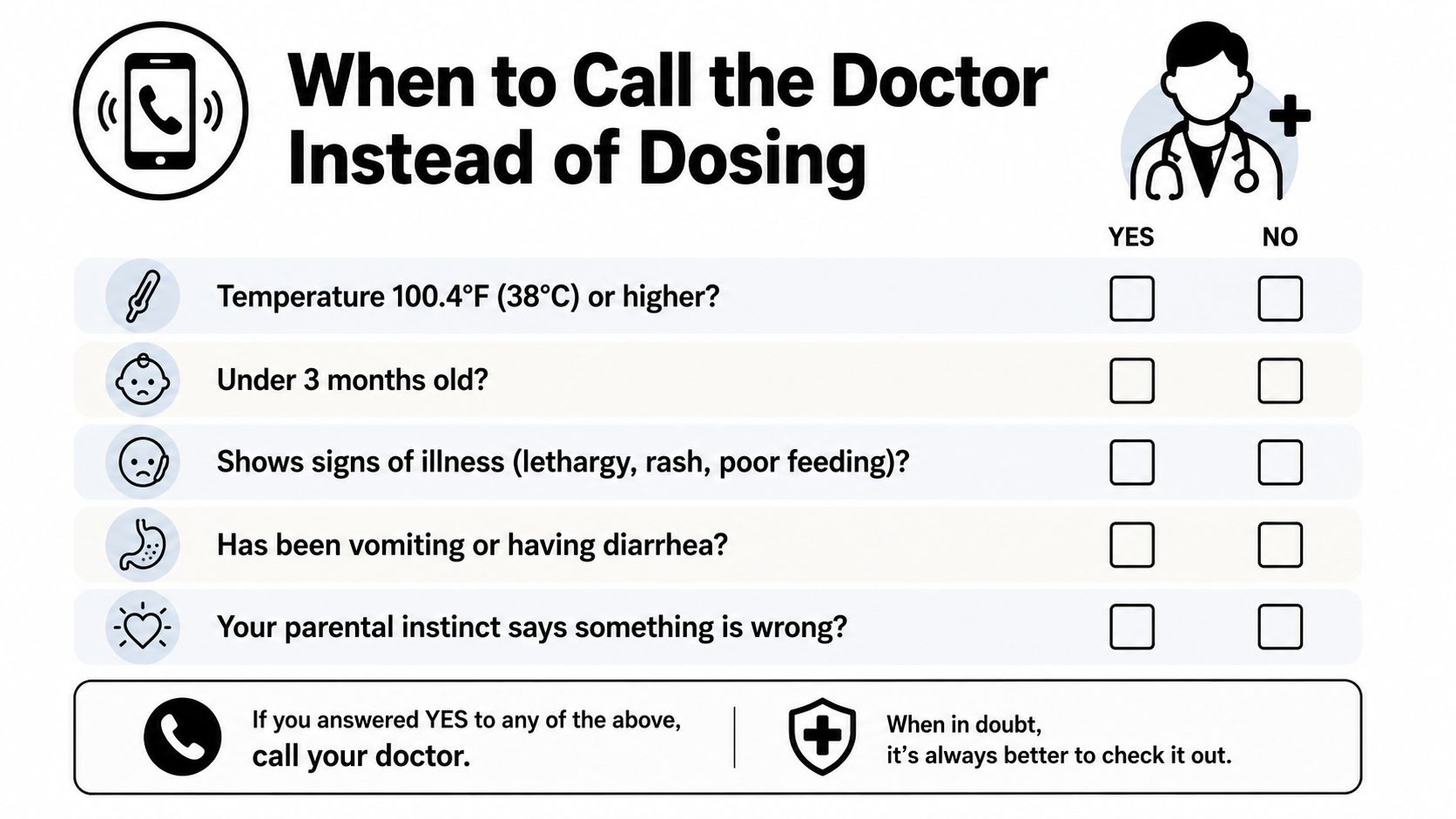
A simple decision tree
Use the chart this way. If your baby is under 12 weeks and has a fever of 100.4°F (38°C) or higher, call right away or go in for evaluation. If breathing is hard, feeding is poor, the baby is unusually floppy, or the baby looks seriously unwell, do not wait to see whether a dose helps. If a clinician already told you to use acetaminophen after a vaccine, follow that plan, but call if the baby seems worse than expected or you are unsure what you are seeing.
Call now or go in right away: Temperature of 100.4°F (38°C) or higher in a baby under 12 weeks, breathing trouble, unusual limpness, poor feeding, or a baby who looks seriously unwell.
Call the pediatrician the same day: Post-vaccine fussiness with a clinician's prior guidance, a baby who seems uncomfortable but is afebrile, or any situation where you're unsure about dosing.
Monitor and document: Mild fussiness in an older infant who is feeding, waking, and behaving normally, with no fever and no red-flag symptoms.
Keep the threshold in plain sight. The first 12 weeks are not the time to test whether a home dose is enough, because newborn symptoms can change quickly and the cause may need to be found before anything is given. When you call, the pediatrician needs the baby's age, weight, temperature, and whether any medicine has already been given.
What to tell the nurse on the phone
Have the exact temperature, how you took it, your baby's age in weeks, current weight, feeding pattern, wet diapers if you've been tracking them, and the time of the last medication dose. If the baby had a vaccine recently, say so. If you've already given acetaminophen, tell them the bottle strength and the milliliters you measured.
Use this call as a quick handoff, not a guessing game. Lead with the age, the temperature, the weight, and the symptoms. That helps the nurse sort out whether the baby needs immediate evaluation, same-day advice, or simple monitoring.
For many parents, the hard part is deciding whether the crying is ordinary newborn fussiness or a sign that something is off. If your instinct says the baby is not acting right, make the call. A brief phone call is far safer than waiting through a fever in a newborn and hoping it settles on its own.
Your One-Page Newborn Tylenol Quick Reference
A newborn fever call should start with the baby's age, temperature, and current weight, then move straight to the question of whether a doctor wants acetaminophen given at all. In the first 12 weeks, that call comes before any home dose. If the bottle in your hand is not the standard 160 mg per 5 mL concentration, stop and verify it before you measure anything. The dose chart belongs beside the medicine, but it does not replace a clinician's instruction for a newborn. Use the AAP guidance and the Tylenol dosing chart as references, not as a substitute for medical advice in the first weeks of life.
The three habits that matter most
Verify current weight: Never guess from memory or use an old weight.
Confirm concentration: Read the label before every dose.
Measure with the provided syringe only: Do not use kitchen spoons or other improvised tools.
Use this as a bedside checklist, not a substitute for a call when the baby is very young or clearly unwell. If the temperature is 100.4°F (38°C) or higher, the next step is urgent medical evaluation, not a home dose. If the baby is under 12 weeks, call the pediatrician first even when the fever seems mild, because the cause matters as much as comfort. If you are unsure whether the chart or the bottle matches what you have, stop and confirm both before giving any medicine.
If you need to keep the process simple at 2 a.m., use this order: check the temperature, check the age, check the weight, check the bottle, then call if the baby is in the newborn window or has a fever. A careful pause now is safer than a fast dose given from the wrong chart, the wrong syringe, or the wrong assumption about what the baby needs.