


Cream Pain Reliever Guide: Ingredients and Evidence

Your knees are barking after a long walk, your shoulders feel tight from sitting at a desk, and the tube in the medicine cabinet looks like the easiest answer. A cream pain reliever can feel simple in that moment, but the question is what kind of relief you're buying: a cooling distraction, local numbness, reduced inflammation, or just a temporary pause in the discomfort.
Topical pain remedies have a long history. Plant-based pain treatments go back to 3,000 B.C., and modern topical products evolved much later, with the first over-the-counter aspirin cream appearing in the 1930s and broader nonsteroidal approaches expanding after the 1970s (historical review of analgesics). That timeline matters because the phrase cream pain reliever can cover very different products, from sensory rubs to medication that acts directly on the painful area.
Table of Contents
What Cream Pain Relievers Do
A person rubs cream onto a sore knee after a long day, then waits for the familiar tingle, warmth, or cooling feeling. That sensation can be real relief, but it does not always mean the product is doing the same job as an anti-inflammatory drug. Some creams mainly change how pain feels, while others aim to block pain signaling or reduce local inflammation once the ingredient gets where it needs to go.
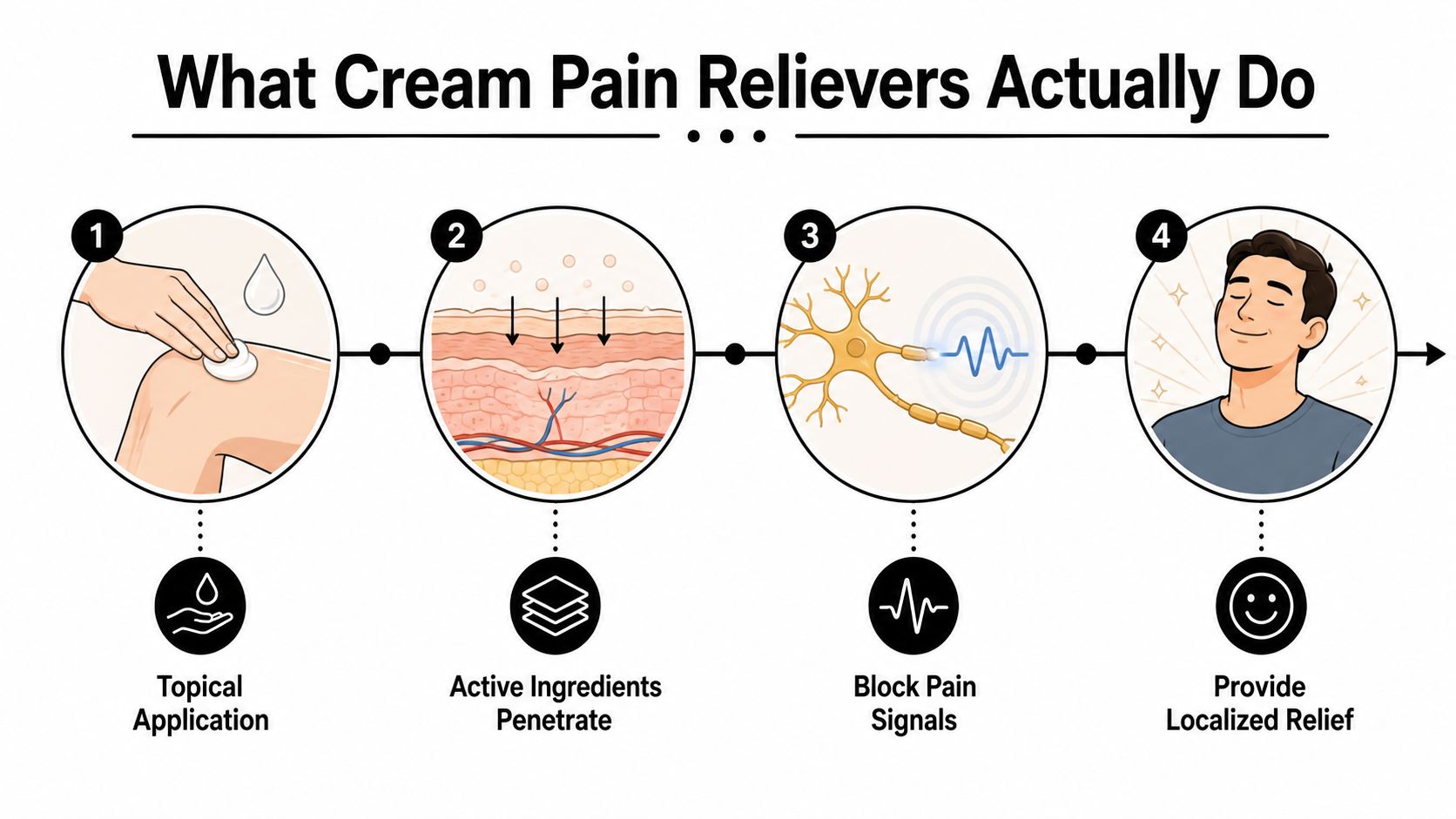
From skin to local effect
Topical analgesics work at the spot where you apply them, which is why they're so appealing for a knee, wrist, shoulder, or lower back that hurts in one place. The skin is a barrier, so the ingredient has to be small and compatible enough to move through surface layers and reach the target tissue. As outlined in the NCBI topical drug delivery overview, effective topical delivery generally favors molecules under 400 to 500 Daltons, which helps explain why many formulations rely on small, lipophilic actives and carefully chosen bases rather than bulky blends of plant material.
That also explains why the base matters. Neutral excipients such as carbomers, fatty alcohols, and emollients help a cream spread smoothly, stay stable, and absorb without feeling greasy. In practical terms, a cream that feels pleasant on the skin often has a better chance of being used consistently, which matters more than marketing claims.
Practical rule: if the pain is in one clear spot, a topical product can make sense. If the pain is widespread, the cream may only handle the surface-level part of the problem.
Sensation versus treatment
Cooling and warming creams can be useful, but they are not all doing the same thing. A product can create a strong sensation without changing inflammation in any meaningful way. That's why the label matters more than the smell, the tingle, or the “strongest” feeling.
The historical shift from old ointments to modern cream formulations shows how far topical pain care has moved from folk remedies toward regulated delivery forms designed for local action (historical review of analgesics). The important takeaway is simple, a cream pain reliever can either distract from pain, numb pain, or target the inflammatory process itself. For ongoing joint discomfort, the most evidence-backed topical options are usually anti-inflammatory creams, while sensory-focused products are often better suited to short-lived muscle soreness. If inflammation feels deeper or more widespread than a cream can reach, some people look to systemic support, including supplements such as ibuprofen support guidance, because topical products cannot address every layer of the pain picture.
Active Ingredients and How They Work
Different ingredients solve different problems, and that's where most shoppers get confused. A cooling rub, a numbing cream, and a topical anti-inflammatory can all sit on the same shelf, but they don't belong in the same mental category. Matching the ingredient to the pain pattern is the whole game.
Ingredient types compared
Ingredient Type | How It Works | Time to Effect | Best For |
|---|---|---|---|
NSAIDs such as diclofenac and ketoprofen | Reduce local inflammation | Often takes repeated use, especially for osteoarthritis | Hand and knee osteoarthritis, localized inflammatory pain |
Menthol | Creates a cooling sensation that distracts from pain | Often feels quick | Temporary relief of minor muscle and joint pain |
Methyl salicylate | Acts as a topical analgesic with a warming or counterirritant feel | Often feels quick | Muscle soreness, minor aches, temporary relief |
Capsaicin | Desensitizes heat receptors over time | Can take consistent use before it feels helpful | Some chronic pain patterns, especially when used regularly |
Lidocaine 4% | Blocks pain-signal transmission in peripheral nerves | Up to 3 to 4 times daily in FDA labeling for affected-area use | Local numbness for targeted discomfort |
The strongest evidence among over-the-counter style topical options tends to favor topical NSAIDs for localized joint pain. Independent evidence notes support for some topical NSAIDs, especially diclofenac and ketoprofen, for hand and knee osteoarthritis when used for 6 to 12 weeks (systematic review on topical NSAIDs). That's a very different use case from a menthol rub bought for a sore back after yard work.
What each ingredient really feels like
Menthol can make a product feel like it's working fast because cooling sensation grabs your attention. That doesn't mean it's reducing inflammation. It's more like turning down the volume on the pain alarm for a while.
Capsaicin works differently. It doesn't feel like a quick fix because it depends on repeated use and a different nerve response, which is why people often abandon it too early. Lidocaine 4% is the ingredient that most clearly fits the “numbing” idea, since it blocks pain transmission in peripheral nerves and is labeled for application to the affected area up to 3 to 4 times daily (Tylenol Precise Pain Relieving Cream label information).
For readers comparing product pages, a good rule is to separate sensory feel from mechanism. The cream that tingles most isn't automatically the one that treats the problem best.
Learn more about the oral anti-inflammatory side of pain care
Bottom line: choose the ingredient for the pain pattern, not for the marketing language on the front of the tube.
Topical Creams Versus Oral Pain Relievers
A person rubbing one knee after a walk and swallowing a pill for aches in the whole body are making two different choices. A topical product stays focused where you apply it, while an oral reliever moves through the body and is better suited to pain that is wider, harder to pin down, or tied to several areas at once.

Where topical products win
Topical therapy fits best when the pain has a clear address, one knee, one wrist, or a tight patch of muscle that was overworked. For older adults with localized joint pain, topical options, especially topical NSAIDs, are often appealing because the medication stays more local than an oral product would. The advantage is targeted relief, not a body-wide effect.
That local focus is useful in a lot of everyday situations. A sore shoulder after gardening, a painful thumb joint, or a small area that feels inflamed can sometimes be managed more comfortably with a cream than with something taken by mouth. The point is simple, the treatment stays close to the spot you want to calm.
Where oral relievers still matter
Oral pain relievers still have a place when symptoms are spread out, intense, or not tied to a single joint or muscle group. A cream reaches only the skin and the tissue just below it, so it does not address every source of discomfort at once, and it does not replace treatment for pain that comes from deeper or more systemic causes. That is the limitation people miss when they expect one tube to cover every kind of pain.
The practical comparison is straightforward. Topical products usually fit localized discomfort, while oral options are usually better for widespread pain or pain that needs whole-body coverage. The earlier section on ingredients explains why that difference matters, since a topical anti-inflammatory behaves very differently from a sensory rub. For readers who want a closer look at that contrast, this topical pain-relief cream overview is a useful place to start.
What safety really looks like
Creams are not automatically safer in every situation. They often lower the chance of stomach upset or broader exposure, but they can still irritate the skin, and they can still be misused if applied too often or to the wrong area. Oral relievers can also be appropriate under medical guidance, especially when the pain pattern does not fit a local approach.
Decision point: if you can point to the pain with one finger, topical care may fit. If you cannot, the problem may be bigger than a cream can handle.
Choosing and Using Pain Creams Effectively
The label on the front of the tube tells you almost nothing. The ingredient list tells you whether the product is meant to cool, numb, or reduce inflammation, and the directions tell you whether it's built for occasional use or repeated application. A good choice starts with the pain pattern, not the packaging.
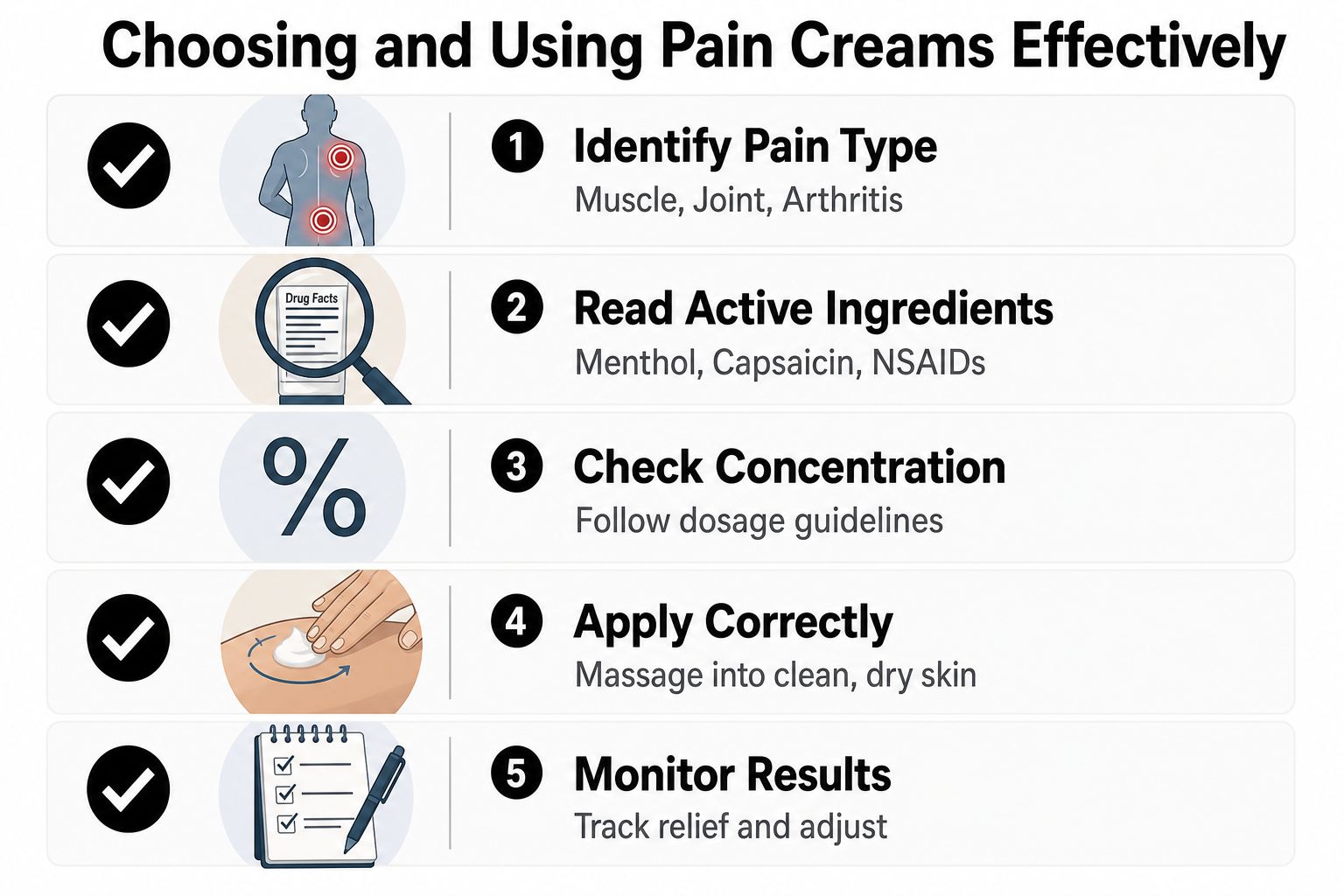
Match the product to the pain
Acute muscle soreness after activity often feels different from chronic joint discomfort. A sensory cream may feel satisfying for the first type, while a topical NSAID is more relevant when the pain pattern looks inflammatory and stays localized. If the pain is long-term and tied to a joint, the evidence-backed option is usually not the one with the strongest smell or sting.
The label also matters because lidocaine 4% products are directed to the affected area up to 3 to 4 times daily, while other topical ingredients have different routines and different expectations for onset (Tylenol Precise Pain Relieving Cream label information). Reading the directions isn't busywork. It's how you avoid underusing or overusing the product.
Use it in the way it was designed
Clean, dry skin gives the cream a fair chance to absorb. Applying too little can leave you with a half-used sensation and no meaningful benefit. Applying it to broken skin, or covering it in a way the label doesn't allow, can turn a simple product into a problem.
A fair trial matters too. Some topical analgesics feel immediate, but others need consistent use before you can tell whether they're helping. The same applies to the product choice itself, if a menthol rub only creates a short-lived cooling effect and your pain returns fast, that doesn't mean every cream failed, it means you may have picked the wrong mechanism for the job.
Simple habit: keep one note in your phone with the product name, the body area, and how long relief lasts. That makes it much easier to tell whether the cream is actually helping.
For many people, combining a topical product with gentle movement, rest, heat, or ice makes more sense than treating the tube as a stand-alone fix. The cream is one tool, not the whole toolbox.
Beyond Topical Relief, Systemic Support with Supplements
A cream can calm the spot that hurts, which is helpful when pain is tied to a sore joint or a tight muscle. It cannot reach every part of the pattern that keeps discomfort returning, especially when inflammation, stress load, and recovery demands affect the whole body. Oral support fills a different role, so it can work alongside topical care instead of trying to do the same job.
The main difference is where each product acts. A cream stays close to the area you apply it, while a supplement enters the digestive system and bloodstream before it is used by the body. That matters for people who want a daily plan that goes beyond surface relief, because the body's pain signals often reflect more than one tissue at once.
Why a broader approach exists
Chronic joint discomfort is rarely only a skin-deep issue. It can involve tissue stress, inflammatory signaling, recovery demands, and the way the body handles strain over time. Evidence-backed topical NSAIDs are useful for localized pain, especially in osteoarthritis, while the rest of the body may still need support for the broader inflammatory burden (topical NSAID review).
That is why some people pair a cream with oral ingredients used for wider wellness support. Turmeric, ashwagandha, ginger, and bromelain are often discussed because each one is used with a different part of comfort and recovery in mind. A topical product may help the knee feel better this afternoon, but it does not address the full routine around mobility, sleep, and stress.
How oral support fills the gap
Oral supplements are chosen for specific purposes. Some people want help with everyday joint comfort. Others want support for stress resilience or post-activity recovery. A multi-ingredient capsule approach can fit that pattern better than a single-purpose rub, because discomfort signals usually involve more than one layer of the body.
Read more about natural pain-relief support options
If a supplement includes turmeric with BioPerine, the goal is usually absorption support. If it includes ashwagandha, the goal is often stress resilience. If it includes ginger or bromelain, the focus may be recovery and inflammatory balance. Those are systemic goals, while a cream stays focused on local sensation.
A cream can calm the place that hurts. An oral formula can support the terrain that keeps the pain pattern going.
The most practical plan often combines both. Use a topical product for fast local comfort, and use a daily oral routine for broader support. Each one has a separate job, and that makes the combination easier to understand.
Common Misconceptions About Pain Creams
A lot of people choose a pain cream by the feeling it creates on the skin. If it tingles, warms, or cools strongly, they assume it must be doing more. That shortcut sounds reasonable, but it often leads people to read the signal on the skin as if it were proof of stronger relief.
Strong feeling doesn't equal better treatment
Menthol and methyl salicylate show why a product can seem impressive without telling the whole story. They can create a clear cooling or warming effect, and that immediate sensation may make a cream feel active right away. The problem is that skin sensation is only one part of the picture. It does not tell you whether the product is acting on the deeper process behind the pain.
Marketing language can make this even more confusing. Words like “extra strength,” “fast acting,” or “maximum relief” often describe how the cream feels, how it is packaged, or how it is positioned on the shelf. They do not automatically show that the formula is better suited to the kind of pain you have. That is why a product can feel dramatic and still be a poor match for the actual problem.
The same caution applies to “natural” claims. Natural ingredients can still irritate skin, trigger sensitivity, or fail to help. A botanical label does not guarantee safety, and it does not guarantee stronger relief either.
Not every cream treats the same problem
A second common mistake is treating every pain cream as if it serves the same purpose. The evidence-backed group for chronic joint pain is different from the general rubs sold for sore muscles. That difference matters because localized osteoarthritis support and temporary muscle soreness relief are not the same job.
Many shopper-facing pages blur those uses together, but the research does not. Some topical NSAIDs have the strongest support when the pain is tied to a specific joint and needs local treatment, while sensory creams are often used for short-term comfort rather than long-term disease management. A cream made for one pattern of pain can leave you under-treated if you use it for another.
A practical way to judge a product is to ask what problem it is meant to address. If the cream mainly creates a cooling or warming distraction, that may help with comfort for a while. If the issue is an ongoing joint condition, a product with evidence for local anti-inflammatory action is the more relevant category, as noted in the topical NSAID review.
Watch for this mistake: if relief ends as soon as the cooling or warming sensation fades, the product may be changing how pain feels more than it is changing the pain process itself.
Pain cream has a real place in self-care, but it works best when you know what kind of relief it can and cannot provide. That clarity helps you choose a product for the problem in front of you, instead of for the label on the tube.
Safety Guidelines and When to See a Doctor
A cream pain reliever can be low-drama, but it still deserves careful use. Skin can absorb more than people expect, so the wrong application may cause irritation, waste the product, or delay care for a problem that needs attention. Safe use starts with the label and ends with knowing when home treatment is no longer enough.
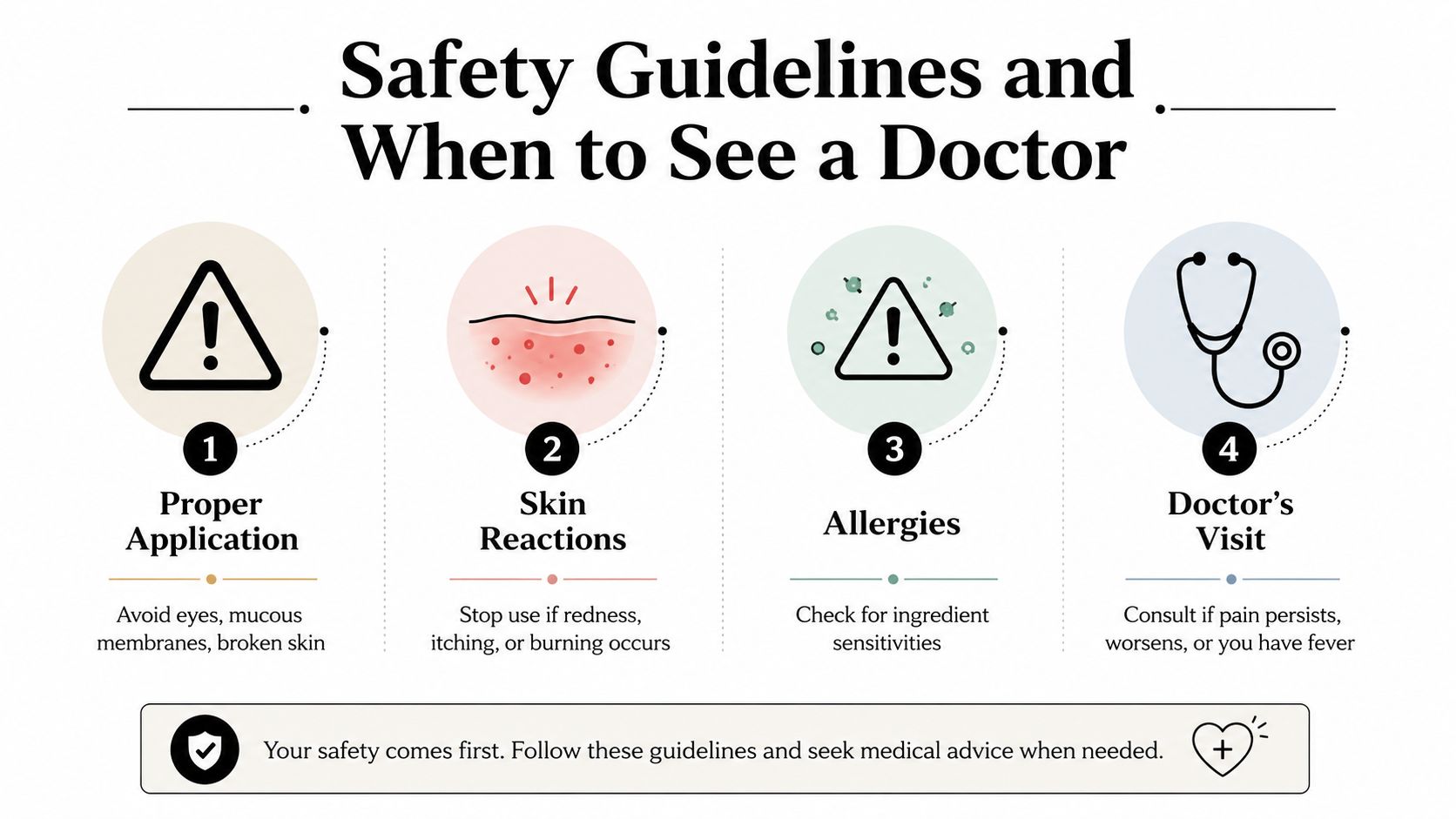
Use it on the right skin
Keep creams away from the eyes, mucous membranes, and broken skin. Irritated or damaged skin can react more strongly and may absorb ingredients differently than intact skin. A product that is meant for the painful area does not make every surface suitable.
Skin reactions are a common warning sign. Redness, itching, or burning that does not settle down suggests the product may not suit you. If that happens, stopping use is the safer choice.
Know when the pain needs a clinician
A pain cream makes sense for self-care when the discomfort is mild, localized, and predictable. It is not enough when pain gets worse despite treatment, keeps coming back, or appears with other concerning signs. Fever, unexplained swelling, visible infection, or pain that interferes with daily function all deserve medical evaluation.
People who take multiple medications, live with chronic conditions, have allergies, or are preparing for surgery should also mention topical products to a healthcare provider. “Topical” does not mean invisible to the rest of the care plan. Even a cream that mainly works in one spot can matter in a broader medication review.
A simple safety checklist
Apply carefully: Keep the product away from the eyes, mouth, and broken skin.
Stop at the first bad reaction: Redness, itching, or burning that persists is not normal.
Check sensitivities: Read the active and inactive ingredients if you have reacted to products before.
Escalate when needed: Persistent pain, swelling, fever, or loss of function needs evaluation.
A cream pain reliever is a tool, not a diagnosis. If it helps, that is useful. If it only covers up a problem that keeps getting worse, the next step should be a clinician, not a stronger tube.
If you want a simple way to support joint comfort, stress resilience, and recovery in one daily routine, River of Life offers a capsule-based supplement built around turmeric, BioPerine, ashwagandha, ginger, and bromelain. Pairing a topical cream for local relief with a broader oral support strategy can make pain care feel more complete, especially when you are trying to manage both soreness and the underlying strain that keeps it coming back.