


Ibuprofen Guide: Uses, Risks, and Natural Alternatives

Your knee is barking after a long walk. Your head is pounding after a rough night of sleep. A fever starts to creep in, and your hand goes to the same place it always does. The medicine cabinet. The familiar bottle. Ibuprofen.
That habit makes sense. Ibuprofen has earned its place as a go-to pain reliever because it works, and it often works fast. But a lot of people only know the front-label version of the story. They know it helps with pain, swelling, and fever. They don't always know how it works, why it can irritate the stomach, or why using it often for chronic pain can become a trade-off your body pays for later.
If you use ibuprofen once in a while, this guide will help you use it more wisely. If you rely on it a lot for arthritis, recurring soreness, or daily aches, this guide will help you step back and ask a better question. Is this still the right tool for the job?
Table of Contents
The Go-To Pill in Your Medicine Cabinet
You probably didn't learn about ibuprofen in a classroom. You learned it in real life. A parent handed it to you for a fever. A friend suggested it for cramps. A trainer mentioned it after a hard workout. Over time, it became the pill you reach for without much thought.
That's part of why ibuprofen matters. It isn't some niche drug used in a specialist clinic. It's a household name, and for many people it feels as ordinary as a thermometer or a box of bandages.
How it became so familiar
Ibuprofen has been around long enough to feel almost timeless, but it has a clear history. It was patented in 1961, launched in the United Kingdom in 1969 for rheumatoid arthritis, and became available in the United States in 1974. It's also described as the first available over-the-counter NSAID and one of the most commonly used NSAIDs worldwide, as outlined in this history of ibuprofen's origins and launch timeline.
That timeline helps explain its reputation. Ibuprofen moved from research to everyday use quickly, then stayed there. Once a medicine is easy to buy, familiar to families, and effective for common symptoms, it starts to feel simple.
Why that matters: Familiar doesn't always mean harmless. It often just means people stop asking questions.
Why people trust it
Ibuprofen gets used for a wide range of everyday problems. Think headaches, period pain, dental pain, fever, sore joints, and the swelling that can follow minor injuries. It gives many people the kind of relief they can feel, often soon enough to get through the workday, sleep better, or make it to a family event.
That convenience is real. So is the trap.
When a drug works well for short-term problems, people often start using it for long-term ones. A stiff knee becomes daily dosing. Weekend soreness becomes a routine. Chronic inflammation gets handled like a series of mini-emergencies instead of a bigger pattern that needs support from sleep, movement, nutrition, and stress reduction.
A good way to think about ibuprofen is this. It's like a fire extinguisher in your kitchen. You want it nearby when you need it. But you wouldn't use it every day instead of fixing the faulty wiring.
How Ibuprofen Silences Pain and Fever
You twist your ankle, your head is pounding, or a fever starts climbing by dinner. You take ibuprofen because you want the volume turned down fast.
That is basically what ibuprofen does. It does not erase the injury or infection. It lowers the chemical signals that make pain, swelling, and fever feel louder.
Why it works for so many symptoms
Your body uses chemical messengers to coordinate its response to stress or injury. One important group is called prostaglandins. They help increase pain sensitivity, support inflammation, and raise temperature during fever.
Ibuprofen works like a dimmer switch on that system. It blocks COX enzymes, which help the body make prostaglandins. With fewer of those messengers being produced, the pain signal often feels less intense, swelling may ease, and fever can come down.
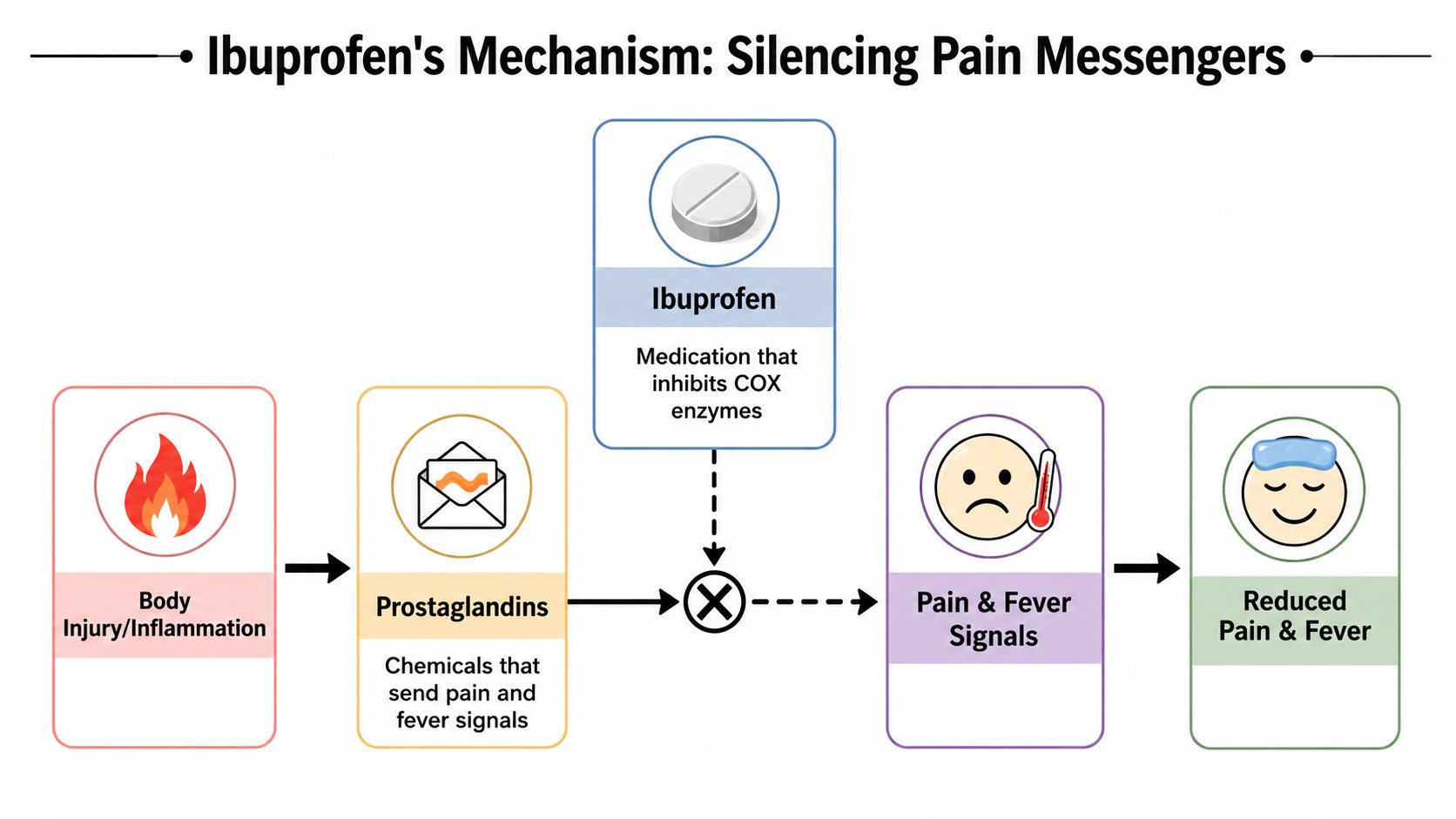
In plain English, the sequence looks like this:
Irritation or injury triggers a response
COX enzymes help make prostaglandins
Prostaglandins amplify pain, inflammation, and fever
Ibuprofen slows that production, so the signals drop
Ibuprofen is also absorbed fairly quickly by mouth and reaches peak blood levels within about 1 to 2 hours, according to this pharmacokinetic review of ibuprofen formulations and absorption. That helps explain the relatively quick onset of relief.
Why relief has a cost
The part that often gets missed is that prostaglandins are not just “pain chemicals.” They also help with normal housekeeping. Some protect the stomach lining. Some support blood flow to the kidneys. Some play a role in healing and recovery.
Ibuprofen blocks COX activity broadly, not just in the sore knee, cramped uterus, or inflamed shoulder. That broad action is part of why one pill can help several symptoms at once. It is also why repeated use can create trade-offs outside the painful area.
A simple way to view it is this. Ibuprofen lowers the fire alarm. That can be helpful when the alarm is blaring during a short-term problem. If the alarm keeps going off every day, though, quieting it over and over does not fix the wiring.
Ibuprofen reduces the body's alarm signals. It does not correct the reason those signals keep returning.
That difference matters more with chronic issues than with a one-off headache or fever. For occasional use, the trade-off may be reasonable. For recurring arthritis pain, daily back soreness, or habitual post-workout use, it makes sense to ask a bigger question. Are you treating a brief flare, or are you muting a pattern your body keeps trying to report?
Using Ibuprofen Safely and Effectively
You wake up sore after a hard workout, take ibuprofen, and get through the day. The next morning, you do it again. A week later, the bottle has subtly become part of your routine.
That is the point to pay attention.
Ibuprofen is usually safest when you use it for a clear, short-term reason. A headache. A fever. A brief flare after an injury. Problems start when a rescue tool turns into a daily habit for arthritis, back pain, or post-workout soreness. Relief can make that shift feel harmless, even when it is not.
What common dosing looks like
Store shelves make ibuprofen look simple, but the dose still matters. Over-the-counter tablets are often 200 mg. Adults commonly use 200 to 400 mg at a time, spaced every 4 to 6 hours for short-term pain or fever. Prescription plans can be much higher, and those higher totals are meant to be monitored by a clinician, not copied at home.
Here is the practical difference:
Use case | Typical pattern |
|---|---|
Everyday pain or fever | 200 to 400 mg every 4 to 6 hours |
Prescription anti-inflammatory use | Much higher daily totals under medical supervision |
The easy mistake is assuming, "If one pill helped, regular use must be fine." Dose and frequency change the risk. So does the reason you are taking it. Using ibuprofen for a day or two after a dental procedure is very different from relying on it most days to get through knee pain.
Habits that make short-term use safer
A few simple rules lower the odds of trouble:
Use the smallest dose that gives enough relief. More is not better if less already works.
Keep the time frame short. Ibuprofen fits temporary pain better than ongoing self-treatment for a chronic problem.
Take it with food if your stomach is sensitive. That can make it easier to tolerate.
Check labels carefully. Some cold and flu products already contain pain relievers, which makes accidental double-dosing easier than many people realize.
Watch the pattern, not just the pain. If you need ibuprofen often, the bigger issue may be the condition driving the pain.
A good rule of thumb: if ibuprofen has become routine, the next question is not "Can I keep taking it?" It is "Why does my body keep needing this much help?"
That question matters most for chronic conditions. If stiff joints, recurring back pain, or exercise soreness keep pulling you back to the same bottle, it may be time to build a longer-term plan instead of repeating the same short-term fix. For some people, that means working with a clinician. For others, it means exploring options that support inflammation more gently over time, such as the ingredients covered in this guide to natural anti-inflammatory supplements like turmeric and more.
Safe use starts with respect. Ibuprofen can be very helpful. It just works best as a temporary tool, not a daily strategy.
The Other Side of Relief Risks and Side Effects
Ibuprofen is commonly known to upset the stomach. Fewer people know that the bigger concern often isn't a single dose. It's repeated use, higher doses, or using it often enough that the body never really gets a break.
The common problems most people notice first
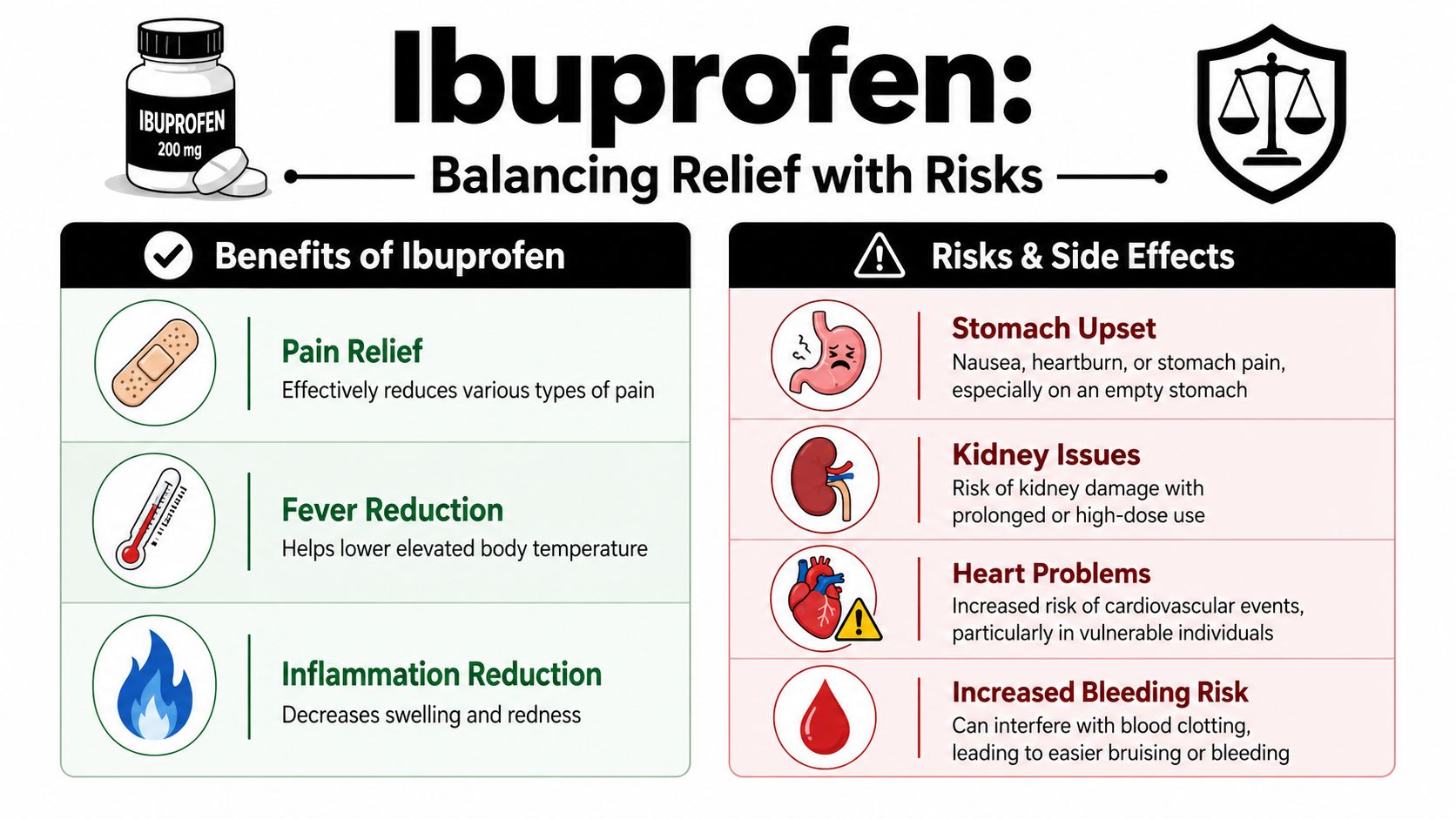
The first signs of trouble are usually the obvious ones. Nausea. Heartburn. Stomach pain. That's often why people are told to take ibuprofen with food.
But stomach irritation is only the visible part of the story. Because ibuprofen changes signaling pathways that help protect body tissues, the side effects can reach further than the digestive tract.
The bigger risks people often miss
One observational study of nearly 30,000 patients found a 31% increase in the risk of out-of-hospital cardiac arrest associated with ibuprofen use, and sources also note increased risks of heart disease, stroke, renal damage, and gastric bleeding, especially with longer-term or higher-dose use, as summarized in this ibuprofen safety overview.
That doesn't mean every person who takes ibuprofen is headed for a major complication. It does mean the “it's over the counter, so it must be mild” mindset is too simplistic.
Here are the main trade-offs to keep in mind:
Heart and circulation concerns can matter more if you already have cardiovascular risk factors.
Kidney stress becomes a bigger issue with frequent use, dehydration, or existing kidney vulnerability.
Bleeding risk matters because NSAIDs can affect the stomach lining and clotting balance.
Stacking risks can happen when people combine ibuprofen with other similar pain relievers or medicines that already strain the stomach, kidneys, or circulation.
A lot of readers get stuck at this point and think, “So should I never use ibuprofen?” That's not the right takeaway. The better takeaway is this: use a strong tool for situations that justify a strong tool.
If you're exploring gentler long-term approaches for ongoing inflammation, this guide to natural anti-inflammatory supplements including turmeric and more is a useful next step.
Relief is a benefit. Risk is part of the price. Wise use means knowing both before you swallow the pill.
Ibuprofen Use in Special Populations
Some groups don't have the same margin for error with ibuprofen. The medicine may still be used in certain situations, but the decision deserves more care because the downside can grow faster.
Children and older adults
With children, dosing isn't something to guess. It needs to follow age-appropriate and weight-based guidance from a clinician or product labeling. A “small adult dose” is not a safe shortcut.
Older adults face a different issue. They're more likely to have the kind of background factors that make NSAID use trickier. Kidney function may be less resilient. The stomach lining may be more sensitive. Cardiovascular concerns may already be in the picture.
That doesn't automatically rule ibuprofen out, but it changes the question from “Does this help?” to “Is this the safest way to help?”
Pregnancy needs earlier caution than many people realize
Pregnancy is where a lot of public advice becomes too vague. Many people have heard some version of “avoid ibuprofen after 20 weeks.” That's useful, but incomplete.
Recent data described in the prompt's verified material states that first-trimester use is linked to a 1.5-fold increased risk of certain fetal malformations, and FDA warnings highlight a potential 30% increased risk of miscarriage in the first 12 weeks, discussed in this FDA safety communication on NSAID use during pregnancy.
That shifts the conversation. It suggests the concern isn't only late pregnancy. It may begin much earlier than many people assume.
A simple way to think about it:
Group | Main concern |
|---|---|
Children | Dosing must be precise, not estimated |
Older adults | Kidney, stomach, and cardiovascular risks may be magnified |
Pregnant women | Caution may need to start earlier than the common 20-week message suggests |
If you're pregnant, trying to conceive, or think you might be pregnant, don't treat ibuprofen as a default option. Get individualized guidance first.
This is one of the clearest examples of why “common” and “safe for me right now” aren't the same thing.
The Crossroads Short-Term Fix vs Long-Term Support
You finish a hard workout on Tuesday. Your knees ache again on Thursday. By Saturday, you are reaching for ibuprofen before the soreness has even had time to speak clearly. That is the crossroads.
The question isn't whether ibuprofen can bring relief. It can. The better question is whether a short-term pain switch is the right match for a problem that keeps coming back.
If you twisted your ankle, have a fever, or woke up with a pounding headache, ibuprofen may fit the moment. If your knees hurt every morning, your back pain keeps returning, or exercise leaves you taking pills several times a week, the pattern matters more than the single dose.

When a useful tool becomes a default habit
It is common to slide into routine use without planning to. One dose helps. Then another. Soon, the bottle becomes part of the weekly rhythm for arthritis pain, desk-related neck tension, or post-workout soreness.
That matters because pain relief and repair are not the same job.
Ibuprofen lowers signals involved in pain and inflammation. That can be helpful in the short run. But if the same ache keeps returning, repeatedly quieting the signal can make it easier to miss the bigger issue, such as overloaded joints, poor recovery, repetitive strain, or chronic low-grade inflammation.
For readers dealing with recurring joint discomfort, this article on how turmeric curcumin may help with arthritis and joint pain offers a more useful long-term frame.
Why recovery and suppression are not the same thing
A good analogy is a car dashboard light. Covering the light may make the drive feel less stressful, but it does not fix the engine. In the same way, reducing soreness does not always improve recovery.
That point has come up in sports medicine research. A 2019 review on a PMC-hosted page cited in the prompt discusses concern that using NSAIDs such as ibuprofen around training may interfere with some of the normal repair and adaptation processes the body uses after exercise. For someone training to get stronger, that trade-off deserves attention.
Here is the practical split:
Short-term pain event. Ibuprofen can be a reasonable tool.
Ongoing daily or weekly pain. A broader support plan usually makes more sense.
Post-workout soreness after hard training. Relief now may work against the adaptation you want later.
A short explainer can help put that in context:
If you keep needing ibuprofen for the same issue, that is often a sign to change strategy. Use it as a short-term tool, not a long-term foundation.
Building a Natural Anti-Inflammatory Strategy
A long-term plan should do more than turn pain down for a few hours. It should support the conditions your body needs to calm inflammation, recover well, and move with less friction day to day.
That's where natural strategies can be useful. Not because they're magic, and not because they replace medical care in every case. They matter because they shift the goal from repeated suppression to steady support.
What long-term support looks like
A better long-range plan usually combines several levers instead of relying on one pill.
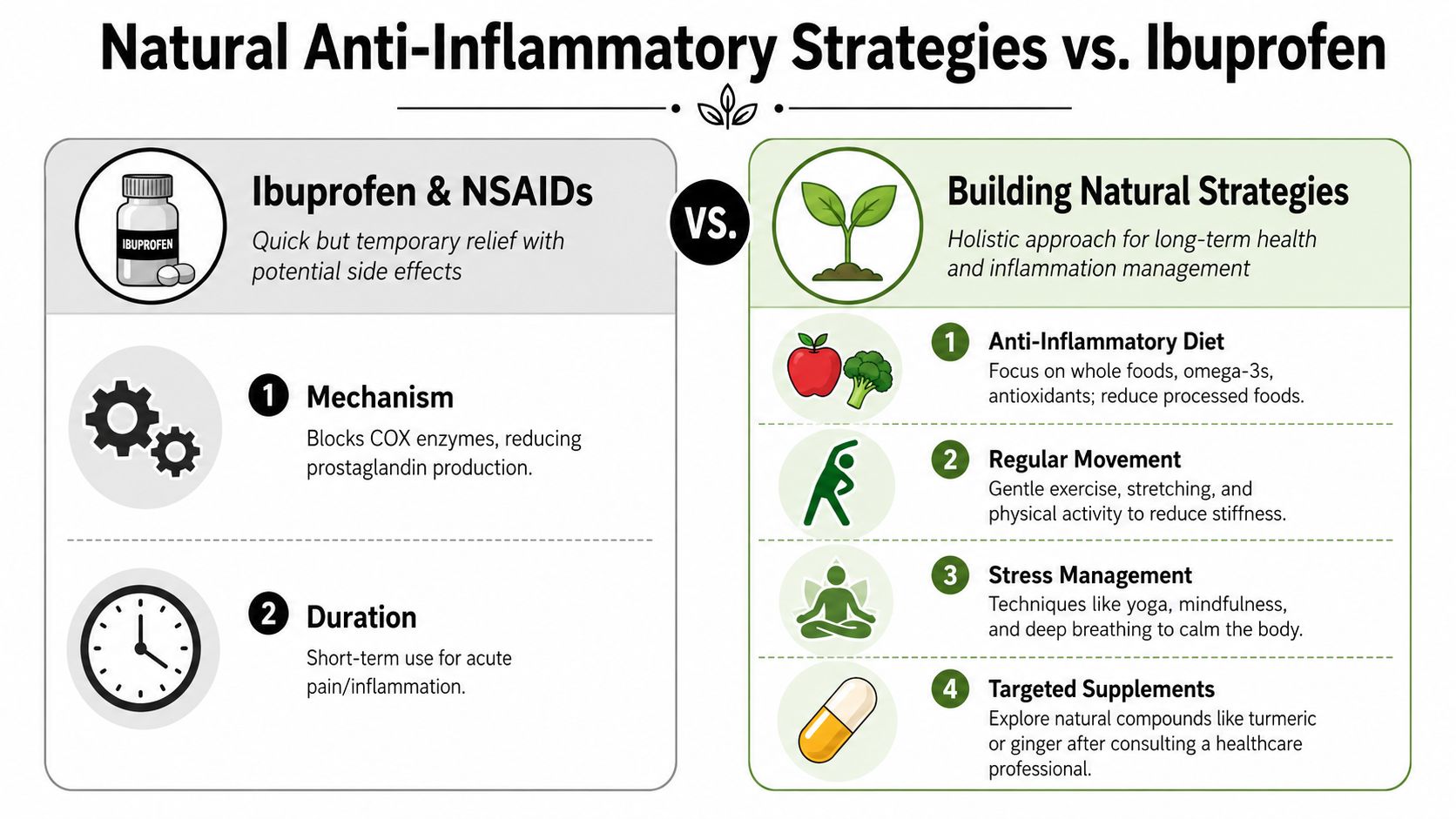
Some of the most practical pieces are:
Food choices that lower background stress on the body. A pattern built around whole foods usually does more for chronic inflammation than a cycle of flare-and-medicate.
Regular movement. Gentle strength work, walking, mobility work, and stretching often help more than complete rest for stiffness-driven pain.
Sleep and stress support. Ongoing stress can keep the body in a more reactive state. That's one reason chronic pain and poor sleep often travel together.
Targeted botanicals and enzymes. Ingredients like turmeric, ginger, bromelain, and ashwagandha are often used by people who want daily support rather than occasional chemical shutdown of symptoms.
This is also where a multi-ingredient option can fit. River of Life Capsules combine turmeric extract with BioPerine, plus ashwagandha root, ginger, and bromelain, as a capsule-based supplement intended to support joint comfort, stress resilience, sleep quality, and mental clarity. It's one example of a non-drug daily support option among other lifestyle approaches.
How to make the shift without feeling overwhelmed
You don't need a perfect routine by Monday. You need a smarter pattern than “hurt, take ibuprofen, repeat.”
Try this approach:
Keep ibuprofen for true short-term needs. Acute headache. Fever. A clear flare. Use it deliberately.
Track the repeat triggers. Morning stiffness, long car rides, poor sleep, hard training days, stress-heavy weeks.
Build one daily support habit first. Start with movement, a bedtime routine, or an anti-inflammatory supplement plan. One consistent habit beats five abandoned ones.
Reassess after consistency. The goal is fewer repeat pain spikes, less need for rescue medication, and better function.
If you want more ideas for making that shift, this guide to natural pain relief approaches offers practical options.
The smartest place for ibuprofen is in your toolkit, not at the center of your lifestyle.
Used wisely, ibuprofen can be helpful. Used habitually for chronic issues, it can keep you stuck in a loop where relief is real but progress is limited. Natural strategies don't always act as fast, but for many people they fit the long game far better.
If you're ready to move from short-term symptom control toward steadier daily support, River of Life offers a capsule-based botanical formula with turmeric, BioPerine, ashwagandha, ginger, and bromelain. It's designed for adults looking to support joint comfort, recovery, stress resilience, sleep quality, and mental clarity as part of a broader wellness routine.
Refined using Outrank