

Turmeric and Curcumin Supplement: A 2026 Buyer's Guide

You're rubbing a stiff knee after a walk, or feeling that familiar ache when you stand up from your desk, and the question pops up again. Should you try turmeric and curcumin supplement products, or is this just another wellness trend in a yellow bottle?
The short answer is that turmeric has a real place in supplement aisles, but the label often matters more than the hype. Turmeric is the plant and spice. Curcumin is the main active compound people study for joint comfort and inflammation support. That difference changes everything, from how you read a bottle to whether the product can do much for you.
Table of Contents
Why Everyone Is Talking About Turmeric
A lot of people reach for turmeric when their body starts sending small warnings. The stairs feel steeper. The gym soreness hangs around. Mornings feel a little creaky. That's where the appeal starts, because turmeric sounds natural, familiar, and easy to trust.
The catch is that often, two very different things are compared without realizing it. One is the spice in your kitchen. The other is a concentrated turmeric and curcumin supplement built around a specific active compound and, often, a delivery system that helps your body use it.
Why the label matters more than the powder
Turmeric powder in food and a supplement capsule are not interchangeable. The capsule may contain standardized extract, absorption support, or both. The spice jar usually doesn't.
That's why shoppers get confused. They see “turmeric” on a bottle and assume all products work the same way. They don't. Some formulas are basically pantry seasoning in capsule form. Others are built to target joint comfort and mobility more directly.
Practical rule: If you're buying turmeric for a health goal, look past the front label and inspect what the product is actually standardized to and how it's delivered.
This guide is designed to make that choice simpler. By the end, you should be able to tell the difference between a casual wellness label and a product that's structured around real supplement science.
Turmeric vs Curcumin Understanding the Difference
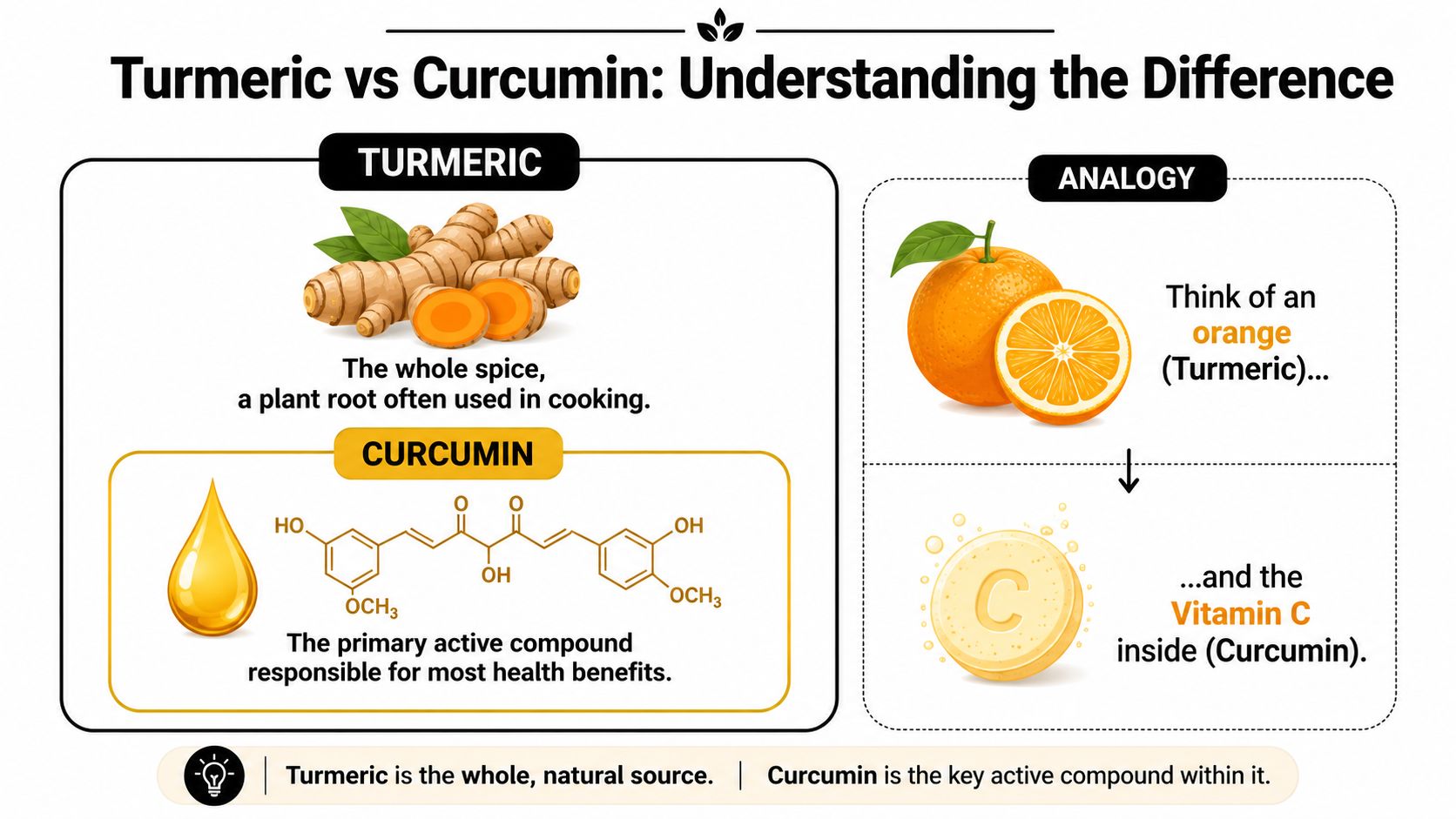
Turmeric is the whole root and the golden spice made from it. Curcumin is one of the active compounds inside turmeric, and it's the one most often studied for health support. The easiest way to think about it is this, turmeric is like an orange, curcumin is like the vitamin C people care about inside that orange.
That analogy matters because it explains why two products can look similar and behave very differently. A capsule filled with plain turmeric powder contains the plant material, but not necessarily enough of the studied compounds to matter much. A standardized extract is more like a concentrated version of the useful part.
What “standardized” usually signals
When a label says a product is standardized, it's telling you the formula is controlled for a specific level of active compounds. That helps reduce the guesswork. Without standardization, two turmeric products can look identical on the shelf and deliver very different amounts of curcuminoids.
Curcuminoids are the family of compounds that includes curcumin. Curcumin gets the spotlight because it's the best studied, but for shoppers, the essential consideration is simpler. You want to know whether the product is designed to deliver the part of turmeric that's relevant for supplementation, not just the plant bulk.
Why this distinction changes shopping decisions
A lot of people compare bottles by capsule count or by the amount of turmeric listed on the front. That's the wrong comparison. The more useful question is how much curcuminoids the product provides, whether it includes an absorption aid, and whether the dose resembles the kinds used in clinical trials.
That's also why supplements with just “turmeric root powder” can be underwhelming for people looking for joint support. They may still be fine as a general wellness product, but they're not the same thing as a curcumin-focused formula.
The Health Benefits Backed by Science
A person with stiff knees usually wants one question answered first. Can turmeric or curcumin help? The clearest research signal points to joint pain and physical function. A meta-review of systematic reviews found moderate-quality evidence supporting turmeric and curcumin for relieving osteoarthritis pain and improving physical function. An arthritis review also supported turmeric extract at about 1,000 mg/day of curcumin as efficacious, and preparations were considered safe at doses up to about 1,200 mg/day for up to 4 months.
That does not mean every bottle on the shelf will do the same job. It means the strongest evidence sits in a fairly specific lane, joint comfort, mobility, and inflammatory balance. That is a clearer claim than broad wellness marketing, and it is the one the science supports most consistently.
Where the evidence is thinner
Turmeric is also sold for mood, sleep, stress, and “mental clarity.” Those uses are popular, but the evidence is less settled. Broad reviews and wellness summaries keep the strongest support anchored to arthritis symptom relief, while claims outside that lane remain more variable and less clearly defined in healthy adults BHF summary on turmeric supplements.
That is not a reason to brush the ingredient aside. It is a reason to stay precise. If you want a supplement because your knees feel stiff, turmeric-curcumin has a clearer evidence base. If you want it for sleep or mood, treat those as possible secondary effects, not guarantees.
Some supplements are sold as if they can do everything at once. Curcumin is better understood than that. Its strongest role is still joint-related support.
A balanced way to read the marketing
Many buyers get confused by labels that promise “inflammation support.” That phrase can sound broader than the science really is. The most defensible claim is narrower, support for osteoarthritis pain and function, with broader wellness use still developing.
For readers comparing options for pain support more generally, this pain relief guide can help frame turmeric as one piece of a wider strategy. The goal is not to oversell it. The goal is to match the supplement to the problem.
What clinical strength looks like in practice
Dose matters because it separates serious formulas from vague wellness products. A capsule with a token amount of turmeric may sound healthy, but it may not resemble the amounts studied for joint outcomes. The practical takeaway is simple. The label should show a product built around curcumin delivery, not just turmeric branding.
A second point matters just as much. The most useful supplements are not only about the ingredient itself, they are about how well the body can use it. Curcumin is often compared with a key in a lock. If the shape is right but the key never turns, the benefit stays limited. That is why readers should look beyond the front label and ask how the formula is designed to work in the body.
The Bioavailability Problem and How to Solve It
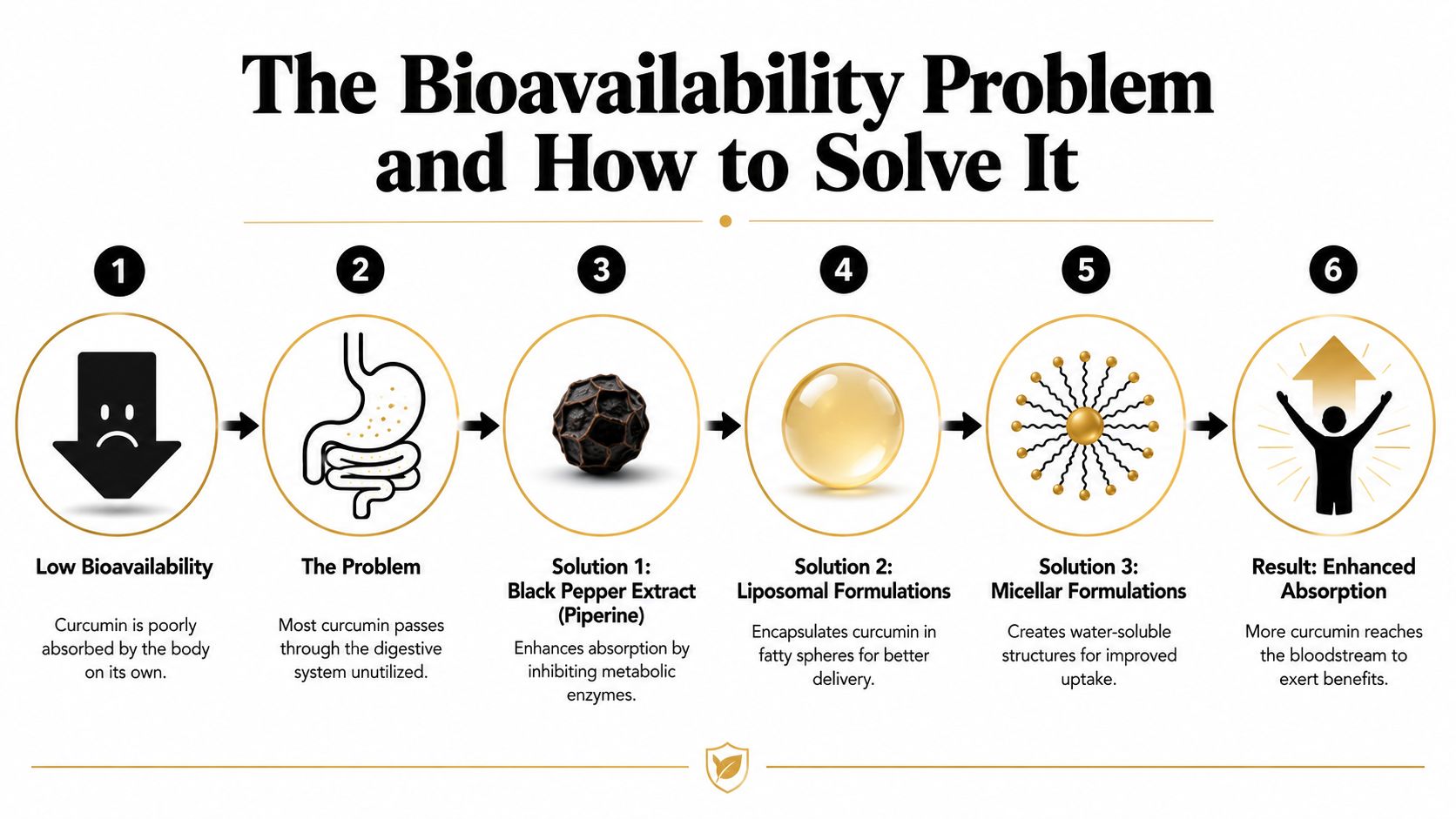
A capsule can look strong on paper and still fall short in the body. Curcumin has that problem. It does not absorb well, so a label may list a solid amount while the body sees only a small share of it. A review in Frontiers review describes low bioavailability because of poor intestinal absorption, fast metabolism, and quick elimination. That is why the number on the front of the bottle can be misleading if the delivery system is weak.
Without the right address, a package never helps the person it was meant for. Curcumin works the same way. The supplement can exist, but if it does not reach the bloodstream in usable form, the benefit stays limited.
Why delivery systems matter more than raw milligrams
Two products can list the same curcumin amount and still behave very differently inside the body. That is the part shoppers often miss. The form of the supplement changes how much gets through.
A human pharmacokinetic trial found that a turmeric colloidal suspension produced 24-fold higher relative bioavailability than a standard turmeric extract, 22-fold more bioavailable than a piperine-curcuminoid combination, and 6-fold more bioavailable than a phytosome formulation under the study conditions PMC trial. Those results do not mean one delivery system suits everyone. They do show that absorption technology is not a small detail. It can decide whether a capsule acts more like a real dose or just a polite suggestion.
Where piperine fits in
Piperine, the black pepper compound used in many curcumin formulas, is one of the common ways to support absorption. Reviews note that enhanced-bioavailability turmeric products can be effective, and clinical reporting has found turmeric and turmeric-plus-piperine products were generally well tolerated NMI review. For shoppers, the lesson is simple. Black pepper extract is not there by accident. It is part of the delivery plan.
What to look for on the label
A good label does more than say “turmeric.” It should tell you the form, the active compounds, and how the formula helps absorption. If it only lists turmeric powder, you are probably looking at a low-intensity product. If it lists standardized curcumin plus piperine or another delivery system, you are closer to a formula designed for real-world use.
For readers who want a plain-English explanation of why black pepper shows up so often in curcumin products, this black pepper and curcumin guide is a useful place to start. The point is not that every product needs the same add-on. The point is that delivery changes the result.
Simple rule: The same curcumin dose can act very differently depending on the delivery system, so do not shop by milligrams alone.
How to Choose a High-Quality Turmeric Supplement
Start with the ingredient panel, not the marketing claims. A strong product usually shows standardized curcuminoids, an absorption enhancer, and a transparent formula. If those details are missing, you're guessing.
The easiest way to shop is to use a checklist. It keeps the decision practical and helps you compare products side by side instead of falling for front-label language.

A quick label checklist
Standardized curcuminoids: This tells you the product is controlled for the active compounds, not just the raw root.
Absorption support: Look for piperine or another enhanced-delivery method, because curcumin's low bioavailability is a real limitation.
Third-party testing: Seals such as NSF or USP can help verify purity and potency.
Capsule format and diet fit: Vegan capsules matter if you avoid gelatin, and a capsule is often easier to dose consistently than loose powder.
Goal-specific extras: Ginger or bromelain may make sense for people looking for a broader joint-support formula, though they shouldn't distract from the curcumin foundation.
Why consistency beats hype
A supplement only helps if you can take it reliably. Capsules win here because they're predictable, portable, and easy to standardize. That matters for daily use, especially when the product is being chosen for long-term mobility support rather than a one-off wellness experiment.
River of Life Capsules is one example of a turmeric-and-black-pepper product built around standardized turmeric extract plus BioPerine black pepper extract, with ginger and bromelain included in the formula. It's a single product choice, but the more important point is the structure, standardized extract plus absorption support, not just turmeric powder alone.
How to avoid weak products
Don't let a long ingredient list fool you. Extra botanicals are only useful if the core curcumin piece is strong enough to matter. And don't assume a higher price means better performance. The label details, testing, and delivery system tell you far more than the sticker price does.
If you're comparing blended formulas, this ginger and turmeric capsule guide can help you think through how companion ingredients fit into a joint-support product without losing sight of the main active.
Proper Dosing Safety and Potential Side Effects
If you are looking at a turmeric and curcumin supplement for daily use, the first question is usually simple: how much is reasonable, and what does that mean for safety? Clinical arthritis trials supported turmeric extract at about 1,000 mg/day of curcumin, and preparations were considered safe at doses up to about 1,200 mg/day for up to 4 months. That gives useful context, but it is not a personal dose recommendation. Product directions and medical advice still matter, especially if you take other medications or have a health condition.
Side effects in the clinical literature have generally been mild. Turmeric and turmeric-plus-piperine products were usually well tolerated, and mild gastrointestinal complaints were the most common adverse events. Reports also did not show serious adverse events tied to the supplements NMI review.
The safety issue people miss
Ordinary turmeric in food is not the main concern. The bigger issue is concentrated, high-bioavailability curcumin. Better absorption can be useful, but it also means the body is handling a more concentrated exposure. That is why “more absorption” is not automatically better in every situation.
Who should be more cautious
People with liver disease should speak with a clinician before using a concentrated curcumin supplement. Anyone taking prescription medication should also ask about interactions, since turmeric products can complicate medication use in some cases. Pregnant or breastfeeding readers should get individualized medical guidance before starting any concentrated botanical supplement.
High-absorption formulas deserve special attention because they may increase exposure in ways that are not always obvious from the front label. The ScienceDirect review and earlier discussion of absorption both point to the same practical idea, a formula that is easier to absorb is not always a formula that is easier to tolerate for every person.
Practical rule: Stop the supplement and seek medical advice if you notice unusual abdominal pain, nausea that does not settle, dark urine, yellowing skin or eyes, or other signs that something is off.
How to use it responsibly
Start with the product label and the reason you are taking it. If your goal is joint comfort, use a formula that matches the evidence and keep the rest of your routine steady so you can judge whether it helps. If you are choosing a high-absorption formula, choose one from a company that offers testing and clear ingredient disclosure.
Food use and supplement use are different tools. Turmeric in cooking fits into a normal diet, while a supplement is a concentrated product meant to deliver a more targeted amount of curcuminoids. That difference matters when you are weighing benefits against side effects, especially if you are sensitive to supplements or already take medication.
Frequently Asked Questions
Can turmeric and curcumin interact with medications
They can. If you take blood pressure medicine, diabetes medication, or anything that affects bleeding, ask your clinician or pharmacist before starting a concentrated supplement. Curcumin should be treated like an active compound, because it can affect the body in ways a kitchen spice usually does not.
How long does it take to notice anything
That depends on the product, the dose, and the person taking it. Since the research has focused most strongly on joint pain and physical function, many people judge it over time instead of expecting a quick effect. A formula that matches the evidence and includes absorption support is easier to evaluate fairly, because you are giving it a realistic chance to work.
Is turmeric in food the same as a supplement
No. Turmeric in cooking is part of a normal diet, while a supplement is a concentrated product designed to deliver a more targeted amount of curcuminoids. One fits the dinner table, the other is meant for a specific supplement routine. That difference matters because the body does not handle both forms in the same way.
What liver warning signs should I watch for
Watch for symptoms that suggest liver stress, especially after starting a high-bioavailability product. Reported liver damage has been linked to these formulas, as noted earlier, so unusual fatigue, abdominal discomfort, dark urine, or yellowing skin should prompt medical attention. A product that absorbs more easily can also expose you to more than the label makes obvious, so new symptoms should never be ignored.