


Ginger Turmeric Capsules: Your 2026 Evidence-Based Guide

You're probably here because you've seen ginger turmeric capsules everywhere. Maybe your knees feel stiff when you get out of bed, your body stays sore longer after workouts, or you're trying to support digestion and overall recovery without turning every small ache into a medicine-cabinet event.
That's exactly where these supplements get interesting, and where marketing starts getting slippery. Ginger and turmeric both have legitimate science behind them. But “legitimate” doesn't mean every capsule is equal, every formula is safe for every person, or that two good ingredients automatically become a miracle when they're put in the same bottle.
Key questions are more practical. What do these herbs do? Does black pepper really matter? Are the benefits from the combo itself, or from each ingredient doing its own job? And if a product is designed for stronger absorption, does that change the safety picture?
Table of Contents
The Golden Duo for Modern Wellness
Modern life has a way of stacking small annoyances on top of each other. A stiff back after sitting too long. Hands that feel creaky in the morning. A stomach that gets touchy when stress runs high. Sleep that doesn't feel as restorative as it used to.
That's why ginger and turmeric keep showing up in wellness conversations. They're familiar, food-based ingredients, but they're also more than kitchen spices when they're concentrated into capsule form. People often reach for them because they want support that feels gentler and more sustainable than using a quick fix for every flare-up.
The appeal makes sense. Turmeric is usually discussed for inflammation support, while ginger is often associated with digestive comfort and nausea relief. Put the two together and it sounds like an easy yes.
But “easy yes” can turn into “confusing fast.”
Some labels make the pair sound like a guaranteed power couple. Others focus heavily on black pepper extract for absorption. A few barely explain whether the product contains plain powdered root or a more concentrated extract. Those details matter because they shape both effectiveness and safety.
What matters most: the ingredient form, how well it's absorbed, and whether the label is honest about what the capsule is designed to do.
There's also a gap between what people hope a combo supplement will do and what evidence really supports. In some cases, ginger and turmeric may complement each other. In other cases, it's more accurate to think of them as two useful tools in one capsule, not a magic blend that always works better together than apart.
That honest middle ground is where smart supplement decisions happen. You don't need hype. You need a label you can understand, expectations that match reality, and enough context to know when a stronger formula is helpful and when it deserves more caution.
How Ginger and Turmeric Actually Work
You swallow one capsule with breakfast and expect one neat effect. Your body does not handle it that way. It handles ginger and turmeric more like a small team of plant compounds, each with its own job, speed, and weak spots.
That helps explain why two bottles with nearly the same front label can feel very different in real life.
The key compounds inside the capsule
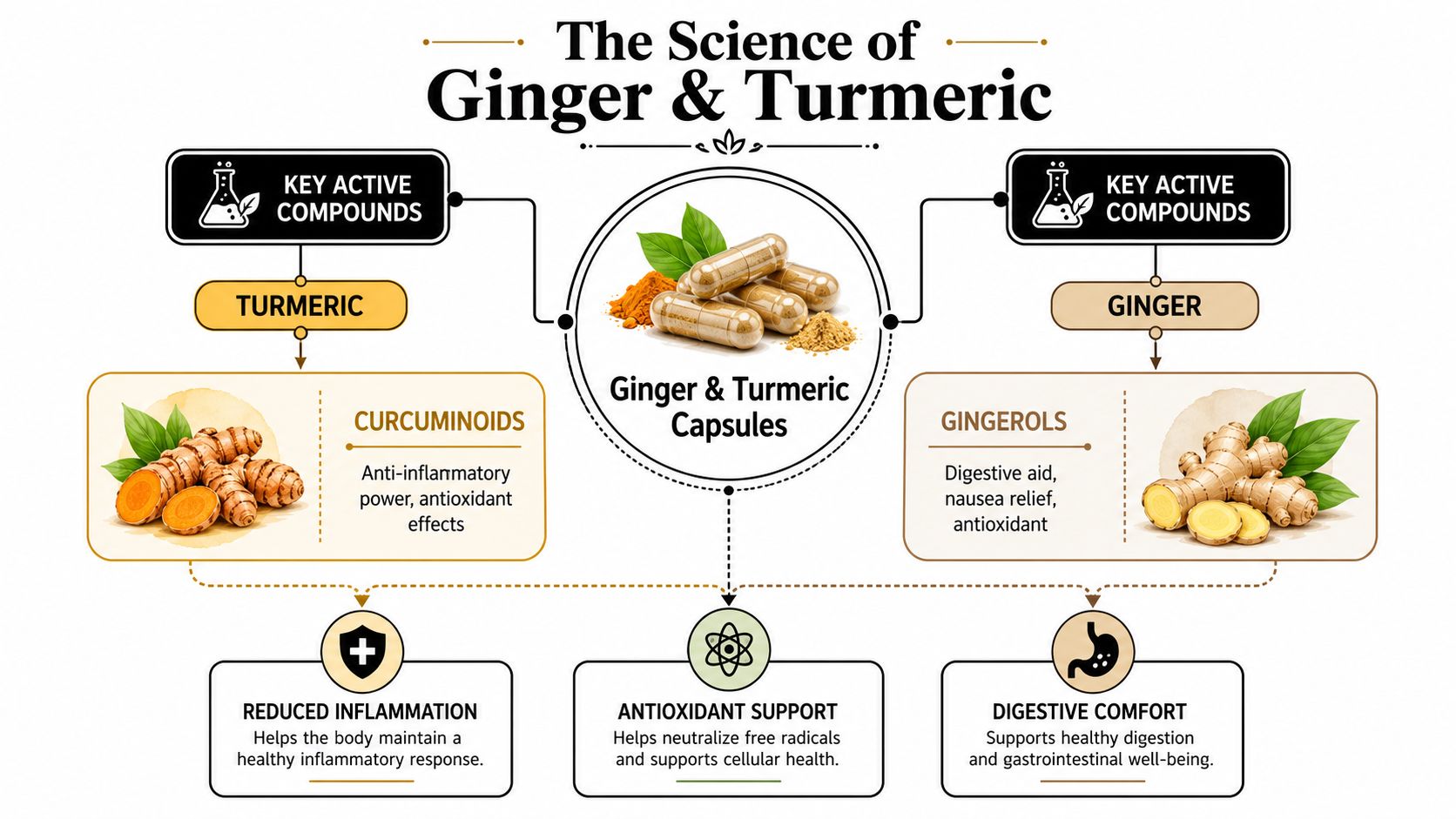
Turmeric is best known for curcuminoids, especially curcumin. Ginger is best known for gingerols and related compounds that can shift as ginger is dried or processed. Researchers study these compounds because they are tied to inflammation pathways, oxidative stress, digestive comfort, and nausea support.
So the label matters.
A capsule made with plain powdered root is closer to using the whole spice rack. A capsule made with a standardized extract is closer to using a measured concentrate. Neither is automatically better. They do different things. Whole-root products may offer a broader mix of compounds in smaller amounts. Standardized extracts aim for more predictable potency.
Why absorption changes the whole picture
Curcumin has a frustrating trait. Your body tends to absorb and clear it poorly on its own.
That is why many turmeric formulas add an absorption helper such as piperine from black pepper, phospholipids, or other delivery systems. A common comparison is coffee grounds and a filter. You can start with great material, but the setup determines how much ends up where you want it.
The upside is clear. Better absorption can make a lower dose more useful.
The caution is just as important. Stronger absorption is not always a free bonus. Piperine can affect how the body processes certain medications, and highly bioenhanced turmeric products have drawn more safety questions than plain culinary turmeric or simpler root powders. For someone comparing options for inflammation support or natural pain relief approaches that fit daily life, this is one of the biggest details to look at. A formula designed to push more curcumin into circulation may feel more potent, but it also deserves a more careful look if you take prescriptions or want a gentler long-term option.
Additive effects versus true synergy
In such cases, labels often get ahead of the evidence.
Additive means ginger helps in its own way and turmeric helps in its own way, so the capsule gives you both sets of benefits. Synergy means the two interact in a way that creates a bigger effect than you would expect from combining them.
Early lab research has made the synergy idea look promising in some settings. But lab findings are not the same as clear proof that every ginger turmeric capsule works better as a pair in humans. For daily supplement use, the safer assumption is usually this: ginger and turmeric may complement each other, yet many of the benefits still come from each herb pulling its own weight.
That distinction matters because it keeps expectations realistic. If a brand promises magic from the combo alone, slow down and read the label more closely. Key questions are simpler. What form is used. How is it absorbed. Is the dose meaningful. Does the formula make sense for your goal and your risk tolerance.
A smart ginger turmeric capsule is not just a “two herbs are better than one” story. It is a formula choice, and formula details shape both benefit and safety.
The Science-Backed Benefits of Ginger Turmeric Capsules
When people ask whether ginger turmeric capsules “work,” they usually mean one of three things. Will they help with stiffness and soreness? Will they settle the gut? Will they make me feel better overall?
The answers depend on what outcome you care about most.
Supporting Joint Comfort and Reducing Inflammation
This is the strongest evidence lane for many shoppers.
A triple-blind randomized controlled trial published in 2025 found that ginger supplements produced a median C-reactive protein reduction of 9.0, turmeric supplements produced a median reduction of 4.0, and the placebo group had a median increase of 2.50, according to the Scientific Reports trial on ginger and turmeric. C-reactive protein, often shortened to CRP, is a marker commonly used to track inflammation.
What does that mean in normal language? It means the active compounds in these herbs didn't just sound anti-inflammatory on paper. In that trial, they were linked to measurable changes in inflammation-related markers.
For someone with daily stiffness, workout soreness, or nagging discomfort that seems tied to inflammation, that matters. It doesn't mean a capsule will erase pain overnight. It does mean there's a real scientific basis for using these herbs as part of a broader routine for joint comfort and recovery.
If you're comparing options for non-prescription support, it can help to also understand how supplement approaches differ from conventional pain relievers. This overview of natural pain relief options gives useful context for that decision.
Aiding Digestion and Gut Health
Ginger has long had a reputation for settling the stomach, and that reputation didn't appear out of nowhere. Many people use ginger-containing products when they want digestive ease, especially during occasional nausea or after meals that sit heavily.
Turmeric gets discussed more often for inflammation than for immediate digestive comfort, but some people include it in a gut-support routine because digestive irritation and whole-body inflammation can overlap. That doesn't mean everyone will feel a dramatic digestive effect from turmeric itself. It means some users value the combination because ginger speaks more directly to the stomach, while turmeric may support a calmer inflammatory backdrop.
A useful way to think about the pairing is this:
Ginger's lane: digestive comfort, stomach settling, support during occasional nausea
Turmeric's lane: broader inflammation support
The combo's appeal: convenience, because one capsule can cover more than one reason people supplement
That's a more honest explanation than pretending every dual-ingredient formula creates a brand-new effect that neither herb has on its own.
Enhancing Mood and Sleep Quality
Readers should keep expectations modest.
Inflammation, discomfort, poor sleep, and stress often feed each other. If your joints feel less irritated or your stomach feels calmer, sleep can become easier because your body is less bothered at night. That's a real-life pathway people notice.
But ginger turmeric capsules aren't best understood as direct sleep supplements. They're better viewed as foundational support products that may help some people feel more comfortable in their bodies, which can indirectly support rest and day-to-day resilience.
A supplement doesn't need to knock you out or act like a stimulant to be useful. Sometimes the win is that your body feels less “busy,” and that makes sleep and mood easier to manage.
The big takeaway here is simple. The most grounded benefits are usually about inflammation support, joint comfort, recovery, and digestive ease. Anything beyond that should be viewed as a possible side benefit, not the main promise on the bottle.
Understanding Safety and Potential Interactions
A lot of supplement content treats safety like a quick disclaimer at the bottom of the page. That's backwards. Safety should shape the buying decision from the start, especially with formulas designed for stronger absorption.
Why Absorption Support Changes the Safety Conversation
Better absorption sounds automatically better. Sometimes it is. Sometimes it also changes the risk profile.
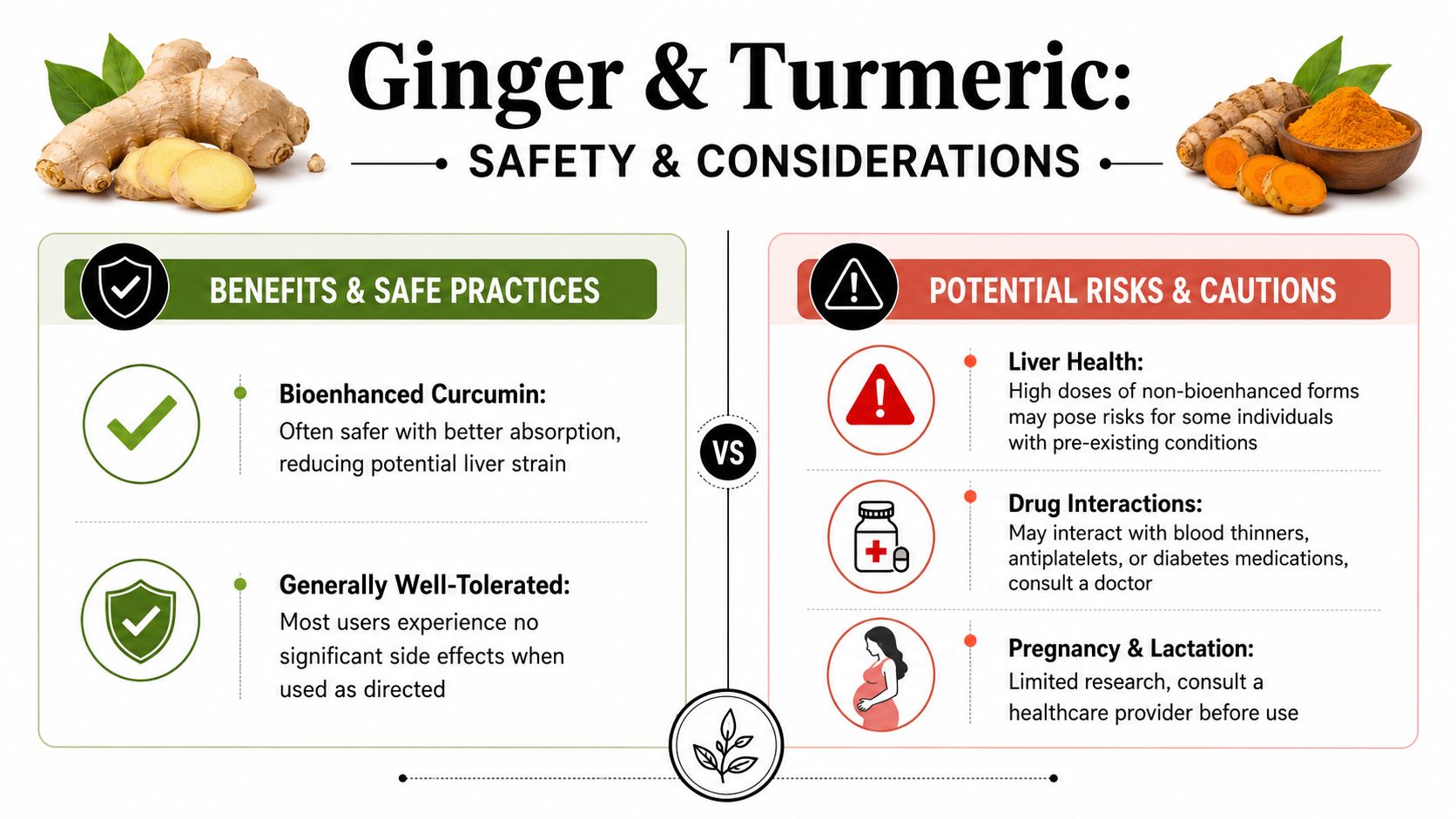
The National Center for Complementary and Integrative Health states that while turmeric is generally considered safe, some people consuming bioavailable curcumin formulations, including products with piperine or phospholipids, have experienced liver damage, as noted on NCCIH's turmeric safety page. That point gets glossed over in a lot of marketing.
This doesn't mean black pepper extract is “bad” or that no one should use bioenhanced formulas. It means you should understand the tradeoff. A product built to raise absorption may also deserve more caution, especially if you have a liver condition, a history of medication-related liver stress, or symptoms such as jaundice, dark urine, or unusual fatigue after starting a supplement.
Stronger absorption isn't a free upgrade. It's a design choice, and design choices have consequences.
Who Should Slow Down and Ask a Clinician First
Some people shouldn't treat an over-the-counter supplement like a casual purchase.
Use extra caution if you:
Take blood thinners or antiplatelet drugs: ginger and turmeric may not be a simple add-on for you.
Use diabetes medications: changes to your routine deserve a medication review.
Have known liver issues: the caution around bioenhanced curcumin matters more here.
Take several medications at once: the more moving parts you have, the more valuable a pharmacist or clinician becomes.
Are pregnant or breastfeeding: product labels and internet reassurance aren't enough.
If you're weighing herbs against standard pain options, this comparison of ibuprofen and related considerations can help you think through the tradeoffs before you discuss options with your clinician.
Common Sense Side Effect Checklist
Users of these products generally seek support, not drama. Mild digestive effects are still possible, especially when starting a new formula or taking it on an empty stomach.
A simple check-in list helps:
What to watch | What it may mean |
|---|---|
Mild stomach upset | Your body may tolerate it better with food |
Nausea or burning | The dose or formula may be too aggressive for you |
New fatigue or dark urine | Stop and contact a healthcare professional promptly |
Easy bruising or unusual bleeding | Review use with a clinician, especially if you take medications |
The goal isn't fear. It's clarity. A supplement can be useful and still deserve respect.
How to Choose a High-Quality Supplement
A bottle can look impressive and still tell you almost nothing useful. Bright turmeric roots on the label, words like “maximum strength,” and a long promise list do not tell you what form is inside, how much you are getting, or whether the formula makes sense for your goals.
The better approach is to shop like you are reading ingredients for a recipe, not a slogan. With ginger turmeric capsules, the details on the Supplement Facts panel matter far more than the front of the bottle.
Read the Front Label, Then Read the Supplement Facts
Start with one basic question. What, exactly, is in the capsule?
A label may say “turmeric” in large print but leave out whether it contains plain turmeric root powder, a curcumin-rich extract, or a standardized ingredient with a defined potency. Those are not small differences. They are closer to the difference between eating grapes and drinking a measured serving of juice concentrate. Same source plant, different concentration.
The same goes for ginger. Some products use plain ginger powder. Others use extracts standardized for key compounds. If a brand is vague about the form, it becomes hard to compare one product with another or connect the formula to how these ingredients are commonly used in research and practice.
For turmeric, pay close attention to whether the product explains its absorption strategy. Curcumin is known for poor bioavailability, so many brands try to increase absorption. That can be helpful, but stronger delivery is not always a simple upgrade. A bioenhanced formula changes how much of the compound reaches your system, which is one reason quality and safety deserve equal attention.
A Short Buying Checklist That Helps
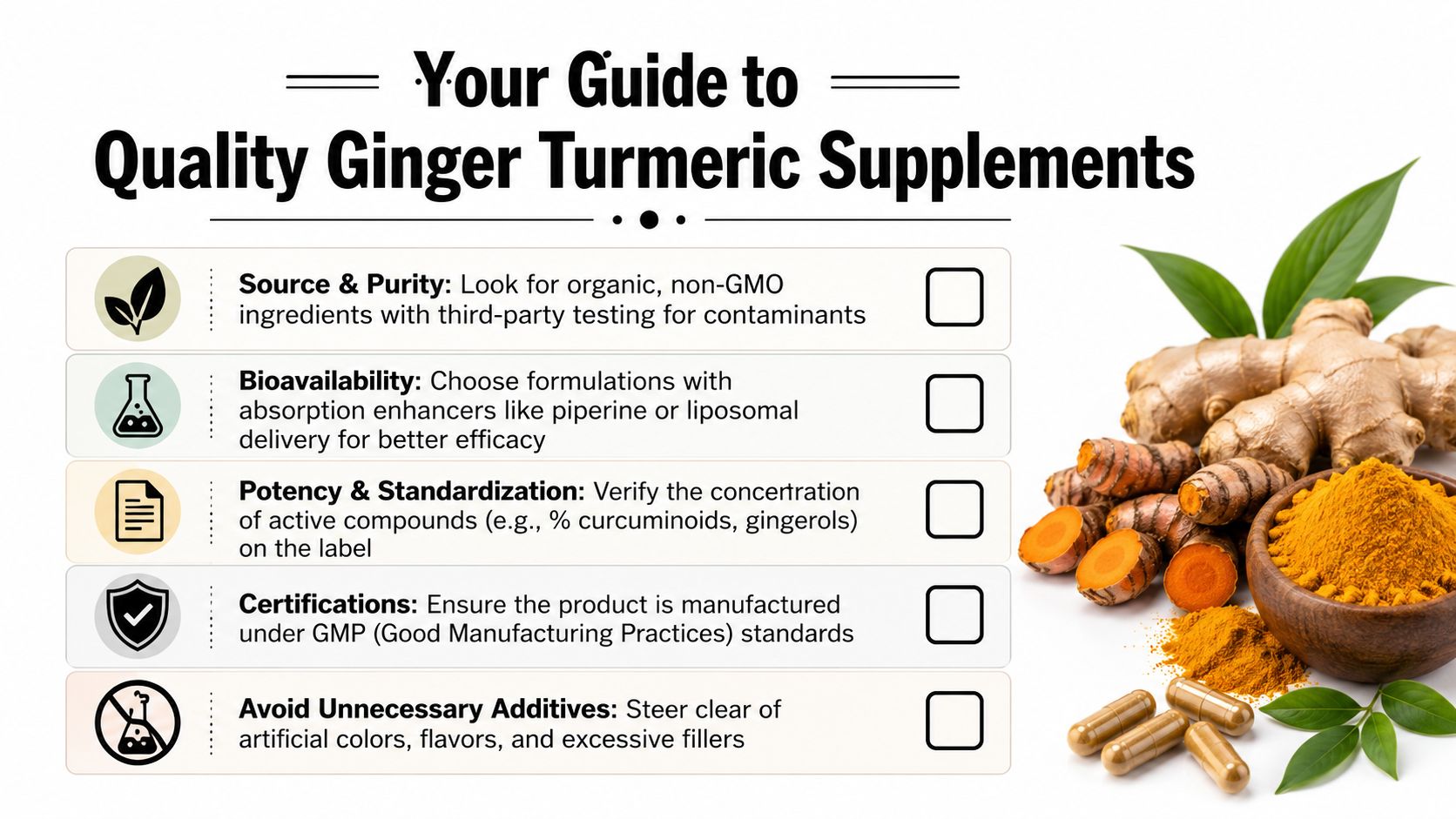
Use this checklist when you compare products:
Look for the ingredient form: “Turmeric root” and “curcumin extract” are not interchangeable. The same is true for ginger powder versus ginger extract.
Check for standardization: A label that lists a standardized extract gives you a clearer idea of consistency from batch to batch.
Read the absorption method carefully: If the formula uses piperine or another bioenhancer, the brand should explain it plainly. More absorption is not always better for every person.
Be cautious with vague proprietary blends: If the amounts are hidden, you cannot tell what is doing the work.
Prefer third-party testing: Independent testing adds a useful layer of confidence for purity and label accuracy.
Keep the formula simple: Extra herbs, stimulants, or “metabolism” add-ons can make the product harder to judge and harder to tolerate.
Choose a capsule you will stick with: A well-designed supplement only helps if it fits your routine and does not bother your stomach.
If your main goal is mobility, this guide to natural joint support supplements for everyday movement can help you compare broader options.
To see how supplement education often gets explained visually, this short video is a helpful companion:
What Quality Looks Like at a Glance
Good supplement shopping works like checking a passport. You want clear identity markers, not a polished cover.
A quick comparison makes that easier:
Better sign | Weaker sign |
|---|---|
Turmeric and ginger forms named clearly | Generic plant names with little detail |
Standardized extract listed when relevant | No potency information |
Absorption support explained in plain language | Curcumin included with no delivery explanation |
Third-party testing or verification mentioned | No purity or quality details |
Simple formula with a clear purpose | Long ingredient list with unclear roles |
One more point matters here. Ginger and turmeric are often marketed as a perfect pair, but a smart buyer should still ask whether the formula is built for synergy or just stacking ingredients for label appeal. A good product explains why the ingredients are combined, how they are delivered, and what tradeoffs come with that design.
If a brand cannot tell you what form of turmeric it uses, how the formula handles absorption, and who should be cautious with it, keep scrolling.
A Practical Guide to Dosing and Timing
A lot of people overcomplicate supplement timing. For ginger turmeric capsules, the basics matter more than hacks.
Start Lower Than Your Enthusiasm
If you're new to the category, start with the product's labeled serving instructions and resist the urge to “go hard” on day one. Your stomach, your medication list, and your overall tolerance matter more than internet bravado.
This is especially true with formulas that use absorption enhancers. A stronger delivery system may be useful, but it's also a reason to begin carefully and pay attention to how you feel.
A sensible rhythm often looks like this:
Read the serving size exactly as written
Take the lowest practical starting amount
Watch for digestive or unusual symptoms
Only continue if tolerance feels solid
Take It With Food and Be Consistent
Many people do better when they take these capsules with a meal. That can be easier on the stomach, and for turmeric-containing formulas it may also support absorption in a real-world way, especially if the meal includes some healthy fat.
Consistency matters more than perfect timing. Taking a capsule at breakfast every day is usually better than taking it “optimally” for three days and then forgetting it for a week.
The best dosing schedule is the one you can repeat without effort.
What to Expect From Daily Use
These supplements usually make more sense as a routine than as a rescue remedy. People often get disappointed because they expect the effect profile of a fast-acting pain reliever. That's not the right comparison.
Think of ginger turmeric capsules like regular mobility work or a steady sleep routine. The value often comes from cumulative support, not from one dramatic moment. You're looking for signs that your body feels a bit less stiff, a bit less reactive, or a bit easier to settle over time.
A few practical expectations help:
Expect subtle change first: less morning stiffness or easier recovery can be meaningful.
Track one goal: joint comfort, digestion, or post-exercise soreness. Don't judge a product by ten goals at once.
Stop if your body objects: “natural” doesn't mean push through.
If you want a quick rule, use the capsule regularly, take it with food unless the label says otherwise, and judge it by steady patterns rather than one-day swings.
Conclusion Integrating Ginger and Turmeric into Your Routine
Ginger turmeric capsules deserve more credit than cynical marketing critics give them, and more scrutiny than flashy labels usually allow. That's the balanced view.
These herbs have real potential, especially for people focused on joint comfort, inflammation support, digestive ease, and recovery. But the details matter. The form of the ingredients matters. Absorption support matters. Safety matters, particularly when a formula is built to deliver more curcumin into the system.
The most useful shift is moving away from the “golden duo” fantasy and toward a more grounded question: does this product fit my goals, my body, and my health situation? For some people, the answer will be yes. For others, a single-ingredient product, a different formula, or a conversation with a clinician comes first.

An informed supplement user is usually a safer and happier one. If you decide ginger turmeric capsules belong in your routine, choose a brand that's clear about extract forms, honest about absorption, careful about safety, and transparent about quality testing. That approach won't guarantee a miracle, but it does give you a much better shot at choosing something worth taking.
If you're ready to choose a formula built around the quality markers discussed above, take a look at River of Life. Their approach centers on a vegan capsule with turmeric extract, BioPerine, ginger, and other supportive ingredients, along with educational resources that help you make a more informed decision.