


Supplements for Joint Support: Your 2026 Guide

You wake up, swing your legs out of bed, and your knees argue with you before your feet even hit the floor. The first few steps feel stiff. Stairs feel less friendly than they used to. Maybe you still walk every day, lift weights, garden, or chase kids around the house, but now you're starting to look at the supplement aisle and wonder which bottle is useful and which one is just expensive optimism.
That's where many get stuck. The labels sound scientific, the claims sound confident, and the timelines are often fuzzy. One product talks about cartilage, another talks about inflammation, and a third promises “mobility support” without clarifying what that means. It's easy to assume all supplements for joint support work the same way. They don't.
Some ingredients aim to calm inflammatory pathways. Some try to support connective tissue. Some are only worth considering if the formula solves an absorption problem. And some of the most important questions have nothing to do with the ingredient itself. Is the extract standardized? Is the dose meaningful? Has the brand tested what's in the bottle? How long should you realistically give it before deciding whether it helps?
Table of Contents
Introduction to Joint Support with Supplements
Maria is the kind of person who doesn't think of herself as “old” or “injured.” She just notices that getting moving in the morning takes longer than it used to. Her knees feel tight after sitting. A long grocery trip leaves her more sore than expected. Her doctor has already talked with her about exercise, weight management, and prescribed care, but she also wants to know whether a supplement could help.
That's a reasonable question.
Interest in supplements for joint support keeps growing because people want options that feel practical and sustainable. Some want help with knee osteoarthritis symptoms. Some want to stay active without feeling beaten up after every walk or workout. Others aim to preserve day-to-day comfort so normal tasks stay normal.
The hard part is that joint supplements live in a gray zone between hope and evidence. Some ingredients do have human research behind them. Some show measurable symptom relief. But that doesn't mean every product is well made, and it definitely doesn't mean a supplement can rebuild a worn joint like patching a bicycle tire.
Plain-language takeaway: Think of a joint supplement as a support tool, not a mechanical repair kit.
That shift in mindset matters. If you expect instant relief or cartilage regrowth, you'll probably be disappointed. If you use supplements as one part of a broader plan, and you choose products with solid formulation details, you give yourself a much better shot at a fair trial.
Here, it helps to think like a careful shopper and a curious student at the same time. You want to know what the ingredients are supposed to do, what the evidence supports, how to spot a weak formula, and why timelines matter so much.
Understanding Ingredients and Mechanisms
A good joint formula is less like a random mix of healthy-sounding ingredients and more like a small toolkit. Each ingredient is supposed to do a different job. Some aim to calm inflammatory signaling. Some are included to support cartilage or connective tissue. Some try to improve the environment around the joint so movement feels more comfortable over time.
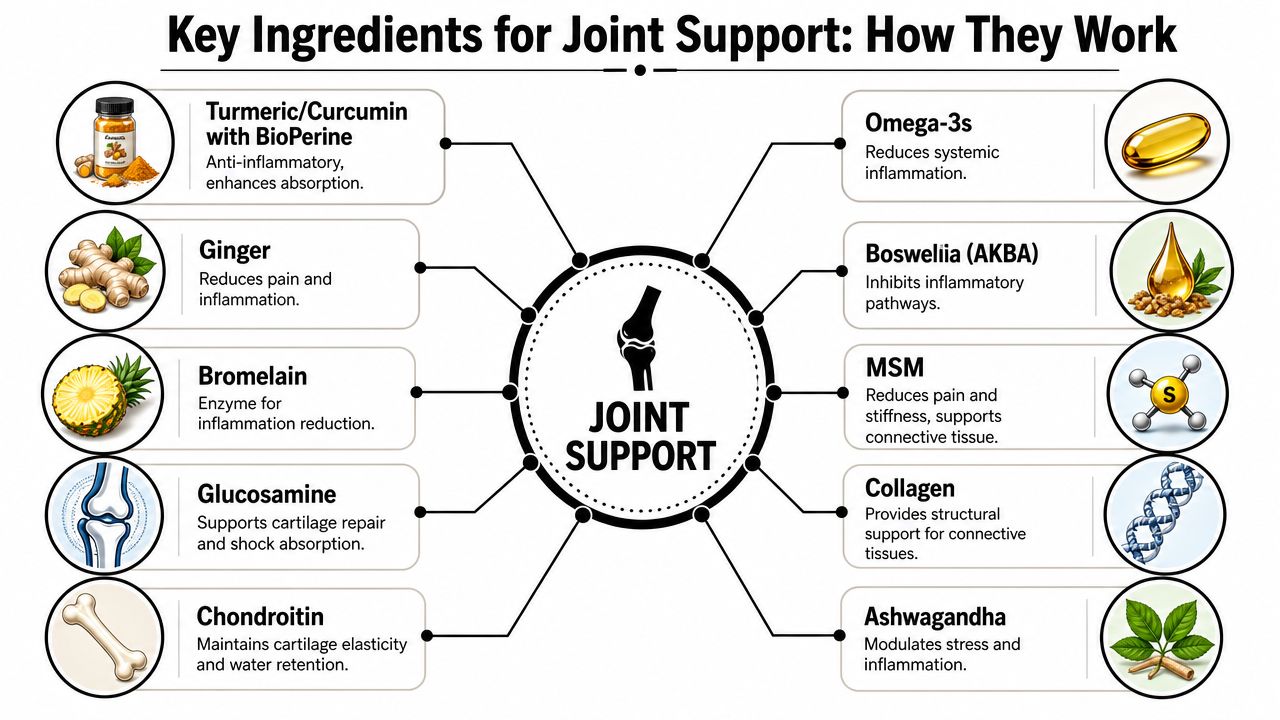
That job description matters because ingredients with similar marketing claims can work through very different pathways.
Why ingredients can act differently
Curcumin is a clear example. It is the main active compound in turmeric, and it is usually included for its effects on inflammatory signaling. The catch is absorption. Curcumin on its own is absorbed poorly, so the form matters almost as much as the ingredient name on the front label. A product that uses a phospholipid complex, a specialized curcumin extract, or a formula paired with absorption helpers may perform very differently from a plain turmeric powder capsule.
This is one place where supplement quality starts to matter before you even reach the evidence section. Two labels can both say "curcumin," but if one uses a standardized extract with documented bioavailability and the other does not, you are not really comparing the same tool.
Boswellia serrata works through a different mechanism. It is commonly discussed for its effect on 5-lipoxygenase, an enzyme involved in leukotriene production. That sounds technical, but the basic idea is simple. Inflammation is not a single on-off switch. It is more like a control panel with several circuits. Curcumin and Boswellia may both be used for joint comfort, yet they can act on different parts of that panel.
Glucosamine and chondroitin are a different category again. They are usually presented as cartilage-support ingredients rather than classic anti-inflammatory compounds. A simple way to understand them is to picture the joint as a living cushion system. These ingredients are marketed less as volume knobs for inflammation and more as raw materials or support pieces for the cushioning structure around the joint. Whether that leads to noticeable symptom relief varies by the form used, the person taking it, and the condition being targeted.
Other common ingredients fill narrower roles:
Ginger is often included for joint comfort and inflammatory support.
Bromelain is an enzyme used in formulas aimed at swelling or activity-related discomfort.
Omega-3s are commonly used for broader inflammatory balance.
MSM is often marketed for stiffness and connective tissue support.
Collagen is used for structural support in connective tissues.
Ashwagandha is different. It is usually included for stress and sleep support, which can matter because poor sleep and chronic stress often make pain feel stronger.
If you want background on one of the structural-support options, this guide to undenatured type II collagen explains how that category is intended to work.
A common point of confusion is this: an ingredient can sound promising in theory and still disappoint in a real product. That often happens because the label tells you the ingredient name, but not whether the dose is realistic, whether the extract is standardized, or whether the form is absorbed well enough to matter.
The gut-joint axis and other emerging ideas
Some newer ideas in joint support focus less on the joint surface itself and more on body-wide immune signaling. One area getting more attention is the gut-joint axis. The University of Nottingham has reported on emerging research suggesting that prebiotic fiber may help reduce arthritis pain and improve function through gut-related immune effects in knee osteoarthritis (University of Nottingham report on gut health and arthritis pain).
Here is the simpler version. A joint is not an isolated hinge. It sits inside an immune system, a digestive system, and a sleep-stress cycle. If the gut affects immune behavior, and immune behavior affects inflammatory tone, then a supplement that helps gut health could influence joint comfort indirectly.
The house analogy fits well here. Some ingredients try to quiet the smoke alarm in one room. Others try to reduce the smoke being produced in the kitchen. Both approaches can make the house easier to live in, but they are solving different parts of the problem.
This is also why realistic timelines matter. Ingredients that mainly influence inflammatory signaling may be noticed sooner than ingredients meant to support cartilage, connective tissue, or immune balance over time. A fair trial depends on matching the ingredient to its job, then checking whether the product gives that ingredient a real chance to work through bioavailable forms, clear standardization, and third-party testing.
Evaluating Evidence for Joint Support Supplements
A supplement label can make every formula sound equally convincing. The research record does not look that tidy. Some ingredients have repeated human data behind them. Others are supported mainly by popularity, older studies, or trials that used a different form than the one sitting on the shelf.
That difference matters because joint supplements are a bit like replacement parts and lubricants for a machine. Two products may both say they help the hinge, but one has been tested in the right form, at the right dose, and in a form the body can absorb. The other may only sound similar.
What the stronger evidence points to
Curcumin remains one of the better-studied options for joint comfort, especially in knee osteoarthritis. Reviews of human studies have found meaningful improvements in pain and function, with some comparisons suggesting symptom relief in the same conversation as common over-the-counter pain medicines, while still being treated as a supplement that supports care rather than replaces prescribed treatment. For readers who want a product-specific look at one of the better-studied botanicals, this article on how turmeric curcumin helps with arthritis joint pain adds helpful context.
Boswellia also has encouraging support. An AARP review of joint supplement evidence describes findings from a recent systematic review and meta-analysis in which standardized Boswellia extracts and some broader nutraceutical approaches improved pain scores, even though the overall evidence quality was still rated low.
Here's the visual summary.
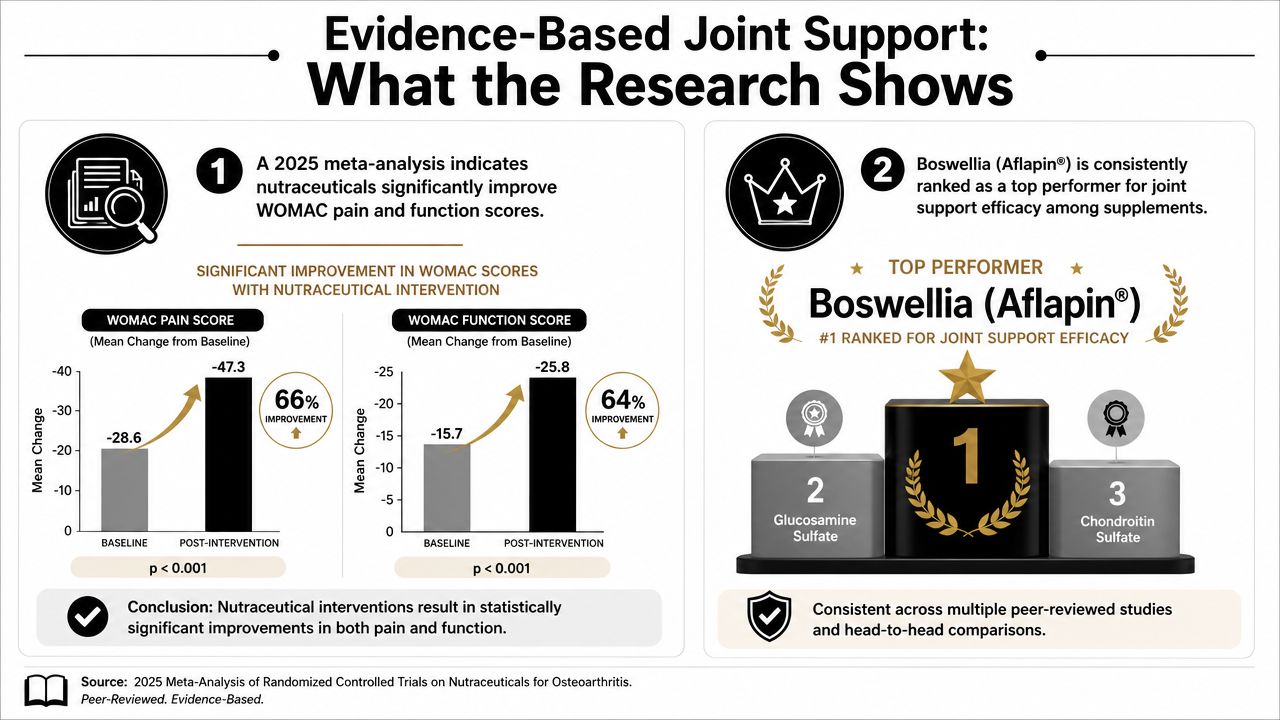
A more specific Boswellia review in PubMed Central adds an important detail that many buying guides skip. The results were tied to named, standardized Boswellia preparations rather than to any random Boswellia capsule. In that review, Aflapin was highlighted as one of the stronger performers for pain, and a three-month trial using a defined daily amount showed moderate symptom improvement without significant adverse events in the reviewed data.
That is a useful lesson. Evidence usually belongs to a particular ingredient form, not to a marketing category.
A short explainer can also help make the evidence easier to interpret.
Where the evidence gets messy
This is the part that trips readers up. A supplement can be famous and still have mixed evidence.
That is the case with glucosamine and chondroitin. Reviews summarized in the same AARP article note that the overall evidence across joint supplements is often very low quality, and these two ingredients have produced small, inconsistent, or clinically questionable benefits in many trials. Even within glucosamine, the form matters. Glucosamine sulfate has shown more promise in some studies, while glucosamine hydrochloride has often looked unimpressive.
A simple way to read this is to ask three questions before trusting a claim.
What exact form was studied? Boswellia extract, for example, is more informative than just “Boswellia.”
Was the product standardized? A standardization statement helps show that each dose contains a defined amount of active compounds instead of a vague plant powder.
Can the body absorb it well enough to matter? Curcumin is the classic example. A weakly absorbed formula can look good on a label and still underperform in real use.
That is why “supports healthy joints” is such a weak claim on its own. It tells you almost nothing about whether the formula matches the research.
Evidence rule: Look for the exact ingredient form, the amount used, whether the extract is standardized, and whether the company offers third-party testing. Those details tell you more than a bold headline on the front of the bottle.
A practical way to sort claims is to place them into rough tiers:
Ingredient category | Evidence picture in plain English |
|---|---|
Curcumin | Promising for symptom relief, especially in well-absorbed formulations |
Boswellia | Encouraging for pain and stiffness, especially standardized extracts |
Glucosamine and chondroitin | Mixed results, with meaningful differences between forms |
Everything else in blends | Harder to judge if the label hides doses or uses poorly defined ingredients |
Time matters too. Joint supplements rarely work like a fast-acting pain reliever. In the Boswellia review above, symptom changes were assessed over months, not days. A fair trial is usually measured in 8 to 12 weeks, especially for ingredients meant to influence inflammation or joint function gradually. If nothing improves after that window, the supplement may be the wrong fit, the wrong form, or not strong enough evidence-wise to justify continuing.
That timeline also protects you from a common mistake. People often stop too early when a supplement needs time, or they continue too long because the label sounded scientific. The better approach is to match the ingredient to the evidence, then match the evidence to a realistic testing period.
Safe Dosing and Potential Interactions
A common real-world mistake looks like this: someone buys a joint supplement, takes the full label dose on day one, adds a second product a week later, then has no clear idea which ingredient helped, which one upset their stomach, or whether either dose made sense for their medications.
Dose is part of the test. So is the ingredient form.
A capsule label can make two products look similar even when they behave very differently in the body. Curcumin is a good example. Some forms are designed to absorb better, while plain turmeric powders may deliver much less of the active compounds to circulation. That is why a dose number by itself can be misleading. The useful question is not only “how many milligrams?” but also “what form, and how well is it absorbed?”
Boswellia has a similar issue. Products often use different extracts, and labels may or may not tell you how the extract is standardized. If the company does not clearly identify the extract type, comparing doses becomes like comparing scoops of coffee made from different beans, grinds, and brew strengths. The scoop size is only part of the story.
A safer way to start
Start low, use one product at a time, and give your body a steady routine. That approach makes side effects easier to spot and keeps you from blaming the wrong capsule.
A simple method works well:
Pick one supplement first. If you start three at once, you cannot tell which one helped or caused trouble.
Use the label as a ceiling, not a challenge. Beginning with the lower end of the suggested serving is often easier on the stomach.
Take it consistently. Skipping days makes it harder to judge whether the supplement is doing anything.
Track one or two symptoms. Morning stiffness, walking comfort, or soreness after normal activity are easier to remember than a vague sense of “better.”
Reassess after a fair trial. Joint supplements usually need weeks, not a weekend.
A short phone note works well: “Stiff for 20 minutes after getting up. Stairs easier this week.” That gives you something concrete to compare later.
Interactions deserve more attention than they usually get
“Natural” does not mean interaction-free.
Joint supplements can affect bleeding, digestion, blood sugar, or the way the body handles other compounds. Piperine is the classic example because it is added to some curcumin products to improve absorption. Better absorption can be helpful for the supplement itself, but it also raises a practical question: could it change how another substance is absorbed too? That is the kind of detail worth checking before you add a product to a regular medication routine.
Extra caution makes sense for people who take:
Blood thinners or antiplatelet drugs
Diabetes medications
Regular NSAIDs
Multiple daily prescriptions
Drugs that already cause stomach irritation
Allergy details matter too. Glucosamine may come from shellfish. Capsules can contain gelatin or other materials some people avoid. Herbal blends can include ingredients that are easy to miss if you only read the front label.
Digestive side effects are also common enough to watch for early. Nausea, reflux, cramping, or diarrhea may mean the dose is too high, the formula does not suit you, or the timing with food needs adjustment. If symptoms are more than mild, stop the product and check with a clinician or pharmacist.
One more practical rule helps prevent confusion. Change one variable at a time. New supplement, same diet. Same supplement, new dose. That kind of clean test tells you much more than changing everything in the same week.
If you have a medical condition, take prescription drugs, are pregnant, or are planning surgery, get dosing advice from a clinician or pharmacist before starting a joint supplement. That step may feel slow, but it is often the fastest way to avoid a month of guesswork.
Assessing Supplement Quality for Joint Support
Two bottles can sit side by side on a store shelf, both promising joint support, and still be very different products. One may use ingredient forms that have been studied, list the active compounds clearly, and show proof of testing. The other may rely on broad ingredient names, vague blends, and marketing language that sounds impressive but says very little.
That is why label reading matters so much here. For joint supplements, quality is not a small detail. It often decides whether you are buying a formula with a reasonable chance of helping or paying for a bottle that only looks convincing.
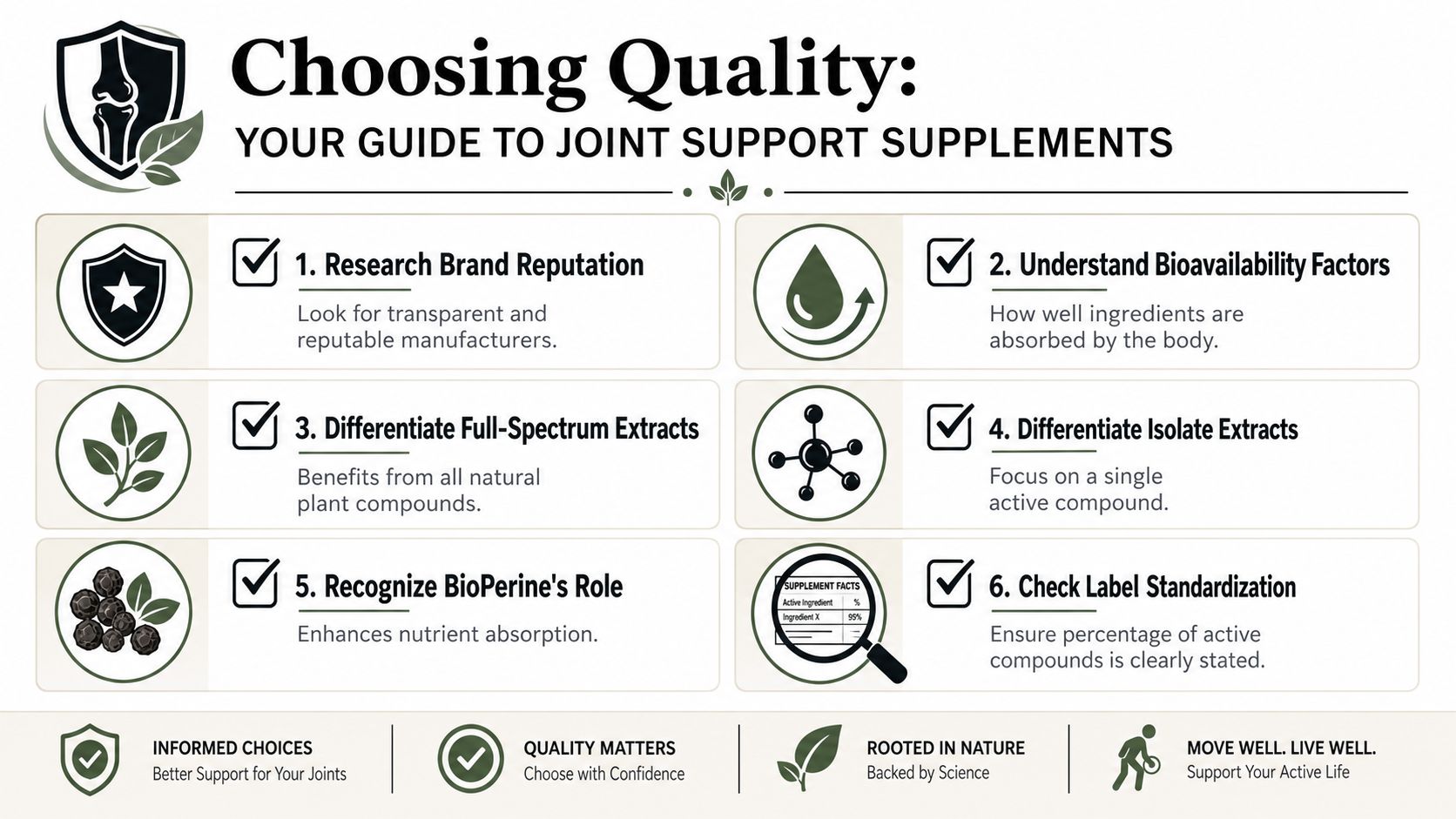
What to look for on the front and back label
Start with bioavailability. That term means how much of an ingredient your body can absorb and use. A label can list a large amount of curcumin, for example, but if the formula does little to improve absorption, the headline dose can be misleading. It works like buying seeds but never planting them in soil that lets them grow. The ingredient is present, but the useful effect may stay limited.
For curcumin products, brands often try to improve absorption with ingredients such as black pepper extract or with specialized delivery systems. That does not automatically make one formula better for every person, but it does show the company has addressed a known problem instead of pretending it does not exist.
Next, check standardization. This tells you whether the extract is prepared to contain a consistent amount of the compounds researchers usually focus on. With Boswellia, that often means listing boswellic acids or AKBA. With turmeric extracts, it may mean stating the percentage of curcuminoids. Without that information, you cannot tell whether the product resembles the ingredient used in studies or just shares the same plant name.
Many labels lack clarity. A front panel may say “joint complex” or “advanced turmeric blend,” while the Supplement Facts panel gives little detail about the active compounds inside. If the label hides doses inside a proprietary blend, comparison gets harder because you cannot see how much of each ingredient you are getting.
Third, look for third-party testing or certification. Programs such as USP Verified, NSF, or testing through reputable independent labs can help screen for identity, purity, and label accuracy. That does not prove a supplement will reduce pain or stiffness for you. It does mean the bottle is more likely to contain what it claims, in the amount it claims, and with lower contamination risk.
A realistic quality check also includes the claims on the bottle. Joint supplements are often marketed with language that suggests they rebuild cartilage or restore joints to their younger state. As noted earlier, those promises go further than the evidence. A higher-quality brand usually sounds more restrained. It talks about support, comfort, mobility, or healthy inflammatory balance rather than implying structural repair from a capsule.
A simple quality checklist
If labels start to blur together, use this short filter:
Ingredient form: Does the label name the specific form, or only a broad ingredient category?
Absorption support: If the ingredient has known absorption limits, does the formula address them clearly?
Standardization: Does it state the active compounds or extract percentage?
Testing: Is there mention of third-party testing, certification, or clear manufacturing quality standards?
Transparent dosing: Can you see the amount of each ingredient, or is it hidden in a proprietary blend?
Packaging: Does the bottle seem suited to protect the product from heat, light, and moisture?
Formula design: Are the ingredients there for a reason, or does the label look padded with extras to sound more impressive?
One more point often gets skipped in buying guides. Price only makes sense when you connect it to usable quality and realistic timelines. A cheaper bottle that uses weak forms, unclear standardization, and no testing may cost less upfront but offer little value over the 3 to 6 months many joint supplements need for a fair trial. A better product is not always the most expensive one. It is the one that gives you a clear label, a plausible formula, and enough information to judge whether the product is worth sticking with.
Good supplement shopping works like choosing tools for a home repair. You do not need the shiniest package. You need the one built for the job, with parts you can inspect before you bring it home.
When to Expect Results and Lifestyle Complements
The biggest gap in joint-supplement education isn't usually the ingredient list. It's the timeline.
The timeline most labels skip
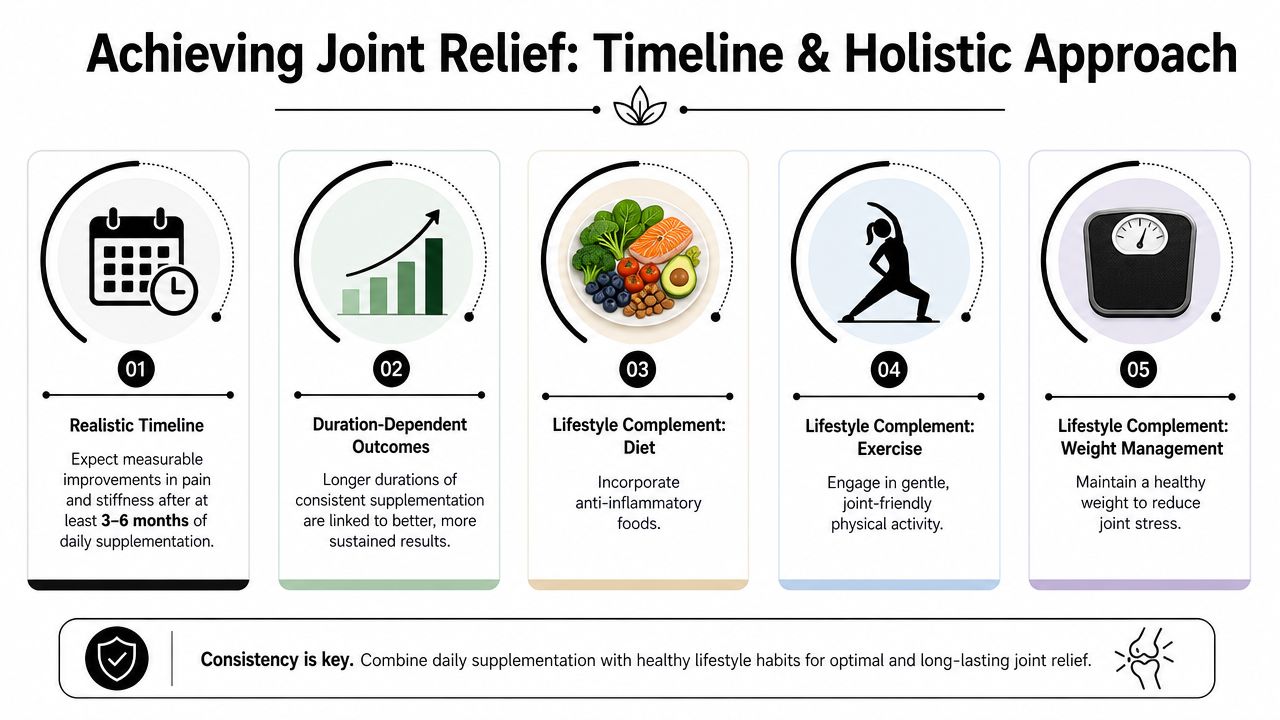
Verified data reports that a 2026 umbrella review confirms that most joint supplements require a minimum of 3–6 months of consistent use to achieve clinically meaningful reductions in pain and stiffness, and that longer durations correlate with better outcomes. It also notes that few brands communicate this clearly to consumers (umbrella review summary on realistic supplement timelines).
That matters because people often quit too early or judge the wrong thing. A joint supplement isn't like a pain reliever you take for a headache and evaluate by lunchtime. It's more like planting and watering a garden bed. You're looking for gradual, accumulated change.
A fair expectation sounds like this:
Time period | What to watch for |
|---|---|
Early weeks | Tolerance, consistency, whether the routine is sustainable |
Middle stretch | Small changes in stiffness, walking comfort, or recovery after activity |
Longer use | Whether the improvements are steady enough to justify staying on it |
If a product promises overnight transformation for long-standing joint discomfort, the promise is the red flag.
Daily habits that make supplements more useful
Supplements work best when the rest of your routine stops fighting them.
Exercise helps because joints like movement, especially controlled movement. Gentle strength work, walking, cycling, swimming, and mobility work can support function without asking the joint to do more than it's ready for.
Weight management matters because less load on weight-bearing joints often means less strain during everyday movement. That doesn't require perfection. Even basic consistency with food and activity can help.
Sleep is often ignored. Poor sleep tends to turn pain volume up. If you wake often or sleep lightly, the joint discomfort you feel during the day may hit harder.
Food choices can also support the bigger picture. A pattern that leans toward minimally processed foods, fiber-rich plants, and balanced meals tends to fit well with an anti-inflammatory lifestyle.
Try combining these habits with one chosen supplement rather than changing everything in a chaotic burst. When the plan is too complicated, people quit. When it's simple enough to repeat, they learn what helps.
Practical Buying Guide and River of Life Spotlight
A good buying decision usually comes down to three questions: what's in it, can your body absorb it, and can you realistically stick with it long enough to judge it fairly?
How to compare products without getting overwhelmed
When you're scanning options, ignore the front-label poetry for a minute and compare these practical details instead:
Does the formula match your goal? A product centered on curcumin and botanicals is different from one centered on glucosamine or collagen.
Does it solve an absorption problem? This matters most for turmeric-based formulas.
Are the ingredients spelled out clearly? You want specifics, not mystery blends.
Can you use it consistently? Bottle size, refill options, and return policy all affect follow-through.
Does the brand teach, or only sell? Educational resources are a quiet sign that a company expects informed customers.
One example of applying the checklist
One factual example is River of Life Capsules, which combine turmeric extract with BioPerine black pepper, plus ashwagandha root, ginger, and bromelain, in a vegan capsule format. The company sells one-time and subscription options, ships to more than 40 countries, uses climate-resistant packaging, offers a 30-day return policy for unopened bottles, and publishes educational content through The ROL Journal. If you're comparing turmeric-based products, a guide on curcumin with black pepper is relevant because it focuses on the absorption issue that often decides whether a formula is worth considering.
That doesn't mean it's automatically the right fit for every person. It means it can be evaluated using the same checklist as any other supplement.
If you're buying for joint support, keep your standards boring and consistent. Choose products with transparent ingredient forms. Prefer formulas that address bioavailability when needed. Look for testing signals. Be skeptical of repair claims. And buy only what you're willing to use steadily enough to judge objectively.
If you want a turmeric-based option that fits the quality principles discussed above, River of Life offers a capsule formula with turmeric extract, BioPerine, ginger, bromelain, and ashwagandha, along with one-time and subscription choices that can make a consistent trial easier to manage.