


Natural Pain Relief: An Evidence-Based Guide for 2026

Some of you are reading this with a heating pad on your back, a stiff knee under the desk, or a shoulder that never quite settled down after an old injury. You've probably tried the usual cycle. Rest for a few days, push through, take something for the pain, then realize the problem keeps coming back.
That's where natural pain relief can help, but only when it's approached with some discipline. The goal isn't to collect random remedies from social media or swap one quick fix for another. The goal is to lower the things that keep pain active, calm the nervous system, support movement, and use supplements carefully enough that they help instead of complicating the picture.
Table of Contents
The Growing Shift Towards Natural Pain Solutions
Pain changes ordinary decisions. You stop taking the stairs without thinking. You plan errands around how long you can stand. You sleep lightly because turning over wakes you up. That kind of daily friction pushes people to look for options beyond a pill bottle, and that search isn't fringe anymore.
A JAMA analysis of National Health Interview Survey data found that the share of U.S. adults using complementary health approaches rose from 19.2% in 2002 to 36.7% in 2022. Among people using those approaches, the share using them specifically for pain management increased from 42.3% to 49.2%. In plain terms, natural and non-drug pain strategies have moved into the mainstream.
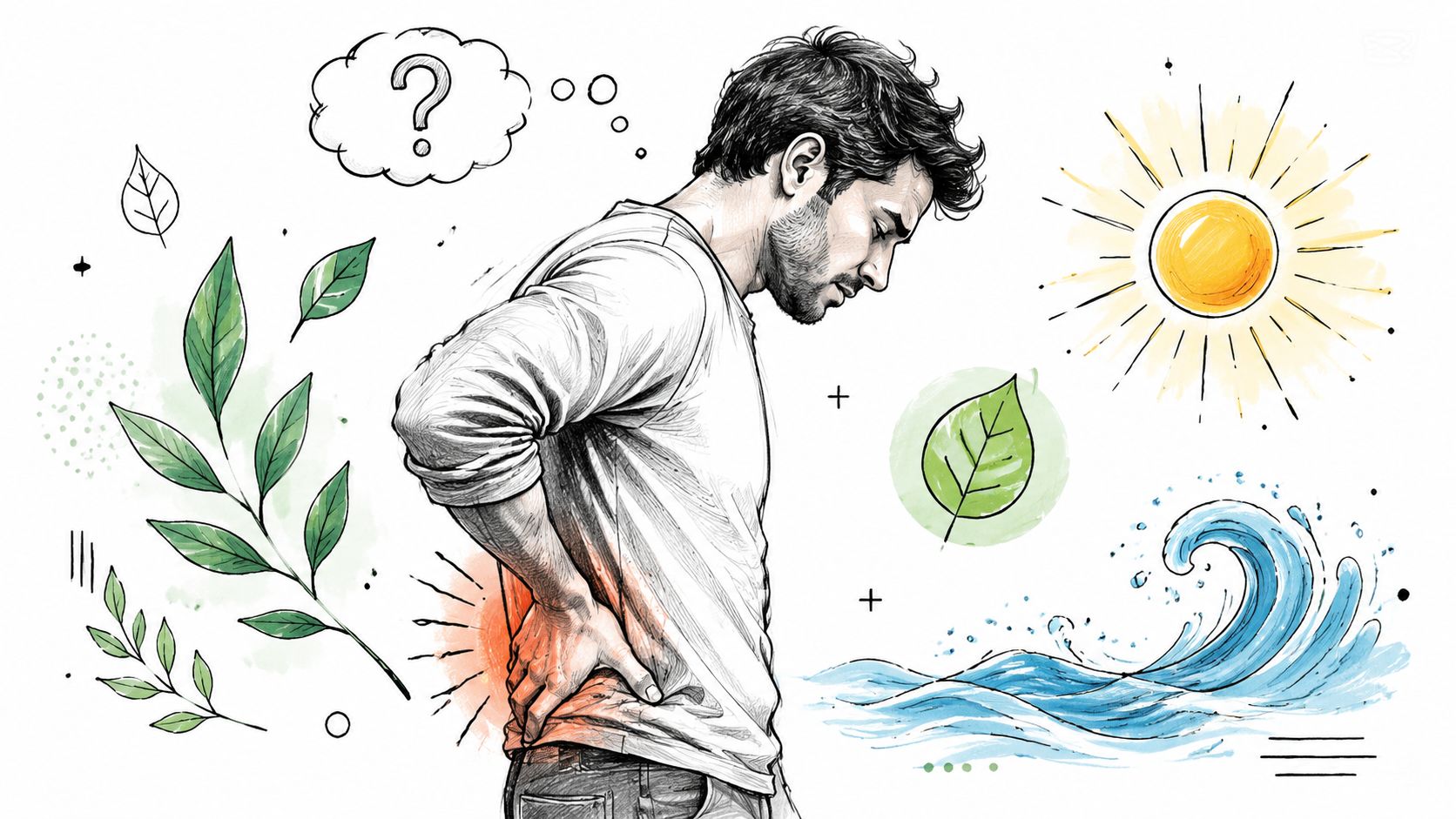
That shift makes sense in practice. Many people want relief, but they also want to stay clear-headed, protect their stomach, avoid overreliance on medication, and keep functioning at work or home. Natural pain relief appeals because it can target more than one pain trigger at the same time. Food quality, sleep depth, stress load, movement habits, and selected supplements all influence how loudly the body keeps sending pain signals.
Natural pain relief works best when you stop treating pain like a single problem. Most persistent pain behaves more like a knot of inflammation, tension, poor recovery, guarded movement, and nervous system over-alertness.
Some methods help because they reduce mechanical strain. Others help because they reduce inflammatory signaling or improve resilience under stress. The practical question isn't whether a remedy sounds natural. It's whether it fits the reason your pain is staying active.
The Four Pillars of Managing Pain Naturally
Pain that lasts rarely comes from one thing alone. Some people are dealing with joint irritation. Others have tight, deconditioned muscles, poor sleep, increased stress, or all of it at once. That's why a useful plan needs structure.
A CDC data brief reported that 24.3% of U.S. adults had chronic pain in 2023, and 34.9% of adults with chronic pain had high-impact chronic pain that frequently limited life or work activities. That's a strong reason to build strategies that people can maintain.
Right near the start, it helps to see the full framework.
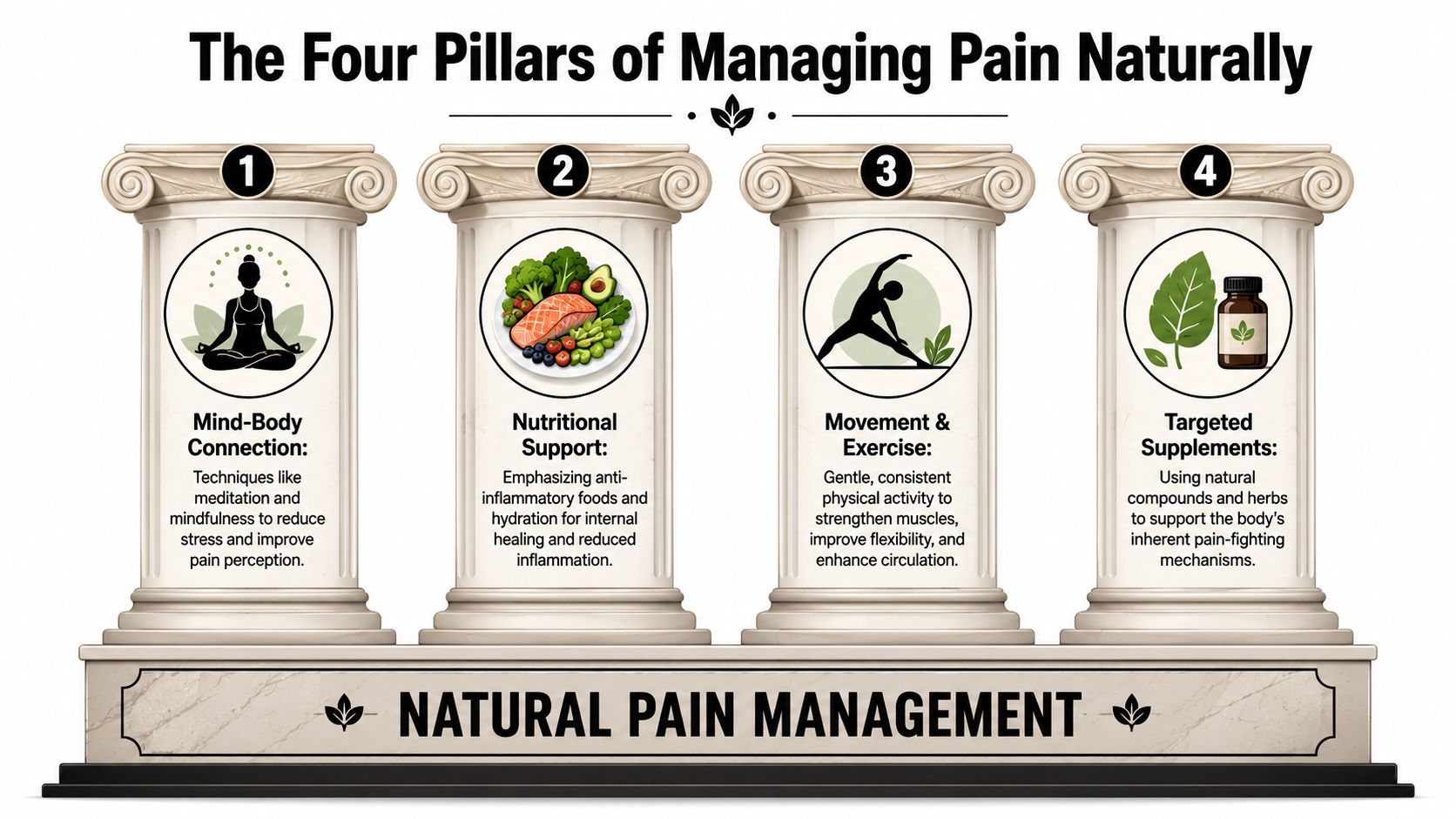
Why pain rarely has one driver
Think of pain management like stabilizing a table with four legs. If one leg is missing, the table wobbles. If two are weak, everything on top feels unstable.
The same pattern shows up with natural pain relief:
Anti-inflammatory lifestyle helps reduce internal conditions that keep tissues irritated.
Restorative movement prevents the body from stiffening, guarding, and losing function.
Mind-body balance lowers the stress response that can amplify pain perception.
Targeted botanical support can add focused help when the basics are already in place.
How the pillars work together
If someone eats well but sleeps poorly, pain often stays louder than expected. If someone takes supplements but avoids movement out of fear, stiffness and weakness usually keep feeding the cycle. If someone stretches every day but lives in a constant state of stress, their muscles may never fully let go.
That's why I prefer systems over hero ingredients. Sleep improves tissue recovery. Better food choices reduce some inflammatory burden. Gentle movement improves circulation and joint confidence. Stress regulation lowers the volume on the alarm system. Targeted supplements can support the process, but they shouldn't be expected to carry it alone.
A short mind-body routine can make the rest of the plan work better. If stress is one of your amplifiers, this piece on ashwagandha for stress and anxiety is a useful companion read.
Later in the day, this kind of movement-focused guidance can help reinforce the message that the body often needs steady input, not heroic effort.
Practical rule: Don't ask one tool to do the work of four. Supplements can't replace sleep, stretching won't undo a highly inflammatory routine, and meditation won't fix a knee that needs proper loading.
Your Anti-Inflammatory Diet and Movement Plan
The most useful diet and movement plan is the one you can repeat when life gets busy. It doesn't need to be extreme. It needs to reduce friction, lower flare triggers, and rebuild trust in your body.
What to change on your plate first
Start with subtraction before complication. If your meals are built around ultra-processed foods, heavy fried foods, or sugary snacks that crowd out nutrient-dense basics, your body has to manage more metabolic stress while it's already trying to recover. That doesn't mean every ache comes from diet. It means food can either support recovery or make it harder.
Focus on simple upgrades:
Build meals around whole foods: Vegetables, fruit, legumes, nuts, fish, eggs, and minimally processed proteins give the body raw material for repair.
Choose fats that support recovery: Fatty fish, olive oil, nuts, and seeds are generally more useful than a steady stream of heavily processed fats.
Hydrate consistently: Muscles and connective tissue don't like dehydration. People often notice more cramping, fatigue, or stiffness when fluid intake is poor.
Use strategic swaps: Try berries instead of dessert most nights, olive oil instead of heavily processed dressings, and a protein-rich breakfast instead of a pastry and coffee crash.
If joint stiffness is part of your picture, this overview of functional nutrition trends for joint health and turmeric's role in anti-inflammatory diets connects the food side with ingredient support.
Food doesn't have to be perfect to help pain. It just has to stop working against you three times a day.
A good rule is to look for meals that leave you steady rather than swollen, foggy, or exhausted. That kind of feedback matters. Your body usually tells you whether a pattern supports recovery.
How to move when movement hurts
The worst advice for chronic pain is often hidden inside tough-sounding slogans. “Push through it” works for very few pain problems. So does complete rest. An intermediate approach often proves more effective.
Movement helps because it lubricates joints, improves circulation, reduces guarding, and reminds the nervous system that not every sensation is a threat. The key is dose. Too much, too fast, too soon often creates a flare. Too little leads to stiffness and weakness.
Here's a better starting framework:
Begin below your flare threshold
If ten minutes of walking leaves you miserable for the rest of the day, start with less. Five easy minutes done consistently beats a big effort followed by a setback.Pick rhythmic, low-threat movement
Walking, gentle yoga, mobility work, easy cycling, and light stretching are often easier to tolerate than high-impact training during a flare.Use the next-day test
Some soreness is normal. A large spike in pain the next morning usually means the dose was too high.Train frequency before intensity
The body tends to respond better to regular input than to occasional heroic sessions.
For stiff backs and hips, I often tell people to think of movement like oiling a hinge. You're not trying to force it open. You're trying to restore smooth motion gradually.
A short daily template often works better than a formal workout:
Morning reset: Easy spinal mobility, ankle circles, shoulder rolls, and a few minutes of walking.
Midday break: Stand up, stretch hip flexors, and walk briefly instead of sitting for another hour.
Evening downshift: Gentle stretching, slower breathing, or a warm shower before bed.
What usually doesn't work
Some patterns look productive but backfire:
All-or-nothing plans: Strict diets and punishing exercise routines rarely survive a pain flare.
Bed rest for too long: Short rest can help an acute aggravation. Ongoing inactivity usually feeds stiffness.
Changing everything at once: If you can't tell what helped, you can't build a repeatable plan.
The body responds best to steady, boring consistency. That's not exciting, but it's reliable.
Evidence-Based Supplements for Joint and Body Comfort
Supplements can be useful in natural pain relief, but only when they're chosen for a reason. A bottle with a leaf on the label isn't enough. You want ingredients with a plausible mechanism, realistic use cases, and a form the body can absorb.
What the strongest supplement evidence points to
The clearest evidence in the data provided here centers on turmeric extract standardized for curcuminoids. A 2021 meta-analysis found that standardized turmeric extract at 1,000 to 1,500 mg daily was as effective as NSAIDs for knee osteoarthritis pain, with significantly fewer gastrointestinal side effects. The same evidence also noted that curcumin's usefulness depends heavily on absorption, and that combining it with piperine from black pepper can increase absorption by up to 2,000%.
That detail matters. Curcumin is powerful on paper because it affects inflammatory pathways, including NF-κB activity and enzymes such as COX-2 and MMP-3. But if it isn't absorbed well, the body can't make much use of it. This is why formulas that pair turmeric with black pepper extract are common.
If you want a deeper ingredient-specific breakdown, this article on how turmeric curcumin helps with arthritis and joint pain is worth reading.
How these ingredients can complement each other
Turmeric gets most of the attention, but multi-ingredient formulas often aim at different pain inputs at once.
Ginger is commonly used when people want extra support around inflammatory discomfort and digestive tolerance. It's often paired with turmeric because the two sit in a similar category of botanical support, though they aren't interchangeable for every person.
Bromelain is an enzyme rather than an herb. In practice, it's usually discussed for tissue recovery and swelling-related discomfort. It makes more sense as part of a broader support plan than as a standalone answer.
Ashwagandha belongs in the conversation for a different reason. Pain isn't only mechanical. Poor stress resilience and poor sleep can turn up the body's alarm system, tighten muscles, worsen recovery, and lower pain tolerance. An adaptogenic ingredient won't act like a direct painkiller, but it may help when tension, stress load, and restless sleep are part of the cycle.
That's why some combination products try to support more than joints alone. River of Life Capsules combine turmeric extract with BioPerine black pepper, alongside ashwagandha root, ginger, and bromelain. That doesn't make it right for everyone. It does make the design logic easy to understand: one formula aimed at inflammation, stress resilience, and day-to-day body comfort.
The best supplement plan matches the reason your pain sticks around. Inflamed joints, stress tension, poor sleep, and post-activity soreness don't always respond to the same tool.
Key Natural Supplements for Pain and Inflammation
Supplement | Primary Mechanism | Best For... | Evidence Level |
|---|---|---|---|
Turmeric extract with piperine | Supports inflammatory pathway regulation and improves curcumin absorption | Joint discomfort, knee osteoarthritis patterns, people seeking an NSAID-adjacent botanical option | Strongest specific evidence in this article |
Ginger | Botanical support for inflammatory discomfort | General body aches, digestive-sensitive users who want broader herbal support | Traditional and supportive use |
Bromelain | Enzyme support for tissue comfort and recovery | Post-activity soreness, swelling-related discomfort | Supportive use |
Ashwagandha | Stress-response support that may indirectly help pain tolerance and recovery | Stress-linked tension, poor sleep, wired-but-tired patterns | Indirect support |
What to look for on the label
Before buying any pain-support supplement, check for these basics:
Standardization: With turmeric, the active compounds matter. “Turmeric” alone can mean many different strengths.
Absorption support: Piperine or a phospholipid delivery system makes a practical difference for curcumin.
Transparent ingredient list: You should be able to tell what's in the formula and why.
A role in your plan: If the product doesn't match your symptoms or routine, it's probably not the right pick.
What doesn't work well is supplement hopping. Taking one product for four days, then another for three, then stacking several at once usually creates confusion, not clarity.
The Essential Guide to Supplement Safety
Most supplement articles get this wrong. They talk about benefits, then end with a vague reminder to “ask your doctor.” That's too thin to be useful.
A Cleveland Clinic overview of natural pain relief highlights an important gap: herbs may help, but they need to be checked against current medications because ingredients such as turmeric can interact with common drugs, including NSAIDs and anticoagulants. That's the part people skip, and it's where avoidable problems happen.
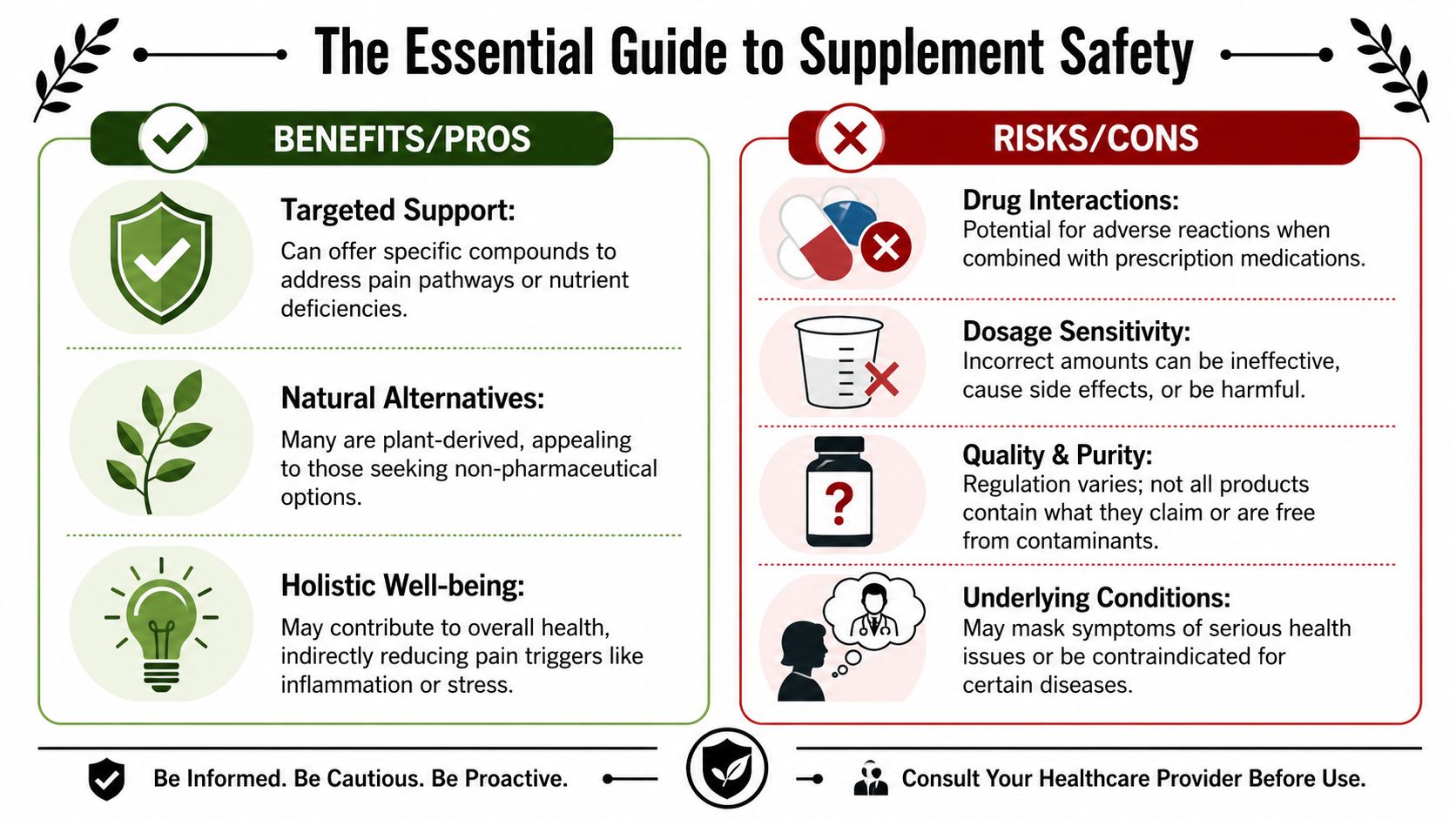
Natural does not mean risk-free
Natural pain relief still involves chemistry. Turmeric, ginger, magnesium, CBD, capsaicin, and other common options affect real pathways in the body. That's why they can help. It's also why they can clash with medications, procedures, or medical conditions.
Pay special attention if you take medication that affects bleeding or if you use NSAIDs regularly. Some herbs may not be a clean “either-or” substitute. In some cases, they make more sense as an adjunct, and in other cases they may not fit at all.
A few practical cautions matter more than trendy claims:
Medication overlap: If you take prescription medication, don't assume an herb sits outside that system.
Condition-specific risk: Gallbladder issues, digestive sensitivity, or a history of medication reactions can change what's appropriate.
Life stage matters: Pregnancy, breastfeeding, and upcoming procedures call for extra caution.
More is not better: A higher dose can increase side effects without improving results.
Safety check: Bring the bottle, the ingredient panel, and your medication list together. If you can't review those three things side by side, you're not ready to start.
A practical safety checklist
Use this before starting any supplement for pain:
List every medication and supplement you already take
Include over-the-counter pain relievers, sleep aids, and “only as needed” products.Match the supplement to the symptom
Don't take a stress-focused product for a clearly mechanical injury and expect direct relief.Start one change at a time
If you begin three things together, you won't know what helped or what caused a reaction.Watch for stomach, skin, sleep, or bruising changes
Side effects don't always arrive dramatically. Sometimes they show up as subtle intolerance.Use supplements as support, not camouflage
If pain is worsening, don't use natural products to cover a problem that needs evaluation.
Quality also matters. Two labels can say “turmeric” and behave very differently if one uses a meaningful extract with absorption support and the other does not. The same caution applies to purity and manufacturing quality. A cheap product with unclear sourcing can create uncertainty before you ever get to the question of efficacy.
When to Partner with Your Doctor for Pain Relief
Natural pain relief is most useful when it's part of a coordinated plan, not a private experiment you run in the dark. A clinician can help rule out structural problems, inflammatory conditions, nerve involvement, medication conflicts, and patterns that need more than self-care.
Signs you should not self-manage
Get medical evaluation promptly if pain comes with warning signs such as fever, unexplained weight loss, new numbness, marked weakness, loss of bowel or bladder control, chest pain, major swelling, or pain after a significant injury. The same goes for pain that keeps progressing, repeatedly wakes you from sleep, or changes quickly without a clear reason.
If you're relying on larger and larger amounts of over-the-counter medication just to get through the day, that's also a sign the plan needs review. Persistent pain deserves diagnosis, not just symptom management.
If pain keeps taking function away from you, don't keep negotiating with it alone.
How to bring supplements into the conversation
You don't need to walk into an appointment apologizing for wanting natural options. Bring useful information instead.
This is what helps a visit go well:
State the pattern clearly: Where the pain is, how long it's been going on, what worsens it, and what eases it.
Bring a full list: Include supplements, pain relievers, sleep products, and anything you use intermittently.
Describe your goal: Better sleep, fewer flares, easier walking, less stiffness in the morning. Specific goals lead to better plans.
Ask integration questions: “Is this safe with my current medications?” and “Should this be adjunctive or avoided?” are better questions than “Is natural pain relief good?”
That last point matters. Sometimes the best answer is a blend of approaches. A person may need physical therapy, better sleep habits, a targeted supplement, and a medication review. Another may need imaging or a specialist referral before trying anything else. Partnership keeps guesswork from turning into delay.
If you want a simple starting point, River of Life offers educational resources and a capsule formula built around turmeric extract with BioPerine, plus ashwagandha, ginger, and bromelain. Use it the way any thoughtful practitioner would recommend using a supplement. As one option within a broader plan that includes movement, sleep, food quality, and proper review of medication interactions.
Prepared with Outrank tool