

Supplements Longevity: A Practical Evidence Guide

Most advice about longevity supplements starts with the wrong question. People ask which capsule will make them live longer, as if aging were a single lock and one pill were the key.
The human evidence doesn't support that story. Recent reviews note that no supplement has been shown in a large human clinical trial to extend lifespan, and most research measures shorter-term biomarkers or functional outcomes instead of years added to life, as summarized in this review of longevity supplement evidence. That doesn't make supplements useless. It means you need a better question.
A smarter question is this: what measurable part of aging does a given compound improve, in which people, and under what conditions? When you use that lens, the noise drops. You stop chasing anti-aging slogans and start looking for specifics like sleep quality, stress resilience, inflammatory markers, mobility, or recovery.
Table of Contents
What the Human Evidence Actually Shows for Longevity Supplements
Mapping River of Life Ingredients to Longevity-Relevant Pathways
A Practical Framework for Choosing and Using Longevity Supplements
Why the Longevity Pill Question Misses the Point
A long life is a blunt scorecard. What usually matters day to day is whether you can sleep well, think clearly, climb stairs, recover from exercise, and stay independent.
That is why the better question is narrower. Lifespan counts total years. Healthspan counts functional years.
A supplement can help one part of healthspan without proving anything about total lifespan. That may sound less exciting, but it is a more useful way to judge real products. If magnesium improves sleep quality in a person who is low in magnesium, that matters. If omega-3s lower triglycerides or modestly reduce inflammatory markers in the right group, that matters too. Those are concrete outcomes. They are easier to measure, easier to compare, and more relevant to everyday decisions than a vague promise about "anti-aging."
The better target is function
Home maintenance works as a good comparison. Replacing a worn-out water heater will not make the house last forever. It does prevent cold showers and water damage. Supplements often work the same way. They may improve a specific system, such as sleep continuity, muscle function, or nutrient status, while leaving the much bigger question of lifespan unanswered.
That mismatch is where marketing gets slippery. Labels often speak in grand terms, while human trials usually test narrower endpoints such as blood markers, symptom scores, exercise recovery, or physical performance. A claim becomes much easier to judge once you ask, "What exactly is supposed to change?"
Practical rule: If a supplement cannot name a measurable outcome, the claim is too vague to help you choose.
What a useful evaluation looks like
I use four filters when teaching this topic.
Mechanism: Which aging-related pathway is the compound supposed to affect?
Human outcome: Has it improved something measurable in people, rather than only in cells or animals?
Magnitude: Is the change large enough to matter in real life?
Fit: Does the evidence apply to your age, diet, symptoms, lab values, and medications?
The last filter gets ignored far too often. Supplement effects are rarely uniform. A person with low vitamin D, low magnesium intake, high triglycerides, poor sleep, or heavy training stress may respond differently from a healthy adult with none of those issues. Reviews of targeted supplementation repeatedly find that baseline status, age, adherence, and study population shape the result, as discussed in this Frontiers review on targeted supplementation and heterogeneous response.
Bioavailability matters too. A capsule only helps if the body can absorb and use what is inside. Curcumin is the classic example. It has interesting mechanisms on paper, but plain curcumin is absorbed poorly, so formulation changes can matter as much as the ingredient name on the label. The same logic applies across the category. Two products can list the same compound and produce different blood levels or different results.
So the useful question is specific. Which outcome are you trying to move, in what kind of person, and does this form and dose have human evidence behind it? That question will get you much closer to reality than asking for a single longevity pill.
The Core Biology of Aging and Where Supplements Intervene
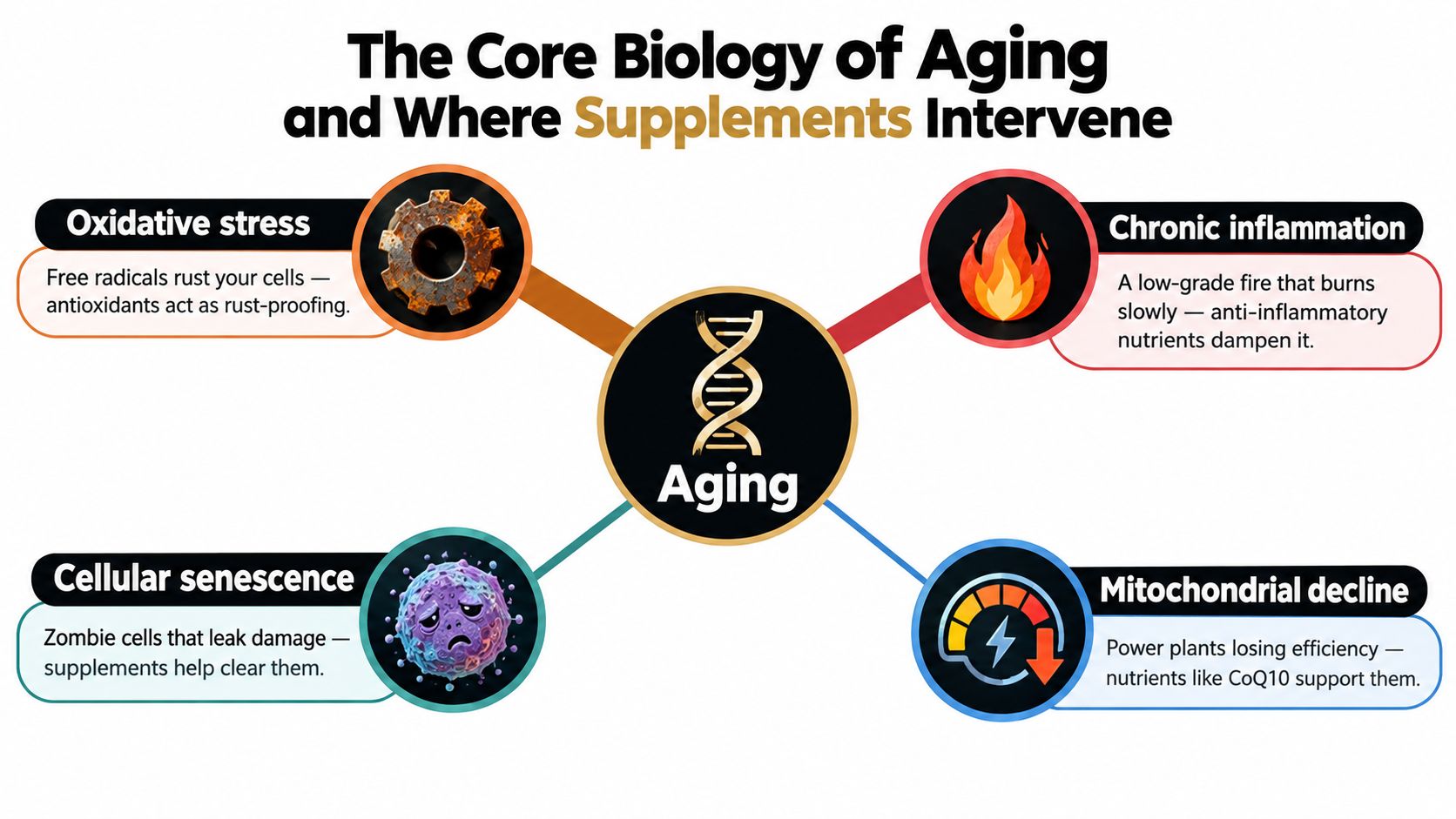
Aging isn't one process. It's more like a neighborhood with several problems happening at once. Some houses are rusting. Some have smoke damage. Some have failing batteries. Some have abandoned units leaking trouble into nearby buildings.
Oxidative stress and inflammation
Oxidative stress is the rust problem. Cells generate reactive byproducts as part of normal life, and those byproducts can damage DNA, fats, and proteins. A biomarker some readers may have seen is 8-OHdG, which reflects oxidative DNA damage. Antioxidant-oriented compounds try to reduce that burden, though lower oxidation on paper doesn't automatically mean better long-term aging.
Chronic inflammation is the slow-burn fire. It's not the dramatic inflammation of an acute infection. It's the low-grade, persistent kind that can wear down tissues over time. A common marker here is hs-CRP. Curcuminoids and omega-3s often get attention because they aim at this pathway.
NAD decline and cellular senescence
NAD biology is the battery problem. NAD helps cells handle energy transfer and repair work. Blood NAD levels are one of the easier markers people hear about. Compounds like NMN and NR are popular because they try to support this pathway, but improving a battery reading isn't the same as proving better long-term function.
Cellular senescence is the zombie-cell problem. These are cells that stop dividing normally but don't leave. They can release signals that irritate neighboring tissue. A biomarker discussed in aging research is p16INK4a. Senolytic compounds are marketed around this idea, though the human evidence remains early.
Aging is multifactorial. If one supplement targets one pathway, it may still leave several others untouched.
Why this matters for stack design
People get tripped up here. They hear one strong mechanism and assume they've found the answer. But aging doesn't care about your favorite pathway. If sleep is poor, training is inconsistent, inflammation is high, and recovery is weak, a single capsule aimed at one node won't solve the larger pattern.
A sensible stack, if you use one at all, should match the problem you're trying to solve. Someone focused on stress and sleep may look at different compounds than someone focused on deficiency correction or inflammatory discomfort. The biology pushes you away from miracle-pill thinking and toward targeted use.
What the Human Evidence Actually Shows for Longevity Supplements
The popular question is too blunt. Asking which supplement helps you live longer is like asking which tool builds a house. A hammer matters, but only for nails. Human studies on supplements work the same way. The useful question is narrower: which measurable outcome changes, in which people, and by how much?
A good reality check comes from population data. In a U.S. cohort with a median follow-up of 6.1 years, researchers recorded 3,613 total deaths, including 945 cardiovascular deaths and 805 cancer deaths, and found that ever-use of dietary supplements was not associated with mortality benefits among adults. A separate European follow-up also found no broad survival advantage, and among smokers, supplement use was linked with higher all-cause mortality risk in some analyses, according to this mortality analysis of dietary supplement use.
That does not mean every supplement is useless. It means the category "supplements" is too wide to treat like one intervention.
Human evidence, sorted by outcome
Supplement | Best human evidence | What seems to move | What keeps the claim limited |
|---|---|---|---|
Ashwagandha | Modest | Stress, sleep quality, perceived recovery in some trials | Benefits are outcome-specific, trial sizes are usually small, and lifespan effects have not been shown |
Curcumin | Modest but highly formulation-dependent | Some inflammation-related and comfort outcomes in selected contexts | Poor absorption is a major constraint, so the label dose often tells you less than the delivery system |
NMN and NR | Early | NAD-related biomarkers and some metabolic measures | Biomarker movement is not the same as proven gains in function or survival |
Vitamin D and calcium | Targeted | Bone-related outcomes, especially in people with low intake, deficiency, or higher fracture risk | Broad anti-aging claims do not fit the evidence |
Broad supplement use | Weak for longevity | No reliable lifespan benefit as a general habit | "Uses supplements" is not a meaningful exposure by itself |
The curcumin row is a good example of why bioavailability matters. A person may swallow 2 grams and absorb very little, which is a bit like pouring water onto dry soil that has turned hard. The amount on the package looks large, but only a small fraction may get where it needs to go. In one human study, 2 g curcumin alone produced undetectable or very low serum levels, while adding 20 mg piperine increased bioavailability by 2000%, yet a later critical reappraisal found unconjugated curcumin plasma levels remained below 2 nM in most tested high-dose curcumin-plus-piperine products, as described in this curcumin bioavailability review.
Ashwagandha shows a different pattern. The signal is less about aging itself and more about inputs that shape healthspan, especially stress and sleep. Human randomized trials summarized earlier reported better sleep quality with 250 mg and 600 mg root extract versus placebo, and another trial found final sleep scores of 58.4 ± 12.4 versus 48.2 ± 15.0 for placebo, based on the review cited earlier. That does not prove a longer life. It does suggest a plausible benefit for people whose weak point is stress-heavy, poor-quality sleep.
NMN and NR often create the most confusion. Raising an NAD-related marker can be interesting, but a marker is a proxy, not the finish line. If your car's dashboard shows a fuller battery, that is useful information. It still does not prove the engine runs better over years of driving.
Subgroup effects matter here. Bone-support supplements make more sense in older adults with low intake, deficiency, or high fracture risk than in healthy younger adults looking for a general anti-aging pill. The same logic applies across the category. A compound can be helpful for a narrow problem and still be a poor choice for broad longevity goals.
If you want a more consumer-facing overview of compounds with human research behind them, River of Life has a related explainer on supplements backed by science.
The pattern across this literature is less glamorous than the marketing. Supplements rarely act like master switches for aging. They act more like small levers. The practical job is to ask which lever, which outcome, which person, and whether the form and dose are even capable of producing that effect in humans.
Healthspan Outcomes Versus Lifespan Claims
A headline about longevity usually points your mind to birthdays. Research often points somewhere else.
A person can sleep better, recover faster, or move with less discomfort and still show no proven increase in lifespan. That's not failure. It's a category mistake to expect every useful intervention to prove life extension.
Two kinds of evidence that people mix up
Biomarker and function studies ask questions like these:
Did sleep improve?
Did stress scores drop?
Did mobility or comfort improve?
Did an inflammation-related marker move?
Lifespan evidence asks a harder question: did people die later, not just feel or function better for a period of time?
Those are different standards. A supplement can clear the first bar and miss the second.
Better sleep, steadier training, and less pain can matter a lot even if no one can claim extra years from the product.
Comparison table
Compound | Healthspan Endpoint Strength | Lifespan Evidence Quality |
|---|---|---|
Ashwagandha | Moderate for stress and sleep in human trials | Not established for lifespan |
Curcumin | Mixed to moderate, heavily dependent on formulation and target outcome | Not established for lifespan |
Vitamin D and calcium | More relevant in targeted deficiency or bone-health contexts | Not broad anti-aging proof |
NMN and NR | Early biomarker-oriented evidence | Not established for lifespan |
Generic supplement use | Weak as a useful healthspan category because it lumps unlike products together | Population data doesn't support a simple mortality benefit |
The key lesson is simple. Healthspan outcomes are not consolation prizes. They are often the most realistic and measurable targets available.
Prioritizing and Dosing Supplements for Real-World Use
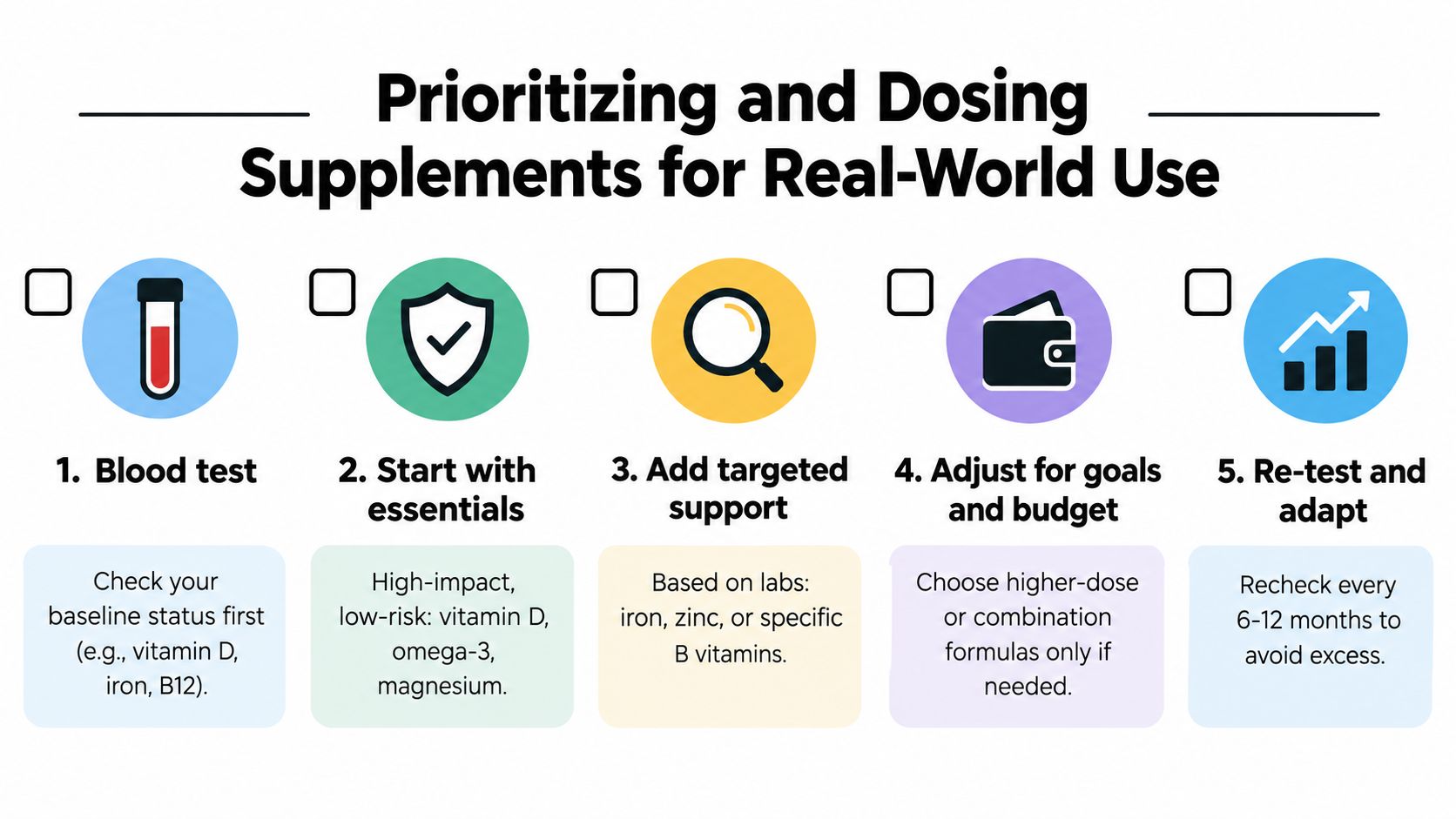
The practical question is not, "What should I take for longevity?" It is, "What outcome am I trying to move, and how will I know if it moved?"
That shift changes almost everything. A bottle can look impressive on a label and still do little for the result you care about. Real-world use starts with a target, then checks whether the compound can reach the body in a meaningful amount, and only then worries about stacking products.
Start with the outcome, not the ingredient
Use three buckets:
Deficiency correction
This is often the highest-yield category. Correcting a genuine shortfall is less exciting than buying a "longevity stack," but it is usually more grounded in physiology.A defined functional goal
Better sleep, lower perceived stress, fewer pain flare-ups, improved recovery, or bone support are all clearer than "anti-aging." Clearer targets are easier to judge.Biomarker experimentation
This includes many NAD-related products. That does not make them pointless. It means you should treat them like an experiment, not like established life-extension therapy.
If you are unsure why one form works differently from another, this guide to supplement bioavailability explains the absorption problem in plain language.
Dose on the label is not the same as dose your body can use
Absorption is the part people skip.
Curcumin is a good example. Two products can both say "curcumin" and still behave like two different compounds once swallowed. One may pass through with little systemic exposure. Another may use a delivery system that changes how much gets into circulation. In practice, form can matter as much as the ingredient name itself.
That is why "more milligrams" is a weak shortcut. A larger shovel is not helpful if the bucket has a hole in it.
Here is a short explainer worth watching before you buy complex stacks:
Build a stack like a small test, not a shopping spree
A useful plan is boring in the best way. Pick one goal. Choose one or two products that plausibly affect that goal. Use amounts that have been studied in humans when those ranges are available. Track something concrete for a few weeks.
For example, if the goal is sleep or stress support, ashwagandha has been studied in human trials at a range of standardized extract doses, including lower and moderate daily amounts. The lesson is not that everyone needs ashwagandha. The lesson is that dosing should come from the studied form and outcome, not from whatever number looks strongest on the front of the bottle.
A short checklist helps:
Match the supplement to one measurable goal: sleep latency, nighttime wake-ups, stress rating, joint comfort, recovery, or another outcome you can monitor.
Check the form, not just the ingredient name: magnesium, curcumin, and many botanicals can vary a lot by formulation.
Add products slowly: if you start four things at once, you learn almost nothing.
Watch for tradeoffs: cost, GI side effects, sedation, and interactions count against a stack even if the marketing sounds good.
Reassess after a defined trial period: no noticeable or measurable change means the supplement has not earned its place.
This is the part of longevity supplement use that gets missed. Prioritizing is less about building the biggest stack and more about removing guesswork. The best stack for real life is often the smallest one that produces a result you can notice, measure, and repeat.
How Supplements Fit With Sleep, Stress, Diet, and Movement
Supplements are amplifiers. They aren't replacements for the habits that shape aging day after day.
If sleep is fragmented, stress is chronic, movement is inconsistent, and diet quality is poor, even a well-chosen stack will have a low ceiling. That's why the most useful way to think about supplements longevity is as a support layer on top of four foundations: sleep, stress regulation, diet quality, and regular movement.
Where they can help
Take ashwagandha as an example. The most defensible longevity-adjacent benefit in humans isn't "anti-aging." It's support for sleep continuity and perceived stress, which can make it easier to recover, train consistently, and manage cardiometabolic risk over time.
That matters because supplements often work indirectly. Better sleep can improve exercise adherence. Lower perceived stress can reduce the friction that makes healthy routines fall apart. Less joint discomfort can make walking or strength training more realistic.
A practical sleep-focused example is discussed in River of Life's article on three ingredients often used for sleep support.
Use supplements to strengthen a good routine, not to rescue a failing one.
The hierarchy that keeps people honest
The order matters:
Sleep first: If your nights are chaotic, recovery suffers.
Movement next: Strength work and aerobic activity protect function in ways pills can't duplicate.
Diet after that: A nutrient-poor diet limits what supplements can realistically fix.
Supplements last: They can sharpen the edges, but they don't rebuild the whole system.
Many people win. Not from finding a mythical longevity pill, but from choosing a product that nudges one stubborn bottleneck enough to make the bigger lifestyle machine run better.
Mapping River of Life Ingredients to Longevity-Relevant Pathways
A multi-ingredient formula only makes sense if each ingredient maps to a clear outcome. Otherwise it's just a crowded label.
For a longevity-relevant lens, the useful question isn't whether a blend is anti-aging. It's whether its components target pathways tied to inflammation, stress response, recovery, or sleep in ways that matter for daily function.
Ingredient-by-ingredient view
Ingredient | Primary Mechanism | Evidence Strength | Studied Dose |
|---|---|---|---|
Turmeric extract with BioPerine | Curcumin targets inflammation-related pathways, while piperine may increase absorption depending on formulation | Moderate, but highly formulation-dependent in humans | Human bioavailability data cited for 2 g curcumin with 20 mg piperine, though later evidence shows mixed reliability across products |
Ashwagandha root | Stress-response and sleep support through HPA-axis-related effects | Moderate for stress and sleep support in human trials | Human trial evidence includes 250 mg and 600 mg root extract |
Ginger | Often used for recovery and inflammatory discomfort support | Plausible and commonly used, but not established here with verified dosing data | Qualitative only |
Bromelain | Proteolytic enzyme used for swelling and recovery-related support | Plausible and commonly used, but not established here with verified dosing data | Qualitative only |
What this means in practice
Among these ingredients, the clearest verified human support in the provided evidence sits with ashwagandha for stress and sleep, and curcumin for a formulation-sensitive anti-inflammatory strategy. Ginger and bromelain fit best as supportive ingredients aimed at comfort and recovery, but I wouldn't oversell them beyond that without stronger human endpoint data in this context.
This is also the one place a branded product can fit logically. River of Life Capsules combine turmeric extract with BioPerine, ashwagandha root, ginger, and bromelain in a single capsule. Framed conservatively, that makes it a pathway-based formula for people more interested in stress, sleep, recovery, and joint comfort than in sweeping lifespan claims.
A Practical Framework for Choosing and Using Longevity Supplements
Don't need a bigger supplement list. They need a better filter.
A five-step decision tree
First, name the outcome. Are you trying to improve sleep, reduce stress, support bone health, ease inflammatory discomfort, or correct a likely deficiency? If your true goal is "live longer," be honest that the evidence usually won't let a product promise that.
Second, audit the foundations. Sleep quality, movement, diet pattern, and stress load still do most of the heavy lifting. Supplements can support those systems, but they can't replace them.
Third, match the compound to the job. If the best human evidence is for sleep and stress, don't buy it for mitochondrial hype. If the best use case is subgroup-specific, don't assume universal benefit.
Fourth, check the form. With compounds like curcumin, the delivery system can matter almost as much as the ingredient name. A weak form at a flashy dose can underperform a better-designed product.
Fifth, watch safety and fit. Drug interactions matter, especially if you use anticoagulants, thyroid medication, or immunosuppressants. Reassess with your clinician when needed, and judge results by symptoms, labs, or function, not by marketing language.
Buy supplements the way you'd hire a contractor. Give them one defined job, inspect the work, and don't keep paying if the result isn't there.
River of Life offers a single capsule formula built around turmeric extract with BioPerine, ashwagandha root, ginger, and bromelain, aimed at outcomes that matter more than vague anti-aging promises: joint comfort, stress resilience, sleep quality, and recovery support. If that's the kind of targeted, healthspan-first approach you're looking for, visit River of Life and review the formula in the context of your own goals and routine.