

Brain Fog Relief That Actually Works and Lasts

By the time someone searches for brain fog relief, they're usually in the middle of it. It's 2:30 p.m. You've reread the same email three times. You opened a tab to do one task, then forgot which task it was. A simple word won't come. Your body feels heavy, your patience is thin, and your brain seems to be moving through syrup.
That feeling is real. It's also common enough that it shouldn't be brushed off as laziness or a lack of discipline. One large study of 25,796 app users found that 7,280 people, or 28.2%, reported brain fog, and a commentary on that dataset described it as affecting more than a quarter of adults in the general population in this journal review and commentary.
The mistake I see most often is people trying to force clarity with more stimulation. More caffeine. More tabs. More pressure. More “brain hacks.” For many people, that backfires because brain fog often isn't just a cognition problem. It's a sleep-stress-fatigue loop. If sleep is off, stress rises. If stress rises, sleep gets lighter and more fragmented. Fatigue follows, and then your attention, recall, and processing speed drop.
Relief usually works better in layers. First, calm the loop that's draining your brain. Then use a few same-day resets to steady yourself. Then build habits that keep the fog from coming back as often. Supplements can fit into that picture, but they usually work best when they're supporting a system, not replacing one.
Table of Contents
What Brain Fog Really Feels Like and Why It Happens
Brain fog isn't a formal diagnosis. It's a cluster of symptoms people use to describe mental cloudiness, slowed thinking, poor focus, word-finding trouble, forgetfulness, and that odd sense of not feeling mentally “online.” Some days it feels like distraction. Other days it feels like your brain is underpowered.

What people usually notice first
They don't describe brain fog in clinical terms. They describe moments.
You lose your train of thought halfway through a sentence. You read something and realize none of it stuck. You sit down to work, but your mind keeps sliding off the task. You know what you want to say, but the word won't arrive. By evening, you're not just mentally tired. You're irritated, discouraged, and often worried that something bigger is wrong.
That emotional layer matters because fog rarely stays in a neat “thinking” box. It changes how people move through the day. Tasks feel harder than they should. Small decisions take too long. Many people start blaming themselves when the better question is, “What is draining the system?”
Brain fog often feels cognitive, but the trigger is frequently physical, emotional, or both.
Why your brain feels slower
Several basic functions tend to dip when you're under strain. Attention gets jumpy. Working memory gets weaker, so holding information in mind becomes harder. Processing speed drops, which makes everything feel delayed.
Sleep debt is a common driver. So are stress, dehydration, under-fueling, illness recovery, and long stretches of sitting while breathing shallowly. In practice, these don't show up one at a time. They stack.
A person might sleep poorly, rush into the day under-caffeinated and under-hydrated, skip lunch, sit for hours, and then wonder why their brain won't cooperate by mid-afternoon. Another person might be weeks or months past an illness and still feel mentally flat because fatigue, sleep disruption, and mood strain are all feeding each other.
What helps now versus what helps over time
For immediate brain fog relief, the goal isn't to become brilliant in ten minutes. It's to reduce the load on the brain enough that it can function again. That usually means calming the nervous system, correcting obvious basics, and stopping the push-crash cycle.
Longer-term relief is different. That requires patterns. Better sleep timing. More stable energy. Smarter pacing. Less all-day stress activation. Better awareness of what reliably makes your fog worse.
Use this article like a filter. Don't try everything at once. Pick one or two likely drivers, test a small change, and notice what shifts in your focus, fatigue, mood, and stamina over several days.
Common Causes Behind Persistent Fog
Persistent fog usually has more than one cause. That's one reason one-size-fits-all fixes disappoint people. Brain fog isn't tied to a single condition or a single type of person. It's showing up across the general population and across major medical categories.
A 2025 expert review summarized that brain fog is reported in 15% to 40% of chronic pain patients, 68% of people with perimenopause, 65% with traumatic brain injury, and 96% with postural tachycardia syndrome, with high subjective cognitive symptom rates also reported in fibromyalgia, chronic fatigue syndrome, and systemic lupus erythematosus, according to this Frontiers review on brain fog across conditions. That broad spread is the point. Fog isn't a wellness buzzword. It's a cross-condition signal.
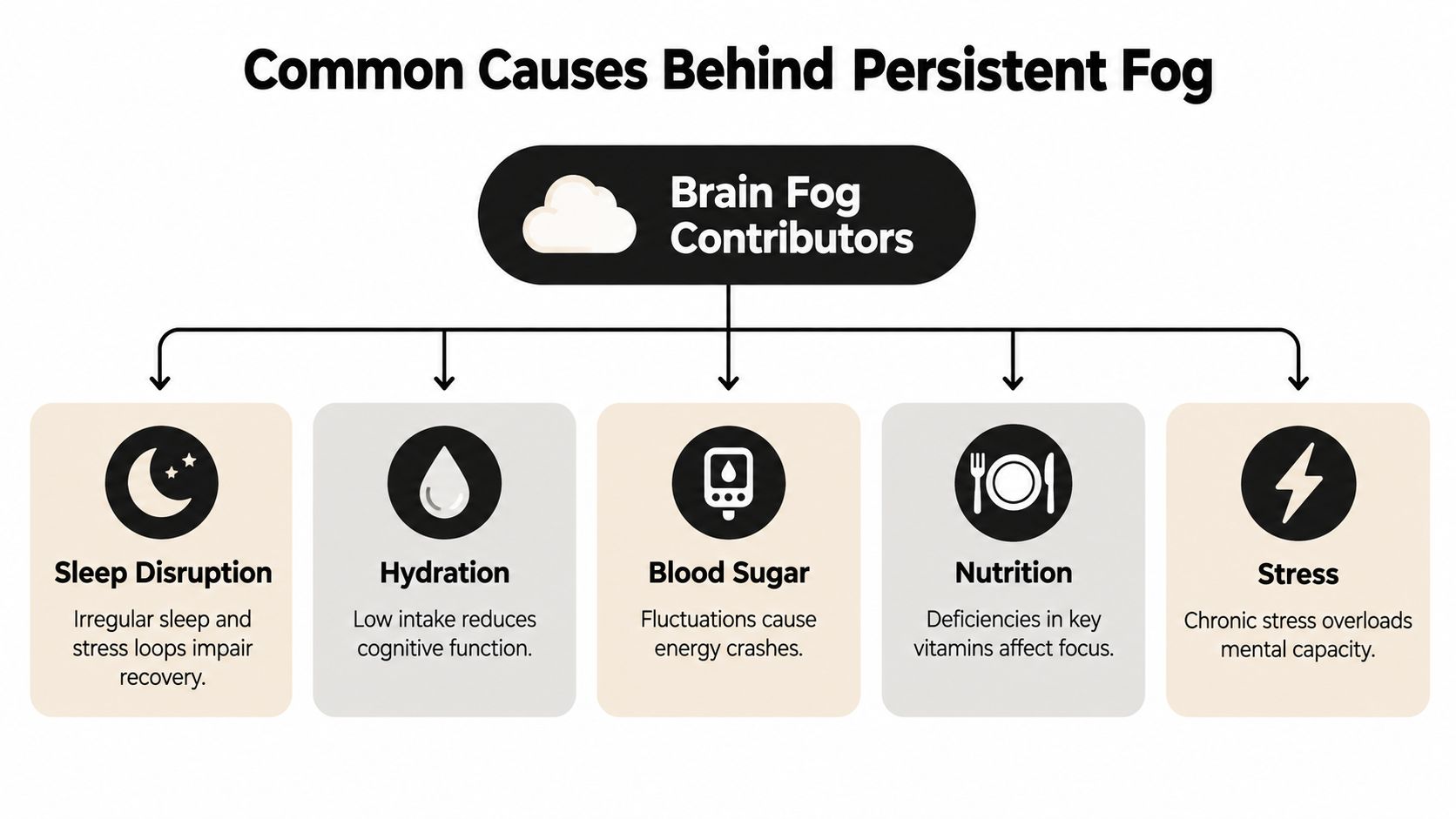
Sleep and stress usually travel together
The most common pattern I see is simple. People think they're dealing with poor focus, but they're really dealing with poor recovery.
A review found that sleep deficits are among the most significant triggers linked to brain fog, and a 2025 study reported a significant negative correlation between sleep quality and brain fog scores. A separate 14-day actigraphy study reported that higher perceived stress was associated with shorter sleep and longer sleep latency in this review of sleep, stress, and brain fog.
If this is your pattern, no amount of productivity pressure will fix it. You have to break the loop.
For a broader look at how daily strain affects recovery capacity, River of Life's article on stress and resilience is a useful companion read.
Everyday drains people underestimate
Not every cause is dramatic. Many are ordinary and cumulative.
Low hydration: Even mild under-hydration can make concentration feel brittle.
Blood sugar swings: Going too long without eating, then grabbing a fast carb heavy snack, can leave you mentally shaky and then flat.
Too much sitting: Hours in one position can lower alertness fast, especially when breathing gets shallow.
Medication effects: Antihistamines, sleep aids, some pain medications, and other prescriptions can leave people feeling dulled.
Hormonal shifts: Perimenopause, menstrual cycle changes, and thyroid issues can all show up as mental fuzziness before people connect the dots.
When fog follows illness or clusters with fatigue
Many people get stuck. They keep chasing cognition alone when the bigger issue is the fatigue burden under it.
A meta-analysis of long-COVID patients showed that people with brain fog had substantially worse cognition than controls, but they also had much higher fatigue and more depressive symptoms in this PubMed-indexed meta-analysis. That's a practical takeaway, not just a research point. If you're only trying to sharpen focus while ignoring fatigue and mood strain, you're treating the surface.
Self-audit: Ask yourself two questions. What reliably makes my fog worse within the same day? What makes it better by the next morning? Your top two answers usually point to your first real intervention.
Quick Brain Fog Relief You Can Try Today
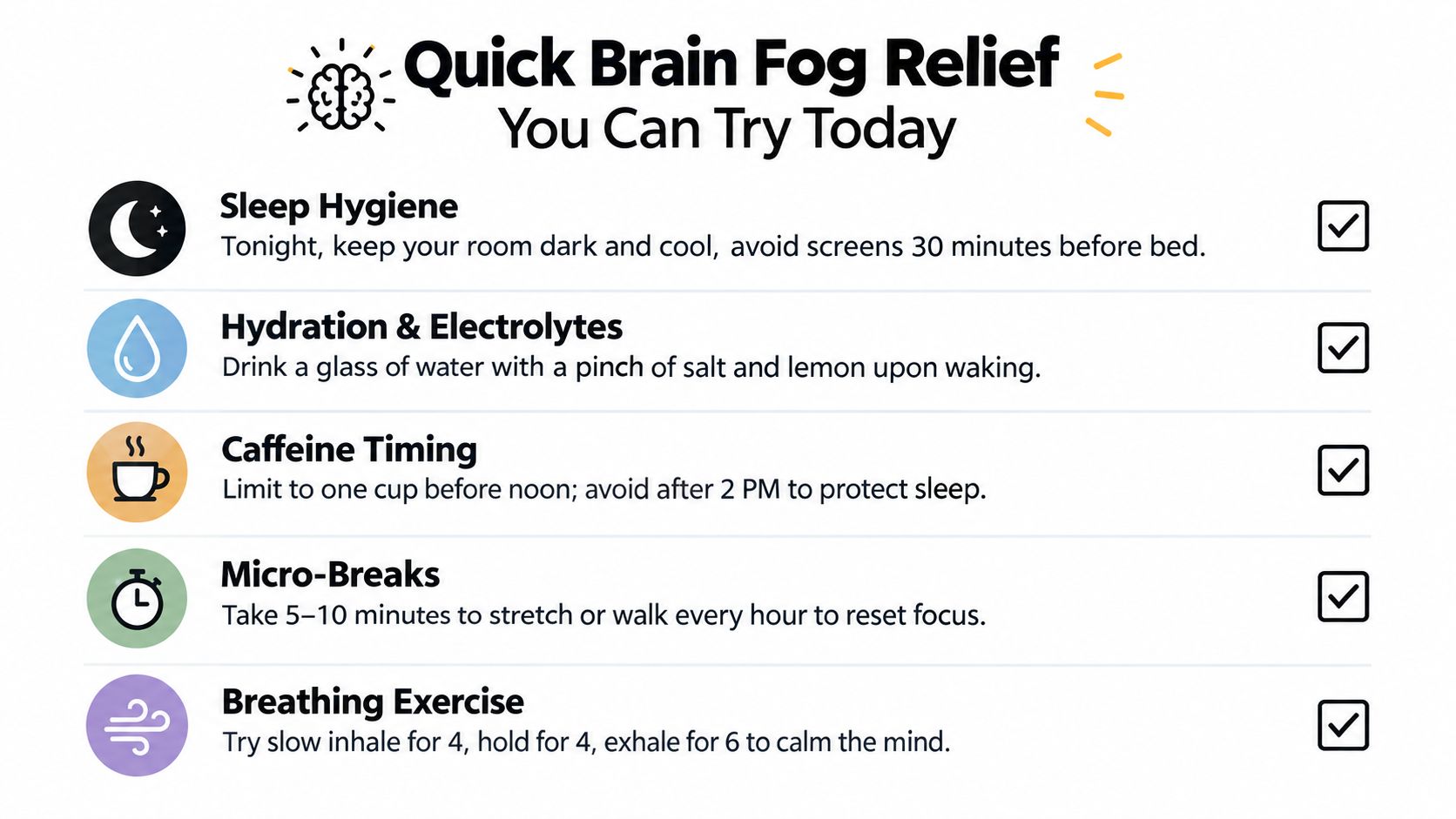
When the fog is heavy, you don't need a philosophy lesson. You need a reset that helps within the same day. These work best when you pair them, not when you treat them like magic buttons.
Reset your body before you judge your brain
Start with hydration. If you've had coffee but very little water, drink a full glass now. If you've been sweating, rushing, or waking up dry-mouthed, adding electrolytes can make more sense than plain water alone. Notice whether your headache, eye strain, or that “hollow” feeling improves within the next stretch of work.
Eat if you've gone too long without real fuel. Aim for a simple combination of protein, fiber, and carbohydrate instead of a sugar-heavy rescue snack that spikes and crashes you.
Then move. Not a hard workout. A brief walk, a few minutes of stairs, light mobility, or standing outside often helps more than trying to grind through another hour in the same chair.
Use caffeine carefully, not emotionally
Caffeine can help. It can also cover up the signal that your brain is under-recovered.
If you haven't had any yet, a moderate amount earlier in the day may improve alertness. If it's already late afternoon and you're tempted to “save” your concentration with another cup, pause. That's often the move that worsens the next night's sleep and keeps the loop going.
A better rule is to use caffeine early and intentionally, then stop using it as a compensation strategy once the day has tilted into fatigue.
Practical rule: If a reset doesn't improve your clarity at least a little, stop stacking stimulants. Shift to food, water, movement, light, or rest.
This short video gives a simple visual walkthrough of quick reset habits:
Try these five same-day tactics
Get bright light early if you can
Morning outdoor light helps anchor your body clock. If it's later in the day, even a few minutes outside can lift alertness better than staring at another screen.Take a focused breathing break
Try a slow inhale, a brief pause, then a longer exhale for two minutes. This helps when the fog feels tangled with tension, pressure, or racing thoughts.Shrink the task
Fog gets worse when the brain sees a giant demand and freezes. Reduce the next step to one visible action. Reply to one email. Outline three bullet points. Open one document only.Change your environment
Stand up. Clear the desk. Close unnecessary tabs. Put your phone in another room. A cluttered environment taxes attention.Protect tonight's sleep
The best brain fog relief sometimes starts before bed, not in the middle of the slump. Dim lights later in the evening, eat dinner at a reasonable time, and don't carry a stress spiral into bed through doom-scrolling.
What to track today is simple. Did your focus, fatigue, or mood improve after the reset? If focus improves only a little but fatigue drops a lot, that's still useful information.
Build Lasting Clarity With Daily Habits
Quick resets help you survive the day. Habits determine whether the same fog keeps returning. The shift that matters most is moving from random effort to a repeatable weekly rhythm.
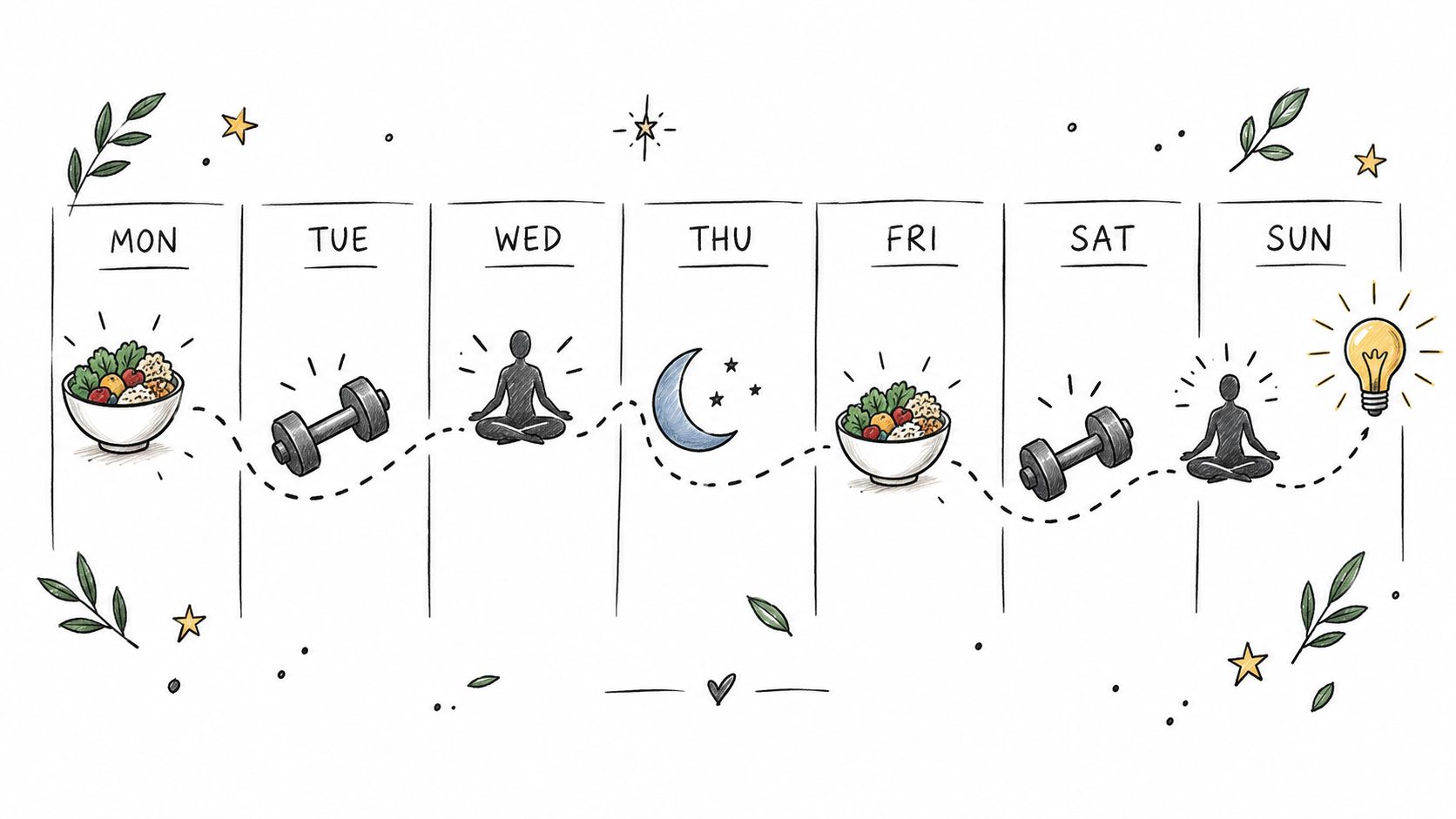
Build around anchors, not motivation
Many people do better with anchors than with ambitious plans. Anchors are the few actions you return to even when life is messy.
Good anchors for brain fog relief often include:
A stable wake time: This does more for sleep rhythm than people expect.
Regular meals: Not perfect meals. Regular ones.
Some daily movement: Walking counts.
A wind-down routine: Repeated cues help the brain exit work mode.
Short recovery pauses: A few real breaks beat one giant collapse at night.
If sleep is one of your main drivers, it helps to tighten the evening routine before adding fancy morning routines. River of Life's piece on three ingredients tied to sleep support may be useful if you're exploring that side of the picture.
A simple weekly rhythm that works
You don't need a biohacking spreadsheet. You need patterns your nervous system can trust.
Here is a practical weekly framework:
Habit area | What to aim for | What to watch for |
|---|---|---|
Sleep | Consistent bedtime and wake time, with a calm hour before bed | Falling asleep later after stressful evenings |
Food | Balanced meals that don't leave long gaps | Mid-afternoon crashes after skipped lunch |
Movement | Frequent walking and a few planned exercise sessions | Brain fog that worsens after overdoing it |
Stress | Brief daily downshifts such as breathing, journaling, or quiet time | Carrying work activation into the night |
Recovery | At least one lower-demand block in the week | Trying to “catch up” by pushing harder every day |
Pace energy if fatigue is high
This matters more than people think. If you're tired enough that activity sharply worsens your symptoms, “push through it” usually isn't the right lesson.
Pacing means doing enough to support function without provoking a bigger crash. For some people that means alternating focused work with short resets. For others it means reducing social, physical, and cognitive load on the same day instead of stacking them all together.
The people who improve fastest often aren't the people who push hardest. They're the people who stop draining themselves faster than they can recover.
Review your medications and recurring symptoms with a clinician if the fog is persistent. Sometimes the fix isn't a stronger routine. It's identifying a side effect, a sleep disorder, a nutrient issue, or a hormone-related pattern that needs direct attention.
A simple habit tracker can help. Use one line per day and note sleep quality, stress level, energy, fog severity, and one habit you completed. You're looking for patterns, not perfection.
Supplements for Brain Fog and How to Use Them Safely
Supplements can support brain fog relief, but they tend to work best after you've addressed the obvious drains. If sleep is chaotic, stress is constant, and meals are all over the place, a capsule won't reliably outperform those problems.
What supplements can and can't do
For some people, supplements are most useful when brain fog seems tied to stress load, poor recovery, or an inflammatory-feeling pattern after hard training or a rough stretch of life. They are less useful when the issue is untreated sleep apnea, a medication problem, thyroid dysfunction, or a nutrient deficiency that needs testing and targeted care.
One practical option in this category is River of Life Capsules, a vegan capsule formula that includes turmeric extract with BioPerine, ashwagandha root, ginger, and bromelain. The brand sells 60-capsule bottles, offers one-time purchase and subscription options, ships to more than 40 countries, and has a 30-day return policy for unopened bottles. If you want a product-specific overview, their article on a brain fog supplement approach explains how the formula is positioned.
Supplement ingredient rationale at a glance
Ingredient | Intended Support | Use Note |
|---|---|---|
Turmeric extract | Supports a healthy inflammatory response | Look for consistent daily use rather than random dosing |
BioPerine | Included to enhance turmeric absorption | Check compatibility if you take medications regularly |
Ashwagandha root | Often used for stress resilience and calmer recovery | Best discussed with a clinician if you have thyroid concerns or take prescription medications |
Ginger | Commonly used to support recovery and general wellness | May not be a fit for everyone, especially around certain medications |
Bromelain | Often included in recovery-focused blends | Use cautiously if you take medicines that affect bleeding risk |
Safe use matters more than hype
A few ground rules help:
Check interactions first: This matters if you take blood thinners, thyroid medication, sedating medications, or multiple prescriptions.
Use one new product at a time: If you start three things together, you won't know what helped or what caused a problem.
Give it a fair trial: Consistency tells you more than taking something only on bad days.
Stop if symptoms worsen: Upset stomach, headaches, agitation, or poor sleep are reasons to reassess.
The most common mistake is expecting a supplement to act like a stimulant. That's not usually the best use case. Think support, not rescue.
When to Seek Medical Care and What to Ask
Brain fog deserves medical attention when it is new, persistent, worsening, or out of proportion to your usual stress and sleep strain. It also deserves prompt evaluation when it comes with symptoms that suggest something more serious.
Red flags that shouldn't wait
Seek urgent medical care if brain fog comes with:
Sudden confusion
New weakness or numbness
Trouble speaking
Severe headache
Chest pain
Fainting
Head injury
Fever with worsening mental status
Those aren't “wellness” issues. They need clinical evaluation.
Common causes worth asking about
A major gap in public advice is treating brain fog like a standalone problem when it can reflect an underlying condition. Independent clinical guidance emphasizes that brain fog can reflect sleep apnea, hypothyroidism, or vitamin B12 deficiency, and that fixing the cause can improve cognition within weeks in this clinical guide on when brain fog needs workup.
If your fog is hanging on, ask your clinician to think beyond generic stress. Especially if you snore, wake unrefreshed, feel cold, have constipation, notice hair or skin changes, have numbness or tingling, or recently started a new medication.
Bring this checklist to the appointment
Don't show up and say only, “I feel off.” Bring a short record.
Symptom pattern: When did the fog start, and is it constant or episodic?
Sleep notes: Bedtime, wake time, nighttime waking, snoring, and whether you wake rested
Stress and mood: Anxiety, low mood, overwhelm, grief, or burnout
Fatigue pattern: Is the fog worst in the morning, after meals, after exertion, or late afternoon?
Medication and supplement list: Include over-the-counter products
Relevant history: Recent illness, hormonal changes, pain issues, concussion history
Ask direct questions. Could this be a sleep issue? Could a medication be contributing? Are thyroid or B12 issues worth checking? Is there anything about my symptoms that points to a neurological evaluation?
Brain fog relief works best when you stop fighting your brain and start reading the signals it's giving you. Sometimes the right next step is better sleep and pacing. Sometimes it's a medical workup. Knowing the difference saves people months of guessing.
If your brain fog tends to show up with stress, poor sleep, recovery strain, or that worn-down feeling that affects both body and mind, River of Life offers a single capsule formula built around turmeric extract with BioPerine, ashwagandha root, ginger, and bromelain. You can explore the formula, shipping options, and educational resources directly at River of Life.