

Supplements Backed by Science: What Works in 2026

You're standing in front of a shelf filled with turmeric, curcumin, ashwagandha, and “advanced” botanical blends. Two bottles look almost identical. Both mention clinical research. One costs $18, the other $48. You're trying to work out whether the difference reflects better evidence, better ingredients, or better packaging.
That confusion is understandable. “Supplements backed by science” doesn't mean every product works for everyone, or that one positive study proves a bottle will deliver a promised result. It means the ingredient has human evidence that can be examined for its study design, dose, population, outcome, and certainty.
This article uses that standard to evaluate turmeric curcumin, BioPerine, ashwagandha, ginger, and bromelain, including how a combined formula such as River of Life's capsule should be judged. The aim isn't to turn a complicated research field into a yes-or-no slogan. It's to give you a practical way to separate a plausible, appropriately formulated supplement from a label built mostly around marketing language.
Table of Contents
The Supplement Aisle Problem and Why Science Matters
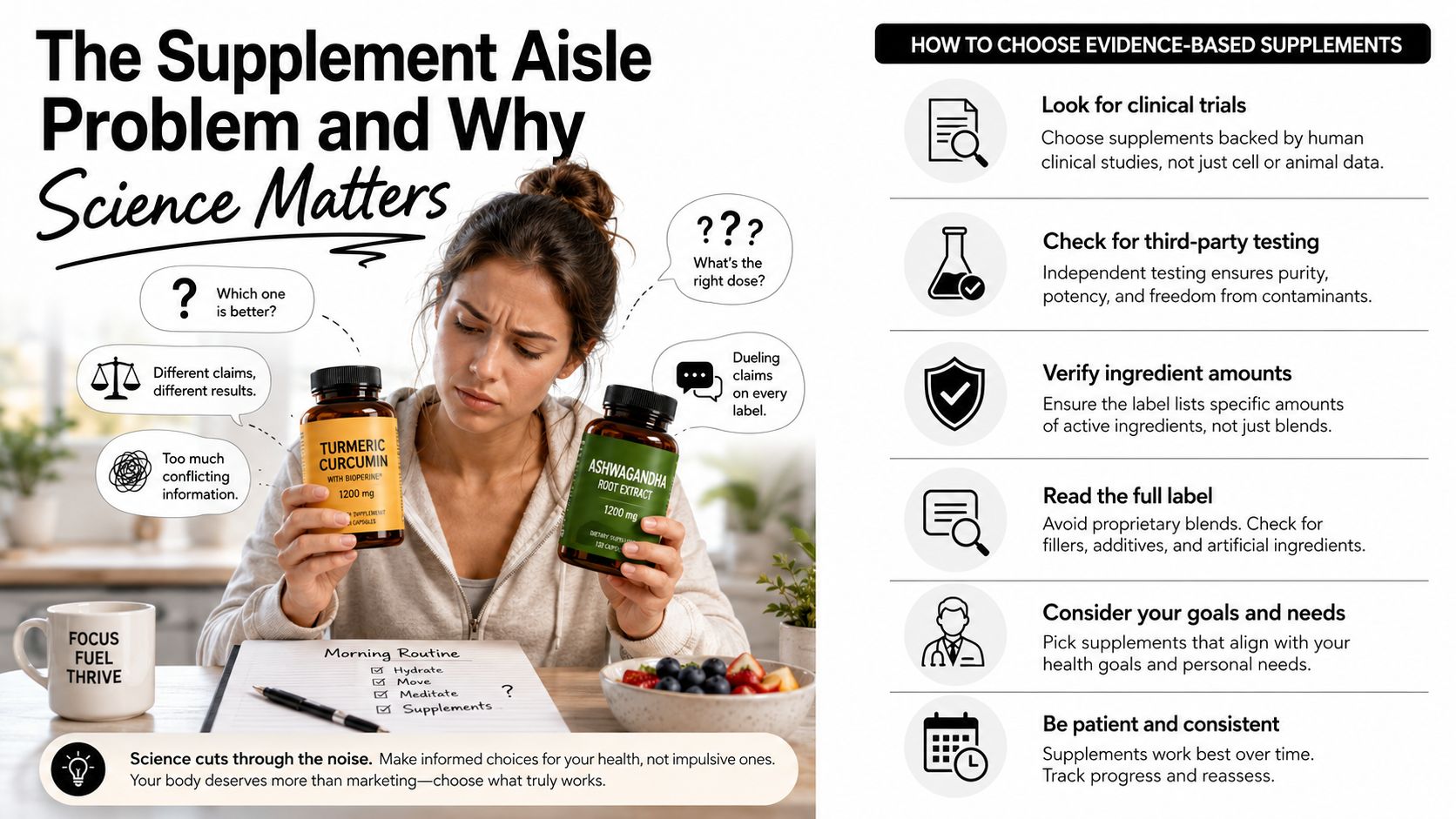
A shopper may begin with a simple goal, perhaps less joint discomfort or better sleep. She picks up a turmeric bottle, then an ashwagandha bottle. One label says “clinically studied.” Another says “doctor formulated.” A third promises a “science-backed” blend, but doesn't clearly state the amount of each active ingredient.
Those phrases can sound reassuring, but they don't answer the questions that matter most. Was the ingredient tested in people? Was the study randomized and controlled? Did researchers use the same extract and dose found in the bottle? Did the trial measure a meaningful outcome, or only a laboratory marker?
A working definition for evidence
A useful definition is deliberately narrow. A supplement is backed by science when a specific ingredient or formulation has credible human research supporting a defined outcome under identifiable conditions. The claim should match the evidence.
That means “curcumin may support joint comfort in some adults after repeated use” is a more defensible statement than “turmeric fixes inflammation.” Likewise, ashwagandha research may support gradual improvements in stress or sleep measures, but it shouldn't be presented as an instant sedative.
Practical rule: Treat “clinically studied” as an invitation to inspect the study, not as proof that the product works.
The four questions to ask
Use the same checklist for every bottle, including a stacked formula containing turmeric, ashwagandha, ginger, bromelain, and BioPerine:
Human testing: Were randomized controlled trials conducted in people?
Dose matching: Does the label provide an amount comparable to the studied preparation?
Outcome clarity: Did researchers measure pain, sleep, stress, or another defined result?
Product identity: Is the clinical ingredient the same extract, standardization, and delivery form in the bottle?
Price doesn't answer any of these questions. A more expensive product may offer clearer standardization, testing, or dosage, but it may also rely on premium positioning. A less expensive bottle may be appropriately formulated, or it may conceal a low active dose inside a proprietary blend.
The practical task is to move from the front label to the Supplement Facts panel, then from the panel to the research. That habit turns a persuasive claim into a testable question.
How Supplements Became Evidence-Based in the First Place
The modern evidence framework didn't appear because supplement marketing became more cautious. It developed through formal review infrastructure. The NIH Office of Dietary Supplements was created after the Dietary Supplement Health and Education Act of 1994, and in fiscal year 2001 it received a congressional mandate to evaluate supplement efficacy and safety through systematic reviews using the Agency for Healthcare Research and Quality's Evidence-based Practice Centers program, as described in this NIH overview of the Office of Dietary Supplements.
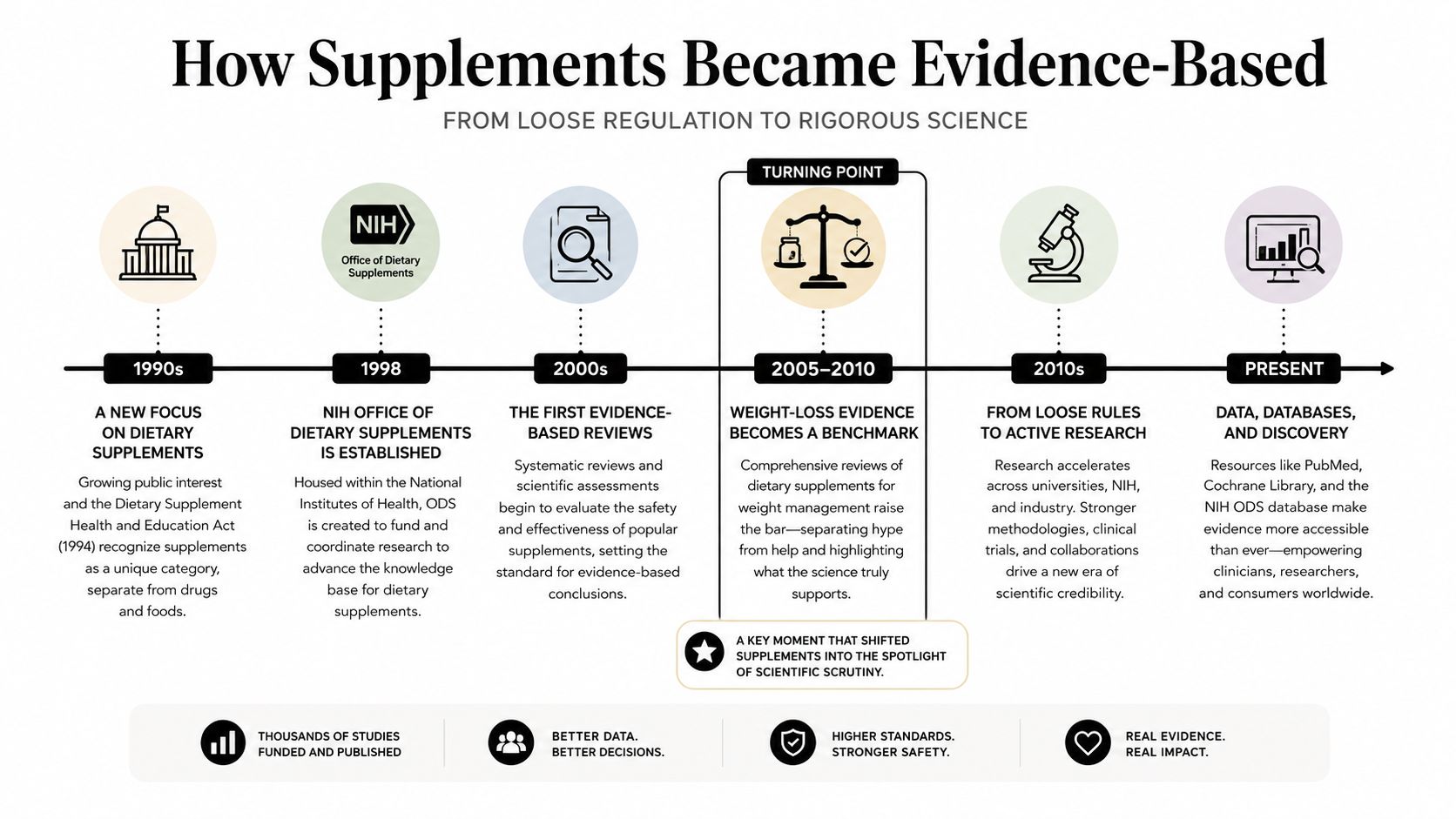
That history matters because “supplement” describes a marketplace category, not a guaranteed level of proof. A product can contain a familiar herb and still have little evidence for the specific dose, extract, or claim printed on its label. Formal review systems help distinguish the ingredient people recognize from the formulation researchers tested.
What systematic reviews add
A single trial can be informative, but it can also be small, short, poorly matched to the consumer, or inconsistent with other trials. Systematic reviews gather relevant studies, assess their limitations, and look for patterns across outcomes.
The weight-loss literature demonstrates why this distinction matters. In one review of dietary supplements for weight loss, only 16 included comparisons, or 31%, showed significant pre/post inter-group differences, and the authors concluded that the overall evidence was weak and didn't support strong, high-quality efficacy claims, according to the systematic review of dietary supplements for weight loss.
That finding doesn't mean every supplement is ineffective. It means broad category labels hide substantial variation. One ingredient may show a narrow benefit under specific conditions, while another may have only preliminary or conflicting evidence.
The consumer version of the research ladder
You don't need to perform a full academic review at the shelf. You do need to identify three things:
Study design quality: Was the research randomized, controlled, and appropriately blinded?
Effect size: Was the observed change meaningful, or merely statistically detectable?
Certainty: Do several well-conducted studies point in the same direction?
This ladder is more useful than a star rating, influencer recommendation, or front-label seal. It also explains why a formula can contain several plausible ingredients without proving that the combination itself has been tested as a complete product.
Reading Supplement Research Without Getting Fooled
A broad review of dietary supplements for human health found that 41.3% of results suggested potential benefit, but most of those findings had low or very low certainty. Only 26.7% supported efficacy with moderate to high certainty, while 17.3% found supplements ineffective and 10.7% were uncertain or conflicting, according to the review of dietary supplements for human health.
Those figures provide a useful mental model. “Potential benefit” is not the same as reliable efficacy. A claim can look promising while remaining too uncertain for confident consumer advice.
Four levels of evidence
Evidence Tier | What It Actually Supports | Turmeric-Curcumin Worked Example |
|---|---|---|
Systematic review or meta-analysis | Shows the overall pattern across multiple studies, while accounting for inconsistency and study quality | Several controlled trials suggest curcumin may support joint comfort, but the result still depends on formulation, dose, and population |
Randomized controlled trial | Tests whether a defined intervention outperforms a comparator in a selected group | A 12-week trial using 500 mg of curcuminoids with piperine can support a claim about that preparation and outcome, not every turmeric product |
Open-label or observational study | Identifies an association or early signal, but can't separate the supplement effect from expectation and other influences | People taking turmeric report better comfort, but the design can't establish that turmeric caused the change |
Mechanistic or animal research | Explains biological plausibility or generates hypotheses | Curcumin shows antioxidant activity in cells, but that alone doesn't demonstrate improved symptoms in humans |
A label reader should also look for common weaknesses. A single small study may produce an unstable result. A trial without a comparator can't show whether the change exceeded normal fluctuation or placebo response. Industry funding doesn't automatically invalidate research, but it makes independent replication especially important.
Other warning signs are vague outcomes, undisclosed doses, and claims that leap from a mechanism to a clinical promise. “Supports antioxidant pathways” and “reduces joint pain” aren't interchangeable statements.
For a practical example of how turmeric evidence is translated into consumer decisions, compare this guide to supplements for inflammation. The same ladder applies to BioPerine, ashwagandha, ginger, and bromelain. The ingredient name is only the starting point. The extract, amount, population, and measured outcome determine what the research can support.
Turmeric Curcumin and BioPerine What the Numbers Show
Curcumin illustrates a common supplement mistake: treating the amount swallowed as if it were the amount absorbed. Oral bioavailability depends on the chemical form, the delivery system, and whether the formula includes an absorption enhancer.
In a human pharmacokinetic study, adding piperine increased relative curcumin bioavailability by 154%, alongside a longer time to maximum concentration and lower clearance, as reported in this human study of curcumin and piperine pharmacokinetics. The frequently repeated 2,000% figure applies to early timepoints in healthy volunteers, not necessarily to total exposure over the entire measurement period.
Why BioPerine changes the label question
Piperine appears to increase exposure partly by inhibiting metabolic breakdown pathways such as glucuronidation. In plain language, the body may break down and clear curcumin differently when piperine is present.
That doesn't mean every product with black pepper delivers the same result. The label should identify the curcumin preparation, the piperine amount, and whether the product uses a standardized extract or another delivery system.
Formulation | Relative Bioavailability | Study Type | Typical Label Dose | Notes |
|---|---|---|---|---|
Curcumin alone | Baseline comparator in the pharmacokinetic study | Human pharmacokinetic research | Product-dependent | Exposure depends on the specific curcumin form |
Curcumin with piperine | 154% relative increase in the cited human study | Human pharmacokinetic research | Product-dependent | The result reflects the tested combination and study conditions |
Early-timepoint co-administration result | The often-cited 2,000% figure | Early plasma timepoint analysis | Product-dependent | It shouldn't be treated as a universal whole-day absorption increase |
Unstandardized turmeric powder | Not directly interchangeable with standardized curcumin extracts | Not equivalent to the cited comparison | Not equivalent | Curcuminoid content may be unclear |
Clinical evidence is more persuasive for some joint-comfort outcomes than for broad promises about cognition or cardiovascular health. A product that lists standardized curcuminoids is easier to compare with research than one that lists turmeric powder.
Readers using anticoagulants or other medicines that affect bleeding should ask a clinician or pharmacist before using concentrated turmeric, curcumin, or piperine products. Bioavailability enhancement can also change how the body handles substances beyond curcumin, which makes medication review important. For a deeper explanation of the absorption issue, see this curcumin bioavailability guide.
Ashwagandha Stress Sleep and the Multi-Week Question
Ashwagandha has one of the clearer clinical signals among commonly discussed stress and sleep botanicals, but the timing matters. It behaves more like a repeated-dose adaptogen than an acute sedative, so taking one capsule and expecting an immediate sleep effect misunderstands the research model.
A 2026 meta-analysis found significant improvements in stress, depression, and anxiety, while an earlier sleep-focused meta-analysis covering five randomized controlled trials and 400 participants found a small but significant sleep benefit, with a standardized mean difference of -0.59, according to the ashwagandha meta-analysis.
Dose, extract, and duration are connected
Positive trials commonly use standardized root extracts rather than an unspecified amount of raw powder. KSM-66 and Sensoril are examples of named preparations used in clinical research, but the extract identity alone doesn't guarantee that a product matches every trial.
The sleep analysis reported better effects among adults with insomnia, with stronger results at 600 mg per day or above and treatment periods of at least 8 weeks, as detailed in the same clinical evidence review. That supports a realistic expectation: stress resilience and sleep quality may change gradually, and the relevant evaluation window is measured in weeks rather than a single evening.

A small pack designed for a brief trial can't reproduce a multi-week protocol. A daily-use bottle with enough capsules for the studied duration is more transparent about what the evidence does and doesn't promise.
The safety profile is often described as generally tolerable, but that doesn't make ashwagandha appropriate for everyone. People who are pregnant, have hyperthyroidism, or use immunosuppressants should seek medical guidance before taking it. Anyone with persistent anxiety, insomnia, or mood symptoms should also treat a supplement as an adjunct, not a substitute for assessment.
This ashwagandha daily dosage resource can help readers compare a label's extract and serving information with the way clinical protocols are typically described.
Here's a concise visual explanation of why the time horizon matters:
Ginger Bromelain and BioPerine as the Supporting Cast
A multi-ingredient formula can look impressive while giving each component too little space to match research. The useful question isn't how many recognizable ingredients appear on the label. It's whether each one has a clear role, an identifiable dose, and evidence relevant to the intended outcome.
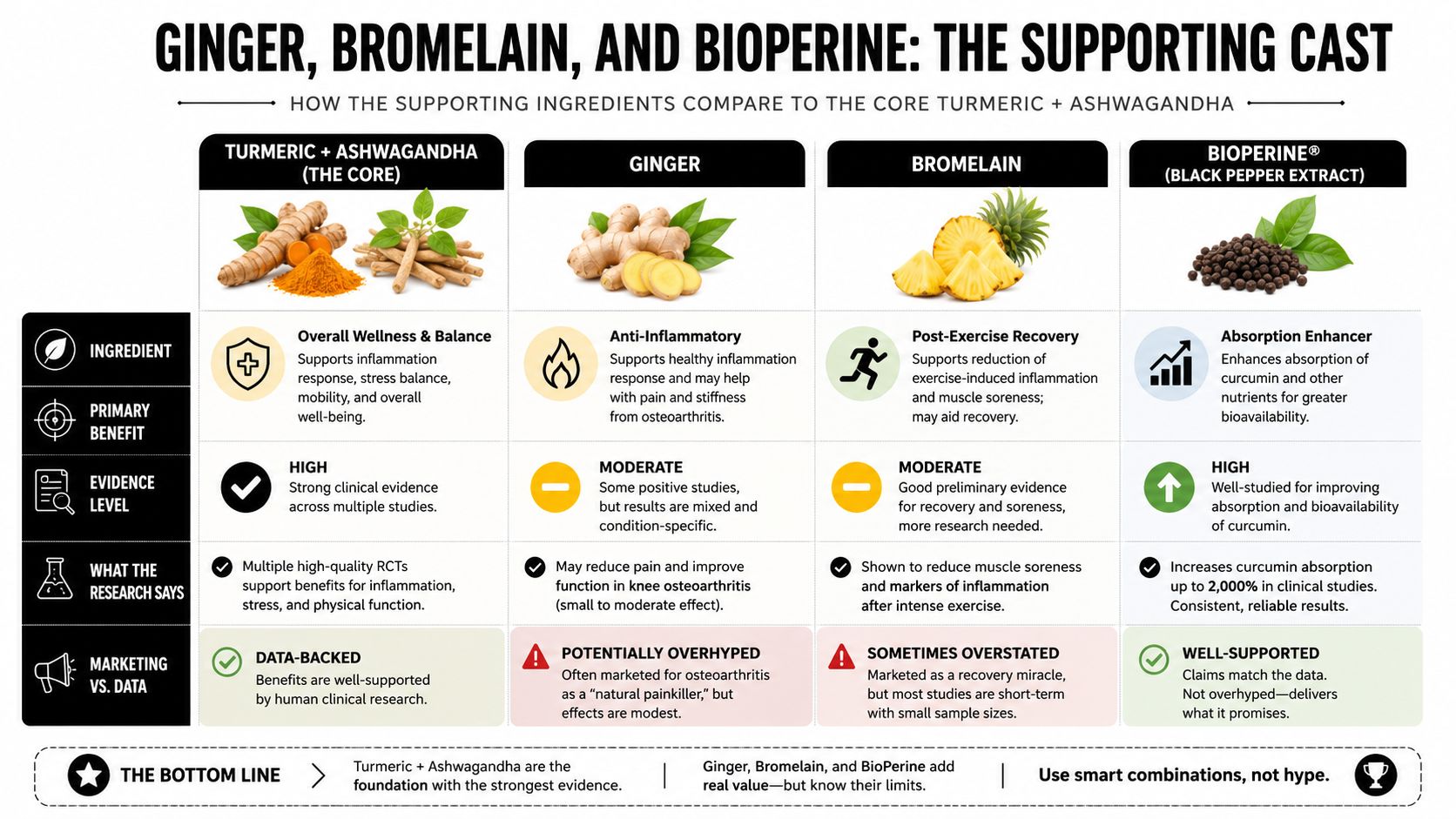
Ginger has human research for nausea and digestion, while evidence for joint comfort and exercise-related soreness is more specific and less universal. Studies and reviews have examined standardized ginger preparations, but a ginger-containing blend shouldn't inherit every finding from an isolated ginger trial.
Bromelain is an enzyme mixture derived from pineapple. Research has explored post-surgical swelling and osteoarthritis-related symptoms, but its clinical trial base is narrower than curcumin's. The label should identify enzyme activity, such as MCU or another disclosed activity measure, rather than relying only on a weight in milligrams.
BioPerine's clearest role in this combination is formulation-related. The cited human pharmacokinetic study found a 154% relative increase in curcumin bioavailability when piperine was co-administered, but that result belongs to the tested pairing and shouldn't be automatically transferred to every botanical in a blend.
Where the supporting ingredients fit
Ingredient | Most Defensible Role | Evidence Limitation | Safety Question |
|---|---|---|---|
Ginger | Nausea, digestion, and selected soreness or comfort outcomes | Results vary by preparation and outcome | Check medication and bleeding considerations |
Bromelain | Possible support for swelling or recovery-related symptoms | Narrower human evidence base | Consider pineapple allergy and medication interactions |
BioPerine | Absorption enhancer for selected compounds | Increased exposure doesn't prove clinical benefit | Review possible effects on medication metabolism |
Turmeric curcumin | Joint-comfort research with formulation dependence | Not every turmeric product matches studied extracts | Ask about anticoagulants and other medicines |
Ashwagandha | Stress and sleep outcomes over repeated use | Effects depend on extract, dose, duration, and population | Caution with thyroid and immune-related conditions |
These ingredients may be most relevant to adults seeking support for joint comfort, stress, sleep, or post-exercise recovery. They're not interchangeable with medical treatment, and the evidence for a combined capsule may be less direct than the evidence for each ingredient considered separately.
Who Actually Benefits and the Subgroup Gap
“Science-backed” is incomplete without a second question: backed for whom? A result in a selected clinical group may not apply to a healthy person, an older adult, a competitive athlete, or someone taking several medicines.
A review of supplements used by elite athletes found that results varied by supplement, sport demand, dose, and athlete characteristics. Female athletes represented only 10% of the studies in that review, according to the review of dietary supplements in elite athletes. That underrepresentation limits how confidently researchers can generalize findings across sex, training status, and physiology.
Match the study to the person
Consider three readers:
A 35-year-old with desk-job stress may find ashwagandha research more relevant if the studied participants had higher stress and used a standardized extract for multiple weeks.
A 65-year-old with joint discomfort may care more about curcumin studies involving osteoarthritis-related symptoms than about laboratory antioxidant findings.
A competitive athlete needs evidence from comparable training demands and must also consider banned-substance screening and product certification.
The same ingredient can be relevant to one person and largely irrelevant to another. A supplement trial doesn't establish universal usefulness just because the average result was positive.
A subgroup checklist
Ingredient | Best-Supported Population | Typical Studied Dose | Cautions / Underrepresented Groups |
|---|---|---|---|
Curcumin | Adults studied for selected joint-comfort outcomes | Match the specific extract and protocol | People using anticoagulants need professional guidance |
Ashwagandha | Adults with stress or sleep concerns, especially when symptoms are present | Standardized extract protocols vary | Pregnancy, thyroid conditions, and immunosuppressant use require caution |
Ginger | Selected digestive, nausea, soreness, or comfort populations | Match the preparation studied | Medication interactions and allergy history matter |
Bromelain | Selected swelling, recovery, or osteoarthritis populations | Use disclosed enzyme activity | People with pineapple allergies should be cautious |
BioPerine | People using a compatible compound requiring enhanced exposure | Match the tested pairing | Higher exposure may affect medication handling |
Researchers often exclude people with complex medical conditions, pregnancy, medication use, or multiple diagnoses. That makes safety information thinner precisely where consumers may need it most. A marketing label usually doesn't show those exclusions, so the buyer has to look for them in the study and discuss personal risks with a clinician.
Choosing and Using Science-Backed Supplements Safely
Start with a pause if you're pregnant or breastfeeding, under 18, taking anticoagulants, thyroid medication, immunosuppressants, or chemotherapy, or managing a complex condition. People over 65 may also benefit from clinical guidance before adding a multi-ingredient product, particularly when prescription medicines are involved.
Then inspect the label as if you were checking a research protocol.
What to verify before buying
Named extracts: Look for standardized curcuminoids, a clearly identified ashwagandha extract, disclosed ginger standardization, and bromelain activity.
Exact amounts: A proprietary blend total doesn't tell you how much of each ingredient you'll receive.
Testing documentation: A Certificate of Analysis should connect the finished batch to identity, potency, contaminants, and manufacturing checks. A seal such as USP, NSF, or Informed Choice can indicate that a product has undergone that organization's defined verification process, but it doesn't prove the product will produce a clinical benefit.
Serving instructions: Compare the daily serving with the dose used in relevant human trials.
Expiration and storage: Heat, humidity, and poor sealing can affect product integrity, so follow the manufacturer's storage directions.
A product standardized to a defined curcuminoid content is easier to evaluate than a label that lists only “turmeric root.” The same principle applies to ashwagandha. Raw powder and a standardized extract aren't automatically equivalent just because both come from the same plant.
Mapping a blended formula to the research
River of Life Capsules offer a 60-capsule, vegan formula containing turmeric extract with BioPerine, ashwagandha root, ginger, and bromelain. Its product information describes 500 mg of curcuminoids, KSM-66 or Sensoril-grade ashwagandha positioning, standardized gingerols, bromelain identified by enzyme activity, and 5 mg of BioPerine. Those details give a buyer specific points to compare with the evidence, but they don't establish that the complete combination has been tested in a single randomized trial.
Set an honest evaluation period. Botanicals aimed at stress, sleep, or joint comfort often require repeated use over the same broad time horizon as the relevant trials. Track one or two outcomes, such as morning stiffness or sleep continuity, rather than changing several supplements at once.
Finally, check interactions before starting, stop if you develop concerning symptoms, and don't use a supplement to delay medical care for significant pain, swelling, insomnia, anxiety, or other persistent symptoms.
River of Life provides a single capsule combining turmeric extract, BioPerine, ashwagandha, ginger, and bromelain for consumers who want a multi-ingredient approach to joint comfort, stress resilience, sleep quality, and recovery. Review the formulation details and purchase options at River of Life, then compare the label with your health needs, medications, and the clinical evidence before deciding.