


Pain Reliever Cream Guide Types Uses and Safety

You wake up with a knee that complains when you stand, or a wrist that throbs after a long day, and swallowing a pill feels like too much for one small spot. That's where a pain reliever cream starts to make sense. You put something on the place that hurts and hope it stays local instead of affecting your whole body.
That simple idea is a big reason topical pain products have become such a major part of consumer health. One market estimate placed the pain relieving cream market at USD 8.50 billion in 2025 and projected USD 12.95 billion by 2032 at a 6.2% CAGR, with North America at 40.26%, arthritis at 45.3% of application demand, and over-the-counter products at 62.4% of type share, according to this pain relieving cream market analysis. Another estimate put the broader topical pain relief market at US$ 11.1 billion in 2024, projecting US$ 18.4 billion by 2034 at a 5.2% CAGR, with creams representing 35.0% of formulation share and North America at 39.7% of revenue in 2023, as summarized in the same market overview of pain-relieving creams.
The shelf can still feel confusing. A cooling gel, a warming rub, diclofenac, capsaicin, lidocaine, “natural,” “maximum strength.” Many people end up choosing by brand familiarity or scent instead of by what kind of pain they have.
Table of Contents
Introduction to Pain Reliever Cream and Why It Matters
A good way to think about topical pain care is this: match the ingredient to the pain, and match the format to your skin and routine. That matters more than the usual “natural versus drug” debate.
When a cream makes more sense than a pill
If your pain is in a finger joint, the front of your knee, your elbow, or a small patch of tight muscle, a topical product is often appealing because the problem feels local. Many people also prefer a cream when they want to avoid adding another oral medicine to the day.
The people who usually benefit most are dealing with:
Surface-near joint pain such as hands or knees
Small muscle strains that don't need whole-body treatment
Repeat flare areas where targeted relief is easier than taking a pill
Situations where oral NSAID risks matter and a local option may be worth considering with clinician guidance
Practical rule: If the painful area is easy to point to with one or two fingers, a pain reliever cream is often a reasonable first thing to consider.
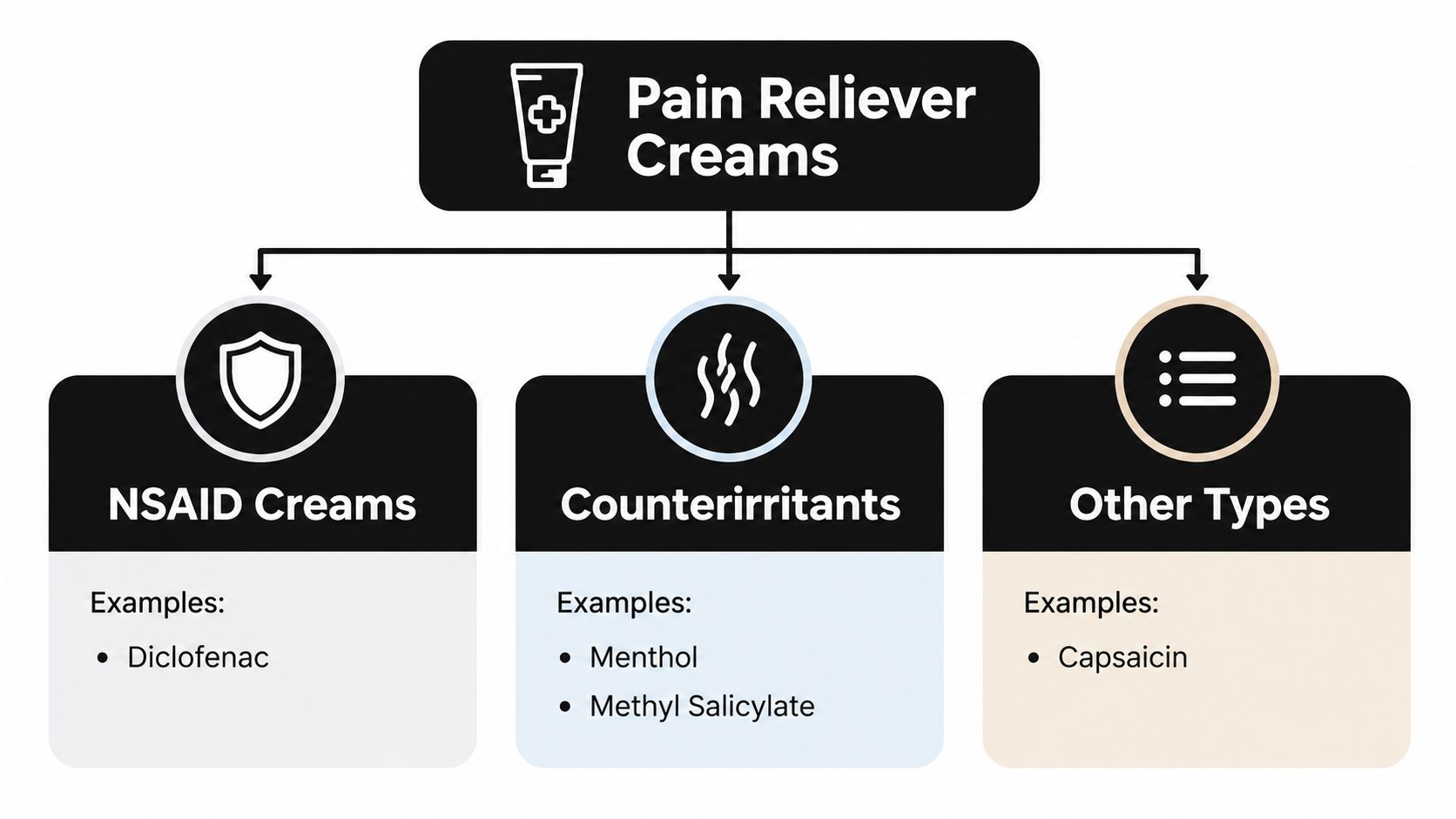
The four big families you'll see
Most products on the shelf fall into a few broad groups:
Topical NSAIDs such as diclofenac
Counterirritants such as menthol-based or warming rubs
Capsaicin creams
Topical anesthetics such as lidocaine
These don't all work the same way, and they aren't equally useful for every kind of pain. A cooling rub may help a sore calf feel better fast but won't do the same job as diclofenac for an arthritic knuckle. Capsaicin may help some chronic joint pain but can irritate sensitive skin.
That ingredient-by-ingredient tradeoff is what usually gets lost in marketing. If you keep that one idea in mind, the rest gets easier.
How Pain Reliever Creams Work on Skin and Joints
When you apply a pain reliever cream, the skin is the first checkpoint. Some of the ingredient stays near the surface, some moves into nearby tissues, and the main effect tends to remain close to where you put it.
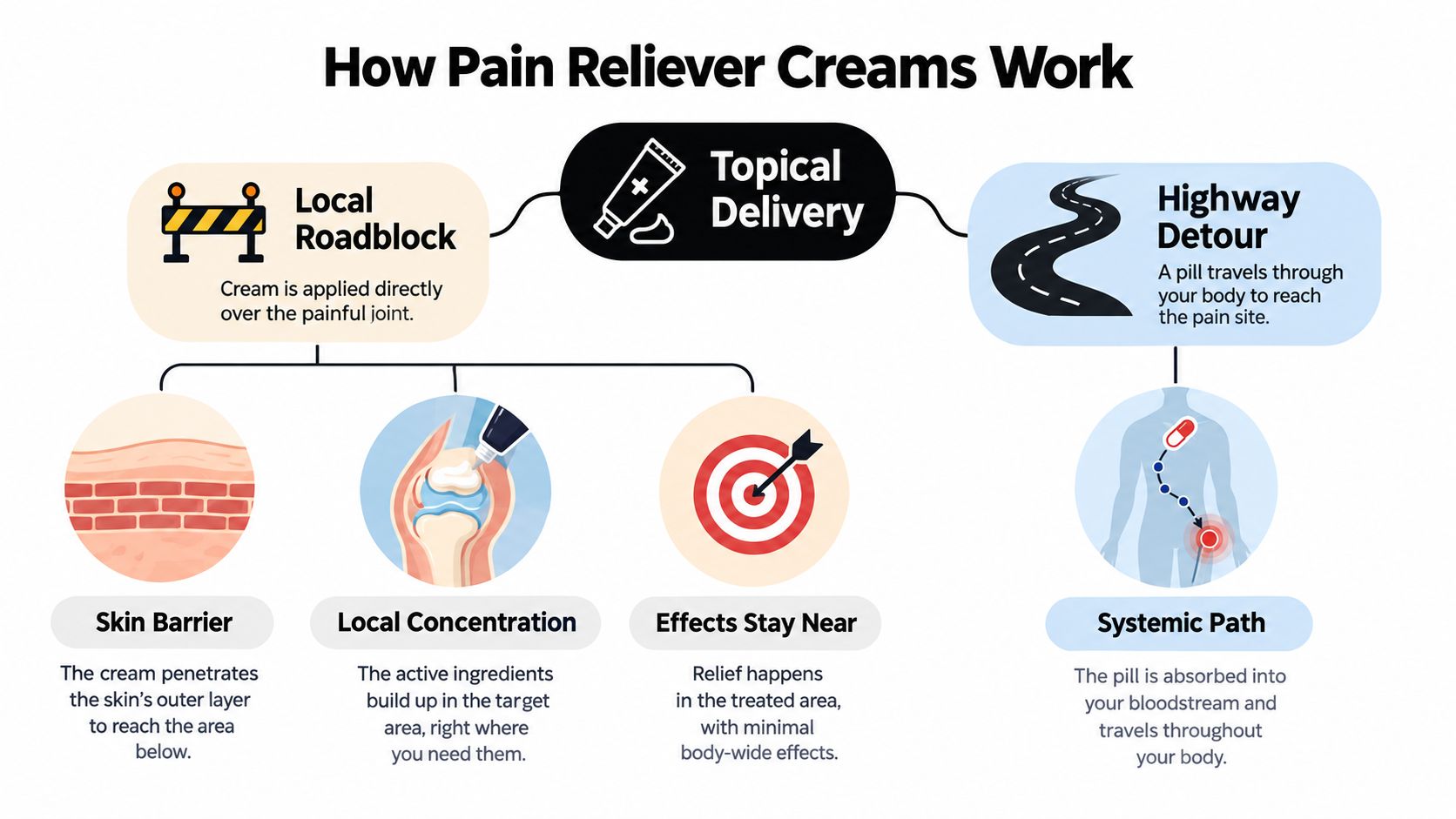
That's different from an oral pill, which has to travel through the body before it reaches the painful area. If you want a simple overview of that local approach, this guide to topical pain reliever cream basics is a useful companion.
Topical doesn't mean weak. It means the treatment is aimed at a place, not at the whole body.
Local roadblock versus highway detour
Think of a sore joint like a noisy intersection. A topical product tries to set up a local roadblock right where the traffic jam is happening. An oral pill takes the highway detour. It enters the bloodstream, circulates widely, and only part of that journey helps the sore spot you care about.
That local focus is why topical products are often attractive for hands, knees, elbows, ankles, and other areas close to the skin.
Four plain-language ways creams can help
Different ingredients use different routes to ease discomfort.
Inflammation blockers: Topical NSAIDs such as diclofenac work on inflammatory pathways in the painful area.
Cooling or warming signal shifters: Menthol and similar ingredients create sensations that compete with pain signals.
Pain transmitter depletion: Capsaicin gradually turns down certain pain signaling over repeated use.
Surface numbing: Lidocaine and similar anesthetics reduce sensation in the skin and nearby superficial nerves.
Each mechanism fits a different kind of problem. That's why someone with a swollen arthritic finger may do better with a topical NSAID, while someone with a small patch of irritated nerve-like discomfort may be more interested in a numbing product.
Why location matters
Topicals usually work best where there isn't much distance between skin and the painful structure. That's why people often notice more from a cream on a hand joint than deep buttock or hip pain.
A second point confuses people: some products feel dramatic right away because they cool or warm the skin, but that sensation isn't the same thing as reducing inflammation. Relief can come from feel, from anti-inflammatory action, from nerve effects, or from some mix of those. Knowing which one you're buying helps set better expectations.
Main Types of Pain Reliever Cream and Active Ingredients
Walk down the pharmacy aisle and many products look similar, but the ingredient list tells the story. Start there, not with the front label.
Topical NSAIDs
If your pain seems tied to arthritis, overuse, or localized inflammation, this is often the category people look at first. Diclofenac is the best-known example.
What it usually feels like: not especially hot or cold. It may feel surprisingly plain.
Best fit: hands, knees, or other localized musculoskeletal pain where inflammation is part of the problem.
Tradeoff: it may not feel dramatic right away, so some people wrongly assume it's not working.
Counterirritants
These are the cooling and warming products. Menthol-based products are the classic example, and some formulas include methyl salicylate or related ingredients.
What they feel like: immediate cool, heat, or alternating sensation.
Best fit: temporary relief for muscle soreness, mild strains, or moments when you want quick sensory relief.
Tradeoff: the strong sensation can make them seem more powerful than they are for deeper inflammatory pain. They can also irritate reactive skin.
Capsaicin creams
Capsaicin comes from chili peppers. It's a very different kind of topical option because it usually works best with consistent repeat use, not one quick application.
What it feels like: warm, stinging, or burning at first.
Best fit: chronic localized pain, especially when a person is willing to apply it regularly and can tolerate the sensation.
Tradeoff: it's one of the products most likely to make people quit early because the skin feel is unpleasant.
Topical anesthetics
Lidocaine is the ingredient many people recognize here. These products are more about numbing than cooling or anti-inflammatory action.
What they feel like: muted, dulled sensation rather than heat or cold.
Best fit: surface tenderness or pain with a nerve-like quality in a small area.
Tradeoff: they may be less satisfying for classic stiff, inflamed arthritic pain.
A quick decision matrix
Situation | Cream family to consider first | Why it may fit | Skin tolerance note |
|---|---|---|---|
Achy finger or knee joint | Topical NSAID | Better match for inflammatory joint pain | Usually easier on skin than capsaicin |
Tight calf or sore shoulder after activity | Counterirritant | Fast cooling or warming feedback | Can sting on sensitive skin |
Chronic small-area pain that lingers | Capsaicin | Works through repeated use over time | Burning is common early |
Small patch of tender, nerve-like discomfort | Topical anesthetic | Surface numbing may help | Watch for local irritation |
A final detail matters more than people expect: format. Creams tend to moisturize more. Gels often dry faster and feel less greasy. Sprays are convenient for hard-to-reach spots. Patches can be easier if you don't want repeated rubbing. The best product isn't just the right ingredient. It's the one you'll use correctly.
How Effective Are Different Pain Reliever Creams
The short answer is that some pain reliever creams have much better evidence than others, which is why ingredient-specific thinking matters most.
Topical NSAIDs have the strongest support
For osteoarthritis and localized musculoskeletal pain, topical diclofenac stands out. A Cochrane review found that diclofenac and ketoprofen can reduce pain by at least half in roughly 1 in 5 to 1 in 10 people over 6 to 12 weeks, and in a 39-study review with 10,631 patients, topical diclofenac and ketoprofen were better than placebo with few harmful systemic effects, according to the Cochrane review on topical NSAIDs for chronic musculoskeletal pain.
That's a useful reality check. These products can help meaningfully, but they don't help everyone, and they don't erase pain for every user.
Capsaicin has a long history and a narrower fit
Capsaicin is one of the foundational ingredients in topical pain care. In a classic double-blind arthritis trial, after 4 weeks of treatment, mean pain reduction was 57% in rheumatoid arthritis and 33% in osteoarthritis compared with placebo, and another study of 0.025% capsaicin cream in osteoarthritis found 81% of patients improved by physician global evaluation versus 54% on vehicle, as reported in the PubMed record for the capsaicin arthritis study.
Later evidence summarized in the same verified literature supports moderate benefit over 4 to 12 weeks, and another analysis concluded topical capsaicin used four times daily was moderately effective for up to 20 weeks.
The catch is tolerability. Capsaicin often causes local irritation, and some people stop because the burning sensation isn't worth it.
The weak spot in the market
A lot of advertising makes multi-ingredient or compounded creams sound automatically smarter. The evidence doesn't support that assumption. A National Institutes of Health review states there are “very few well-designed, randomized, placebo-controlled research trials” on compounded topical pain creams, and the National Academies documented 38 adverse-event reports in FDA FAERS for these products, as noted in the NIH review of compounded topical pain creams.
The safest-sounding label isn't always the most evidence-based choice. The ingredient matters more than the promise on the box.
Effectiveness and Tolerability by Cream Type
Cream Type | Evidence Strength and Benefit | Common Tradeoff |
|---|---|---|
Topical NSAIDs such as diclofenac | Strongest support for osteoarthritis and localized musculoskeletal pain. Meaningful relief is possible for a subset of users over several weeks. | May take steady use and may not give an immediate sensory cue |
Capsaicin cream | Longstanding evidence base for short-term benefit in some arthritis and localized pain settings | Burning, irritation, and early dropout are common |
Counterirritants such as menthol products | Can provide quick temporary sensory relief | Evidence is less clear for sustained benefit, and sensation can be mistaken for treatment of inflammation |
Compounded multi-ingredient creams | High-quality evidence is limited | Less certainty about benefit and safety profile |
If you want the most evidence-based first try for localized arthritis-type pain, topical NSAIDs usually make the most sense. If your skin is sensitive, capsaicin may be harder to live with even if the mechanism is appealing.
How to Apply Pain Reliever Cream Correctly
Using a pain reliever cream well is less about rubbing harder and more about being consistent and careful. Many “it didn't work” stories are really “it wasn't used in a way that gave it a fair chance.”
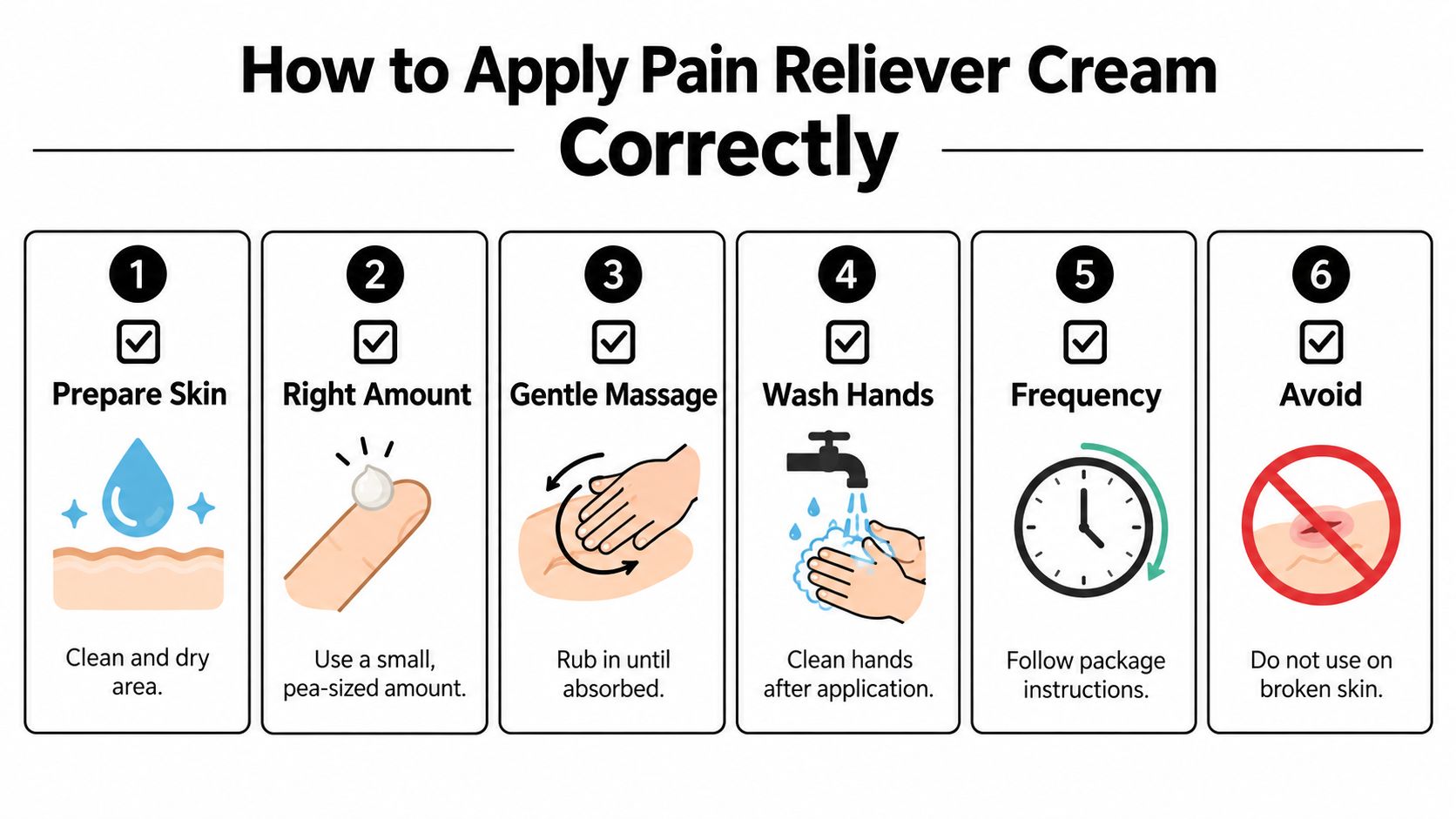
A simple routine that prevents common mistakes
Start with clean, dry skin. Sweat, lotion, or dampness can interfere with how evenly the product sits on the area.
Use a small amount first unless the label directs otherwise. More cream doesn't always mean more relief, and overapplying increases the chance of irritation.
Rub it in gently over the whole painful area, not just the single sharpest point. Then wash your hands well, especially after capsaicin.
A quick visual checklist helps:
Prepare the skin: Clean and dry the area before applying.
Use the directed amount: Follow the package instructions for that product.
Massage lightly: Spread across the painful zone until absorbed.
Wash your hands: This is important with capsaicin and useful with all topicals.
Repeat on schedule: Some products need regular use to work properly.
Avoid problem areas: Don't put it on broken skin, eyes, or inside the mouth or nose.
This short demonstration can help if you want to see application basics in action.
Timing matters more than people expect
Not all products behave the same way.
Counterirritants may feel active almost immediately. Topical NSAIDs often need steady repeat use before you can judge them fairly. Capsaicin especially should not be judged after one or two tries, because its benefit tends to build with repeated application.
Daily-use tip: Pick one painful area, use one product correctly, and judge it over days to weeks instead of switching every day.
What to avoid
A few mistakes cause a lot of trouble:
Applying to broken or irritated skin
Touching your eyes after application
Layering several topical products on the same spot
Using heat over a freshly treated area
Stopping too soon for products that need time
Read the label every time you start a new ingredient. Frequency can differ, and capsaicin regimens in the evidence base have included use four times daily, as noted earlier in the capsaicin research.
Safety Interactions and When to See a Clinician
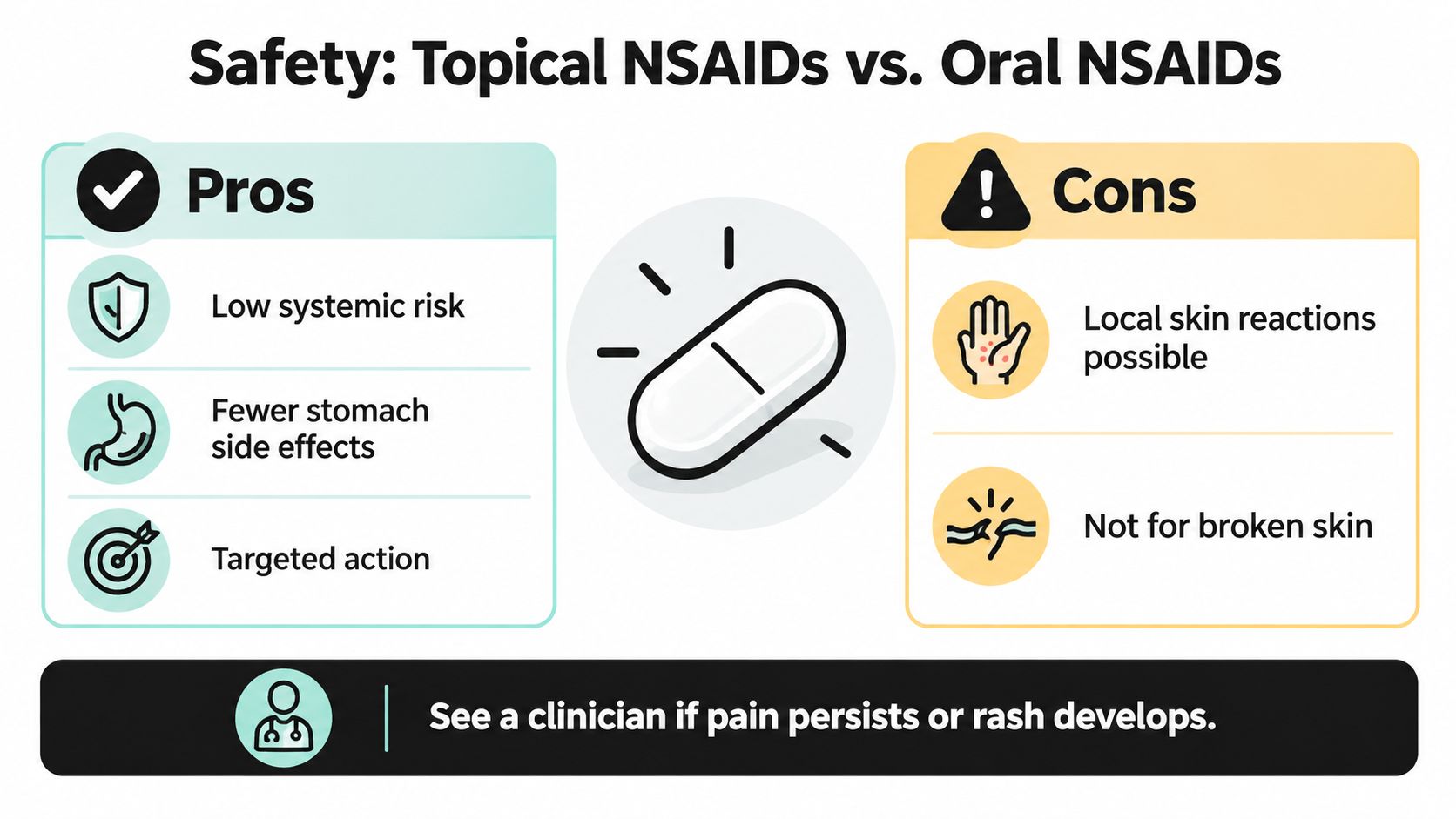
Topical products are often treated as harmless because they're sold over the counter, but “topical” doesn't mean “risk-free.” The main risks are usually skin-related, though some ingredients raise broader medication questions too.
If you're also comparing pills such as ibuprofen, it helps to understand the broader tradeoffs in this overview of how ibuprofen works and where it fits.
The main safety patterns to remember
Topical NSAIDs generally have a lower systemic burden than oral NSAIDs, which is part of their appeal. In the Cochrane review cited earlier, topical diclofenac and ketoprofen had few harmful systemic effects.
Capsaicin is different. Its most common issue isn't stomach or kidney risk. It's the local burning and irritation that can make the product hard to tolerate.
Compounded creams deserve extra caution. As noted earlier, the NIH review found very limited high-quality trial evidence and documented 38 adverse-event reports in FDA FAERS for these products.
A practical risk checklist
Use extra caution or ask a clinician before starting a topical product if any of these apply:
You already take oral NSAIDs regularly: Combining approaches may raise questions about total NSAID exposure.
You have very sensitive skin or eczema: Burning, redness, or rash may be more likely.
You're older and have thinner skin: Absorption and irritation can be more of an issue.
You're pregnant or managing several medical conditions: Product choice should be individualized.
You want to use a compounded cream: Evidence is less extensive than many people assume.
When self-treatment isn't enough
Some pain should not be managed by repeatedly adding more cream.
See a clinician if you develop:
Worsening pain instead of gradual improvement
Marked swelling, heat, or loss of function
Rash, hives, or signs of allergy
Pain with fever or feeling unwell
Pain that keeps returning without a clear reason
If a cream only lets you postpone dealing with a worsening joint or injury, it's doing the wrong job.
A final point is easy to miss: if you need a topical every day for a long stretch and still aren't comfortable, that usually means it's time to rethink the diagnosis, the ingredient, or the larger treatment plan rather than just applying more.
Complementary Options and Next Steps for Lasting Comfort
A pain reliever cream can be a useful tool, but it works best as part of a bigger routine. For many people, the win comes from combining targeted local relief with daily habits that make flare-ups less frequent.
What pairs well with topical relief
For joint and muscle comfort, the most helpful add-ons are often simple:
Gentle movement: Stiff joints usually prefer regular motion over complete rest.
Strength and mobility work: Better support around a painful joint can reduce repeat irritation.
Sleep and stress support: Poor sleep and high stress can make pain feel louder.
Thoughtful oral support: Some people prefer a daily supplement approach rather than relying only on symptom-by-symptom topical use.
If you're interested in broader non-prescription strategies, this guide to natural pain relief approaches covers the bigger picture.
Choosing a format and knowing when to add oral support
A simple decision matrix can help:
Need | Format that may fit | When oral support may enter the picture |
|---|---|---|
Quick, temporary muscle relief | Gel or counterirritant cream | If soreness is frequent and part of a larger recovery pattern |
Localized arthritis-type discomfort | NSAID gel or cream | If pain is recurring and daily support is needed beyond flare treatment |
Sensitive, dry skin | Cream over a fast-drying gel | If skin limits what topicals you can tolerate |
Hard-to-reach area | Spray or patch | If topical application is inconsistent or inconvenient |
One oral option in this general category is River of Life Capsules, a vegan multi-ingredient supplement that combines turmeric extract with BioPerine, plus ashwagandha, ginger, and bromelain. It's positioned for daily use as an oral support approach rather than as a replacement for targeted topical treatment.
The practical mindset is simple. Use a pain reliever cream for the spot that hurts now. Build daily habits, and possibly oral support, for the pattern that keeps bringing the pain back.
If you're looking for a broader routine beyond spot treatment alone, River of Life offers a capsule-based option designed to support joint comfort, recovery, stress resilience, sleep quality, and mental clarity. You can learn more about the formula, purchase options, and daily-use approach at River of Life.