
Supplement Bioavailability Explained

You take a capsule with breakfast, drink some water, and move on with your day. The label promises a carefully selected dose, yet the body still has to release, protect, transport, and use that compound before it can support anything. Supplement bioavailability explains why swallowing a larger dose doesn't automatically mean your cells receive more of the ingredient.
That distinction matters when you're comparing a basic powder with a complex delivery system, deciding whether an absorption enhancer is useful, or wondering why the same supplement seems to work differently for different people. The practical question isn't only, “How much is in the capsule?” It's also, “How much reaches the body in a usable form?”
Table of Contents
Evaluating Real-World Formulations Like River of Life Capsules
What Supplement Bioavailability Actually Means
Suppose two people take supplements labeled with the same amount of a botanical ingredient. One product dissolves readily, survives digestion, crosses the intestinal wall, and reaches circulation. The other passes through the digestive tract poorly, undergoes extensive breakdown, or remains trapped in a form the body can't use efficiently. The labels may look similar, but the delivered dose can be very different.
Bioavailability is the fraction of an ingested active compound that reaches systemic circulation and becomes available for biological use. It isn't the amount you swallow. In pharmacokinetic terms, researchers often examine how much of a compound enters circulation and how long it remains there. That blood exposure can help researchers compare formulations, but it doesn't automatically prove a better long-term health outcome.
A delivery-service analogy makes the distinction easier:
Ordering the package is taking the supplement.
Leaving the warehouse is releasing the ingredient from the capsule or tablet.
Passing the checkpoints means surviving stomach conditions, enzymes, intestinal barriers, and liver metabolism.
Arriving at the address means reaching circulation or relevant tissues.
Opening the package represents cellular utilization, storage, or transformation into a usable form.
A high number on a Supplement Facts panel tells you what the manufacturer put into the product. It doesn't tell you how much the body will release or use.
Why the label dose can mislead
Poor bioavailability doesn't always mean a product is worthless. Some nutrients are absorbed efficiently in ordinary forms, while others need a specific food matrix, chemical form, or delivery approach. The right choice depends on the compound, the dose, the person's digestive environment, and the intended outcome.
A 2025 review describes bioavailability as a multi-stage process involving release, intestinal absorption, transport, distribution, and cellular utilization or storage. It also highlights host factors such as life stage, nutritional status, disease state, gut microbiota, dose, nutrient interactions, and food matrix conditions. You can read that broader framework in the review of individualized supplement bioavailability.
Practical rule: Treat the labeled dose as the starting amount, not the guaranteed amount your body will use.
This is why premium formulation can sometimes be rational, but not automatically justified. A more advanced capsule may improve delivery for a poorly absorbed compound, while a simple form may be perfectly adequate for another. The meaningful comparison is between delivered exposure, tolerability, evidence quality, and the health goal, not between bottle prices or impressive wording alone.
The Biological Roadblocks to Nutrient Absorption
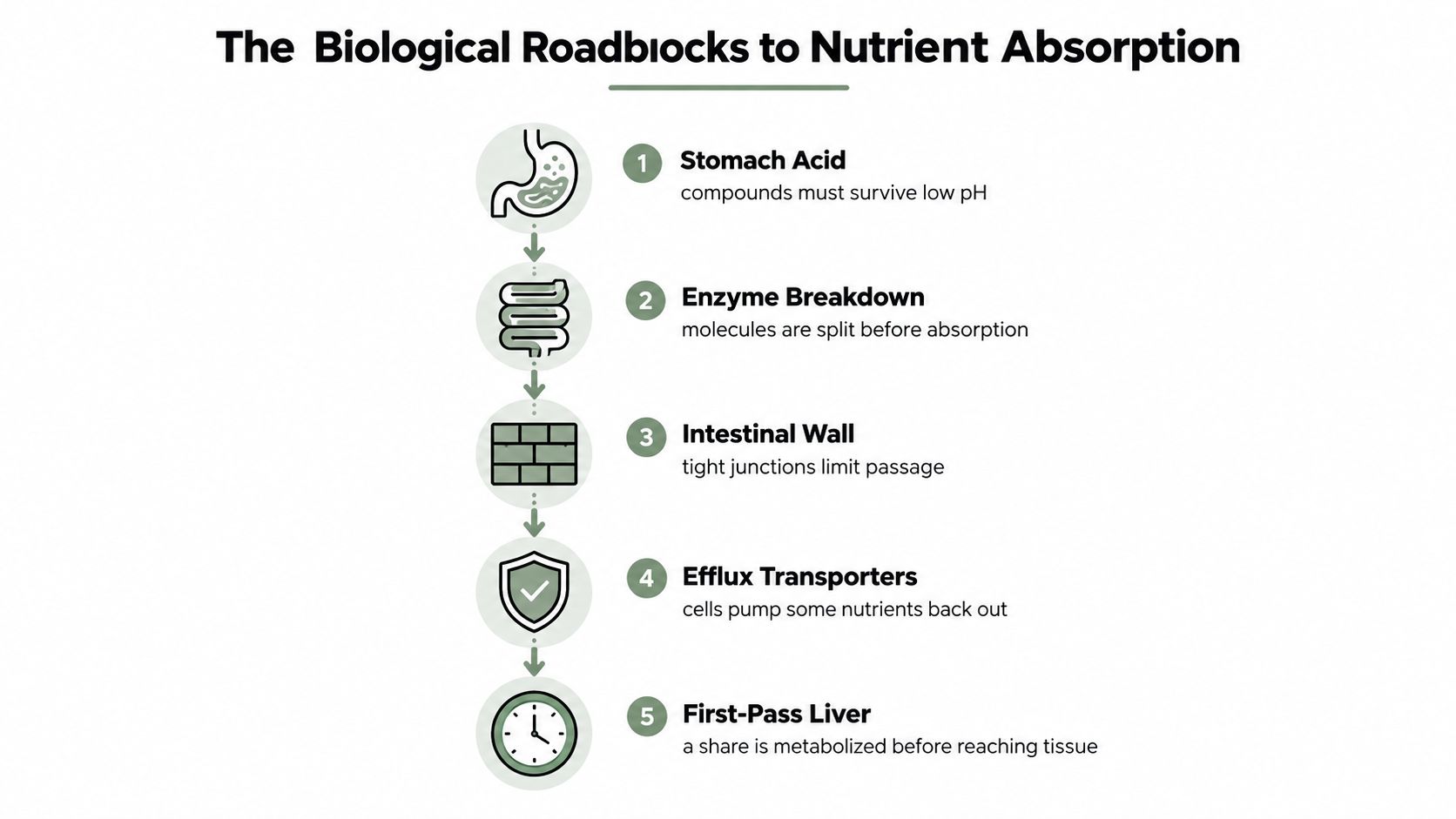
Before an ingredient can influence a tissue, it has to pass through several biological checkpoints. Oral supplements travel through an environment designed to break substances apart, restrict entry, remove unwanted compounds, and transform chemicals before they circulate.
The five checkpoints
Release from the dosage form: A tablet, capsule, powder, or liquid must release its active compounds. If the ingredient doesn't disperse well, later absorption can't compensate.
Stomach conditions: Stomach acid and digestive movement can alter a compound before it reaches the intestine. Some substances remain stable, while others degrade or change chemical form.
Enzyme breakdown: Digestive enzymes split food and supplement molecules into smaller components. That process helps many nutrients become absorbable, but it can also damage fragile compounds.
Intestinal passage: The intestinal wall is selective. Some molecules cross readily, while others have low permeability or require transport mechanisms. The body doesn't treat the intestinal lining as an open doorway.
Efflux and liver metabolism: Intestinal cells can pump certain compounds back into the gut through efflux transporters. Compounds that enter circulation may then undergo first-pass liver metabolism before reaching tissues.
This sequence explains why increasing the raw ingredient can produce disappointing results. More material may remain unabsorbed, undergo breakdown, or encounter a transport limit. The body also has to distribute and process what enters circulation, so a higher swallowed amount isn't equivalent to a proportionally higher usable amount.
Why people absorb the same product differently
Your digestive tract isn't a standardized laboratory vessel. Life stage, nutritional status, disease state, gut microbiota, dose, food matrix, and interactions with other nutrients or medicines can change the journey. A person with digestive problems may release or transport an ingredient differently from someone with an uncomplicated digestive process. Regular eating patterns can also alter the environment surrounding the capsule.
If digestive discomfort, irregular digestion, or suspected gut issues affect your routine, discuss them with a qualified clinician. Educational guidance on digestive enzymes and probiotics can help you understand the digestive context, but it shouldn't replace individualized medical advice.
The useful takeaway is simple: absorption is a process, not an ingredient trait that exists in isolation. A label can identify the molecule, yet the body determines how much survives, crosses, circulates, and becomes available for use.
Formulation Technologies That Boost Absorption
Formulation changes the conditions around an active compound. Instead of asking only whether an ingredient has evidence, ask how the product helps that ingredient reach the body.
Piperine and the curcumin example
Curcumin illustrates the issue clearly. In a landmark human pharmacokinetic study published in 1998, participants who took 2 g of curcumin alone had serum levels that were undetectable or very low. Adding 20 mg of piperine from black pepper raised curcumin bioavailability by 2,000% in humans, with much higher concentrations measured within 0.25 to 1 hour after dosing. The same study reported a 154% increase in rats, so the human and animal findings shouldn't be treated as interchangeable. The original data appear in this human curcumin and piperine pharmacokinetic study.
That result made piperine a prominent absorption enhancer, but it doesn't create a universal rule for every turmeric product. A 2021 review describes plain curcumin as poorly absorbed and discusses piperine, nanoparticles, and phospholipid complexes as different delivery strategies. In one randomized crossover study involving 6 healthy men, 2,000 mg of curcumin plus 5 mg of piperine produced substantially higher exposure than the same curcumin amount alone, with absorption approximately doubled in that dataset. The review also emphasizes that the famous 2,000% result is formulation-specific. See the 2021 review of curcumin bioavailability.
Other delivery approaches
Products may use several kinds of formulation technology:
Phospholipid complexes: These associate an active compound with phospholipids, which can improve dispersion and interaction with biological membranes.
Liposomal delivery: Liposomes surround an ingredient with phospholipid structures. Their performance depends on the actual construction, stability, and testing of the product, not merely the word “liposomal.”
Nanoparticles: Very small delivery structures can alter dispersion and transport, but the specific technology and human evidence matter.
Self-emulsifying systems: These use a formulation that helps create an emulsion in the digestive tract, which may improve handling of certain poorly soluble compounds.
When reviewing a label, look for the named delivery system, the amount of the enhancer, the active ingredient form, and human pharmacokinetic evidence. A vague phrase such as “advanced absorption” doesn't tell you how the product works.
A useful guide to the practical choices appears in curcumin bioavailability and formulation. The central lesson is that a delivery system is a hypothesis that needs product-specific support, not a guarantee printed on packaging.
Daily Habits That Maximize Supplement Uptake
A advanced formulation still has to operate inside your daily routine. Food, fluids, timing, and dose size can change the conditions in which an ingredient disperses and moves through the digestive tract.
Build a repeatable routine
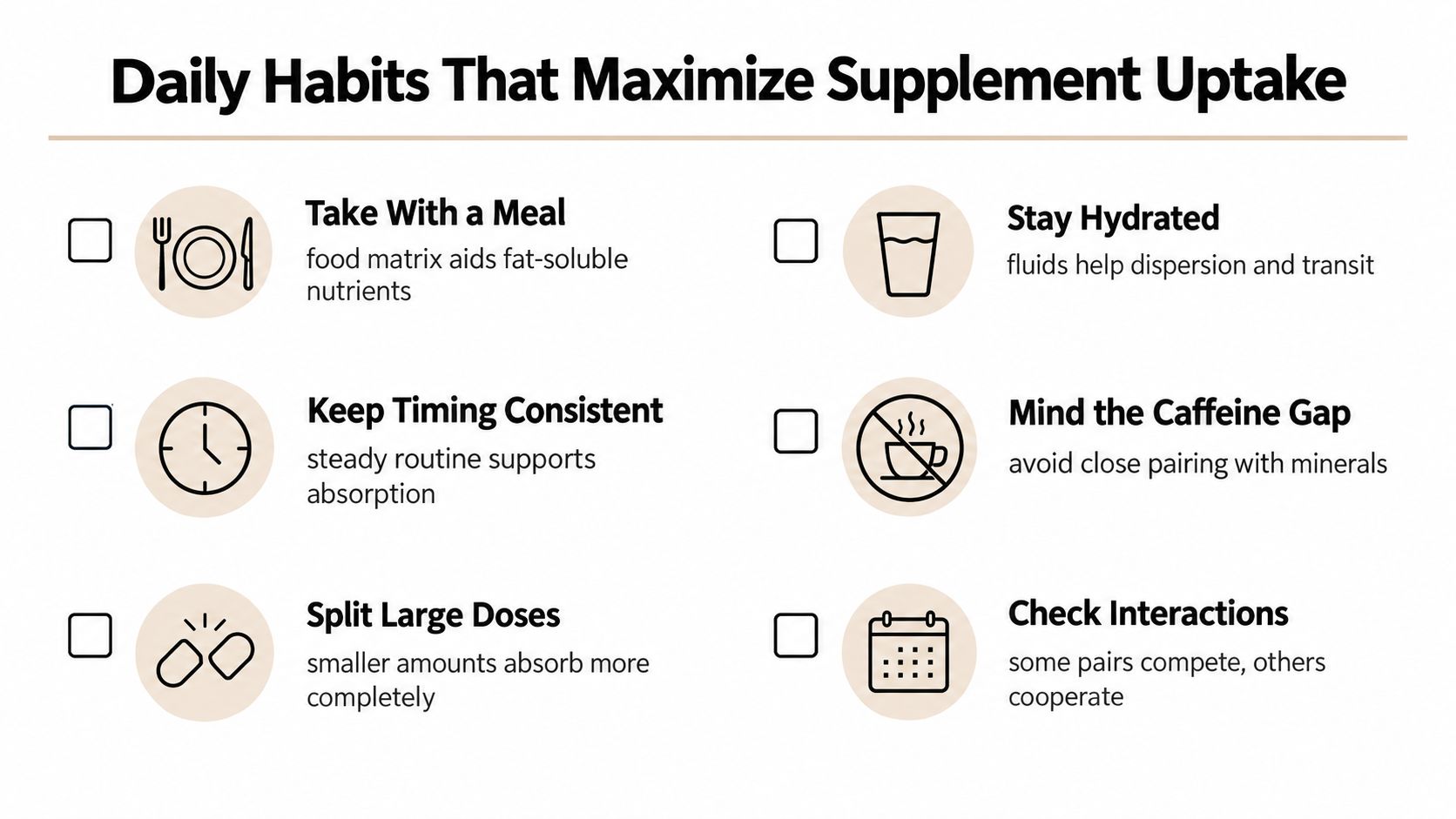
Take fat-soluble compounds with a meal that contains some dietary fat. Fat can help the digestive system handle fat-soluble nutrients and botanical compounds. This doesn't mean adding an unusually large amount of fat. It means avoiding the assumption that every capsule performs best on an empty stomach.
Use enough water. Fluids support swallowing, dispersion, and normal digestive transit. Water won't overcome every formulation problem, but taking a capsule with very little fluid can make the routine less comfortable and less consistent.
Keep timing steady. A repeatable schedule makes it easier to follow label directions, notice tolerability, and identify interactions. Consistency also helps you avoid taking competing products together by accident.
Make the meal part of the formulation
The food matrix surrounding a supplement can matter. Fat and fiber may alter the handling of different compounds, and caffeine can interfere with the absorption of some minerals. The effect isn't identical for every nutrient, so avoid applying one universal timing rule to every product.
Use this practical checklist:
Read the label first: Follow instructions about food, empty-stomach use, and separation from other products.
Separate possible competitors: Ask a pharmacist about spacing minerals, medicines, and caffeine when the label or your clinician raises an interaction concern.
Be cautious with large doses: A bigger serving can create a greater absorption challenge. Dividing a serving may improve tolerability and handling for some products, but don't change a prescribed regimen without medical guidance.
Track the context: Note whether you take the supplement with breakfast, a high-fiber meal, coffee, or other capsules. This gives you useful information if you discuss the routine with a clinician.
Protect the product: Store supplements according to the manufacturer's instructions. Heat, moisture, light, and poor handling can affect product integrity.
A good routine is one you can repeat safely. The most elaborate delivery system won't help if the product stays in a drawer or causes discomfort every time you take it.
The 2025 U.K. government review of novel supplement formulations discusses how food, formulation, and compound-specific behavior shape oral bioavailability. It also notes that dietary fat and fiber can have different effects depending on the compound and delivery system. Review the government assessment of novel oral supplement formulations rather than relying on a single rule copied from another product category.
Evaluating Real-World Formulations Like River of Life Capsules
A multi-ingredient product should be assessed as a system, not as a collection of isolated buzzwords. Start with the intended goal, then examine whether the formulation addresses release, absorption, routine use, and ingredient compatibility.
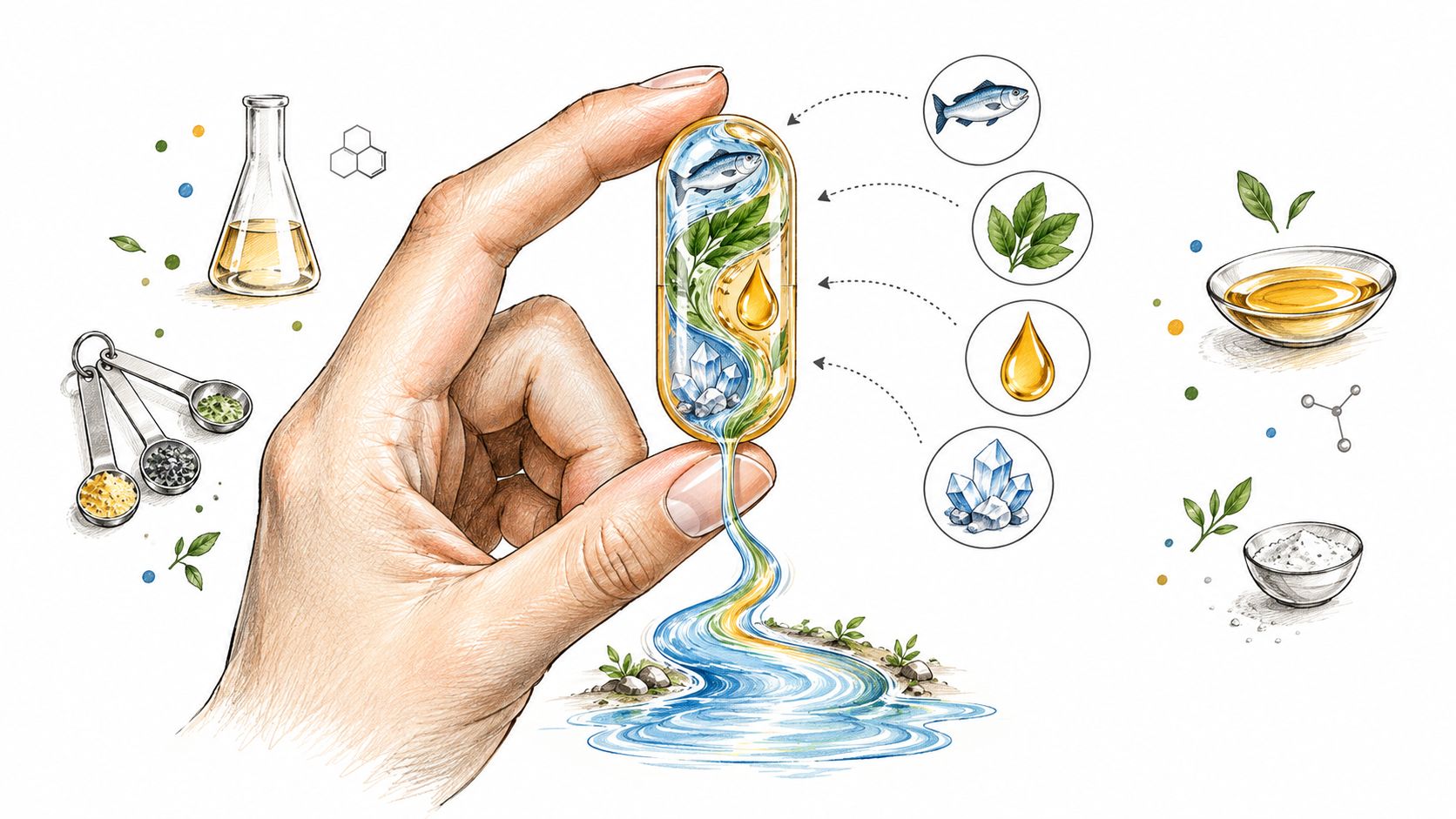
River of Life Capsules provide one example of this evaluation process. The product combines turmeric extract with BioPerine black pepper, alongside ashwagandha root, ginger, and bromelain, in a vegan capsule format. The relevant bioavailability question concerns the turmeric component, because the piperine pairing is intended to address curcumin's limited absorption. The evidence above supports piperine as a potentially important enhancer, while also showing that results depend on formulation and study conditions.
A whole-formula evaluation
Ask four questions before choosing a product:
What is the active form? “Turmeric” and “curcumin” aren't interchangeable label terms. Look for the specific extract or standardized ingredient and its serving information.
Is the absorption strategy visible? A product should identify its delivery approach, such as piperine, a phospholipid complex, or another named technology. The label should make it possible to understand what has been added and why.
Does the routine fit real life? A vegan capsule can be convenient for people who prefer plant-based products, while a single formula may simplify a routine that would otherwise require several separate bottles. Convenience doesn't prove efficacy, but it can support consistent use.
Are the claims appropriately limited? A supplement can be positioned for general wellness support without being presented as a treatment for disease. People with chronic conditions, pregnancy, allergies, or prescription medications should review the full ingredient list with a healthcare professional.
You can use this guide to reading a Supplement Facts panel to examine serving size, ingredient forms, and supporting components. The broader principle applies to any brand: judge the formula by its active ingredients, delivery method, evidence, tolerability, and fit with your goals.
A product that combines several botanicals may be practical, but it also makes troubleshooting more difficult. If you start multiple new ingredients at once, you may not know which one caused a benefit or an unwanted reaction. A staged approach, supported by professional advice when needed, gives you a clearer picture of how your body responds.
Common Bioavailability Myths and Misconceptions
Myth one says a bigger percentage guarantees better results
A higher blood concentration can demonstrate greater systemic exposure. It doesn't automatically demonstrate better cellular utilization, symptom relief, or long-term health outcomes. Bioavailability is one part of the chain, and a compound still has to reach the relevant tissue, interact with biological targets, and produce a meaningful response.
That distinction is especially important for marketing claims built around a single dramatic comparison. The 2,000% human curcumin result from the 1998 study was tied to a particular dose, formulation, and piperine amount. It shouldn't be presented as the expected result for every curcumin product, as the original pharmacokinetic paper demonstrates.
Myth two says every piperine pairing works the same way
A 2025 pharmacokinetic reappraisal found that adding 20 mg of piperine to 2.4 g of curcumin didn't increase systemic uptake or AUC in that formulation. A 2024 in vitro study also found low curcumin permeability with curcumin-piperine co-administration compared with dried, crushed turmeric rhizomes. These findings don't erase earlier evidence. They show that matrix, dose, model, and formulation chemistry can dominate the outcome. The details are available in the 2024 and 2025 curcumin formulation reappraisal.
Myth three says the most expensive delivery system is automatically worth it
More technology can introduce tradeoffs involving cost, stability, tolerability, manufacturing complexity, and ingredient compatibility. The 2025 U.K. review describes varied effects across compounds. For example, quercetin exposure increased about 10.8-fold with a cyclodextrin complex and 62-fold with one self-emulsifying approach, while dietary fat and fiber increased it around 2-fold in the cited evidence. Those comparisons illustrate why “more absorbed” isn't a single universal category.
A credible claim names the ingredient, formulation, comparison, dose, and outcome. If those details are missing, treat a dramatic absorption promise as incomplete information.
Frequently Asked Questions About Supplement Absorption
Is higher bioavailability always better?
No. Higher systemic exposure may be useful when a compound is poorly absorbed, but it doesn't guarantee a better practical result. The compound still needs to be tolerated, distributed, and used by the body. Evaluate human outcome evidence alongside pharmacokinetic data.
Is piperine safe for everyone?
Piperine can change how some compounds are handled in the body, which may affect medicines or other supplements. The evidence is formulation-specific, so don't assume that a familiar black pepper extract is risk-free in every context. If you take prescription medication, have a medical condition, or are pregnant or breastfeeding, ask a pharmacist or clinician before using an absorption enhancer.
Should I take every supplement with food?
No single schedule works for every ingredient. Some products are better tolerated with food, while fat-soluble compounds may benefit from a meal containing dietary fat. Follow the product directions and ask a healthcare professional about timing when food, caffeine, fiber, minerals, or medication may affect your regimen.
How can I tell whether a supplement is working?
Don't rely on a sensation alone. Define the intended goal, follow the label consistently, record relevant changes, and use appropriate clinical testing when a nutrient deficiency or medical condition is involved. A lack of an immediate feeling doesn't prove that a supplement failed, while feeling something quickly doesn't prove improved absorption.
Do subscriptions improve bioavailability?
A subscription doesn't change the chemistry of an ingredient. It can support a consistent supply and routine, but the product still needs suitable storage, intact packaging, and correct use. Check pause, cancellation, delivery, and return terms before enrolling.
Does shipping affect ingredient integrity?
Heat, moisture, light, and handling can affect some products during storage and transit. Climate-resistant packaging is intended to protect product integrity, but consumers should still follow the manufacturer's storage directions when the bottle arrives.
Should I change a supplement dose because a formulation is more absorbable?
Not without guidance. A formulation change can alter exposure, but the appropriate dose depends on the ingredient, product evidence, your health status, and other substances you take. Avoid doubling or combining products because one claims enhanced absorption.
The most reliable approach is to assess the whole pathway, from dosage form and meal timing to individual physiology and clinical purpose. Bioavailability can explain why products differ, but it can't replace careful label reading or professional advice when the stakes are medical.
River of Life offers vegan capsules that combine turmeric extract with BioPerine, ashwagandha root, ginger, and bromelain, making the formula relevant to people evaluating absorption alongside a multi-ingredient wellness routine. Visit River of Life to review the product details, Supplement Facts information, and purchase options before deciding whether it fits your needs.