


Sleep 3 Ingredients That Actually Improve Sleep Quality

You've done everything right. The room is dark, your phone is facedown, and you're tired enough to want sleep badly. Yet your mind keeps replaying tomorrow's tasks, you wake during the night, or you sleep for hours and still feel unrefreshed in the morning. That experience makes the search for “sleep 3 ingredients” seem appealing, especially when supplement labels offer crowded formulas with ingredients you can barely identify.
A simpler approach starts with a better question. Instead of asking whether one supplement works for everyone, ask which sleep problem each ingredient fits best, how the ingredients complement one another, and whether the dose and duration resemble the research. A focused formula built around melatonin, magnesium, and ashwagandha offers three different ways to support sleep timing, physical relaxation, and stress-linked sleep quality.
Table of Contents
Why Three Ingredients Are Enough for Better Sleep
A narrow formula can be easier to understand than a crowded blend. If you take a product containing many botanicals, minerals, amino acids, and extracts, you may not know which ingredient suits your sleep pattern, which one causes an unwanted reaction, or whether the product contains a meaningful amount of anything at all.
The global sleep supplement category reflects strong consumer interest in a relatively small group of familiar compounds. One market report estimates the category at USD 7.8 billion in 2026, with projected growth to USD 12.8 billion by 2033 at a 5% CAGR. The same report identifies melatonin as the leading product segment, with a 35% share, while minerals are described as the fastest-growing category because of demand for magnesium-based sleep support. The Fairfield Market Research sleep supplement report provides that market context. Another market study estimates the category at US$8.74 billion in 2025 and projects US$17.96 billion by 2035, reinforcing the scale of the sleep-support market. The second market estimate is presented by the same linked report, so these figures should be treated as market projections rather than a promise about any individual product.
A tighter formula has a practical advantage
Think of the three ingredients as a small team with separate jobs. Melatonin helps communicate nighttime to the body, magnesium supports a calmer physical state, and ashwagandha is most relevant when stress keeps the nervous system activated. Their value isn't that they create a magical sleep switch. Their value is that they address different obstacles.
A three-ingredient strategy also makes experimentation more sensible. You can identify whether your main issue is delayed sleep timing, physical restlessness, or stress-related poor sleep quality. You can then judge the routine by useful outcomes, such as how long it takes to fall asleep, how often you wake, and how alert you feel in the morning.
A practical rule: Choose the smallest formula that addresses your actual sleep pattern, then use it consistently enough to assess your response.
This guide doesn't promise that supplements will solve every sleep problem. Persistent insomnia, loud snoring, breathing interruptions, severe daytime sleepiness, or symptoms linked to medication or mental health deserve clinical attention. Supplements can support a routine, but they can't replace an evaluation when the underlying problem needs one.
How Sleep Onset and Sleep Quality Actually Work
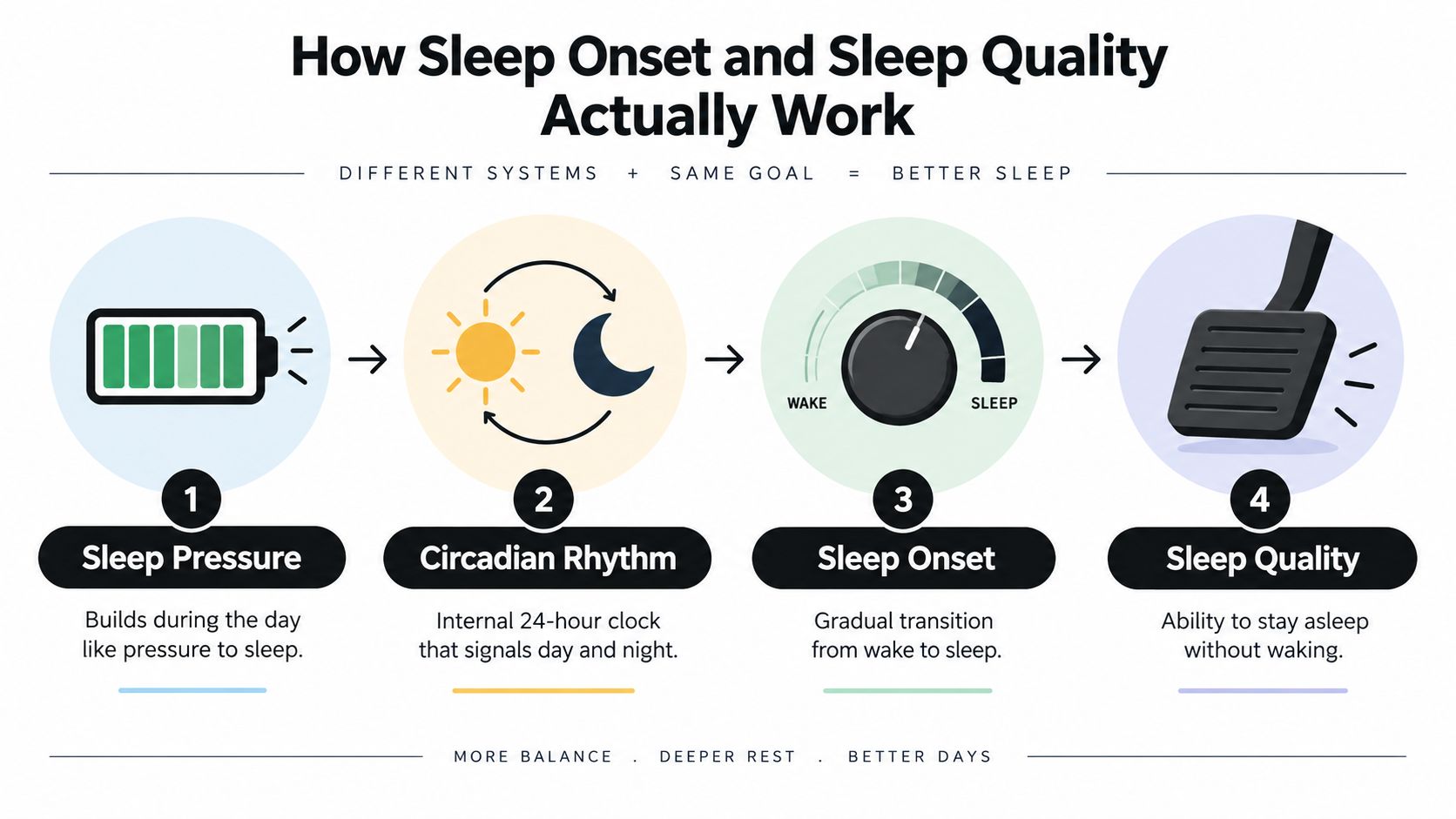
Sleep depends on several systems working together. A useful analogy is a room with a battery, a clock, a dimmer switch, and a brake pedal.
The battery and the clock
Sleep pressure is the battery that fills as you spend the day awake. The longer you remain awake, the stronger the biological drive to sleep generally becomes. A late nap, irregular schedule, or extended time in bed can change how much pressure you feel at night.
Circadian rhythm is the internal clock. It helps coordinate alertness during the day and sleepiness at night, responding to cues such as light, daily routines, and meal timing. A person can feel exhausted but still struggle to sleep if their internal clock is signaling that the biological day hasn't ended.
Melatonin belongs mainly to the clock side of this analogy. It isn't a sedative in the simple sense of knocking someone out. It acts more like a nighttime signal, helping align sleepiness with the desired sleep period. That distinction matters for people whose main problem is a delayed schedule rather than racing thoughts.
The dimmer switch and the brake pedal
Sleep onset is the transition from wakefulness into sleep. It works more like a dimmer switch than a light switch. Your body gradually lowers alertness, muscle activity, attention, and responsiveness. Stress can keep that dimmer from turning down, even when sleep pressure is high.
Sleep quality describes what happens after you fall asleep. Staying asleep, moving through normal sleep stages, and waking with reasonable alertness all matter. A person who falls asleep quickly but wakes repeatedly has a different problem from someone who lies awake at bedtime.
Magnesium is often considered in the physical relaxation and sleep-continuity part of the picture. Ashwagandha fits most naturally when mental strain, stress, or an overactive evening response appears to interfere with rest.
Match the ingredient to the obstacle
Before choosing a formula, write down your dominant complaint in plain language:
Delayed timing: You aren't sleepy until much later than you want.
A busy mind: Your body is tired, but thoughts keep returning.
Light or unsettled sleep: You fall asleep but don't feel that your sleep is restorative.
Morning heaviness: You sleep, yet waking alertness remains poor.
Those descriptions aren't diagnoses. They're a starting point for choosing a more targeted routine. The same ingredient won't be equally useful for every pattern, which is why the three-ingredient question works better as a matching exercise than as a popularity contest.
The Three High Value Ingredients Explained
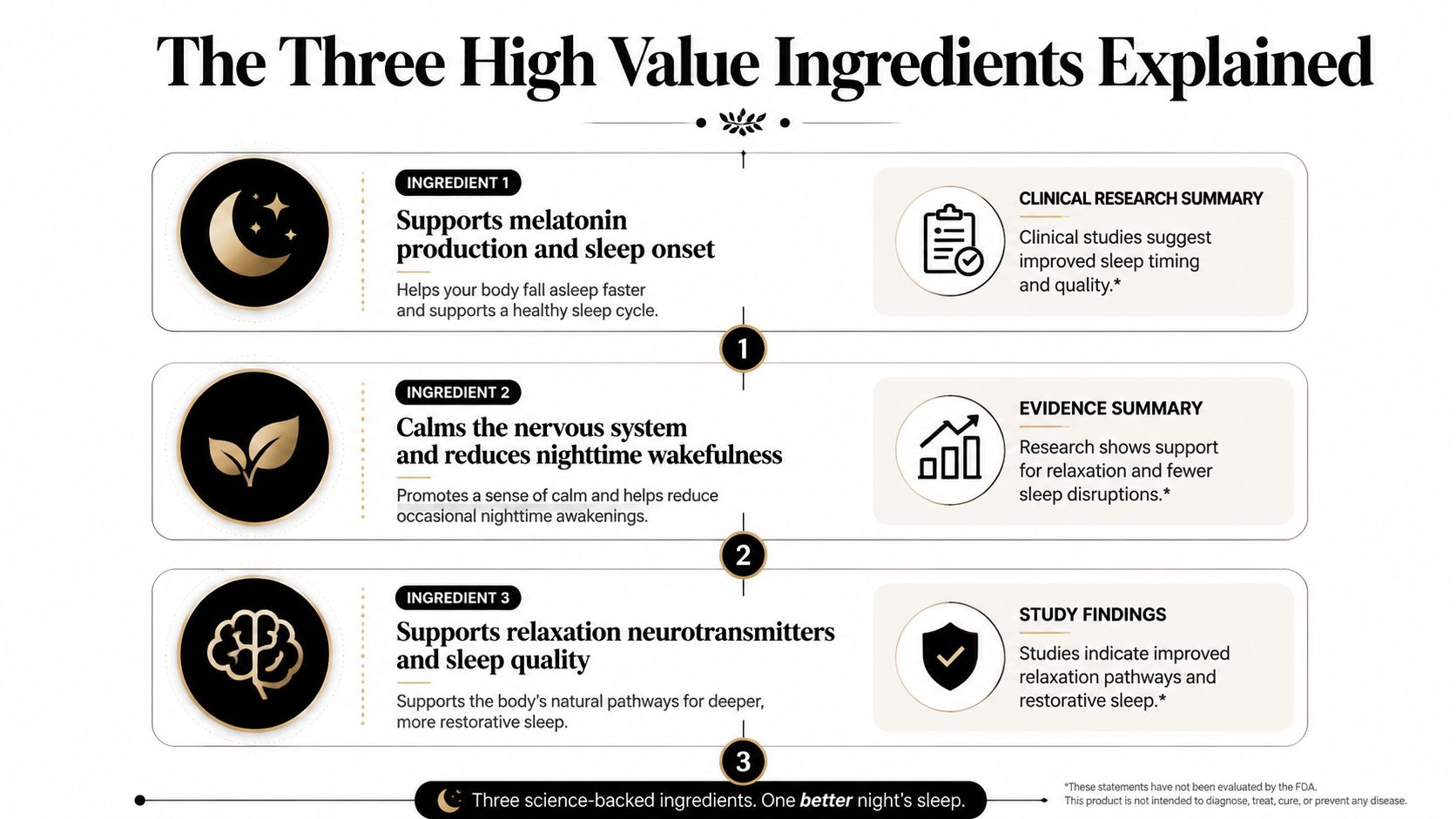
The strongest three-ingredient framework here uses melatonin, magnesium, and ashwagandha. Each has a different role, and the quality of evidence isn't identical across all three.
Melatonin supports sleep timing
Melatonin is most useful to understand as a circadian timing signal. It helps the body recognize that the biological night has arrived, so it tends to make the most sense for someone whose sleep schedule runs late or whose bedtime varies.
A meta-analysis of 19 randomized placebo-controlled trials involving 1,683 participants found that melatonin reduced sleep-onset latency, increased total sleep time, and improved overall sleep quality. The reported benefits didn't appear to diminish over time in those trials. The nutrition review and its cited evidence also place melatonin among the dietary interventions most consistently associated with improved sleep outcomes.
Commonly studied melatonin doses are 0.5 to 5 mg, as summarized in the same evidence review. Timing matters because melatonin is about biological night, not taking the largest possible amount at bedtime. A person should also consider next-morning effects, product quality, and medication interactions before using it regularly.
Magnesium supports a calmer physical state
Magnesium is a mineral involved in many body processes, and sleep formulas commonly use it for relaxation and nighttime stability. Its evidence is more mixed than melatonin's, so it deserves a measured explanation rather than a universal promise.
The nutrition review summarizes commonly studied magnesium amounts at roughly 250 to 500 mg elemental magnesium. It also discusses a human trial using 250 mg elemental magnesium bisglycinate in 155 poor sleepers, which found a statistically significant reduction in insomnia severity. The stronger effects appeared among people with low dietary magnesium intake. Read the nutrition review for the magnesium findings and broader ingredient evidence.
The word elemental matters. A label may state the weight of a magnesium compound rather than the amount of magnesium itself. Different forms can also vary in tolerance, so a product that causes digestive discomfort isn't necessarily a good fit because its label lists magnesium.
Ashwagandha fits stress-linked sleep
Ashwagandha has the clearest sleep-specific role in this three-ingredient group when stress appears to be part of the problem. Rather than functioning primarily as a clock signal, it may help a stressed sleeper move out of a persistent alert state.
A systematic review and meta-analysis of 5 randomized controlled trials involving 400 participants found a significant improvement in overall sleep versus placebo, with a standardized mean difference of -0.59 and a 95% confidence interval from -0.75 to -0.42. The analysis reported larger effects in adults with insomnia, with doses of at least 600 mg per day and treatment lasting at least 8 weeks. It also reported improvements in sleep-onset latency, total sleep time, and mental alertness on rising. The PubMed-indexed meta-analysis contains those findings.
That time frame changes how you judge it. Ashwagandha isn't the ingredient to assess after one restless evening. Consistent daily use over 8 or more weeks is closer to the evidence, although longer-term safety, interactions, and persistence of benefits remain less certain. A practical review of ashwagandha and sleep highlights those evidence gaps and cautions against presenting ashwagandha as a universal sleep solution.
For a broader discussion of how ashwagandha may fit into a nightly routine, see this sleep and recovery guide about ashwagandha.
The most useful takeaway is not that one ingredient wins. Melatonin may help set the clock, magnesium may suit physical tension or inadequate dietary intake, and ashwagandha may be better matched to stress-linked sleep disruption. Their complementary roles explain why a carefully dosed combination can be more logical than a collection of unrelated ingredients.
Choosing the Right Ingredient for Your Sleep Problem
Start with the symptom you want to change, not the ingredient you saw most often online. The following comparison keeps the distinctions clear.
Which Sleep Ingredient Fits Your Needs Best
Ingredient | Primary Mechanism | Best For | Evidence Note |
|---|---|---|---|
Melatonin | Supports circadian timing and the transition toward sleep | People whose sleep schedule is delayed or poorly aligned with their intended bedtime | A meta-analysis of 19 randomized placebo-controlled trials found improvements in sleep onset, total sleep time, and overall sleep quality. Evidence review |
Magnesium | Supports physical relaxation and may help sleep stability | People with low dietary magnesium intake or physical restlessness at night | Evidence is mixed, but a trial of magnesium bisglycinate found a significant reduction in insomnia severity among poor sleepers. Evidence review |
Ashwagandha | Supports stress regulation and sleep quality | Stressed sleepers, people with insomnia symptoms, and those whose minds remain activated at night | A meta-analysis of 5 randomized controlled trials found improved overall sleep, with stronger results at 600 mg per day or more and at least 8 weeks of use. Meta-analysis |
A delayed-sleep sleeper may prioritize melatonin because the central issue is timing. Someone who falls asleep but wakes feeling unsettled may look more closely at magnesium, especially if their diet supplies little magnesium. A person who notices that deadlines, worry, or emotional strain reliably worsen sleep may find ashwagandha more relevant than a purely timing-focused ingredient.
The categories can overlap. Stress can delay bedtime, and a delayed schedule can increase frustration, so the best fit isn't always obvious. A combined approach makes the most sense when the person has more than one clearly related obstacle, rather than adding ingredients because more sounds stronger.
The decision point: Ask whether your main barrier is timing, physical restlessness, or stress-driven arousal. Then choose the ingredient that addresses that barrier first.
Some people also look beyond these three ingredients. Tart cherry products, for example, appear in broader sleep-support discussions, but they shouldn't automatically replace a targeted choice. You can explore how that option is positioned in this guide to tart cherry gummies, while keeping the same rule: match the product to the sleep problem and inspect the actual label.
How to Use the Three Ingredients Safely and Effectively
A good formula can underperform if you use it randomly. Timing, dose consistency, and careful observation give you a better chance of learning whether the routine suits you.
Build the evening around timing
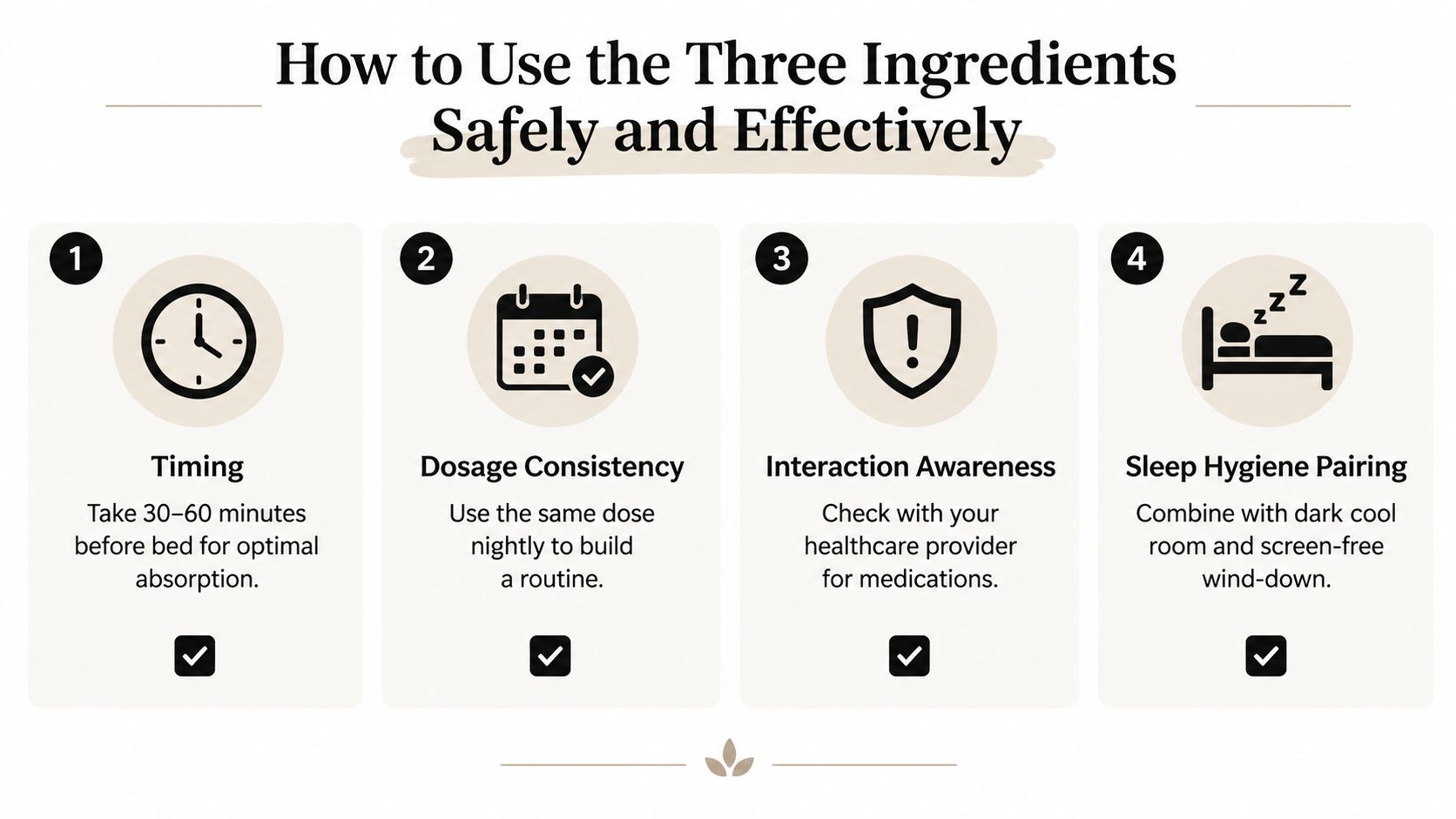
Many sleep products are used 30 to 60 minutes before bed, a timing window shown in the supplied usage guidance. Melatonin is especially dependent on the relationship between the dose and your intended sleep schedule. Magnesium may fit into the same evening routine, while ashwagandha requires a longer pattern of consistent daily use rather than occasional use only on difficult nights.
Follow the product label when its directions differ, and don't assume that combining separate products creates the same dose as a tested formula. Check whether the label lists elemental magnesium, the type and standardization of ashwagandha extract, and the exact melatonin amount.
Use consistency as part of the experiment
Take the same planned dose at the same general time each evening. Keep a brief record of three outcomes:
Sleep onset: How long you think it took to fall asleep.
Nighttime continuity: Whether you noticed awakenings or prolonged wakefulness.
Morning state: Whether you felt alert, foggy, or unusually sluggish.
Ashwagandha research is particularly important here. The sleep meta-analysis found stronger results with at least 600 mg daily and treatment lasting at least 8 weeks, as reported in the clinical evidence. That doesn't mean everyone should automatically take that amount. It means a short, inconsistent trial may not tell you much about whether the ingredient fits your pattern.
Review safety before adding anything
Talk with a healthcare professional before using a sleep formula if you're pregnant or breastfeeding, managing a medical condition, or taking prescription or over-the-counter medication. Melatonin, magnesium, and ashwagandha can each raise different questions depending on your health history and other products.
Stop and seek advice if you develop a concerning reaction. Don't stack several sleep formulas at once, because overlapping ingredients make it harder to identify the cause of side effects and can push total intake beyond the intended amount.
Pair supplements with a dark, cool bedroom and a screen-free wind-down. These aren't cosmetic additions. They reduce competing signals that tell the brain to stay alert, making the supplement routine part of a broader sleep environment rather than the entire strategy.
How Multi Ingredient Formulas Fit Into a Sleep Routine
A multi-ingredient capsule can simplify the daily habit when the formula uses complementary ingredients in transparent amounts. Instead of keeping separate bottles beside the bed, a person may prefer one clearly labeled product that combines the ingredients relevant to their routine. Convenience matters because a plan that's difficult to follow often becomes inconsistent.
Label reading remains essential. Look for the amount of each active ingredient, the form of magnesium, the extract type and standardization for botanicals, serving instructions, allergen information, and warnings. “Proprietary blend” language can make it difficult to determine whether the formula contains meaningful amounts.

Absorption and formula design
Ingredient selection isn't the only formulation question. Absorption can change depending on the delivery system and the ingredients paired together. Piperine, the active compound in black pepper extract, has been reported in PubMed-indexed literature to increase curcumin bioavailability by about 20-fold, often described in later reviews as roughly a 2,000% increase through effects on intestinal and hepatic glucuronidation. The PubMed literature on piperine and curcumin supports the rationale for pairing those compounds, although that evidence concerns curcumin absorption rather than proving a sleep benefit.
River of Life Capsules are one example of a broader wellness formula rather than a dedicated three-ingredient sleep product. The capsule combines turmeric extract with BioPerine, alongside ashwagandha root, ginger, and bromelain, and is presented as a vegan capsule for stress resilience, sleep quality, joint comfort, and mental clarity. If your priority is specifically the melatonin, magnesium, and ashwagandha combination, compare the label carefully because a broader formula may not contain all three sleep anchors.
For people who prefer to avoid melatonin, this natural sleep aid guide without melatonin offers another way to think about ingredient selection. The same principle applies: choose based on your sleep pattern, verify the label, and discuss regular use with a clinician when medication or health conditions are involved.
Your Next Steps to More Restful Nights
Better sleep usually starts with a specific match. Melatonin suits timing problems, magnesium may fit physical restlessness or low dietary intake, and ashwagandha is most relevant to stress-linked sleep disruption, with research suggesting that consistent use over 8 or more weeks is more informative than a few isolated nights. The ashwagandha meta-analysis supports that longer evaluation window.
Try a simple seven-night observation period for the routine you choose, while remembering that this short period can show patterns but can't fully assess an adaptogen. Keep bedtime and wake time reasonably stable, take the product according to its label, and record sleep onset, nighttime awakenings, and morning alertness. Change only one major variable at a time so you can tell what helped or caused a problem.
If stress remains high, treat the wind-down routine as part of the intervention. Dim the room, put screens away, and give your body a predictable transition into sleep. If sleep problems persist or include breathing changes, severe daytime sleepiness, or significant distress, ask a healthcare professional for an evaluation instead of adding more supplements.
River of Life offers a vegan, capsule-based wellness formula featuring turmeric extract with BioPerine, ashwagandha root, ginger, and bromelain, with one-time and subscription purchase options. Visit River of Life to review the formulation and decide whether it fits your broader stress, recovery, and sleep-support routine.