
Curcumin Bioavailability: Why It Matters and What Works

What if the most important question about a curcumin supplement isn't how many milligrams it contains, but how much your body can use? Turmeric has a long history as a food and botanical ingredient, yet curcumin bioavailability is a difficult pharmacology problem. A compound can look impressive on a label and still reach the bloodstream only in a limited, short-lived form.
That's why “more curcumin” and “more absorbed curcumin” aren't interchangeable ideas. The useful comparison is not between a spice and a capsule. It's between delivery systems, meal conditions, metabolic barriers, and human pharmacokinetic measurements. The science becomes much easier to understand once you separate the universal problem, poor absorption, from the formulation-specific attempts to solve it.
Table of Contents
Why Curcumin Bioavailability Deserves Your Attention
Turmeric is the root, while curcumin is one of its principal curcuminoid compounds. Adding turmeric to a curry gives you a food ingredient mixed into a larger meal. A supplement, by contrast, may provide a concentrated extract, a root powder, or a specialized delivery system. Those products can have very different amounts of curcuminoids and can behave differently after swallowing.
Bioavailability means the fraction of an oral dose that reaches the systemic circulation in a form the body can measure. For curcumin, the challenge starts before the compound crosses the gut wall. It dissolves poorly in the watery environment of the intestine, then faces rapid metabolism in the intestine and liver. Whatever reaches circulation may also be cleared quickly.
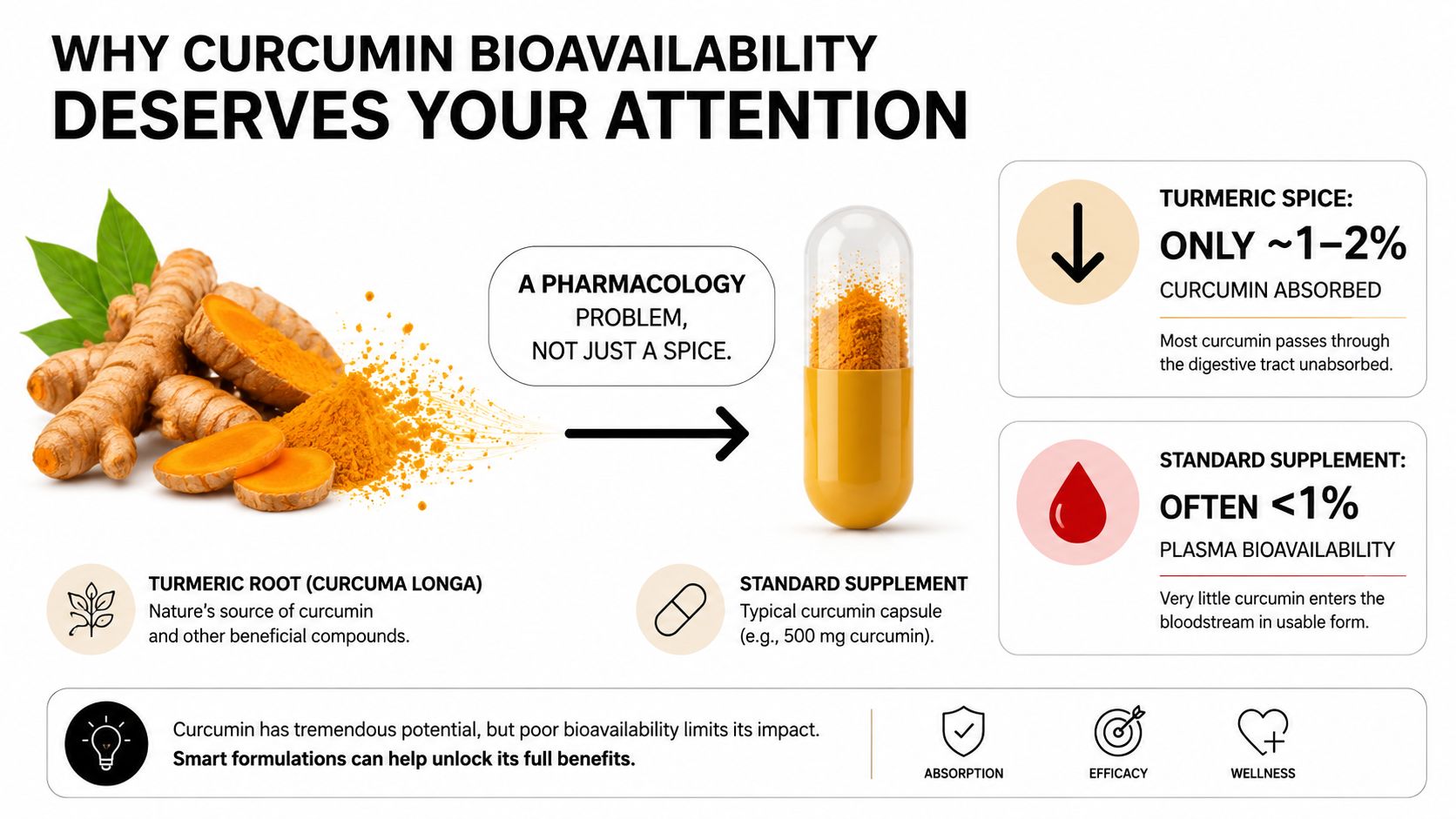
A 1998 human study established one of the most widely cited attempts to address this problem. Participants received 2 g of curcumin with 20 mg of piperine, and the researchers reported a 2000% increase in bioavailability at about 45 minutes after dosing. The same paper reported a 154% increase in rats, helping establish piperine as an early absorption enhancer for curcumin. You can review the original findings in the human and animal piperine pharmacokinetic study.
That headline is important, but it isn't a universal promise for every product containing black pepper extract. The practical questions are more precise:
Why does standard curcumin underperform after oral dosing?
Which formulation strategies have produced measurable human exposure?
What should you look for on a label before treating an “enhanced absorption” claim as meaningful?
The rest of the answer depends on understanding the barriers first.
The Three Walls Blocking Curcumin Absorption
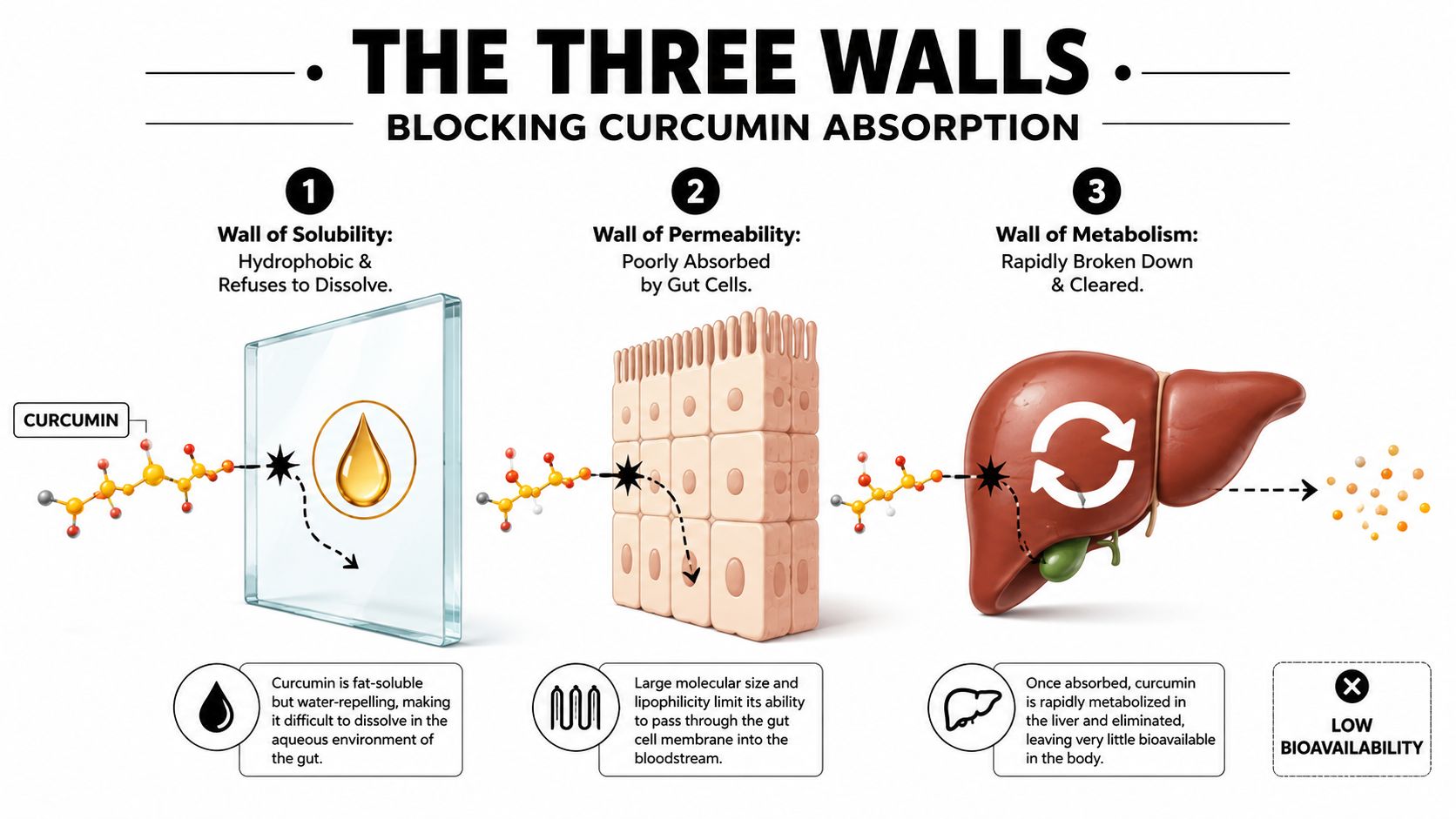
Curcumin encounters several obstacles in sequence. Think of oral dosing as trying to get a parcel from the intestine into the bloodstream, then keep it there long enough to measure. A parcel that doesn't dissolve, can't cross the gate, or gets removed immediately won't create much circulating exposure.
The first wall is solubility
Curcumin is hydrophobic, meaning it doesn't dissolve readily in water. Intestinal fluid is largely aqueous, so undissolved particles have fewer opportunities to interact with the intestinal surface. The analogy is simple: oil droplets in a glass of water remain separate unless something helps disperse them.
This points toward solubility-focused delivery systems, such as micelles, liposomes, lipid complexes, and smaller particles. These approaches try to present curcumin in a form that digestive fluids can handle more effectively.
The second wall is intestinal processing
Even dissolved curcumin must pass through gut cells. Intestinal enzymes can transform it through processes such as glucuronidation and sulfation. The liver adds another metabolic checkpoint after absorption. A useful image is a security desk that immediately tags incoming parcels for removal before they reach the main circulation.
Piperine mainly targets this metabolic wall. By slowing some metabolic processes, it can allow more parent curcumin to remain available for measurement. That mechanism differs from a micelle, which primarily helps with dispersion and transport.
The third wall is clearance
Curcumin that reaches the bloodstream doesn't necessarily remain there. Systemic clearance can reduce circulating parent curcumin quickly, and blood exposure doesn't guarantee retention in a particular tissue. This is why a high dose alone may not solve the problem. If the body removes the compound rapidly, increasing the amount swallowed may produce less improvement than changing the delivery system.
Pharmacology rule: The strongest formula isn't automatically the one with the largest dose. It's the one that addresses the limiting step demonstrated in human testing.
The three walls also explain why marketing claims vary so widely. One product may inhibit metabolism, another may improve solubility, and a third may combine several mechanisms. Those products shouldn't be treated as interchangeable.
How Formulations Try to Break Through Those Walls
Piperine is the familiar entry point because it addresses metabolism rather than trying to make curcumin water-soluble. The 1998 study used 2 g of curcumin and 20 mg of piperine, with the large increase measured shortly after dosing. A later review of clinical trials reported a crossover comparison in which 2000 mg of curcumin plus 20 mg of piperine produced an AUC of about 80 ± 10 ng·h/mL, compared with about 4 ± 2 ng·h/mL for 2000 mg of curcumin alone, an exposure difference of roughly 20-fold. The review also cautioned that the original 2000% figure is formulation- and methodology-dependent. See the review of curcumin clinical trials and bioavailability.
Other platforms work differently:
Phospholipid complexes: Curcumin is associated with phospholipids, which have both water-compatible and fat-compatible regions. This can improve dispersion and facilitate interaction with biological membranes.
Micellar systems: Surfactant structures surround poorly soluble compounds and help disperse them in digestive fluid. They're designed to improve the solubility wall.
Liposomal delivery: Lipid vesicles package curcumin inside membrane-like structures. The intended advantage is compatibility with the body's natural handling of fats.
Polymeric and solid-lipid particles: These systems can alter particle size, protect the payload, and influence release and clearance.
Combination formulas: A product may pair a delivery platform with piperine, using one component to support dispersion and another to slow metabolism.
Formulation | Primary mechanism | Barrier targeted | Typical human-study evidence |
|---|---|---|---|
Curcumin with piperine | Slows aspects of metabolic clearance | Intestinal and hepatic metabolism | Large exposure increases have been reported, but results depend on the product and study method |
Phospholipid complex | Associates curcumin with amphiphilic lipids | Solubility and membrane interaction | Human studies measure improved exposure for some named complexes |
Micellar system | Disperses curcumin in a water-compatible structure | Poor aqueous solubility | Human studies can show substantially higher exposure than unformulated curcumin |
Liposomal system | Uses lipid vesicles for transport | Solubility and digestive handling | Results vary with vesicle design and comparator |
Polymeric or solid-lipid particle | Changes particle size, protection, and release | Solubility and clearance | Human performance is formulation-specific and requires direct testing |
A black pepper ingredient is therefore a mechanism, not a quality certificate. Readers who want the food-based context can also review this discussion of curcumin with black pepper, but the decisive question remains whether the finished product has human pharmacokinetic evidence.
What Human Studies Show
Human studies measure curcumin exposure with AUC, Cmax, and time to peak concentration. AUC estimates total exposure during the sampling period, while Cmax records the highest measured concentration. Neither proves a health benefit by itself. Together, they answer a narrower question: how much of the administered compound reached the bloodstream?
The piperine findings established an important proof of concept. In the 1998 human study, 2 g of curcumin with 20 mg of piperine produced a reported 2000% increase in bioavailability at about 45 minutes. That result encouraged new approaches to delivery, but it is not a guaranteed multiplier for every capsule containing piperine.
A later crossover comparison provides useful context. In the review cited above, the piperine combination reached an AUC of about 80 ± 10 ng·h/mL, compared with about 4 ± 2 ng·h/mL for curcumin alone under the stated conditions. The difference was roughly 20-fold. Results still depend on the formulation, dose, study design, meal conditions, sampling period, and analytical method.
Formulation | Relative AUC vs standard | Cmax increase | Key human-study evidence |
|---|---|---|---|
Curcumin alone | Low exposure in the cited comparison | Not specified in the verified data | Crossover comparison summarized in the clinical-trial review |
Curcumin plus piperine | Roughly 20-fold in the cited AUC comparison | Not specified in the verified data | Clinical-trial review and the original 1998 study |
Modern enhanced formulations | Some can exceed unformulated curcumin by more than 100-fold in human studies | Varies by product | Independent reviews summarized in the 2025 human study report |
Multiple enhanced formulations tested head to head | Unconjugated curcumin remained below 2 nM in most cases | Not specified in the verified data | 2025 crossover study in healthy males |
The final row prevents an overly simple “add black pepper” conclusion. A 2025 crossover study found unconjugated curcumin plasma levels remained below 2 nM in most cases across multiple enhanced formulations, and piperine did not improve systemic uptake in that study. The report also noted that some modern formulations have demonstrated greater than 100-fold higher bioavailability than unformulated curcumin in human studies. Read the 2025 crossover findings on enhanced curcumin formulations for the study details.
“X times more bioavailable” has meaning only when the label or paper identifies the comparator, dose, meal state, sampling window, and endpoint. The listed weight of turmeric is not automatically the amount of curcuminoids. For the source-compound context, see curcumin in turmeric.
Dosing, Timing, and the Role of Dietary Fat
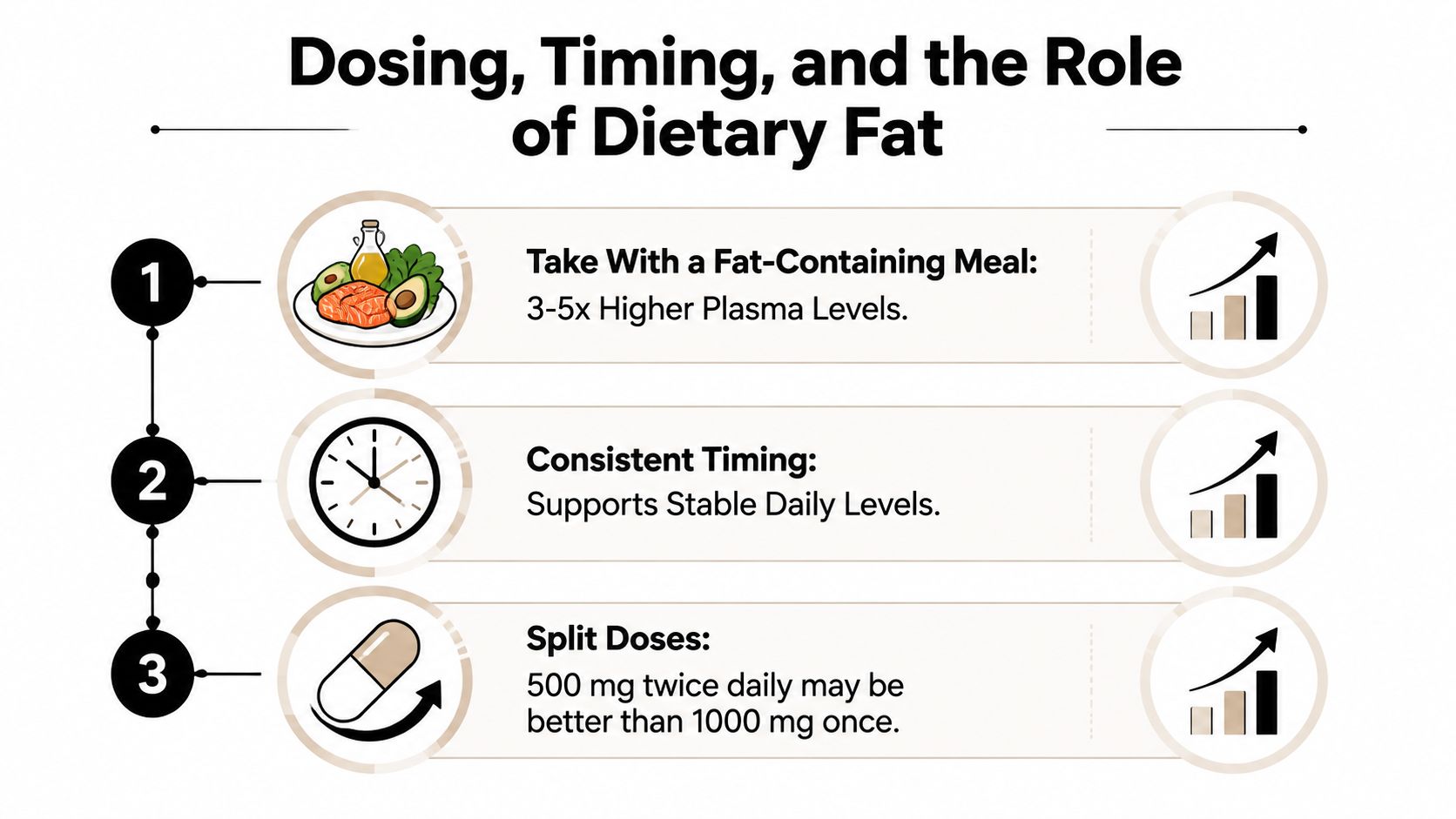
Meal context can change how a lipophilic compound behaves during digestion. Dietary fat stimulates bile release and helps form mixed micelles, structures that carry fat-soluble compounds through the intestinal environment. That's why a curcumin capsule taken with a meal may behave differently from the same capsule swallowed with water on an empty stomach.
The practical routine is straightforward:
Take it with food. A meal containing some dietary fat is a sensible default, especially for a conventional extract or lipid-based formula.
Follow the product's directions. A formulation designed for fasting use may have been tested under different conditions, so don't assume every capsule needs the same timing.
Consider consistency. Taking a product at a similar time each day makes your routine easier to follow and reduces avoidable variation in meal conditions.
Think about split dosing. If a product's directions call for a larger daily amount, dividing it may provide repeated exposure rather than one single absorption event, but the label and clinician guidance should take priority.
A label can also create confusion by listing the weight of turmeric extract instead of the amount of curcuminoids. “Turmeric” and “curcuminoids” aren't equivalent declarations. A specialized delivery system may produce higher exposure from a smaller labeled amount, while a large amount of ordinary root powder may contain much less active material.
Piperine can also change the timing and extent of exposure by slowing metabolic clearance. That doesn't mean it should be added casually to every regimen. Its effects can extend beyond curcumin, which matters if you take medicines that depend on metabolic enzymes or transport proteins.
Practical rule: Treat the meal state as part of the formulation. The capsule, the food, and the timing together determine what the body encounters.
Safety, Interactions, and the Limits of Enhancement
Higher exposure isn't automatically a better outcome. A pharmacokinetic result tells you that more compound appeared in blood, not that a person will experience a proportionally greater benefit. The appropriate target is enough validated exposure for the intended use, not unlimited absorption.
Piperine deserves particular caution because it can affect drug handling. Curcumin and piperine may influence pathways involving CYP3A4, glucuronidation, and P-glycoprotein. That creates a potential interaction issue for medicines whose blood levels depend on those pathways, including some statins, blood thinners such as warfarin, antiepileptics, and certain chemotherapeutic agents. The exact risk depends on the medication, dose, formulation, and individual patient.
Ask before combining
Speak with a prescriber or pharmacist before using a concentrated, enhanced curcumin product if you:
Take prescription medicines: Especially medicines with a narrow safety margin or known CYP3A4, glucuronidation, or P-glycoprotein handling.
Use anticoagulant therapy: Curcumin and piperine may add complexity to a regimen intended to control clotting.
Have a condition affected by concentrated supplements: Food-level turmeric and concentrated capsules aren't the same exposure scenario.
Plan to increase the dose: More capsules won't correct a formulation that hasn't demonstrated useful human exposure.
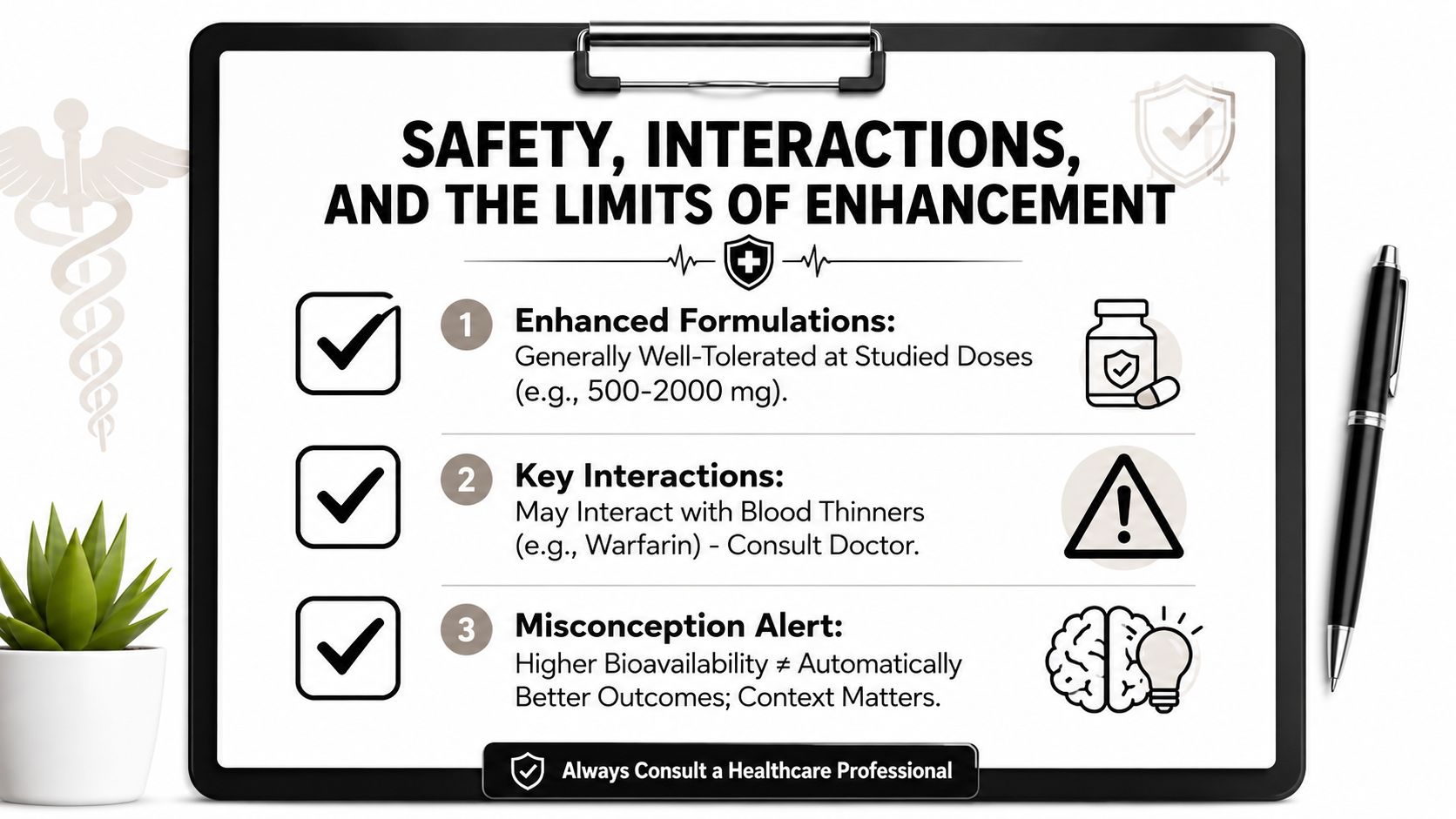
The 2025 crossover findings reinforce the need to check evidence rather than trust the phrase “high bioavailability.” In that study, piperine didn't improve systemic uptake, and unconjugated curcumin stayed below 2 nM in most cases across multiple enhanced formulations. The same evidence summary noted that some modern systems can produce more than 100-fold higher exposure than unformulated curcumin in human studies. Those results can coexist because the products and study methods differ.
Safety first: Choose a product for documented human performance and appropriate clinical context, not for the biggest promotional multiplier.
A Practical Guide to Choosing and Reading Labels
Start with the Supplement Facts panel, not the front-of-bottle artwork. You want to know whether the product contains turmeric root, a concentrated curcuminoid extract, or a named delivery system. A large turmeric number can sound impressive while revealing little about the amount of curcuminoids or the absorption strategy.
Use this label checklist
Curcuminoid disclosure: Look for the actual amount of curcuminoids per serving, not only the total weight of turmeric or turmeric extract.
Standardization: A stated standardization, often expressed as a curcuminoid concentration, is more informative than an unspecified root-powder claim.
Named technology: Look for a clearly identified platform, such as a phospholipid complex, micellar system, liposomal delivery, or a branded ingredient such as Meriva, BCM-95, CurcuWIN, NovaSOL, or Longvida.
Piperine amount: If black pepper extract is included, the label should identify the ingredient and its amount rather than hiding it inside a proprietary blend.
Independent quality checks: Seals or verification from organizations such as USP, NSF, or ConsumerLab can provide additional information about testing, when the specific product is covered.
Human evidence: A premium price makes more sense when the finished formulation has a published human bioavailability study that identifies its comparator and testing conditions.
A proprietary blend is a poor starting point for comparison because it may conceal how much of each active ingredient you're receiving. You also shouldn't treat a branded technology as proof of performance by itself. The relevant evidence is attached to the actual formulation, dose, and study design.
Match the platform to the purpose
For steady daily use, a phospholipid complex may appeal to shoppers who want a delivery system built around lipid association. Micellar or liposomal products may suit someone looking for a formulation specifically designed to improve dispersion, although direct human evidence still matters. Piperine combinations can be a simpler, budget-conscious option, but they deserve extra medication screening because piperine affects metabolic pathways.
River of Life Capsules is one example of a capsule formula that combines standardized turmeric extract with BioPerine black pepper extract, alongside ashwagandha, ginger, and bromelain. If you're comparing it with single-ingredient products, focus on the declared turmeric and piperine amounts, the directions, and whether the product fits your medication and health circumstances. The brand's educational guide on turmeric and curcumin supplements offers additional product context.
At the shelf, ask yourself one question: Can I verify what form of curcumin I'm buying, how much active material it provides, and whether human evidence supports that finished formula?
River of Life offers a vegan capsule combining standardized turmeric extract and BioPerine black pepper with ashwagandha, ginger, and bromelain, making its formulation relevant to readers comparing curcumin absorption approaches. Review the ingredients and purchase options at River of Life, and discuss any enhanced curcumin product with your healthcare professional if you take medication.