


Turmeric with Piperine: What Science Actually Shows

The most famous number in turmeric research is 2,000%. A foundational human pharmacokinetic study reported that adding piperine, the pungent compound in black pepper, increased curcumin bioavailability by that amount, with the effect appearing about 45 minutes after dosing. Yet newer research complicates the headline: in a 2025 study, unconjugated curcumin remained below 2 nM in most cases, even with high-dose piperine combinations, and piperine provided no measurable advantage in that setting (2025 pharmacokinetic reappraisal).
That apparent contradiction is the key to understanding turmeric with piperine. Piperine can change how the body absorbs and clears curcumin, but a higher blood level isn't automatically the same as a better clinical outcome. The result depends on the formulation, dose, type of curcumin measured, and the person's medications and health history.
Table of Contents
Why Turmeric With Piperine Matters
Curcumin is one of turmeric's principal compounds, yet ordinary oral curcumin has poor bioavailability. Only a limited amount reaches the bloodstream in a form researchers can measure. Its water solubility makes absorption difficult, while metabolism in the gut and liver can modify much of what enters the body before elimination.
Piperine, the pungent compound in black pepper, attracted attention because it may affect both stages. It can inhibit intestinal and hepatic glucuronidation, a process that helps prepare curcumin for clearance. In the foundational human study, adding piperine increased measured curcumin bioavailability by 2,000%, with the effect observed approximately 45 minutes after dosing (the pharmacokinetic review in PubMed Central).
The percentage describes measured exposure, not a guaranteed improvement in joint comfort, mood, sleep, or concentration. Pharmacokinetic studies examine how a compound moves through the body. Clinical trials examine whether people experience meaningful changes in symptoms or function. Those findings can inform each other, but they do not answer the same question.
The practical distinction: piperine may increase the amount of curcumin entering circulation, while that increase alone does not prove a larger health benefit.
The older result helps explain why many turmeric supplements include black pepper extract. It also leaves a practical question: why do modern formulations not all produce the same absorption effect? Formulation changes the answer. Delivery systems, the curcumin form being measured, dose, and study design can all influence the result. Recent reappraisals also found unconjugated curcumin often remained below 2 nM, showing why the classic headline needs careful interpretation rather than automatic translation into daily benefits.
How Piperine Changes Curcumin Absorption
Oral curcumin passes through two biological checkpoints. The intestinal wall controls how much enters circulation. Then intestinal and liver enzymes modify a portion of what gets through, preparing it for removal.
Curcumin's low water solubility makes the first checkpoint difficult. The gut is largely watery, but curcumin does not dissolve readily there. After absorption, glucuronidation attaches glucuronic acid to curcumin, producing forms that are more water-soluble and easier to excrete.
Piperine may slow part of this clearance. Mechanistic research indicates that it can inhibit intestinal and hepatic glucuronidation, which may raise measured curcumin exposure. It can also affect drug-metabolizing pathways and transport systems, so its effect is relevant to medication safety as well as absorption. The mechanism is summarized in this mechanistic review of curcumin and piperine.
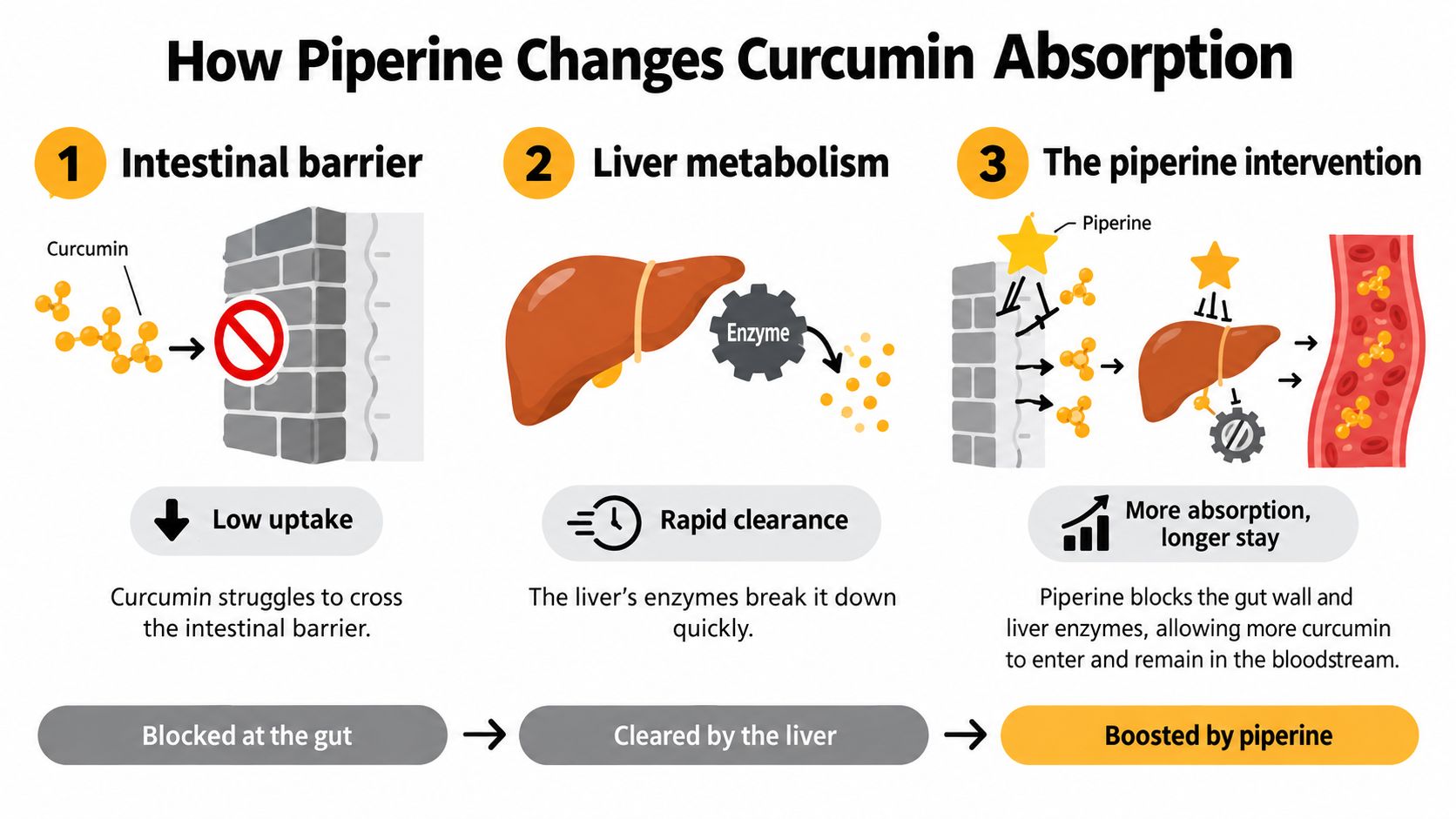
A simple way to read the mechanism
Without piperine, some curcumin molecules fail to cross the intestinal barrier, while others are rapidly converted into conjugated metabolites. Piperine may leave more of the absorbed dose in circulation long enough to be measured.
The measurement still matters. Total curcumin includes conjugated forms, whereas unconjugated curcumin is closer to the free compound. These are different signals, so a higher total level does not automatically mean more free curcumin reaches tissues.
The distinction is explained in this guide to curcumin bioavailability. Piperine's primary role is pharmacokinetic: it can alter absorption, metabolism, and measured exposure. That mechanism alone does not establish improvements in symptoms.
What 2025 Research Reveals About the Piperine Effect
The familiar piperine story is useful, but it does not apply equally to every product. A 2025 pharmacokinetic study compared a water-dispersible turmeric extract with a curcuminoid-piperine combination. The water-dispersible product reached a Cmax of 74.56 ng/mL, compared with 22.75 ng/mL for the piperine reference, despite using a 10-fold-lower active dose (study indexed by PubMed).
This finding does not make piperine useless. It shows that the delivery system can matter more than the presence of black pepper extract. A formulation that disperses curcuminoids in water or changes their delivery may produce higher measured exposure than a conventional piperine combination.
The free compound also presents a more complicated picture. In a 2025 reappraisal, unconjugated curcumin remained below 2 nM in most cases, even after high-dose curcumin with piperine, and the researchers found no measurable piperine benefit (2025 reappraisal of unconjugated curcumin exposure). A separate critical analysis found that 2,400 mg of curcumin plus 20 mg of piperine did not meaningfully improve systemic uptake, area under the curve, or unconjugated plasma levels compared with curcumin alone (critical reappraisal of piperine and high-dose curcumin).
Formulation Type | Baseline Bioavailability Issue | Effect of Adding Piperine | Unconjugated Curcumin Range |
|---|---|---|---|
Conventional curcumin or turmeric extract | Limited intestinal uptake and rapid clearance | May increase measured exposure, based on older human evidence | Can remain low, depending on the study |
Water-dispersible turmeric extract | Delivery system addresses part of the dispersion problem | May offer less additional value than expected | Modern studies show that levels vary by endpoint |
Curcuminoid-piperine combination | Piperine targets metabolism and clearance | Benefit is not guaranteed across formulations | Below 2 nM in most cases in one 2025 reappraisal |
Other engineered delivery systems | Absorption is addressed through the matrix itself | Piperine may add little or alter exposure differently | Must be validated in the specific product |
The practical conclusion is clear. Piperine is a tool, not a magic switch. A single-dose pharmacokinetic result may not predict steady daily use, and total curcumin exposure may not represent free curcumin or a meaningful clinical outcome. Product formulation, the measured form of curcumin, and the outcome being studied all deserve attention before making claims about benefits.
Evidence for Joint, Mood, Sleep, and Cognitive Benefits
A person taking turmeric with piperine usually cares less about plasma curves than about whether walking feels easier, sleep improves, or concentration becomes steadier. Clinical research is more encouraging for joint comfort than for the broader claims often attached to curcumin products, but the evidence still depends on the exact formulation and trial design.
Joint studies commonly assess pain, stiffness, and function with tools such as the WOMAC questionnaire. Some trials report improvement after regular use over several weeks, particularly in people with osteoarthritis. That doesn't make curcumin a pharmaceutical-grade analgesic. It means a well-absorbed formulation may support symptom management as one part of a broader plan involving movement, strength, sleep, and medical care.
Mood studies often use questionnaires such as the PHQ-9 or Beck Depression Inventory. Reported changes tend to be modest, and the signal may be more apparent in people who begin with higher inflammatory burden. Cognitive studies have examined outcomes such as working memory and processing speed, but the evidence remains preliminary. Sleep data are thinner still, and an improvement may occur indirectly when discomfort or anxious restlessness eases rather than because curcumin acts as a direct sedative.
A realistic expectation: joint comfort may be the most practical outcome to monitor, while mood, sleep, and cognitive effects should be treated as possible but unsettled.
Benefit Area | Typical Dose | Trial Length | Realistic Outcome |
|---|---|---|---|
Joint comfort | Often studied with curcumin and piperine combinations | Several weeks | Possible improvement in discomfort, stiffness, or function |
Mood | Formulation-dependent | Short to moderate duration | Modest questionnaire changes in some groups |
Sleep | Formulation-dependent | Limited evidence | Any improvement may follow reduced discomfort or stress |
Cognitive performance | Formulation-dependent | Often shorter trials | Preliminary findings for selected memory or processing measures |
The dose and duration figures sometimes repeated in consumer summaries aren't established across every product. Rather than assuming that one capsule will reproduce a published result, compare the product's extract, curcuminoid amount, piperine content, and study population. For a plain-language discussion of turmeric and joint discomfort, see this overview of turmeric and curcumin for arthritis and joint pain.
Practical Dosing, Timing, and What to Look for on the Label
A label can tell you whether a turmeric product is meaningfully specified or just dressed up with a large root-powder number. Start by identifying the actual curcumin or curcuminoid amount, then check whether the piperine quantity is disclosed separately.
Common supplement guidance often discusses 500 to 1,000 mg of curcumin daily and 5 to 10 mg of piperine, but those amounts aren't universal prescriptions and shouldn't be treated as guaranteed effective doses for every formulation. Piperine may be listed as BioPerine or as a standardized piperine extract. The product's evidence matters more than a familiar ingredient name.
Reading the label in the right order
Find the active amount. Look for a stated curcuminoid quantity rather than only “turmeric root powder.” If the label gives a standardization such as 95% curcuminoids, you can better understand what the capsule contains.
Check the piperine disclosure. A transparent label identifies piperine or a branded equivalent and states the amount. A proprietary blend that hides the piperine quantity makes comparison difficult.
Consider the delivery system. Curcumin may be paired with lipids, phospholipids, or a water-dispersible matrix. These approaches can matter because piperine isn't equally useful in every formulation.
Take it with food if tolerated. Curcumin is poorly water-soluble, so a meal may be more practical than taking a capsule on an empty stomach. If the product irritates your stomach, follow the label and ask a pharmacist whether splitting the daily amount makes sense.
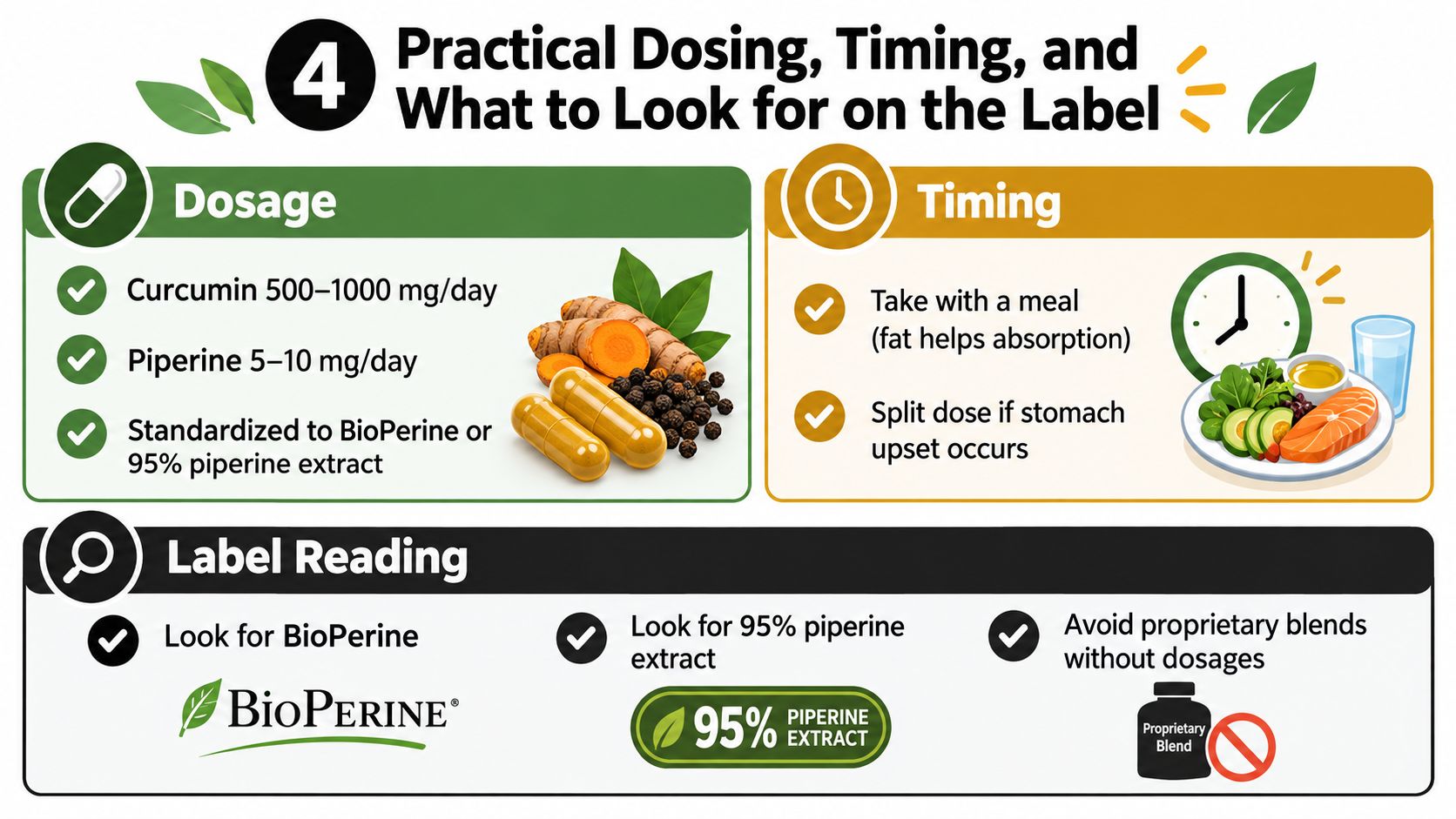
The label guidance at this turmeric and curcumin supplement resource is useful for seeing how a product presents its active ingredients. Avoid claims that promise to treat multiple diseases or guarantee dramatic results. A clear label can't eliminate uncertainty, but an unclear one prevents you from evaluating it.
Safety, Contraindications, and Drug Interactions
Most adults tolerate turmeric and piperine supplements reasonably well, but “usually tolerated” isn't the same as “appropriate for everyone.” Mild gastrointestinal effects can occur, while the more important concern is interaction with medicines and the possibility of rare liver injury associated with concentrated turmeric products.
A recent case-focused review linked turmeric-piperine combinations with drug-induced liver injury and noted that piperine has appeared in several DILIN cases (review of turmeric, piperine, and liver injury). The signal deserves attention even though it doesn't mean every user will develop a problem. Stop the supplement and seek medical advice if you develop symptoms such as unusual fatigue, dark urine, yellowing of the skin or eyes, or persistent nausea.
A practical risk screen
Lower concern: A healthy adult using a clearly labeled product at the manufacturer's standard serving, with no prescription medicines or liver, gallbladder, bleeding, or pregnancy concerns. Mild digestive discomfort remains possible.
Discuss it first: Anyone taking prescription medicines, especially drugs with a narrow safety margin, blood-thinning medicines, diabetes medicines, or treatments affected by liver enzymes and transport proteins. Piperine can inhibit drug-metabolizing enzymes and P-gp, potentially changing exposure to co-administered drugs.
Avoid self-starting: People with liver disease, bile-duct or gallbladder obstruction, active ulcer problems, or pregnancy should obtain individualized medical advice before using concentrated turmeric with piperine. Pharmacological supplement doses aren't equivalent to culinary use.
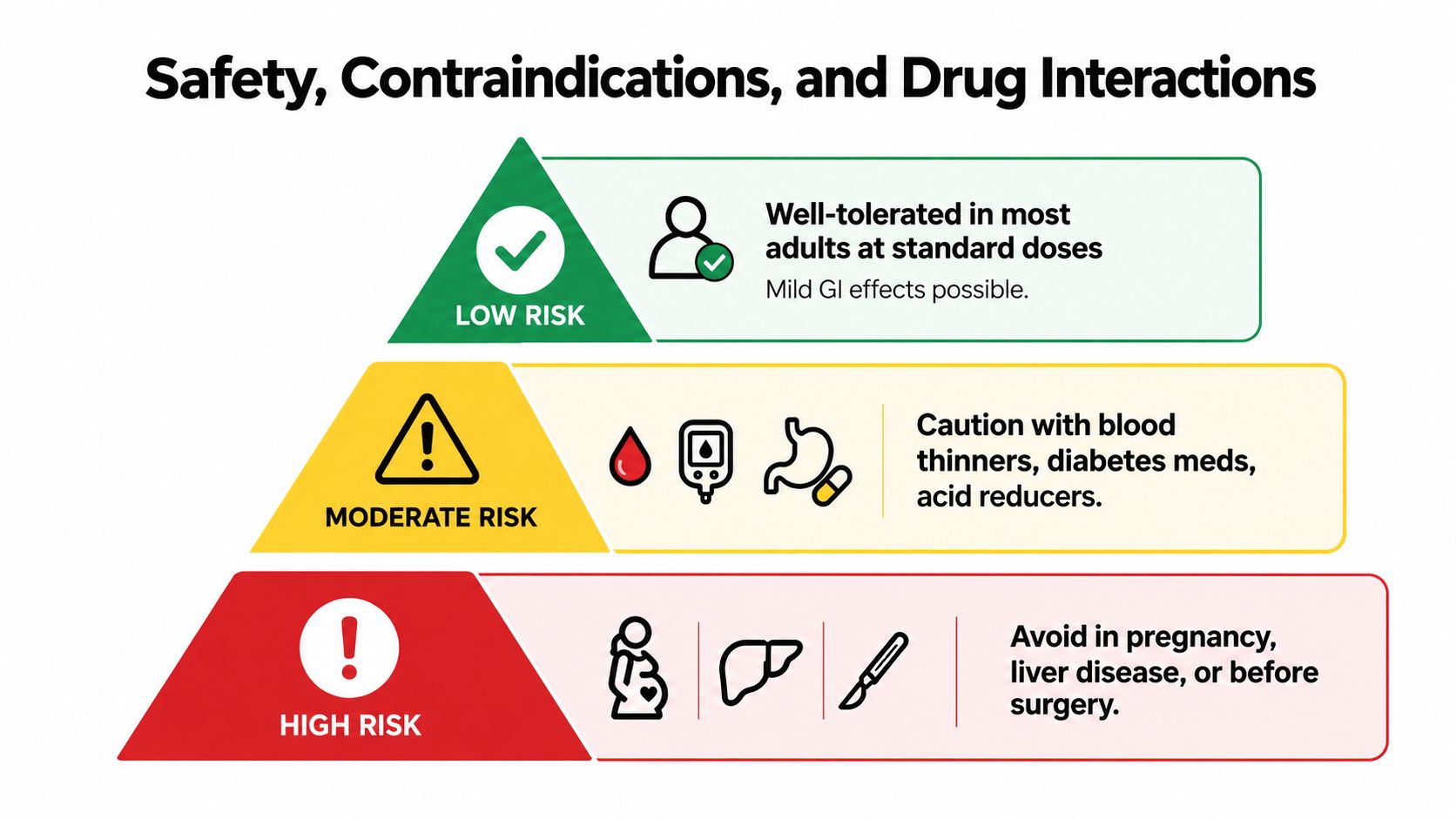
Surgery is another decision point. Because supplement ingredients can affect bleeding or medication handling, tell the surgical team exactly what you're taking and follow their instructions about stopping supplements before a procedure. A pharmacist can check the complete medication list more reliably than a generic online interaction chart.
The safest rule is simple: if you take chronic medication or have a diagnosed condition, don't use piperine to “boost” absorption without checking first. The same mechanism that raises curcumin exposure may alter exposure to something more medically important.
Choosing a Quality Turmeric With Piperine Supplement
A useful product comparison starts with the ingredient panel, not the front-of-bottle strength claim. “Turmeric” can mean a concentrated curcuminoid extract, a whole-root powder, or a blend in which the active amounts remain unclear.
Use these six checks:
Curcuminoid standardization. Look for a disclosed percentage and, ideally, information about curcumin, demethoxycurcumin, and bisdemethoxycurcumin. A stated 95% total curcuminoid standardization is easier to evaluate than an unspecified root amount.
Piperine source and dose. The label should identify BioPerine or an equivalent standardized extract and show the actual piperine amount. A black pepper ingredient without a dose doesn't tell you much.
Delivery design. Lipids, phospholipids, and micellar or water-dispersible systems may be used to address absorption in different ways. Don't assume adding piperine makes every matrix equivalent.
Independent testing. Look for accessible certificates of analysis and testing for identity, contaminants, and heavy metals. A recognizable third-party mark can help, but transparency matters more than a logo alone.
Capsule and excipient details. If vegan capsules or allergen exclusions matter to you, confirm them on the label. Check whether fillers, colorants, and flow agents are disclosed.
Purchase terms. Compare the cost per labeled serving, not just the bottle price. Subscription plans can support regular use, but read the billing, pause, cancellation, and return terms before enrolling.
A two-minute label check
Reject a product if it lists only “turmeric powder” without active standardization, hides piperine inside a proprietary blend, or combines several stimulants without stating their amounts. Prefer a product that identifies its extract, lists piperine separately, provides testing information, and avoids disease-treatment promises.
River of Life Capsules is one example of a vegan, capsule-based formula that combines standardized turmeric extract with BioPerine, along with ashwagandha, ginger, and bromelain. The brand offers one-time and subscription purchasing, so readers can compare its disclosed formulation and terms with other products rather than assuming that every turmeric-piperine capsule works the same way.
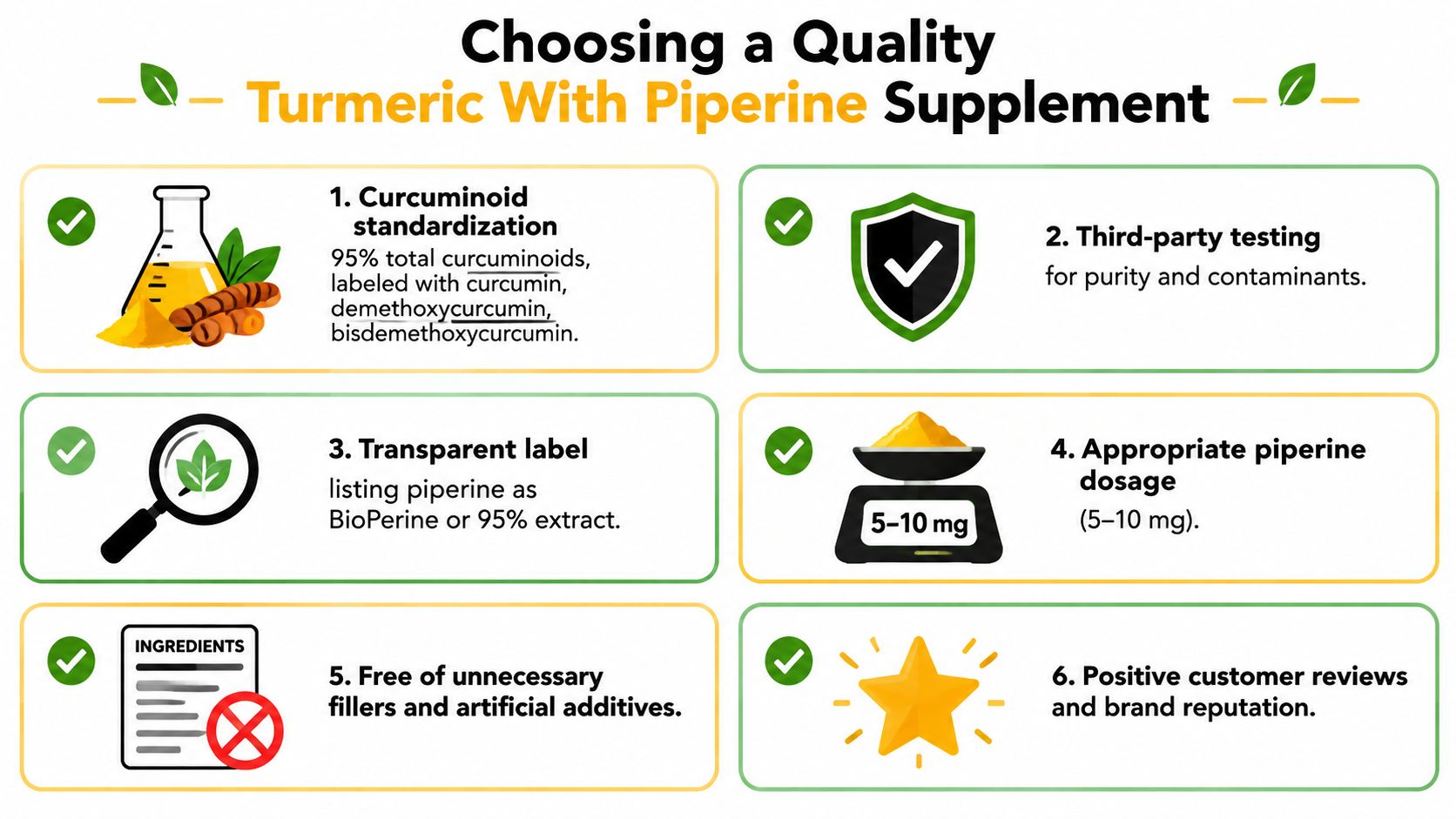
The central buying question is not “Does this contain black pepper?” It is “Does this product disclose enough information for me to judge the formulation, dose, quality controls, and safety fit?”
River of Life offers a vegan capsule formula combining standardized turmeric with BioPerine, alongside ashwagandha, ginger, and bromelain, with one-time and subscription options. If you're comparing turmeric with piperine products, visit River of Life to review the formula and purchase terms before deciding whether it fits your routine.