


Ashwagandha Daily Dosage: Optimal for Stress & Sleep

You're probably here because you searched for ashwagandha daily dosage and got a mess of answers. One label says to take a small amount once a day. Another article suggests a much larger dose. A forum post says powder and extract are the same thing, which they aren't. At that point, many either guess or give up.
That confusion makes sense. Ashwagandha dosage isn't one fixed number. The right amount depends on the form, the strength of the extract, and the reason you're taking it. Someone using it for stress relief may need a different approach than someone focused on sleep quality or mental clarity.
The practical way to think about it is this. Stop asking only “How many milligrams?” Start asking “What kind of ashwagandha is this, and what result am I trying to get?” That shift makes the research much easier to use in real life. If you want a broader framework for building a supplement routine around your needs, this guide to personalized turmeric and ashwagandha wellness routines is a useful next step.
Table of Contents
Finding Your Dose in a World of Conflicting Advice
If you've looked at three supplement labels and five blog posts, you've probably seen dosage advice all over the map. That's one reason people struggle with ashwagandha. They assume every product works the same way, then try to compare doses that aren't comparable.
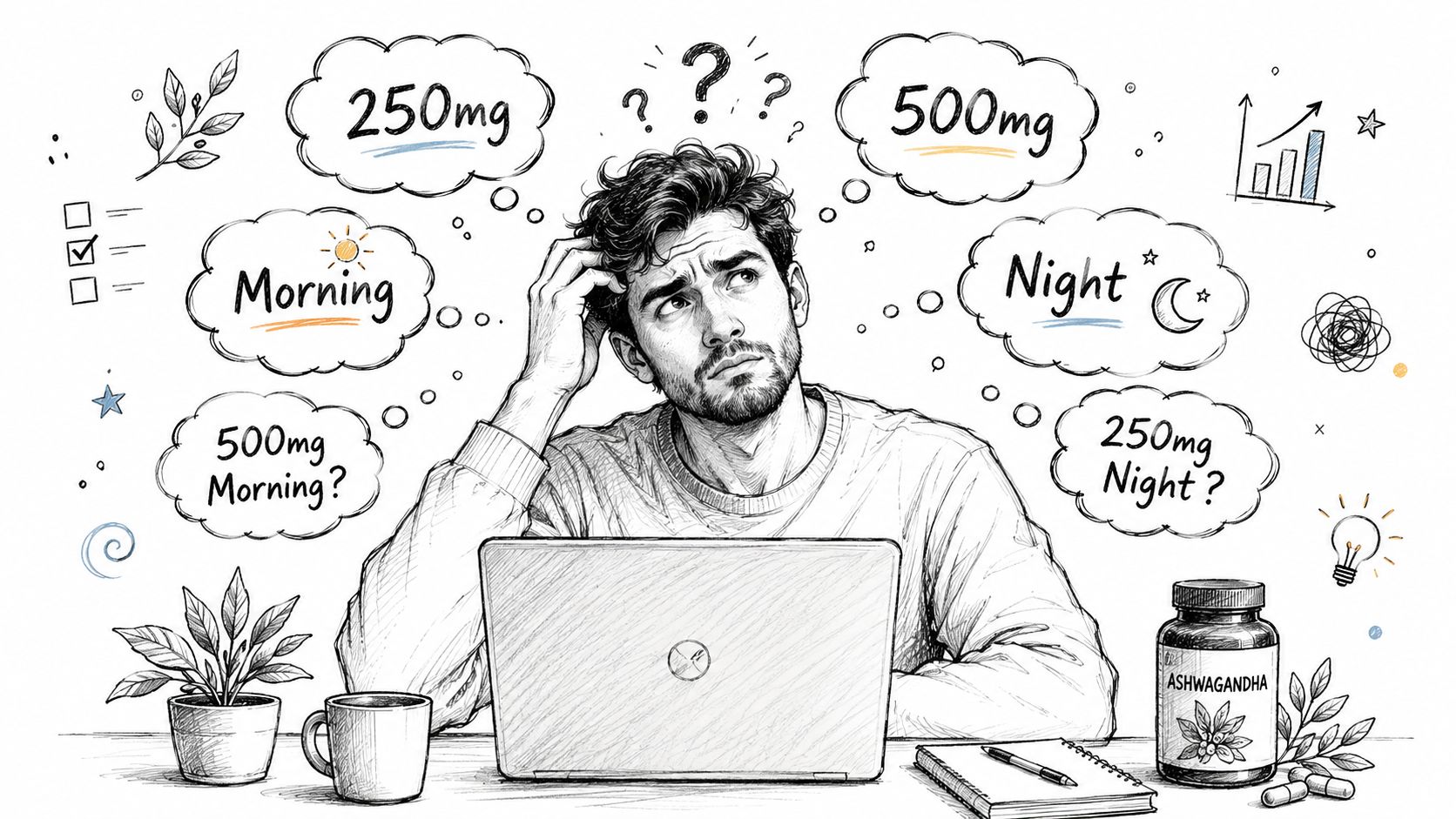
In practice, the best dose starts with three questions:
What is the form. Raw root powder and standardized extract are not interchangeable.
What is the goal. Stress, sleep, and cognition don't always respond best to the same amount.
How well do you tolerate supplements. Even a good dose on paper can feel too strong for some people.
A lot of poor results come from using the wrong product for the job. Someone buys a low-potency powder and expects the kind of response seen in studies using concentrated extracts. Another person takes a stronger formula at the wrong time of day and then assumes ashwagandha “doesn't agree” with them.
Start with the product type, then match the dose to the outcome you want. That's usually where the confusion clears up.
There's also a simple reality clinicians see often. A dose that's sensible for a calm, steady routine isn't always the same dose used in trials for people under high stress. Context matters. So does patience. Ashwagandha usually isn't a one-dose, one-day supplement. It works better when taken consistently and matched to the reason you're taking it.
Why Ashwagandha Dosage Is Not One-Size-Fits-All
A common real-world problem looks like this: one person takes 600 mg and feels calmer within a few weeks, while another takes the same number from a different product and notices very little. The label matches. The formula does not.

Milligrams alone don't tell the full story
The main reason is simple. Ashwagandha dosage depends on both what you are taking and what you want it to do.
Two products can list the same milligrams and still deliver very different results. One may be plain root powder. Another may be a standardized root extract concentrated for a defined level of active compounds. In practice, those are not interchangeable.
Root powder is broader and less concentrated. Standardized extract is measured so the amount of key compounds stays more consistent from serving to serving. For someone trying to match a study dose for stress, sleep, or focus, that difference matters more than the number printed in large type on the front of the bottle.
Coffee offers a useful comparison. The weight of the grounds matters less than the strength of the brew. With ashwagandha, the marker people usually look for is withanolide content, because that is how many extracts are standardized.
Why standardization changes the dosing conversation
Clinical trials for anxiety support do not use random herb amounts. They usually test a specific extract, at a specific daily dose, for a specific goal.
That is why broad advice like “take 300 to 1,000 mg” often creates more confusion than clarity. A low-potency powder used for general wellness is not the same as a standardized extract used in studies on stress or sleep. If the product label does not tell you the form and standardization, the milligram number has limited value.
This also explains why goal-based dosing is more useful than one blanket recommendation. Stress support often uses one extract range. Sleep support may respond to a different intake pattern and timeframe. Cognitive support can involve a different setup again. If you want a more specific breakdown for rest, this guide to how ashwagandha promotes better sleep and recovery shows why the product form matters as much as the dose.
Before comparing bottles, check four things:
Whether it is root powder or extract
Whether the extract is standardized
What the withanolide percentage is
Whether the dose fits your main goal
Practical rule: Match the dose to the goal and the extract type, not just the milligram count.
Other factors still shape response. Body size, sensitivity, whether you take it with food, and how your nervous system reacts to supplements can all change the experience. But the biggest mistake usually happens earlier. People compare products as if all forms of ashwagandha are equivalent, and they are not.
Clinically-Backed Ashwagandha Dosages by Goal
A reader trying to lower stress, sleep better, and stay sharper at work can easily end up with three different dosage suggestions from three different products. The practical fix is to stop asking for one perfect number and start matching the dose to the goal, the extract form, and the time frame used in human studies.
Stress and anxiety support
For stress support, the clearest clinical pattern is 600 mg per day of a standardized root extract, often split into 300 mg twice daily. In practice, this is the range I would look at first for someone whose main target is lower perceived stress, steadier mood, or better resilience under pressure.
Lower amounts can still make sense. Someone who is sensitive to supplements or prone to stomach upset may do better starting lower and building up. But if the question is which dose has the strongest track record for stress, 600 mg daily of a standardized extract is the benchmark used most often.
Sleep support
Sleep dosing is a little less tidy because the goal itself varies. Some people want easier sleep onset. Others want fewer wake-ups, better recovery, or calmer evenings. Across studies, 240 mg to 600 mg daily has been used for cortisol and sleep-related outcomes, with the stronger sleep findings showing up at 600 mg per day after sustained use.
The trade-off is speed versus patience. Sleep support from ashwagandha usually is not a one-night effect. It tends to build with consistent daily use over weeks. If better rest is your main goal, it also helps to pair dosing with good habits around timing and routine, as covered in this guide to ashwagandha for better sleep and recovery.
Focus and cognitive support
Cognitive support points to a different target. For adults under stress who want better memory or focus, 300 mg daily of root extract has been studied over a 90-day period, based on the NIH fact sheet for health professionals on ashwagandha.
That matters because it keeps people from overdoing the dose for the wrong reason. The amount often used for stress is not automatically the best starting point for mental performance. For cognition, a moderate daily dose with enough time to assess the response is usually the cleaner approach.
Health Goal | Clinically Studied Daily Dose | Typical Duration |
|---|---|---|
Stress and anxiety | 600 mg standardized extract, often 300 mg twice daily | Benefits may begin within 2 weeks and build over 6 to 10 weeks |
Sleep quality and cortisol support | 240 mg to 600 mg daily, with stronger sleep findings at 600 mg | At least 8 weeks |
Memory and focus in adults with high stress | 300 mg root extract daily | 90 days |
A few points make this easier to use:
Stress, sleep, and cognition do not point to the same dose.
Extract type matters as much as the milligram number. A standardized extract is the closest match to what was used in clinical trials.
Higher is not automatically better. The best dose is the one that fits the goal and is tolerated well enough to take consistently.
Duration matters. Ashwagandha works better as a steady daily supplement than as an occasional fix.
A Practical Guide to Taking Ashwagandha Daily
Once the dose makes sense, the next problem is routine. Good supplements fail all the time because people take them inconsistently, change timing every few days, or stop before the intended effect has a chance to build.

How to time it
The best timing depends on why you're using it.
If stress support is the main target and you're using a dose split across the day, morning and evening often make practical sense. If sleep is the focus, many people prefer the later portion of their daily amount closer to evening. If you're trying it mainly for focus, earlier in the day is usually the cleaner choice.
Take it with food if your stomach is sensitive. That won't solve every side effect, but it often makes daily use easier. People who take ashwagandha on an empty stomach and then feel off sometimes blame the herb when the issue is really tolerability.
Don't judge your response from one day. Judge it from a consistent routine.
What consistency looks like
The research on cortisol reduction and sleep shows that 240 mg to 600 mg daily can be effective, with the strongest sleep results at 600 mg per day after at least 8 weeks. That's why random use doesn't tell you much. If you're expecting better sleep, think in weeks, not nights.
A practical approach looks like this:
Start lower if you're sensitive. A cautious start helps you assess digestion, sedation, and general tolerance.
Keep the timing steady. Changing from morning to night every few days makes it harder to read your response.
Use the same product long enough to judge it. Constant brand switching creates noise.
Track one main outcome. Stress level, sleep quality, or focus. Pick one primary marker so you know whether it's helping.
For a quick visual overview, this short video is a useful companion:
Many individuals also ask whether they need to cycle off ashwagandha. In general practice, the bigger issue is not cycling. It's whether the person is using an appropriate product, at a sensible dose, for a clear goal. If you're tolerating it well and using it within researched ranges, consistency matters more than fancy scheduling.
Safety, Side Effects, and Who Should Avoid Ashwagandha
A common scenario is simple. Someone picks an ashwagandha dose for stress or sleep, feels hopeful for a few days, then gets stomach upset, feels too sleepy, or realizes they are also taking medication that could interact with it. Dose matters, but safety matters just as much.
Common side effects and when to stop
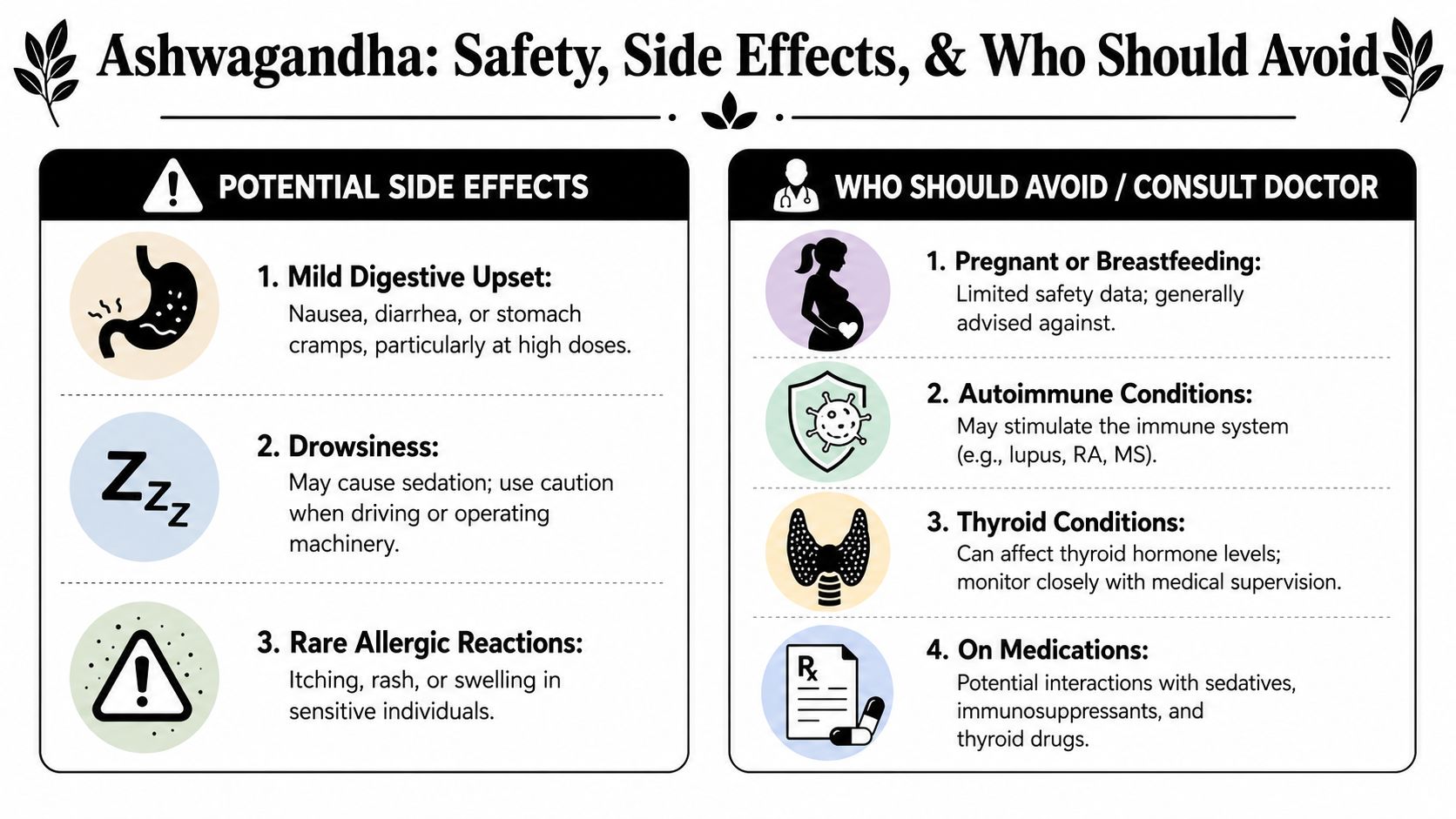
Ashwagandha is often tolerated reasonably well in short-term studies, but the side effects that do show up are predictable. The usual complaints are digestive, such as stomach discomfort, nausea, or loose stools. Some people also feel sedated, mentally dull, or oddly restless instead of calmer.
That response matters more than the label claim.
If your goal is better sleep, mild evening calm may be acceptable. If your goal is daytime focus, that same effect may be a bad trade-off. This is why the right ashwagandha daily dosage is not just about picking a researched amount. It is about matching the dose, extract, and timing to the outcome you want, then stopping if the response is pushing you in the wrong direction.
Stop and reassess if you develop persistent digestive symptoms, feel unusually groggy, notice agitation, or have any symptom that feels out of proportion to the expected effect.
Interactions are another reason people run into trouble. Use more caution if you take medicines that affect sleep, anxiety, mood, thyroid function, blood sugar, or immune activity. If you need to check combinations before trying it, read this guide to ashwagandha interactions and medication concerns.
A supplement should solve a problem, not create a second one.
Who should avoid it
Some groups should treat ashwagandha as a clinician-guided decision, not a casual add-on. Pregnancy is the clearest example. The Healthline review of ashwagandha dosage and safety notes safety concerns in pregnancy, and that alone is enough reason to avoid self-prescribing it.
Breastfeeding belongs in the same caution category. Human safety data are too limited to recommend routine use.
Use extra caution, and usually get medical clearance first, in these situations:
Pregnancy or breastfeeding: Avoid self-use.
Autoimmune conditions: Conditions such as lupus or rheumatoid arthritis deserve a medication and symptom review first.
Type 1 diabetes: Blood sugar effects and medication overlap make self-experimentation a poor idea.
Thyroid concerns or thyroid medication: Ashwagandha can affect thyroid-related physiology, so existing thyroid issues need individual review.
Sedating or psychiatric medications: Additive effects can change how you feel and function.
The practical mistake I see most often is assuming an herb is automatically low-risk. It is not. A dose that makes sense for stress in one person may be inappropriate in someone with thyroid disease, an autoimmune condition, or a pregnancy concern.
The Takeaway Finding Your Personal Dose
A smart ashwagandha daily dosage starts with the outcome you want, not with the biggest number on the bottle. For stress and anxiety, the clearest clinical pattern centers on a standardized extract at 600 mg per day, often split into 300 mg twice daily. For sleep, clinically studied amounts fall between 240 mg and 600 mg daily, with stronger sleep findings at the upper end after consistent use. For memory and focus in adults under high stress, 300 mg daily stands out.
That doesn't mean everyone should take the same formula or the same amount. It means your decision should follow three filters:
Choose the right form
Match the dose to the goal
Respect safety and tolerance
Start low if you're new to it. Increase only if the product is appropriate, your goal is clear, and your body is tolerating it well. Slow, boring consistency usually beats aggressive dosing.
If you're pregnant, breastfeeding, managing an autoimmune condition, dealing with thyroid concerns, or taking medication that could interact, get individualized advice before using it. The best dose is not the one that sounds strongest. It's the one that fits your health picture and gives you a useful response without creating new problems.
If you want a simple way to build ashwagandha into a daily wellness routine, River of Life offers a capsule-based formula that combines ashwagandha root with turmeric extract, ginger, bromelain, and BioPerine for a convenient all-in-one option.