


Choosing a Supplement for Mental Health: A Practical Guide
Most advice about a supplement for mental health starts with the wrong promise. It treats stress, poor sleep, low mood, and brain fog as if they were one problem with one botanical answer. They aren't. An ingredient that may help regulate stress isn't automatically a treatment for depression, and a product marketed for relaxation may do little for persistent insomnia or medication-related fatigue.
The smarter approach is narrower and less glamorous. Name the symptom, check the evidence for that specific outcome, inspect the dose and extract, then review interactions before buying. The guidance below gives you a symptom-to-ingredient map, a label checklist, and a clear boundary between useful support and wishful marketing.
Table of Contents
The Ingredients With Real Evidence and the Ones That Are Mostly Hype
Fitting a Supplement Into a Real Lifestyle Without Overthinking It
Why Most Mental Health Supplement Advice Misses the Point
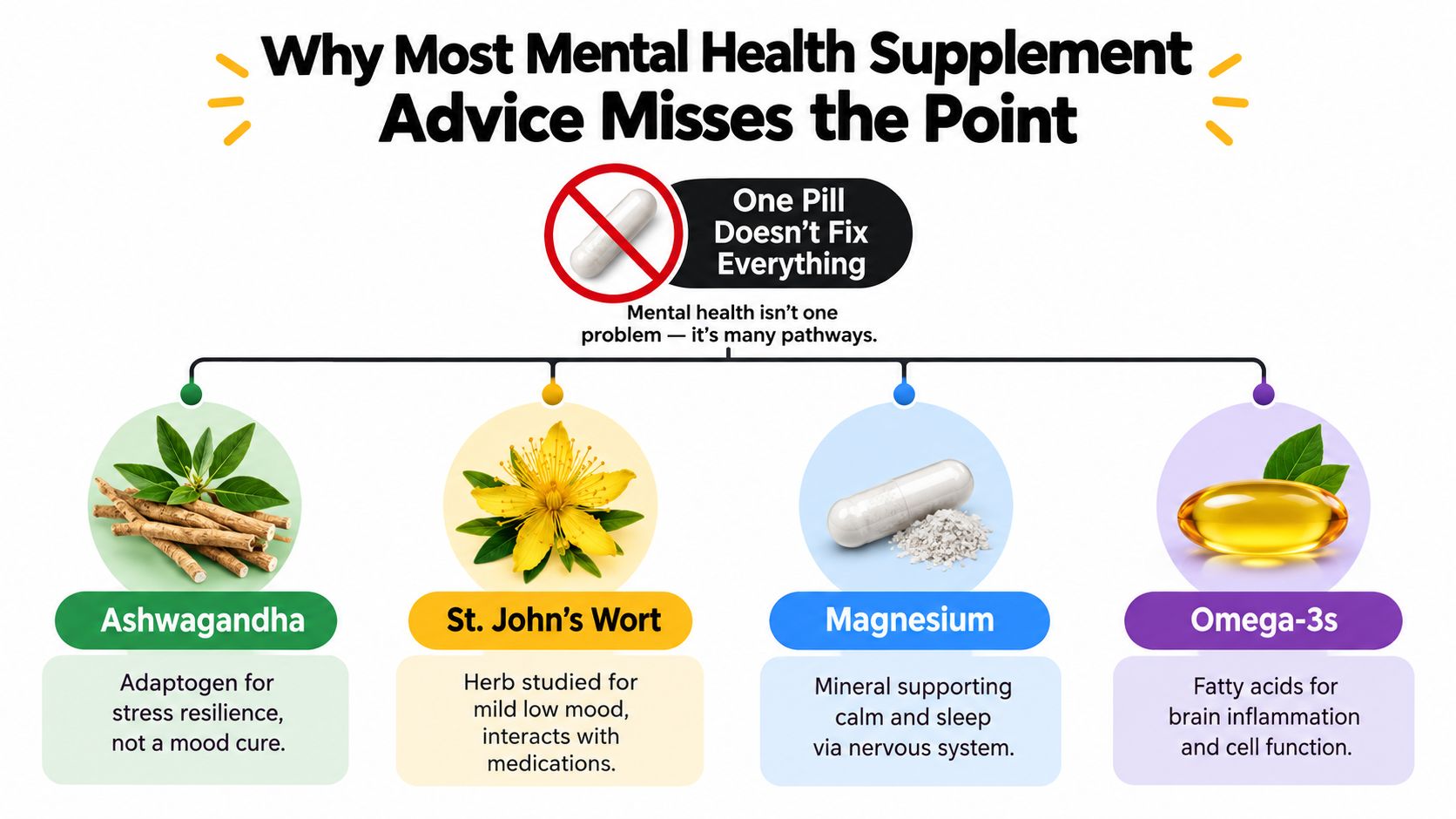
The “one pill fixes everything” promise is convenient marketing, not sound guidance. Stress, poor sleep, low mood, and brain fog may occur together, yet they are different targets. An ingredient studied for stress is not automatically appropriate for depression, and a relaxation blend may do little for persistent insomnia or medication-related fatigue.
Ashwagandha, St. John's wort, magnesium, and omega-3s do not belong in one undifferentiated category. A 2025 review found substantive evidence for a limited group of ingredients, including omega-3s, St. John's wort, probiotics, vitamin D, and saffron, while support for many other marketed products remained weaker or insufficient. The practical lesson is clear: evidence depends on the ingredient and the outcome, not on the label “mental wellness.” The evidence overview reported by Frontiers shows why treating every product as interchangeable is a mistake.
Match the complaint, not the marketing category
Define the problem before choosing an ingredient:
Stress and physical tension: Prioritize ingredients studied for stress responses or anxiety symptoms.
Sleep disruption: Identify whether the problem is falling asleep, repeated waking, or daytime fatigue.
Brain fog: Review sleep, diet, medication effects, and nutrient status before using a stimulant-like blend.
Persistent low mood: Treat lasting symptoms, impaired functioning, or hopelessness as clinical concerns. A supplement must not postpone professional care.
Ashwagandha has one of the clearer evidence bases among supplements marketed for mental-health support, although the research remains mostly short to medium term. The NIH Office of Dietary Supplements evidence summary describes reductions in stress, anxiety, sleeplessness, fatigue, and cortisol compared with placebo. It also identifies gaps around the best dose and duration, so a label should not imply certainty the research does not provide.
Practical rule: More ingredients do not create better mental-health support. Choose a transparent, targeted formula that lets you evaluate one purpose and its risks.
Use three habits consistently. Match each ingredient to a defined symptom, demand a clinically sensible label, and treat medication safety as part of efficacy. If a product cannot identify its contents or intended outcome, leave it on the shelf.
How Mental Health Supplements Actually Work in the Body
Mental-health supplements do not act through one master switch. They affect different biological systems, so the right ingredient depends on the symptom you are trying to address. Reducing stress reactivity will not correct a nutrient deficiency, and supporting cell membranes will not resolve a severe mood disorder.
Neurotransmitters are communication signals
Neurotransmitters help nerve cells pass messages. Serotonin, dopamine, and GABA are commonly associated with mood, motivation, relaxation, and attention, but supplements do not raise these signals in a predictable, universal way. Nutrients can supply cofactors used in these processes, while some herbs may influence signaling indirectly.
Magnesium is often used for relaxation because it supports nervous-system function and may affect GABA-related activity. That makes it a reasonable option to investigate for tension or sleep problems, especially when intake is inadequate. It does not prove that every magnesium product will improve sleep or anxiety.
The stress axis acts like an alarm system
The hypothalamic-pituitary-adrenal, or HPA, axis coordinates the body's response to stress. It helps initiate cortisol release when the brain detects demand or threat. Ashwagandha belongs in the stress-support discussion because clinical trials have measured stress symptoms and cortisol, rather than relying only on a “calm” marketing claim. Supportive placebo-controlled research has also examined sleeplessness and fatigue, although the evidence does not establish one ideal dose or duration.
Inflammation provides another possible pathway. Omega-3 fatty acids, including EPA and DHA, form part of cell membranes and participate in inflammatory signaling. This helps explain why researchers study omega-3s for brain function and mood outcomes. It does not make inflammation the single cause of low mood, or omega-3s a substitute for treatment.
The gut and brain communicate continuously
The gut-brain axis involves microbial activity, immune signaling, and nerve communication through the vagus nerve. Probiotic research therefore depends on the specific strain and measured outcome. A bottle labeled “probiotic” tells you very little by itself. Check whether human research supports the actual strain combination and the symptom you want to address.
Fatigue and poor concentration also have many possible causes, including inadequate sleep, illness, medication effects, and nutrient deficiency. Start there before buying a complex nootropic blend. Mechanisms explain why an ingredient looks promising. Controlled human evidence determines whether it deserves a place in your routine.
The Ingredients With Real Evidence and the Ones That Are Mostly Hype
The honest ranking is not “natural equals safe” or “popular equals effective.” It is ingredient, extract, dose, outcome, and risk. Ashwagandha stands out because the clinical literature repeatedly evaluates standardized root extracts against placebo for stress, anxiety, sleep, and related outcomes. A 2022 dose-response meta-analysis reported significant reductions in anxiety and stress versus placebo, with standardized mean differences of −1.55 for anxiety and −1.75 for stress. The published meta-analysis also summarizes controlled research using standardized extracts and measured outcomes.
A separate 2025 meta-analysis of 22 human studies found significant improvements in stress, depression, and anxiety, while noting heterogeneity across the evidence. That makes ashwagandha a moderate to strong option for stress-related symptoms, not a universal mood cure. KSM-66 and Shoden are recognizable extract names, but the label still needs to state the extract details and amount per serving.
Curcumin has a reasonable anti-inflammatory rationale, especially when paired with a bioavailability strategy such as piperine or a specialized delivery system. Its mental-health evidence is less decisive than ashwagandha's, so I rate it limited to moderate for mood-related use, while its broader wellness positioning may involve other goals. Omega-3s deserve more serious attention, particularly when the product clearly identifies EPA and DHA rather than listing only a total fish-oil weight. The evidence is outcome-dependent, and omega-3s shouldn't be sold as a replacement for treatment.
Magnesium is useful when intake is inadequate or when a person is seeking support for relaxation and sleep, but the form matters for tolerability and the claim should remain modest. B12, B6, and folate make the most sense when a deficiency or relevant nutritional gap is present. Probiotics are promising but strain-specific, which makes generic “psychobiotic” marketing a weak basis for purchase.
Ingredient | Primary mechanism | Evidence strength | Key caution |
|---|---|---|---|
Ashwagandha | Stress response and cortisol regulation | Moderate to strong for stress-related outcomes | Review thyroid conditions, sedatives, pregnancy, and medication use |
Omega-3 EPA and DHA | Cell membranes and inflammatory signaling | Moderate, outcome-dependent | Discuss concentrated products with a clinician if using anticoagulants |
Curcumin with piperine | Inflammatory signaling and absorption support | Limited to moderate for mental-health outcomes | Piperine may affect medication handling |
Magnesium | Nervous-system and muscle function | Limited to moderate, especially when intake is low | Separate from certain antibiotics and review kidney or medication issues |
B12, B6, and folate | Nutrient support and methylation pathways | Conditional on deficiency or use case | Test or review status rather than megadosing blindly |
Probiotics | Gut-brain and immune signaling | Limited and strain-specific | Match the strain and outcome to human research |
St. John's wort | Neurotransmitter modulation | Evidence exists for some low-mood contexts | High interaction burden with medicines |
Kava | Sedative and anxiety-related effects | Limited for broad self-use | High-dose use raises liver-safety concerns |
5-HTP | Serotonin precursor | Limited for unsupervised use | Avoid combining with serotonergic medicines without clinician oversight |
St. John's wort is the classic example of an ingredient that shouldn't be dismissed as useless, but also shouldn't be treated casually. Its medication interactions can outweigh its appeal. SAMe also needs clinician oversight, especially alongside antidepressants. A product containing turmeric, BioPerine, ashwagandha, ginger, and bromelain, such as River of Life Capsules, fits the category of a broad botanical formula, not a proven treatment for every symptom. Read more about the narrower role of adaptogens in this guide to adaptogens for anxiety.
Matching Ingredients to What You Actually Feel
Choose the symptom before you choose the bottle. “I need better mental health” is too broad to guide a sensible purchase. “I feel physically keyed up after work,” “I can't stay asleep,” or “my concentration collapsed after a restrictive diet” gives you a more useful starting point.
Symptom | Best-evidenced ingredient | What it does | Realistic expectation |
|---|---|---|---|
Ongoing stress and worry | Ashwagandha | May influence stress response and cortisol | A gradual reduction in perceived stress, not emotional numbness |
Trouble sleeping with stress or fatigue | Ashwagandha, with magnesium considered by context | May support stress regulation or relaxation | Better sleep continuity for some people, not a guaranteed sedative effect |
Brain fog and poor focus | Correct a confirmed nutrient gap first, then consider omega-3s by use case | Supports normal nervous-system or cell-membrane function | Clarity may improve only if the underlying issue is addressed |
Persistent low mood | Clinician-guided care, with omega-3s or another evidence-matched adjunct | May support mood in selected contexts | Supplements are adjuncts, not substitutes for assessment and treatment |
Stress is not the same as depression
Ashwagandha is the clearest starting point when the main complaint is stress reactivity, tension, or stress-linked sleep trouble. The clinical literature behind the NIH summary commonly used 300 to 600 mg per day and study durations of 6 to 12 weeks, so expecting a meaningful verdict after a single serving is unrealistic. The 2025 evidence summary places those findings in the context of short to medium-term randomized trials.
For low mood that persists or worsens, the priority changes. St. John's wort, omega-3s, saffron, vitamin D, and other options don't have interchangeable evidence, and the best choice may depend on diagnosis, medication, and baseline nutrient status. A supplement may ease a symptom, but it can't replace therapy, prescribed medication, crisis support, or evaluation for medical causes.
Combination products also create a practical problem. When a formula spreads a small amount across many ingredients, you may not receive a clinically studied amount of any one compound. A single ingredient or narrowly targeted combination is usually easier to dose, monitor, and stop.
Reading the Label Like Someone Who Knows What to Look For
The front of the bottle is advertising. The Supplement Facts panel is where the decision happens. Start with the actual active amount per serving, not the weight of a plant powder or a proprietary mixture.
Whole-herb weight tells you how much raw material went into the capsule. A standardized extract tells you more about consistency, such as the percentage of withanolides in ashwagandha or curcuminoids in turmeric. Neither label detail proves effectiveness by itself, but without it, comparing two products becomes guesswork.
The label checks that matter
Look for the extract form, serving size, and active constituents. For fish oil, identify EPA and DHA separately. For magnesium, find the elemental magnesium amount rather than relying on the weight of the attached compound. For turmeric, a product may use piperine, BioPerine, a liposomal system, or another delivery approach to address absorption. Those technologies may improve exposure, but they can also affect drug metabolism and deserve a medication review.
Proprietary blends are a major warning sign because they conceal individual amounts. If a label lists ten ingredients under one combined weight, you can't tell whether the product contains useful quantities or decorative label dust.
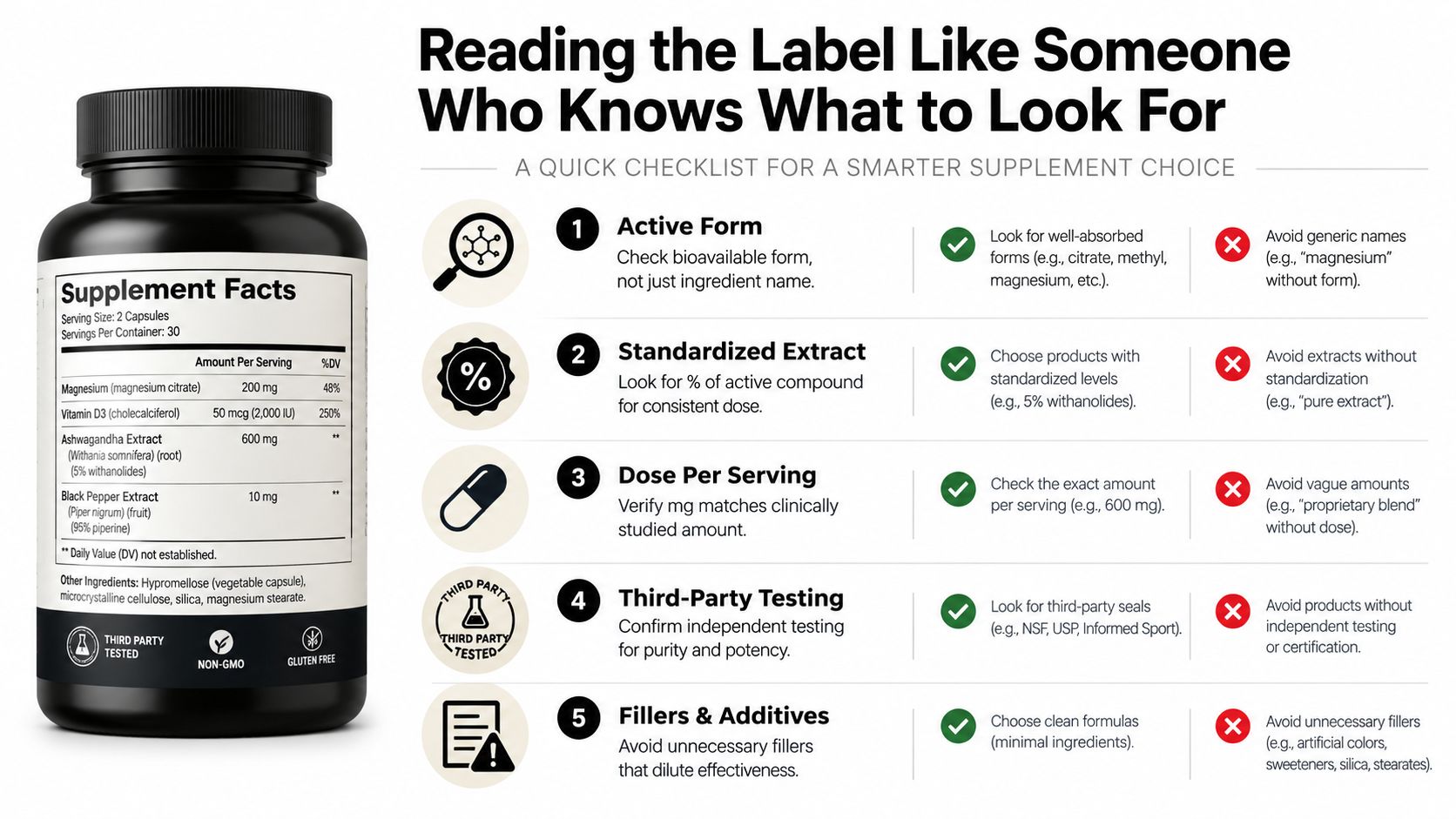
Independent certification adds another layer of quality control. Seals from organizations such as USP, NSF, or Informed Sport can indicate that a product has undergone relevant third-party testing, although you should still verify what the certification covers. Manufacturing in an FDA-registered, cGMP-compliant facility supports process quality, but it doesn't prove that the finished product will help your specific symptom.
For a practical walkthrough of serving sizes, active ingredients, and hidden blends, use this guide to reading supplement facts.
Label red flags: No active amounts, no extract standardization, an unexplained proprietary blend, disease-treatment promises, missing allergen information, or no credible quality-testing details.
A clean label won't turn a weak ingredient into a strong one. It does let you evaluate what you're taking.
Safety, Interactions, and When to Call a Clinician
Safety determines whether a supplement belongs in your routine. If you take prescription psychiatric medication, ask your prescriber or pharmacist before adding an herb, amino acid, mineral, or concentrated oil. Match the product to the symptom you want to address, then check whether its effects overlap with your medicines.
St. John's wort is a major red flag. It can interact with SSRIs, SNRIs, oral contraceptives, and other medicines. Combining serotonergic products can cause excessive serotonin activity, while enzyme effects may reduce the reliability of certain drugs. Do not add 5-HTP or SAMe casually to an antidepressant regimen.
Ashwagandha warrants a medication review if you use thyroid medicine or sedatives. Omega-3 products require caution with anticoagulants, especially in concentrated or high-dose products. Magnesium can interfere with absorption of some antibiotics and may require careful timing around diuretics or other medicines.
Who needs extra caution
Pregnant or breastfeeding people, children, people with bipolar disorder, and anyone preparing for surgery should get individualized advice before using mental-health supplements. A product marketed as mild can still affect sedation, bleeding, hormone regulation, or mood stability.
Bring these details to the appointment:
The exact ingredient: Include the extract name and product label.
The serving amount: State how much you plan to take.
The intended duration: Say whether you want a short trial or ongoing use.
Your current medicines: Include prescriptions, over-the-counter drugs, and other supplements.
Your goal: Describe stress, sleep, focus, low mood, or another specific concern.
Research on ashwagandha remains largely short term, and better studies are needed to clarify ideal use. For medication-specific cautions, review this overview of ashwagandha interactions.
Stop self-experimenting and seek medical help if symptoms are severe, changing rapidly, or connected to thoughts of self-harm, mania, psychosis, or inability to function. Supplements can support therapy, medication, sleep, nutrition, and movement. They cannot replace clinical care.
Fitting a Supplement Into a Real Lifestyle Without Overthinking It
Maya works in a hybrid office role. By late afternoon, she feels anxious and over-alert, then struggles with shallow sleep. Her first mistake would be to buy a ten-ingredient “mood and focus” blend and change everything at once. She'd have no way to know what helped, what caused side effects, or whether her sleep schedule was the main driver.
A more disciplined routine might place a clinically studied ashwagandha extract with breakfast if her clinician approves it for stress support. She could take an omega-3 product with lunch, alongside a meal, and reserve magnesium glycinate for an evening routine if that form and dose suit her health profile. Those choices aren't prescriptions, and they shouldn't be treated as universal instructions. The point is to assign each product a purpose and a consistent place in the day.
Make the trial observable
Maya tracks four simple markers in a notebook:
Afternoon stress: A brief daily rating using the same personal scale.
Sleep onset: Whether she falls asleep more easily than usual.
Night waking: Whether sleep remains fragmented.
Next-day function: Her ability to focus without adding another stimulant.
She keeps her wake time stable, takes a short walk after work, and avoids introducing another product during the same trial. A four to six week tracking window can help her notice patterns, but any timing plan should respect the evidence and safety review for the specific ingredient. If symptoms deteriorate, she doesn't wait for the trial to end.
Travel and weekends need a plan too. A routine that requires complicated cycling often collapses during ordinary life. A simple formula designed around turmeric extract with BioPerine, ashwagandha, ginger, and bromelain may be easier for some people to fit into a daily schedule, but the formula's broad ingredient list also makes medication review more important. Subscription pacing can support consistency, yet it shouldn't lock you into continued use before you know whether the product is appropriate.
A Simple Decision Framework Before You Buy Anything
Run this checklist before you spend money:
Name the symptom. Choose stress, sleep disruption, focus difficulty, or low mood. Don't shop for a vague “mood” solution.
Check the basics. Review sleep, meals, movement, alcohol, caffeine, and possible medical causes. A supplement shouldn't cover for a broken routine or an untreated condition.
Verify the product. Look for human evidence, a transparent dose, a standardized extract where relevant, and independent testing.
Check safety. Give the full label to a pharmacist or clinician and compare it with your medications, health conditions, pregnancy status, and upcoming procedures.
Track the result. Choose a defined trial period and markers you can observe. If nothing improves, stop buying on autopilot and reassess the diagnosis, dose, product, or goal.

The most defensible supplement choice is usually narrow, transparent, and boring. It supports a defined need while you continue the fundamentals that carry the most weight, including appropriate therapy, prescribed treatment, reliable sleep, nutritious food, and regular movement. Compare brands on ingredient disclosure, testing, vegan certification if it matters to you, shipping terms, and returns, not on dramatic promises.
River of Life offers a vegan capsule formula combining turmeric extract with BioPerine, ashwagandha, ginger, and bromelain, with one-time and subscription options for people who want a simple daily routine. Review the label and safety considerations first, then visit River of Life to decide whether its broad botanical approach fits your specific goal.