

How to Read Supplement Facts and Choose Wisely

You're standing in a supplement aisle with two bottles that promise similar benefits. One lists a familiar botanical in a large milligram amount. The other uses a smaller number, adds an extract name, and shows a different serving size. The front labels sound alike, but you still can't tell which bottle provides the dose you'd take each day.
That confusion usually comes from treating Supplement Facts as an ingredient-scanning exercise. It's more useful to treat the panel as a dosing math problem. Start with the serving size, calculate the amount you'll take per day, identify which ingredients have a Daily Value, and then check whether the label gives enough detail to judge the form and quality of each active.
Table of Contents
Proprietary Blends Standardization and Bioavailability Clues
Applying Label Knowledge to Safety and Smart Product Choices
Why Supplement Facts Labels Feel Confusing at First
The front of a bottle is designed to attract attention. It may highlight phrases such as “supports joint comfort,” “vegan,” or “with turmeric and ginger.” Those statements can help you understand the product's intended purpose, but they don't tell you how much of each active ingredient you'll receive. The back panel is where the useful comparison begins.
The U.S. Supplement Facts panel is a formally defined label format, not a free-form marketing box. FDA guidance identifies the nutrition label for a dietary supplement as the “Supplement Facts” panel, and federal labeling requirements establish details such as the heading, serving size, servings per container, and the percentage Daily Value column when a Daily Value exists. You can review the FDA's Supplement Facts labeling guidance for the required structure.
The number on the front isn't the dose
Suppose one bottle highlights turmeric while another highlights a turmeric extract. The larger headline number doesn't automatically represent a stronger or more useful formula. It may refer to the weight of a raw ingredient, a source compound, or a blend whose individual amounts aren't disclosed.
Serving size creates another common trap. A capsule bottle may contain many capsules, but the label might define a serving as multiple capsules. Every amount in the panel is tied to that serving, not necessarily to one capsule and not to the whole bottle.
Practical rule: Never judge potency from the front label or bottle count alone. Find the serving size first.
Learning how to read supplement facts helps with more than comparison shopping. It can reveal whether a daily routine supplies the amount you intended, whether two products are comparable, and whether a blend provides enough information for an evidence-based decision. It also helps you notice ingredients that matter for allergies, tolerability, or interactions.
A label-reading skill you can practice
You don't need specialist training to become comfortable with these panels. Read from top to bottom, write down the serving size, and translate each ingredient amount into the amount you'll consume. After that, examine the ingredient form, the Other Ingredients list, directions, and warnings.
The rest is careful arithmetic and honest interpretation. A transparent label won't prove that a product will produce a particular result, but unclear dosing makes a product much harder to evaluate.
Anatomy of the Supplement Facts Panel Explained
Read the panel in a consistent order. That prevents the eye-catching ingredient name or large number from controlling your decision before you know what it means.
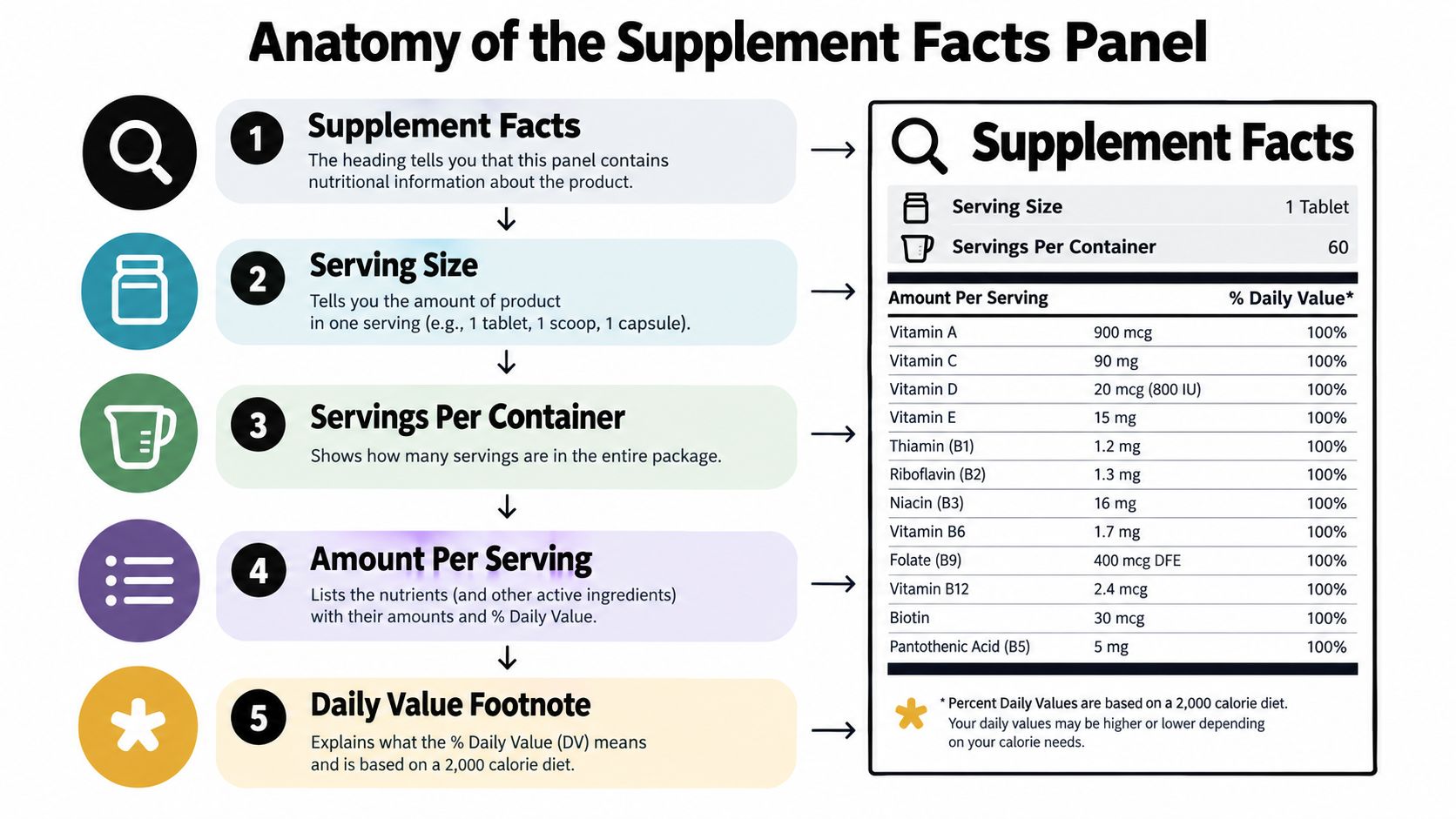
Start at the heading and serving information
The bold Supplement Facts heading identifies the regulated nutrition information area. Directly below it, find Serving Size. For capsule products, the serving size should use a form appropriate to the product, such as capsules. A powder may use a scoop or another household measure, depending on the label.
Next, locate Servings Per Container. This tells you how many labeled servings the bottle contains. It may not match the number of capsules because one serving can include several capsules. That distinction affects how long the product lasts and how you compare its value with another bottle.
Read the chart from left to right
The ingredient table normally presents the amount per serving and, when a Daily Value exists, a % Daily Value column. The amount may appear in grams, milligrams, or micrograms. The unit matters, so don't compare the number alone.
Nutrient ingredients and botanicals may appear in different parts of the panel. Ingredients without an established Daily Value still need to be listed, but they're generally marked with an asterisk and a note such as “Daily Value not established.” This tells you that the absence of a percentage isn't necessarily a missing label element. It reflects the fact that no applicable Daily Value has been established for that ingredient.
A quick orientation check looks like this:
Panel area | What to identify | Why it matters |
|---|---|---|
Heading | Supplement Facts | Confirms you're reading the nutrition panel |
Serving information | Serving Size and Servings Per Container | Anchors every amount and supply calculation |
Ingredient chart | Ingredient name, form, amount per serving | Shows what the product provides |
% Daily Value | Percentage, where established | Helps interpret nutrient contribution |
Footnote and lower list | Daily Value explanation and Other Ingredients | Adds context about non-DV ingredients and inactive components |
Finish with Other Ingredients
Below or near the main chart, look for Other Ingredients. This area may list capsules, binders, fillers, flavorings, colors, or processing aids. It can also contain information important to people avoiding specific allergens or animal-derived materials.
The Supplement Facts panel tells you what active dietary ingredients are present and in what labeled amount. The lower ingredient list helps you assess the rest of the formula. You need both sections to understand the product you're buying.
How to Interpret Serving Size Amounts and Daily Value
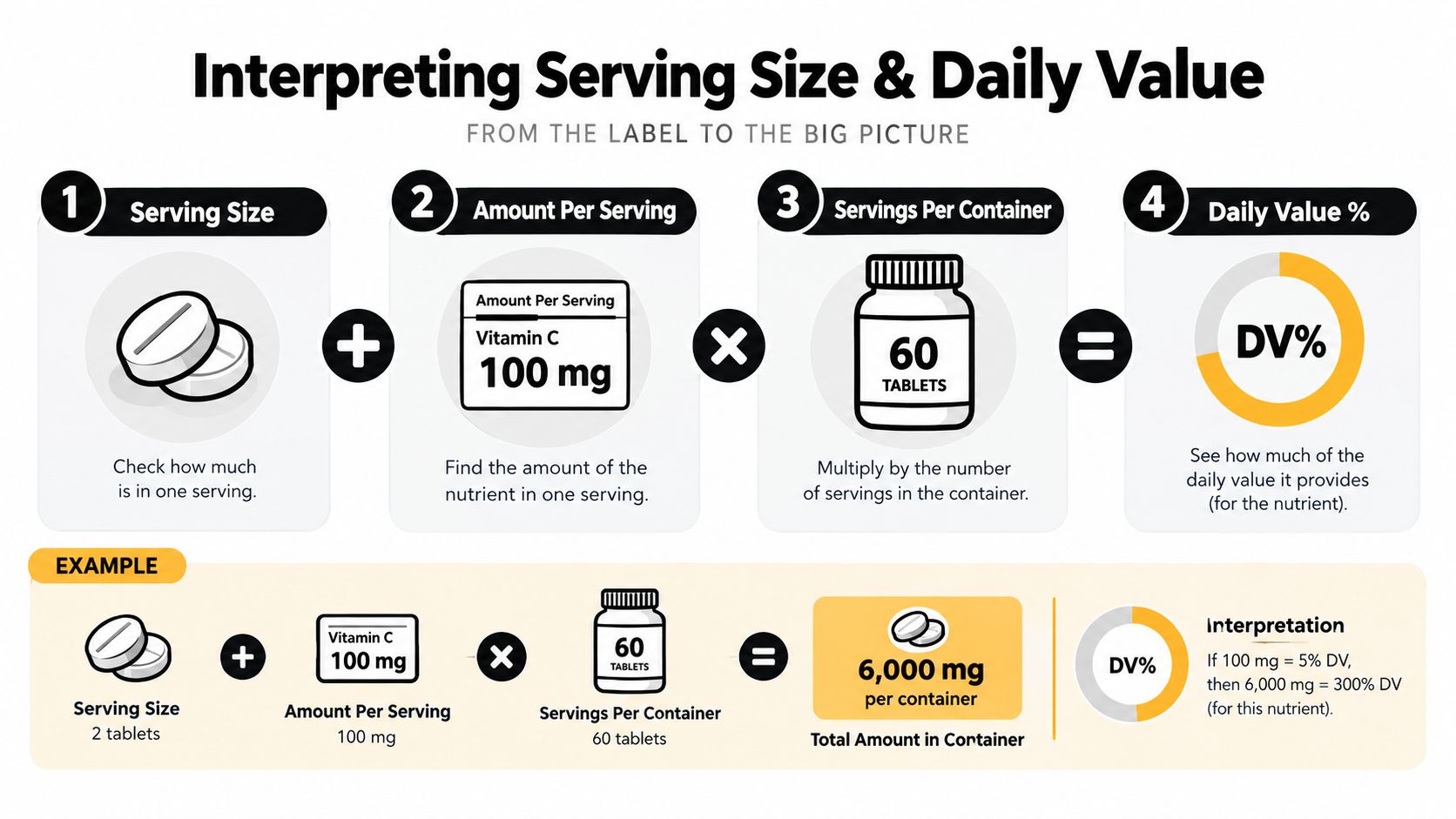
The most important calculation is simple: amount per serving is not always amount per day. Your daily intake depends on the suggested use and the number of labeled servings you take.
Start with the label's serving size. If a serving equals two capsules and the suggested use is one serving daily, the daily amount is the amount printed in the panel. If the suggested use is two servings daily, multiply every listed ingredient amount by two.
For a generic example, imagine a panel that lists a botanical extract at a certain amount per serving, with a serving defined as two capsules. Taking one serving gives you that listed amount. Taking two servings gives you twice that amount, while taking one capsule gives you half, assuming the ingredients are evenly distributed and the label supports that interpretation.
Compare products on a daily basis
Different serving sizes can make similar products look impossible to compare. Convert both labels to the use pattern you're considering.
For example:
Record the serving size. Note whether it's one capsule, two capsules, or another amount.
Record the amount per serving. Write down each ingredient and its unit.
Check suggested use. Determine how many labeled servings you'd take each day.
Calculate daily intake. Multiply the amount per serving by the number of daily servings.
Calculate bottle duration. Divide the total capsules, tablets, or scoops by the amount used per day.
A bottle with a generous capsule count may still provide a shorter supply if its serving size requires several capsules. Conversely, a smaller bottle may last longer if its daily serving uses fewer units. This calculation helps you compare adherence and practical value without relying on packaging impressions.
For a deeper example of reading an ingredient-focused label, see this guide to dietary supplements for joint pain.
Know what % Daily Value can and can't tell you
The % Daily Value is useful when the ingredient has an established Daily Value. FDA guidance describes the calculation as the quantitative amount in the serving divided by the relevant Daily Value, multiplied by 100. That percentage gives context for a nutrient's labeled contribution.
Many botanicals and specialty ingredients don't have an established Daily Value. Their panels may show an asterisk and “Daily Value not established.” In those cases, focus on the absolute amount, such as milligrams or micrograms per serving, then calculate the daily amount from the suggested use.
Don't treat a blank percentage as proof that the ingredient is weak, and don't treat a large percentage as proof that a formula is appropriate. The number answers a narrow labeling question. It doesn't establish clinical equivalence, suitability for your health history, or the quality of the ingredient form.
Avoid source-weight confusion
A label can identify a source compound separately from the active dietary ingredient. With botanicals, it may also identify the plant part or extract form. Read the exact line carefully so you don't mistake the weight of a source material for the amount of the active component you're trying to compare.
Proprietary Blends Standardization and Bioavailability Clues
Two products can list the same ingredients while providing very different levels of useful information. One may disclose every ingredient's amount. The other may group several ingredients under a single total weight called a proprietary blend.
A transparent label lets you see the amount assigned to each listed ingredient. A proprietary blend may name the ingredients but provide only the combined weight. You can't verify how much of each component is present, so you also can't confidently compare that formula with doses used in human studies.
What transparency looks like
Label Feature | Transparent Dosing | Proprietary Blend |
|---|---|---|
Individual amount | Each ingredient has its own quantity | Only a combined blend amount may appear |
Dose comparison | Easier to compare with published human research | Individual dose matching is difficult |
Extract details | May identify plant part, extract type, or marker | Details may be limited |
Consumer decision | Supports clearer potency and value comparisons | Leaves important dosing questions unanswered |
Standardization adds another layer. A raw herb weight doesn't necessarily tell you how much of a relevant marker compound the extract contains. A standardized extract may identify a marker or percentage, giving you more information about composition than raw plant weight alone.
Ingredient form also matters. A salt, extract, branded form, or whole-root material may not be interchangeable because the milligram figures look similar. The label should give enough detail to identify what you're buying, including the extract form and, when relevant, the plant part.
Bioavailability claims need label support
Bioavailability refers broadly to how much of an ingredient becomes available for the body to use. A product may include an absorption-focused companion ingredient, such as BioPerine black pepper extract alongside turmeric. That pairing can be relevant, but the presence of a familiar name isn't a substitute for checking the amount and form disclosed on the panel.
Turmeric illustrates the issue well. A product may highlight turmeric on the front while the Supplement Facts panel identifies a standardized extract, a whole-root material, or a blend. Those descriptions carry different information. For additional context on evaluating turmeric and piperine labels, read this guide to curcumin bioavailability.
A milligram number answers “how much by weight.” It doesn't automatically answer “how much active compound” or “how much the body can use.”
Marketing language requires the same discipline. Phrases such as “supports brain health” or “supports cognitive function” can be interpreted more strongly than the wording intends, and a front-panel claim doesn't guarantee a studied dose. Check the line items, standardization details, and directions before drawing conclusions.
Applying Label Knowledge to Safety and Smart Product Choices
Once you've calculated the daily dose, widen your review beyond the active ingredients. A product can match your target ingredient while still containing an excipient, allergen, or usage instruction that matters to you.
Use a four-part shopping check
Other Ingredients comes first after the active chart. Scan for capsule materials, binders, fillers, flavorings, and colors. If you avoid an allergen or follow a vegan approach, confirm that the listed materials fit your requirements rather than relying on a front-panel badge.
Warnings and directions deserve a full read. Follow the labeled use instructions, and look for cautions connected to pregnancy, medications, medical conditions, or procedures. If you're managing a condition or taking prescription medicines, a qualified healthcare professional can help you decide whether the formula is appropriate.
Quality signals provide useful context. Look for clear manufacturer information, complete Supplement Facts details, and any credible third-party quality verification stated on the packaging. The USP Verified mark, for example, indicates that quality testing has confirmed a product meets USP standards, as described in USP's guide to supplement labels and the USP Verified mark.
Supply calculations prevent accidental gaps. Divide the number of capsules or tablets in the container by the number you'll use daily. Then compare that real supply with another product's supply. A subscription can be convenient, but it shouldn't replace checking whether the serving size and formula suit your routine.
Put the checklist into a real comparison
Suppose you're comparing a single-ingredient capsule with a multi-ingredient formula containing turmeric extract, BioPerine black pepper extract, ashwagandha root, ginger, and bromelain. Don't assume the longer ingredient list offers better value. Check whether each active has an individual amount, whether the botanical form is identified, and whether the daily serving requires more capsules than you expected.
For shoppers interested in a formula built around several researched ingredients, supplements backed by science can provide additional educational context. The same label standards still apply. Match the product to your goal, calculate the daily intake, review warnings, and avoid adding overlapping products without considering the combined ingredients.
A clear panel is a baseline quality signal because it gives you enough information to evaluate the formula. It isn't a promise of results, but missing or vague information makes a careful decision harder.
Confident Label Reading Starts With One Good Habit
Make one habit automatic: start with serving size. Before judging an ingredient, calculate how many capsules or tablets make one serving, how many servings you'll take daily, and how long the container will last.
Then inspect the amount per serving, convert it to your actual daily intake, and separate ingredients with an established Daily Value from botanicals marked “Daily Value not established.” For those botanicals, the absolute amount matters more than a percentage that isn't available.
After the math, review the ingredient form. Look for extract type, plant part, standardization markers, and individual disclosure. Be cautious with proprietary blends because the total blend weight doesn't tell you each ingredient's dose. Finally, read Other Ingredients, directions, and warnings before deciding whether the product fits your needs.
Transparent labeling won't guarantee that a supplement will work for every person. It does give you a stronger foundation for comparing products, avoiding accidental duplication, and choosing a routine that matches your goals for joint comfort, stress resilience, sleep, or mental clarity. Use the panel on your next bottle and write down the daily dose before you buy.
River of Life offers a vegan, capsule-based formula combining turmeric extract with BioPerine black pepper, ashwagandha root, ginger, and bromelain, with one-time and subscription purchase options. Visit River of Life to review the product details and apply the label-reading checklist before choosing.