


Ashwagandha Interactions: A Guide to Safe Supplement Use

You're probably here for one of two reasons. You started taking ashwagandha because stress has been running the show, or you're staring at a supplement label and wondering whether “natural” means “safe for me.”
That hesitation is smart.
Ashwagandha can be useful. It can also change how your body handles other substances. That matters if you take prescription medication, use sleep aids, manage a thyroid condition, or buy multi-ingredient formulas that combine botanicals with absorption enhancers like black pepper extract. Most articles stop at a simple list of “don't mix this with that.” The bigger issue is how interaction strength can change based on the formula itself.
This guide focuses on the practical questions that come up in clinic-style conversations. What should make you pause? Which combinations deserve real caution? And why can the same herb feel mild in one product and much stronger in another?
Table of Contents
Why We Need to Talk About Ashwagandha Interactions
A lot of people come to ashwagandha at a tired point. Sleep is off. Stress feels chronic. Focus is slipping. They want something gentler than another prescription, and ashwagandha shows up everywhere as the calm, balanced option.
That interest makes sense. A 2012 study found that 240 mg daily for 60 days reduced stress and anxiety scores by 30% and lowered cortisol by 27% compared with placebo, which is why so many people look at it as a serious stress-support herb (clinical summary in the verified data set). The important takeaway isn't just that it may help. It's that it clearly does something meaningful in the body.
Once a supplement has a measurable effect, interaction questions become real.
Natural doesn't mean neutral
Many people assume herbs sit in a separate category from medications. In practice, the body doesn't treat them that way. If a root extract affects stress pathways, hormone signaling, sedation, or metabolism, it can also change the effect of medicines and other supplements taken at the same time.
That's where confusion starts. Someone takes an evening sleep aid, adds ashwagandha, and suddenly wakes up groggy. Someone else adds a “wellness blend” and feels stronger effects than expected, even though the ashwagandha dose on paper doesn't look extreme. The label may not explain why.
Practical rule: Treat ashwagandha the way you'd treat any active substance. Check what else you take before you check out.
The safety gap most shoppers run into
The usual advice online is too shallow. It often tells you that ashwagandha may interact with sedatives or thyroid medication, but it doesn't explain how those interactions happen or why one formula may hit differently from another.
That missing detail matters for real-world use. People rarely take one isolated ingredient in a vacuum. They take combinations. They take subscriptions. They take stress support alongside sleep support, mood support, pain support, or blood pressure medication.
A good safety conversation starts with this point. Ashwagandha has benefits because it is biologically active. That same activity is why it deserves respect.
How Ashwagandha Interactions Work in Your Body
Think of your body like a traffic system.
Some interactions happen because two substances are trying to produce a similar effect at the same time. That's like adding more cars to the same lane. Other interactions happen because one substance slows the body's ability to process the other. That's more like blocking an exit ramp and causing a backup.
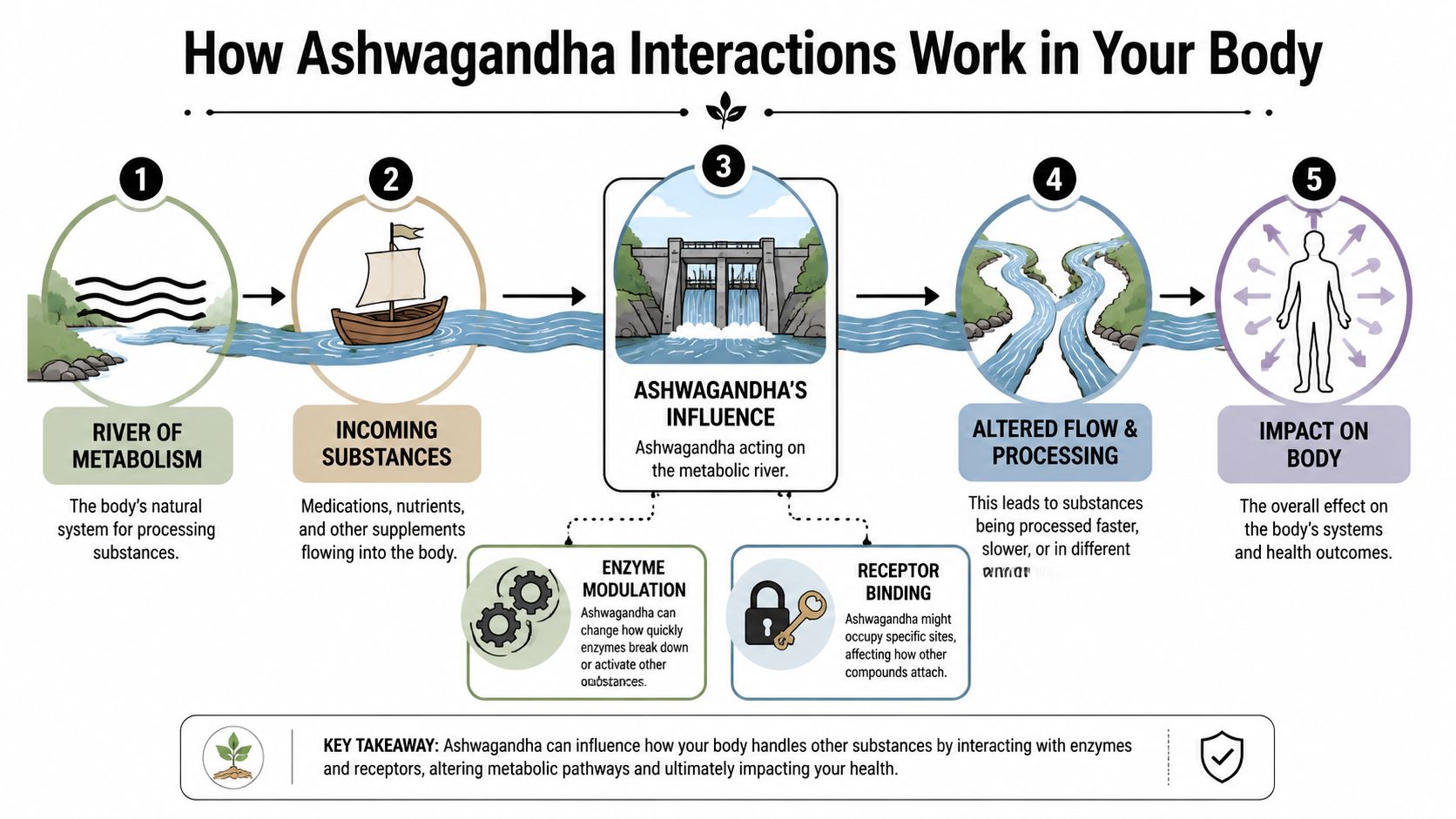
If you're interested in the broader stress-support role of adaptogens, this overview of ashwagandha in stress management gives useful context. For safety, the key is understanding the two interaction types below.
Two kinds of interactions matter most
Pharmacodynamic interactions happen when ashwagandha pushes in the same direction as another substance.
A simple example is sedation. If you take something that already slows the nervous system, and then add a herb that can reinforce that effect, the result may be more drowsiness, slower reaction time, or heavier next-day fatigue than you expected.
Pharmacokinetic interactions happen when ashwagandha changes how quickly your body breaks down another substance.
This second category gets less attention, but it often matters more. You may not “feel” the interaction right away because it's happening through drug metabolism. Over time, however, slower breakdown can mean higher levels of the medication circulating in your system.
Why metabolism matters
Two important metabolic enzymes are CYP3A4 and CYP2D6. These are part of the body's processing machinery for many medications. Verified data show that ashwagandha inhibits CYP3A4 and CYP2D6, and that this can raise blood levels of medications handled by those enzymes by 20% to 40% (peer-reviewed article on CYP interaction potential).
That sounds technical, but the practical meaning is simple. If your body clears a drug more slowly, the drug may act stronger, last longer, or produce more side effects.
Think less in terms of “good herb” or “bad herb,” and more in terms of “What else is using the same roads?”
That's why lists alone aren't enough. The mechanism tells you what kinds of surprises to watch for. Extra sedation. Stronger side effects. A response that feels out of proportion to the dose.
Key Drug and Supplement Interactions to Know
This information is often desired initially, but it makes more sense once you know the traffic pattern. Some interactions come from additive effects. Others come from slower metabolism. A few involve both concerns at once.
Sedatives and other central nervous system depressants
This is one of the clearest caution zones.
Verified data show that ashwagandha can create a synergistic effect with CNS depressants such as benzodiazepines, which can amplify drowsiness and impair psychomotor performance. In those settings, adverse reaction rates can rise by 35% to 50% according to the verified material provided for this article.
What does that look like in daily life? People may notice unusually heavy fatigue, poor coordination, slower reflexes, or a “drugged” feeling that's stronger than what they usually get from their medication alone. That's especially relevant for evening combinations involving sleep medications, anti-anxiety drugs, or other calming supplements.
Antidepressants affected by CYP3A4 and CYP2D6
Ashwagandha also deserves caution with medications processed through CYP3A4 and CYP2D6.
The verified data linked earlier note that concurrent use with medications such as sertraline, escitalopram, and reboxetine can lead to 20% to 40% increases in drug exposure, with reported side effects including myalgia, epigastric pain, nausea, vomiting, restless legs syndrome, testicular pain, ejaculatory dysfunction, severe diarrhea, impaired motor coordination, and muscle weakness.
That doesn't mean every person taking an antidepressant will have a problem. It means the interaction pathway is plausible enough that self-experimenting without review is a bad idea.
If a medication already requires dose stability, don't assume a new herb is a minor add-on.
Other categories that deserve caution
Not every risk category comes with precise numbers in the verified material, so it's better to stay qualitative and practical.
Use extra caution if you take or manage:
Thyroid medication because ashwagandha may affect thyroid activity, which can complicate dose stability in people already treating a thyroid condition.
Blood pressure medication because ashwagandha may have blood pressure-lowering effects, which can increase the chance of lightheadedness or excessive lowering in some people.
Blood sugar-lowering medication because any supplement that shifts metabolic or stress response patterns can complicate glucose management.
Immunosuppressants because ashwagandha may not fit well with conditions or treatment plans where immune activity needs careful control.
Other calming supplements because “natural sleep stacks” can become too sedating when several ingredients pull in the same direction.
Formulas containing black pepper extract, ginger, turmeric, or other active botanicals because the whole blend may matter more than the single ingredient you're focused on.
Here's a quick reference you can scan before buying or combining products.
Medication Class | Type of Interaction | Potential Outcome |
|---|---|---|
Benzodiazepines and other CNS depressants | Pharmacodynamic synergism | More drowsiness, impaired coordination, slower psychomotor performance |
Antidepressants metabolized by CYP3A4 or CYP2D6 | Pharmacokinetic inhibition | Higher drug exposure and greater risk of side effects |
Thyroid medications | Hormonal overlap | Harder-to-predict thyroid response |
Blood pressure drugs | Additive physiologic effect | Dizziness or blood pressure dropping lower than intended |
Blood sugar-lowering drugs | Additive physiologic effect | Glucose control may become less predictable |
Immunosuppressants | Possible physiologic conflict | Treatment plan may be less stable |
Multi-supplement calming stacks | Combined effect burden | Excess fatigue, grogginess, reduced alertness |
The Multi-Ingredient Factor in Your Supplement
Many articles commonly fall short here.
Most interaction guides talk as if you're taking a single-ingredient capsule. Plenty of people aren't. They're taking blends built for stress, joint support, sleep, or mood. Once you move into formulas, the interaction question changes from “Does ashwagandha interact?” to “Does this entire design make the interaction stronger?”

Why BioPerine changes the conversation
The key example is BioPerine, a black pepper extract used to improve absorption.
Verified data note that BioPerine can increase curcumin absorption by up to 2,000%, and that it may also enhance uptake of co-formulated ashwagandha, potentially intensifying its effects (GoodRx discussion of the bioavailability issue). That's the bioavailability paradox. The ingredient added to help the formula work better may also make interaction severity harder to predict.
This doesn't automatically make a formula unsafe. It does mean you should stop thinking only in terms of the listed herb name. Absorption support can act like an amplifier.
For readers interested in how turmeric and ashwagandha are often paired for mood support, this article on combining those botanicals is a helpful companion read.
Why blend logic matters
Once a supplement includes several active botanicals, the actual experience depends on the blend, not just one ingredient.
A few practical examples:
Ashwagandha plus BioPerine may increase the chance that you feel stronger sedative or blood pressure effects than expected.
Ashwagandha plus other calming herbs may create a stack that feels heavier than any one ingredient alone.
Ashwagandha plus turmeric and ginger may be sensible for some goals, but it also means more than one active constituent is in play.
The safest way to read a supplement label is to ask, “What is this formula trying to make stronger?”
That question catches what single-ingredient thinking misses.
Cautions for Special Health Conditions
A common scenario in practice is someone doing everything "right" on paper. They choose a stress or sleep blend, take the label dose, and still feel effects that are stronger than expected. Special health conditions are often the reason. The herb matters, but the person and the formula matter just as much.
That point gets sharper with combination products. If a blend includes black pepper extract to increase absorption, the same dose can hit harder than a plain ashwagandha capsule. For someone with a thyroid condition, autoimmune disease, or an upcoming procedure, that changes the safety conversation.
Hormone-sensitive, thyroid, and autoimmune concerns
Ashwagandha deserves more caution in hormone-sensitive conditions and in people whose thyroid status needs to stay steady. It may influence thyroid activity in some users, which is not a small detail if you already have hyperthyroidism, take thyroid medication, or are being monitored closely for symptoms and labs.
Long-term daily use is another place where I advise restraint. Short-term use has a better safety track record than extended use, and the longer the timeline, the more important it is to ask whether the benefit is still clear enough to justify the unknowns. That is especially true for people with a hormone-sensitive history.
Autoimmune conditions also need a case-by-case review. Ashwagandha may stimulate immune activity, which can be a poor fit when the immune system is already overactive or when treatment depends on suppressing that activity. Add a multi-ingredient formula with absorption support, and the margin for guessing gets smaller.
If sleep support is the main goal, a simpler approach may be safer than jumping straight to a complex blend. This guide to ashwagandha for better rest without side effects is useful background, but it should not replace a medication or condition review.
Pregnancy, breastfeeding, and surgery
Pregnancy and breastfeeding call for a conservative standard. Safety data are limited, so routine self-prescribing does not make sense here.
Surgery is another clear caution point. Ashwagandha can overlap with sedation, blood pressure effects, and medication handling. In a plain product that is already worth mentioning. In a formula designed to improve absorption, the effect can be less predictable. Tell the surgeon and anesthesia team early, not the night before.
A practical rule set works well:
Pregnant or breastfeeding: use it only with direct clinician guidance.
Autoimmune or thyroid condition: review the product before starting, especially if treatment has to remain stable.
Hormone-sensitive history: be conservative with ongoing daily use.
Upcoming surgery: disclose every supplement, including blended products with black pepper extract or other absorption enhancers.
A Practical Guide to Using Ashwagandha Safely
Good supplement use is boring in the best way. It relies on checking, disclosing, starting carefully, and paying attention. That approach doesn't kill the benefit. It reduces preventable mistakes.
Questions worth asking before you start
Bring a full list of what you take. That means prescriptions, over-the-counter drugs, sleep aids, gummies, powders, “stress support” blends, and anything you only use occasionally.
Then ask better questions than “Is this okay?”
Ask about enzyme pathways. “Is any of my medication metabolized through CYP3A4 or CYP2D6?”
Ask about additive sedation. “Could this stack make me too drowsy or affect driving?”
Ask about blood pressure or thyroid stability. “Is there any reason this could complicate my current treatment?”
Ask about the formula, not just the herb. “Does this product contain black pepper extract or other ingredients that may increase absorption?”
If sleep is one reason you're considering it, this discussion of ashwagandha and better rest is useful background, but it shouldn't replace a medication review.
Here's a short video that complements the safety checklist:
What to watch after you begin
If you and your clinician decide to proceed, keep the rollout simple.
Start low and go slow. Don't introduce multiple new supplements at once.
Change one variable at a time. That's the only way to notice what's causing a problem.
Take note of timing. Morning fog, midday dizziness, nighttime oversedation, and GI upset all matter.
Watch for symptom drift. The issue isn't always a dramatic reaction. Sometimes it's a medication that suddenly feels “stronger” or less predictable.
Stop and check in if you notice:
Excess fatigue
Dizziness or lightheadedness
Stomach upset
Unusual sedation
New muscle symptoms
Changes that began after adding a blend, not just after adding a single herb
Safety usually fails at the point where people say, “It's probably nothing,” and keep taking the stack.
Choose products from reputable companies, keep the ingredient panel handy, and review your routine periodically. A supplement that fit last year may not fit after a medication change, a diagnosis change, or a surgery plan.
Your Next Steps for Informed Wellness
You buy an ashwagandha blend for stress support. Then you turn the label over and see other herbs, minerals, and black pepper extract. That is the point where safety questions get more serious, not less.
Ashwagandha is active enough to change how you feel. In some products, the bigger issue is not just the herb itself. It is the formula around it. A multi-ingredient blend can stack similar effects, and black pepper extract can increase absorption in ways that make a mild interaction feel less mild. That bioavailability paradox gets missed all the time. A product may look balanced on paper but hit harder in the body because more of the active compounds get through.
Keep your follow-up practical. Use resources that help you check safety before you add anything new:
NCCIH on ashwagandha for condition-specific and long-term safety questions, as noted earlier
MedlinePlus for medication background and general drug information
Your pharmacist or prescribing clinician for medication pathway, timing, and dose questions
Your surgeon or anesthetic team if you have an upcoming procedure
Good supplement use starts with a full medication list, an accurate product label, and a willingness to treat herbs like active compounds.
That approach shapes how we think at River of Life. If you want a supplement company that puts education first, explore River of Life and the ROL Journal. Strong brands do more than sell capsules. They help you ask better safety questions before you take them.