

Best Joint Support Supplement: A Real Buyer’s Guide

You're standing in front of a shelf packed with joint supplements. One bottle promises pain-free knees, another hides its formula inside a proprietary blend, and a third lists a long ingredient panel without telling you how much of anything you're getting. The practical question isn't which label sounds most impressive. It's which formula has a credible chance of improving stiffness, comfort, or mobility without charging you for decorative ingredients.
The answer starts with label reading. You need to inspect the ingredient form, disclosed dose, absorption strategy, testing, dietary fit, and realistic timeline. Then you can judge any product, including a turmeric-based capsule, against the same standard instead of accepting the loudest marketing claim.
Table of Contents
Why Picking a Joint Supplement Feels So Confusing
Joint supplements look different on the front and surprisingly similar on the back. One may lead with turmeric, another with glucosamine and chondroitin, and a third with collagen, MSM, herbs, or a broad “mobility complex.” The packaging often emphasizes outcomes such as comfort and flexibility while making the details needed for comparison difficult to find.
The underlying consumer need is substantial. Osteoarthritis is the most common form of arthritis globally. An estimated 595 million people were living with osteoarthritis in 2020, equal to 7.6% of the global population, and total cases had increased by 132.2% since 1990, according to the Global Burden of Disease osteoarthritis analysis from the Institute for Health Metrics and Evaluation. A later analysis projected the burden at about 607 million people in 2021, or 7.7% of the world population, so the demand isn't a passing wellness fad.
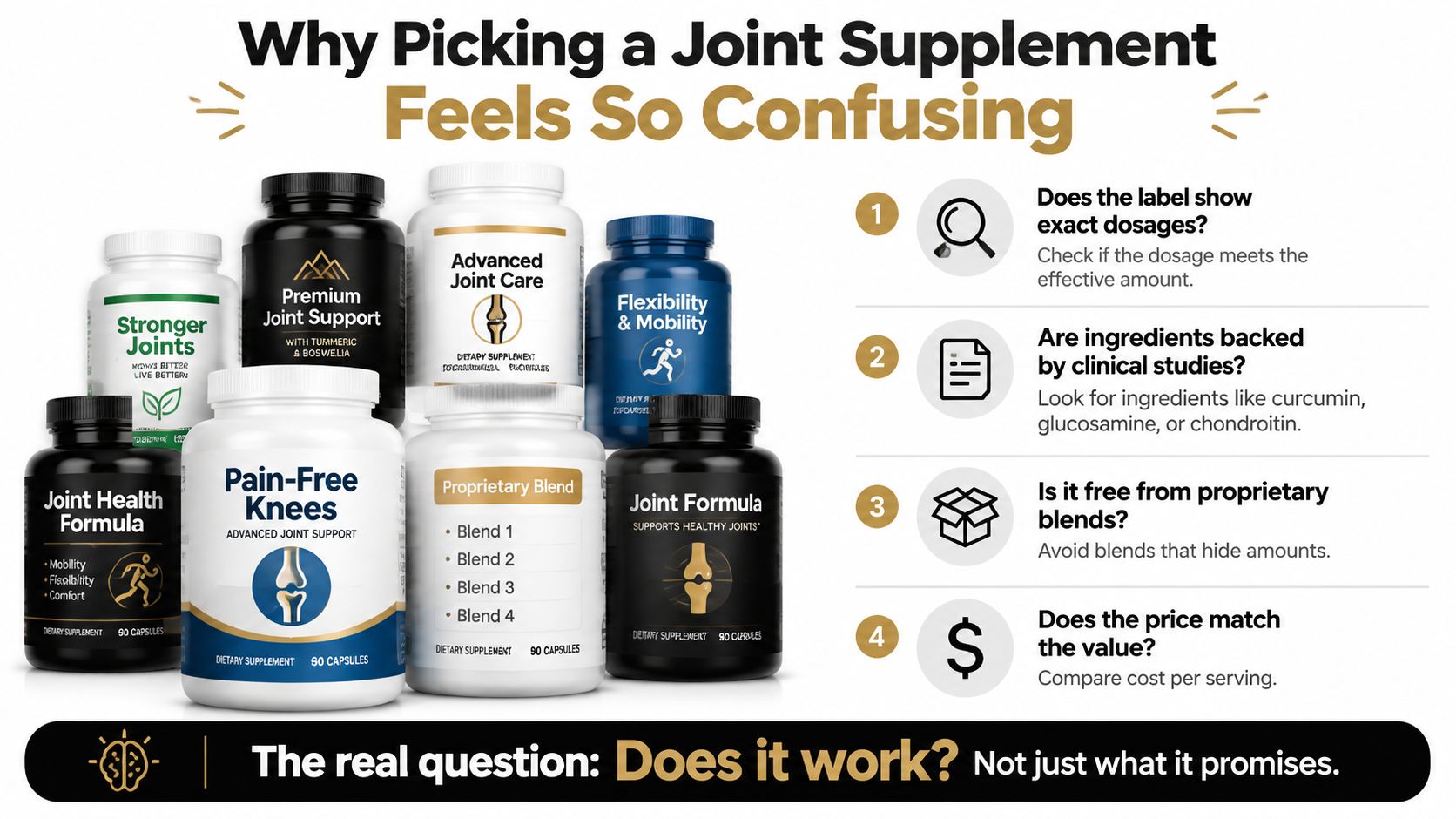
The four questions that cut through the shelf
Start with the Supplement Facts panel, not the front label.
Are exact amounts disclosed? A serious formula tells you how much curcumin, glucosamine, chondroitin, or extract you're taking.
Are the ingredient forms named? “Turmeric” is less useful than a standardized curcumin extract with a stated curcuminoid concentration.
Does the product address absorption? Curcumin has poor inherent absorption, so a bioavailability strategy matters.
Does the price match the active dose? Compare cost per daily serving and per meaningful ingredient, not cost per capsule.
A proprietary blend is a poor starting point because it prevents you from knowing whether the useful ingredient is present in a relevant amount. A long list isn't evidence of a strong formula, and a high milligram total doesn't automatically mean better results.
Label-reader rule: If the product hides the amount of each active ingredient, you can't properly judge its value.
The market reflects that demand. One industry estimate valued the global bone and joint health supplement market at USD 14.17 billion in 2024 and projected USD 27.16 billion by 2033, while another estimated USD 14.99 billion in 2025 and forecast USD 24.12 billion by 2030. These are market estimates, not proof that every product works, but they explain why shoppers face so many competing formulas. The Grand View Research bone and joint health supplements market analysis puts the category in the multibillion-dollar range.
How Joint Support Supplements Actually Work
A joint is more than two bones meeting. Cartilage provides a resilient surface between them, while synovial fluid helps movement stay smooth and supports the joint environment. When cartilage becomes damaged or the surrounding tissues become irritated, normal activities can produce stiffness, aching, and reduced range of motion.
Think of cartilage as a shock absorber and synovial fluid as lubrication. That analogy is useful, but it has limits. Oral supplements don't rebuild a severely damaged joint on demand, and they don't substitute for strength training, physical therapy, activity modification, weight management, or medical evaluation.
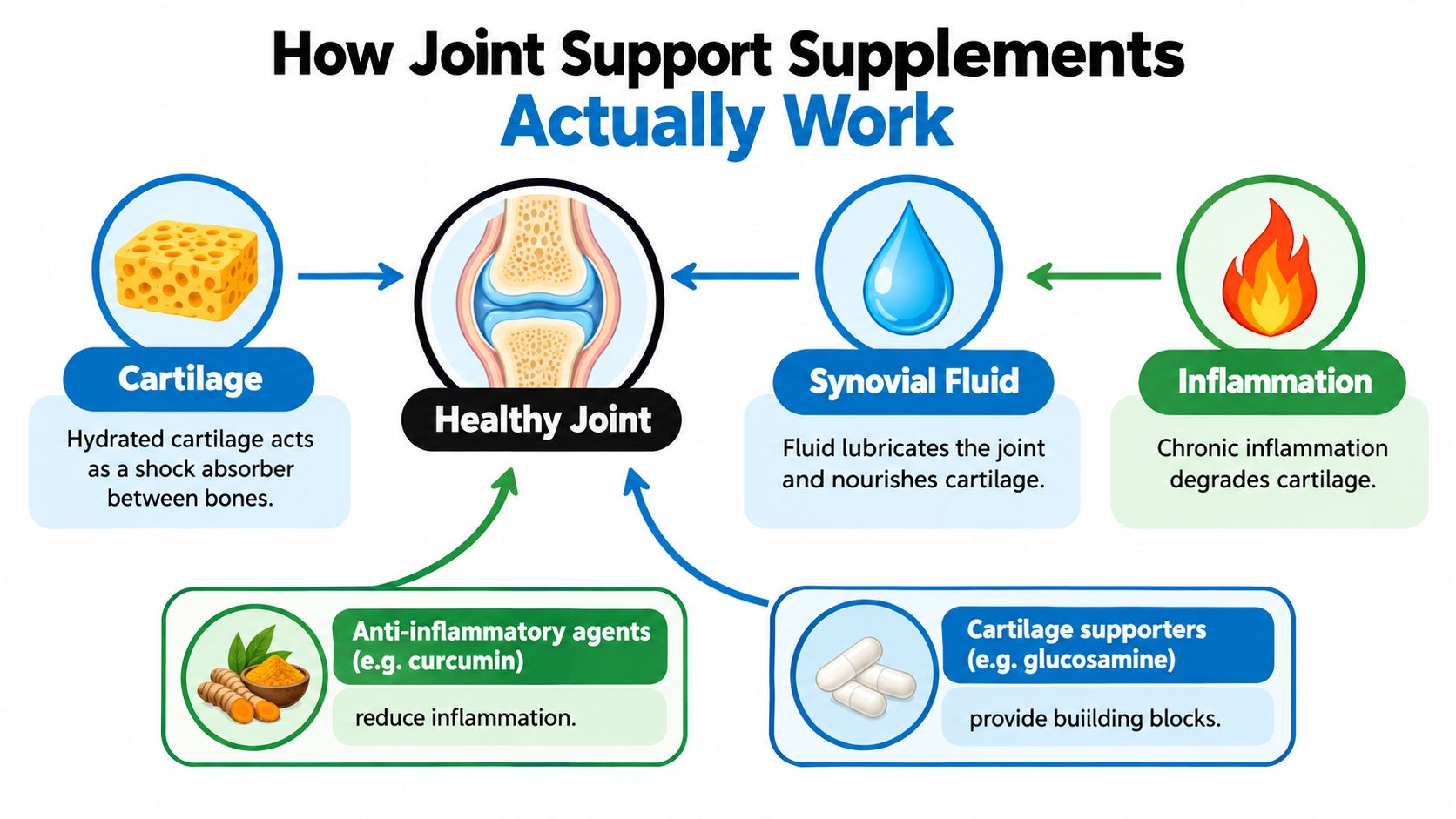
Three targets matter
Most joint formulas aim at one or more of these areas:
Inflammatory signaling. Curcumin, ginger, and some botanical ingredients are used to support a healthier inflammatory response. This is the category most closely associated with daily comfort and stiffness.
Cartilage and connective-tissue support. Glucosamine, chondroitin, MSM, and collagen are positioned as structural ingredients. Their appeal is different from that of an anti-inflammatory botanical, and their research outcomes aren't interchangeable.
Pain and movement experience. The practical outcome is whether you can climb stairs, walk, exercise, or sleep with less disruption. A product that changes a biochemical marker but doesn't improve your daily function isn't a useful purchase.
Curcumin has the strongest evidence signal among the ingredients commonly used for osteoarthritis symptom support. A 2024 umbrella review found statistically significant improvements in pain and function or stiffness measures, and a meta-analysis of 11 meta-analyses reported significant reductions across VAS and WOMAC outcomes. The PubMed review of curcumin for osteoarthritis supports judging the ingredient by human pain and mobility outcomes, not by a raw turmeric label alone.
The important boundary is disease modification. Evidence summaries indicate that glucosamine, chondroitin, turmeric or curcumin, and related ingredients may provide modest pain or function benefits, while structural cartilage protection remains unproven. That distinction should shape your goal. Buy a supplement to test daily comfort or mobility, not on the assumption that it will restore lost cartilage.
Key Ingredients to Look For and What They Really Do
The best joint support supplement isn't the one with the longest ingredient list. It's the one that gives you a clear reason for each active, identifies the form, and discloses enough information to compare the formula with human research.
Curcumin leads for symptom-focused formulas
Curcumin is the concentrated compound family found in turmeric. Look for a standardized extract, such as one identified by its curcuminoid content, rather than assuming a large amount of ordinary turmeric powder delivers the same exposure.
The evidence is most relevant to knee osteoarthritis and chronic joint discomfort, where studies have measured pain, stiffness, and function. Curcumin's main weakness is absorption. The human evidence review on turmeric, curcumin, and piperine notes that piperine can increase curcuminoid bioavailability by up to 154%, while human evidence also indicates that dietary turmeric, with or without black pepper, can improve average pain ratings.
BioPerine is a branded black pepper extract used as a bioavailability enhancer. It isn't a substitute for a properly standardized curcumin extract, but it addresses a real formulation problem. Don't confuse “more turmeric” with “more absorbed curcumin.”
Structural ingredients serve a different goal
Glucosamine, chondroitin, and MSM are commonly used for cartilage and connective-tissue support. If you choose glucosamine, the sulfate form is generally the sensible label detail to look for. Vegans should verify that the glucosamine comes from a microbial source rather than shellfish.
Chondroitin has mixed formulation-dependent evidence. A recent analysis found that chondroitin improved pain and function in one meta-analysis, while glucosamine mainly affected joint-space narrowing, and the combination didn't clearly outperform placebo on symptoms. That's why I wouldn't automatically buy a combination just because it contains three familiar names.
Collagen is another category, but it should be judged separately from glucosamine. For a focused discussion of the evidence and formulation questions around type II collagen, see this guide to undenatured type II collagen. The key point is simple: collagen, glucosamine, and curcumin aren't interchangeable, so match the ingredient to your actual goal.
Adjuncts can be useful, but they don't rescue a weak label
Ginger and bromelain may complement an anti-inflammatory formula, but they shouldn't distract you from checking the primary active. Ashwagandha, particularly named extracts such as KSM-66 or Sensoril, is more relevant when stress, sleep, and recovery are part of the user's concern. It isn't a replacement for a joint-specific structural ingredient.
Watch for three common problems:
Underdosed curcumin: The label names curcumin but provides too little information to judge the extract.
Unclear standardization: “Ginger extract” or “ashwagandha root” appears without identifying the relevant marker compounds.
Proprietary blending: Several ingredients are grouped under one total, so you can't calculate the amount of each.
Ingredient | Primary Action | Typical Effective Dose | Evidence Strength | Key Label Check |
|---|---|---|---|---|
Curcumin | Pain, stiffness, and inflammatory-response support | Use the studied product dose | Repeated meta-analytic signal for osteoarthritis symptoms | Standardization and absorption enhancer |
Glucosamine | Cartilage and joint-structure support | Product-dependent | Mixed and formulation-dependent | Sulfate form and transparent dose |
Chondroitin | Pain, function, and cartilage-related support | Product-dependent | Mixed | Exact amount and source |
MSM | Connective-tissue and comfort support | Product-dependent | Variable | Full dose, not a hidden blend |
Ginger | Complementary inflammatory-response support | Product-dependent | Adjunct evidence | Gingerol standardization |
Bromelain | Enzyme-based adjunct support | Product-dependent | Variable | Activity units such as GDU |
Ashwagandha | Stress and recovery support | Product-dependent | Goal-specific | Named extract and withanolide standardization |
My label checklist is short: standardized extract, named form, disclosed dose, and a bioavailability enhancer where the ingredient needs one.
How to Judge Quality, Safety, and Real Value
Treat the label like a contract. The front panel makes promises, but the Supplement Facts panel tells you what the company is offering.
Start with the active panel
Look for standardized markers such as curcuminoids, withanolides, or gingerols. A raw herb powder can have a place in a formula, but it gives you less control over consistency than a named, standardized extract. Confirm that the serving size is clear and that the dose is disclosed for every meaningful ingredient.
Then inspect manufacturing and testing information. USP, NSF, and independent laboratory reports can provide useful quality signals, although the presence of a seal should still be verified rather than assumed from vague wording. cGMP or ISO 17025 disclosures are also relevant when a brand explains how manufacturing or laboratory testing is handled.
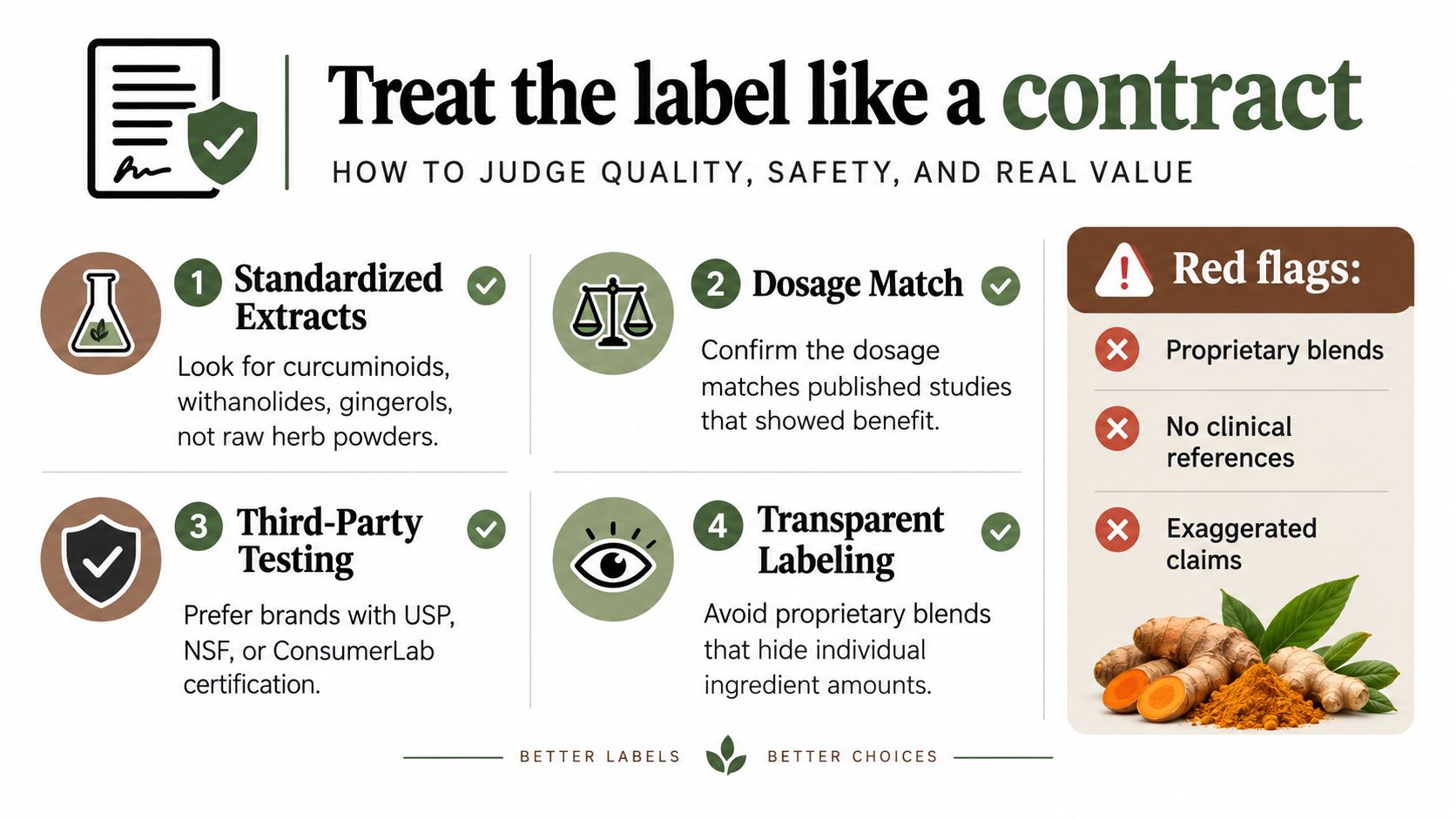
Use this store or browser checklist
Ingredient identity: Is the extract standardized, and is the chemical or botanical form named?
Dose transparency: Can you see the amount of every active ingredient?
Absorption support: Does the formula include BioPerine or another stated bioavailability strategy where appropriate?
Testing evidence: Does the company disclose credible third-party testing or batch documentation?
Dietary fit: Is the capsule vegan if needed, and are common allergens or unnecessary fillers clearly identified?
Drug interaction review: Have you checked the formula against your medications?
Curcumin, ginger, and ashwagandha deserve particular caution if you use blood thinners, diabetes medication, or thyroid medication. That doesn't mean everyone taking those drugs must avoid these ingredients, but it does mean you should ask a clinician or pharmacist before starting a concentrated formula. A supplement can be plant-based and still pharmacologically active.
Practical rule: Calculate cost per daily active dose, not cost per capsule. Two inexpensive capsules may deliver less relevant material than one transparent serving.
For a deeper look at why turmeric formulations differ, use this explanation of curcumin bioavailability and absorption. It's the difference between judging a label by its ingredient names and judging it by how the formula is designed to function.
Realistic Expectations on Results and Timelines
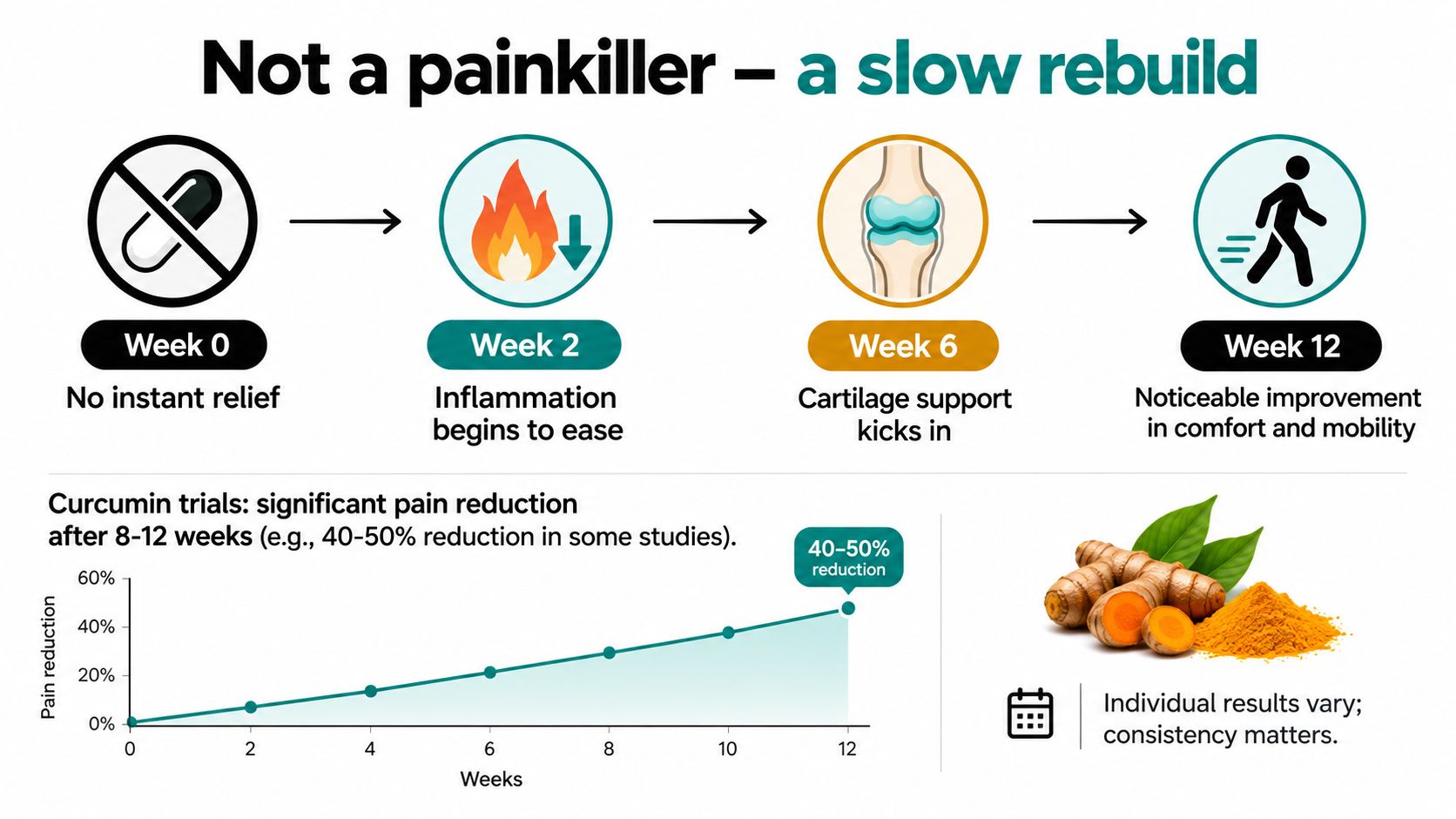
Joint supplements don't behave like painkillers. They're generally tested as gradual approaches to comfort, stiffness, and function, which means a single dose tells you almost nothing.
Some ingredients, including collagen and botanical anti-inflammatories such as turmeric or Boswellia, may require two to six months before a noticeable benefit, while glucosamine and chondroitin results remain mixed and product-dependent, according to ConsumerLab's review of joint supplement testing and quality issues. That range is broad because the ingredient, extract, dose, person, and outcome all matter.
Measure function instead of chasing a feeling
Choose two or three outcomes before you start:
Stairs: Is knee discomfort lower when climbing or descending?
Morning movement: Do your first steps feel less stiff?
Activity: Can you walk, train, garden, or play without the same level of restriction?
Sleep: Does joint discomfort interrupt sleep less often?
Record each outcome weekly on a 1-to-10 scale. You're not creating a clinical trial, but you are reducing the chance that one unusually good day convinces you a product works.
A reasonable test requires consistency and patience. Don't stack several new products at once, because you won't know which one changed anything. If your function hasn't shifted after a sustained trial, stop spending on that formula and reassess the ingredient, dose, diagnosis, or broader treatment plan.
The target is improvement, not perfection. Even a modest reduction in stiffness can matter if it helps you move more, but a supplement shouldn't be sold as a promise of pain elimination. More ingredients also don't guarantee a better result. Head-to-head trials have not established that combination formulas are automatically superior to single-ingredient products.
Where River of Life Capsules Fit the Criteria
River of Life Capsules gives you a useful test case because it takes a botanical route rather than building around glucosamine, chondroitin, or MSM. The formula includes turmeric extract with BioPerine, ashwagandha, ginger, and bromelain in a vegan capsule format. That makes it more naturally suited to someone prioritizing inflammatory-response support, recovery, stress, or sleep alongside everyday joint comfort.
The first question is transparency. The product description identifies the main ingredients and describes turmeric as a standardized extract at 95% curcuminoids, with BioPerine included for absorption. It also identifies named ashwagandha extracts such as KSM-66 or Sensoril, ginger extract standardized for gingerols, and bromelain measured in GDU. Those details are the right kind of information to look for, although you should still verify the current Supplement Facts panel and serving instructions before purchasing.
Score the formula against the label framework
Criterion | What to Look For | River of Life Match |
|---|---|---|
Extract identity | Standardized turmeric, ashwagandha, and ginger extracts | Product information identifies standardized botanical ingredients |
Absorption | Bioavailability enhancer paired with curcumin | Includes BioPerine with turmeric |
Dose transparency | Exact amounts and serving size | Check the current Supplement Facts panel before ordering |
Dietary fit | Vegan capsule and clear excipient information | Described as vegan and capsule-based |
Joint focus | Ingredients connected to comfort and mobility | Botanical blend supports a symptom-focused approach |
Structural support | Glucosamine, chondroitin, MSM, or collagen | Not the central formulation approach |
Testing | Disclosed independent or third-party verification | Confirm current batch-testing disclosures directly with the brand |
The trade-off is clear. This is not the obvious choice for someone whose priority is a broad structural formula containing glucosamine, chondroitin, MSM, or collagen. It is more coherent for someone who wants curcumin-led support and also values ingredients associated with stress resilience and recovery.
I'd judge it over a consistent 90-day window, while tracking stiffness, stairs, walking, exercise recovery, and any medication-related concerns. The product's botanical design is a strength for one goal and a limitation for another. Don't call it the best joint support supplement for everyone. Call it a reasonable candidate for adults who want a transparent, vegan, curcumin-centered routine and accept that it doesn't cover every structural ingredient category.
If that profile fits, review the River of Life 30-day subscription option and compare its terms with a one-time order before committing.
Pricing, Purchasing, and Your Next Step
A price comparison only works when the seller gives you complete current details. River of Life offers 60-capsule bottles, a one-time purchase option, and subscription plans for a 30-day supply or a bi-monthly supply. The company also describes pause or cancel flexibility, international fulfillment to more than 40 countries, climate-resistant packaging, and a 30-day return policy for unopened bottles.
I won't invent a price or pretend a subscription discount has value without verifying the live product page. Prices, shipping charges, bundled extras, and promotional terms can change. Check the current checkout total, then calculate the cost per day and compare it with the amount of active curcumin and accompanying extracts you're receiving.
Option | Bottles | Price per Bottle | Total Cost | Cost per Day |
|---|---|---|---|---|
One-time purchase | 1 | Check current listing | Check current listing | Divide bottle price by stated supply |
30-day subscription | 1 per shipment | Check current subscription price | Check current checkout total | Divide total by stated supply |
Bi-monthly subscription | 2 per shipment | Check current subscription price | Check current checkout total | Divide shipment total by stated supply |
Make the decision in three steps
Buy after checking compatibility. Review curcumin, ginger, and ashwagandha with a pharmacist or clinician if you take blood thinners, diabetes medication, or thyroid medication.
Take it exactly as labeled. Follow the product's serving instructions and take it with food if the label recommends that approach.
Track the first 30, 60, and 90 days. Record stiffness, pain during a specific activity, mobility, sleep disruption, and unwanted effects.
Choose this type of formula if your main goal is daily comfort and a botanical approach. Wait and get professional guidance if joint pain is new, severe, rapidly worsening, associated with marked swelling, or limiting normal function. A supplement shouldn't delay an evaluation when the symptoms need one.
River of Life offers a vegan, turmeric-centered capsule with BioPerine, ashwagandha, ginger, and bromelain for adults seeking joint comfort alongside broader recovery support. Review the current label and purchase terms, then visit River of Life if the formula matches your goals and medication-safety check.