

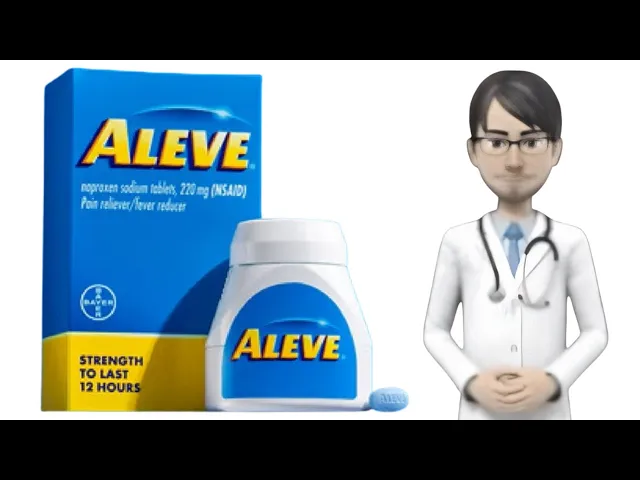
What Is the Pain Reliever in Aleve? a Simple Guide

The pain reliever in Aleve is naproxen sodium 220 mg per tablet or capsule, and it's an NSAID, which means it helps ease pain, inflammation, and fever. If you're reaching for Aleve because your back is tight, your knee is throbbing, or a headache won't let up, that ingredient is what's doing the work.
A lot of people stand in front of the medicine cabinet with the same question: what exactly am I taking, and is it the right choice for this kind of pain? That's especially true with Aleve, because it's common, easy to buy, and often used for everything from sore muscles to joint stiffness.
The useful part is simple. Aleve can be a solid option for short-term pain relief, especially when inflammation is part of the problem. The part that deserves more honesty is this: something sold over the counter can still cause real harm if you use it casually for long stretches, especially if you already have stomach issues.
Table of Contents
The Pain Reliever in Aleve Uncovered
You wake up with a throbbing back after helping a friend move, or your knee swells up after a long weekend project. In moments like that, many people reach for Aleve without stopping to ask a basic question. What is the actual medicine doing the work?
The active ingredient in Aleve is naproxen sodium. That is the pain reliever in Aleve, and it belongs to a group of medicines called nonsteroidal anti-inflammatory drugs, or NSAIDs.
That label matters because it tells you Aleve is often used for pain that comes with inflammation, such as soreness, swelling, stiffness, or tenderness. For short-term problems like a strained muscle, a headache, menstrual cramps, or an arthritis flare, that can make it a useful option. For ongoing daily pain, it deserves more caution than its over-the-counter status suggests.
What NSAID means in plain language
An NSAID works like turning down part of the body's alarm system. When tissue gets irritated, your body sends out chemical signals that increase pain and swelling. Naproxen helps lower that signal, which is why Aleve may feel more helpful for inflammatory pain than a medicine that only changes how pain is perceived.
That does not make Aleve a cure for the underlying problem.
If your shoulder hurts because you overused it, Aleve may calm the pain enough to help you rest and move more comfortably. It does not repair the tissue itself. That is an important distinction, especially for anyone tempted to use it day after day instead of figuring out why the pain keeps returning.
Brand name versus drug name
People mix this up all the time. Aleve is the brand name on the box. Naproxen sodium is the medicine inside.
A simple rule helps here:
Read the active ingredient, not just the brand.
That habit matters because different brands can contain the same drug, and taking more than one product with similar ingredients can raise your risk of side effects. If you want a side-by-side look at another common NSAID, this guide to ibuprofen and how it compares as a pain reliever can help.
Why Aleve is so widely used
Aleve has been around for a long time, which is one reason many adults see it as familiar and dependable. According to WebMD's Aleve product overview, naproxen first appeared as a prescription medicine before later becoming available over the counter.
That history helps explain both its popularity and the confusion around it. A medicine can be common and still carry real risks. Aleve fits best as a tool for acute, short-term pain relief, not as a do-it-yourself long-term plan for chronic pain. If pain keeps showing up, the smarter question is not just "What can I take again?" but "What is causing this, and what else should be part of the plan?"
How Aleve Works to Stop Pain and Inflammation
Pain from inflammation has a chemical side to it. When tissue gets irritated, your body produces substances called prostaglandins, which help trigger pain, swelling, and fever. Aleve works by blocking the enzymes that help make those prostaglandins.
More specifically, naproxen inhibits COX-1 and COX-2 enzymes, reducing prostaglandin synthesis (Bayer Aleve PM information). That's the engine behind its pain-relieving effect.

A plain-language way to picture it
Think of inflammation like a smoke alarm that has become too sensitive. The injury or irritation is the smoke. Prostaglandins are part of the system that keeps setting the alarm off. Naproxen acts like someone lowering the alarm's sensitivity, so the noise doesn't dominate every movement.
That doesn't mean the underlying problem vanishes. If you twisted your ankle, Aleve doesn't repair the ligament. What it can do is reduce the pain and inflammatory signaling enough that you can function more comfortably while your body settles down.
Why that matters for stiffness and swelling
The pain reliever in Aleve often makes more sense than a medicine that only targets pain perception when inflammation is part of the picture. When inflammation is part of the picture, people may notice relief not just in soreness, but in the sense that an area feels hot, puffy, or hard to move.
The same basic mechanism is why naproxen is used for arthritis pain, including stiffness during daily activity and rest-related discomfort, according to Bayer's product information. In practical terms, if your pain feels tied to irritated tissue, Aleve may fit better than a non-anti-inflammatory option.
If you want a side-by-side look at another NSAID, this guide to ibuprofen and how it compares can help clarify where the overlap starts and where the differences matter.
Aleve turns down one of the body's chemical alarm systems. That can be very helpful for short-term pain. It doesn't make long-term self-treatment automatically safe.
Aleve vs Advil vs Tylenol A Practical Comparison
When people ask whether Aleve, Advil, or Tylenol is “best,” the honest answer is that it depends on the kind of pain and how long you need relief to last.
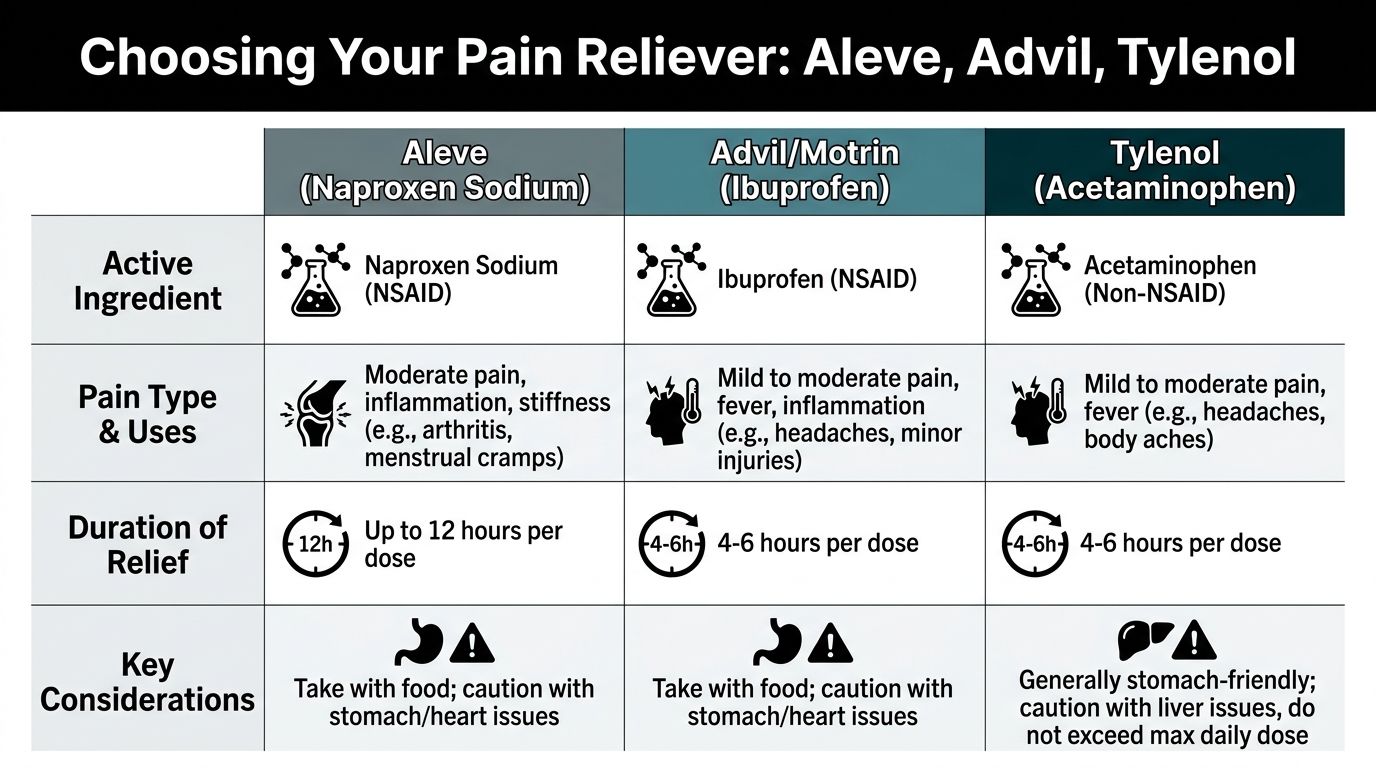
The biggest practical difference is duration. Naproxen, sold as Aleve, can provide relief for up to 12 hours with dosing every 8 to 12 hours, while acetaminophen and ibuprofen typically require dosing every 4 to 6 hours (Hospital for Special Surgery comparison of Tylenol, Advil, and Aleve).
The shelf-level difference that matters most
If you want fewer doses through the day, Aleve stands out. That's one reason people like it for long workdays, overnight soreness, or pain that tends to build back up before the next dose with shorter-acting medicines.
Advil and Motrin contain ibuprofen, which is also an NSAID. Tylenol contains acetaminophen, which is not an NSAID. That means Tylenol can help with pain and fever, but it doesn't work the same way against inflammation.
OTC Pain Reliever Comparison
Feature | Aleve (Naproxen Sodium) | Advil/Motrin (Ibuprofen) | Tylenol (Acetaminophen) |
|---|---|---|---|
Drug type | NSAID | NSAID | Non-NSAID |
Best fit | Pain with inflammation or stiffness | Shorter-term pain with inflammation | Pain or fever when anti-inflammatory action isn't the goal |
Relief duration | Up to 12 hours | 4 to 6 hours | 4 to 6 hours |
Dosing rhythm | Every 8 to 12 hours | Every 4 to 6 hours | Every 4 to 6 hours |
Common question | “Can I take fewer doses?” | “Can I use something flexible and familiar?” | “Do I want an option that isn't an NSAID?” |
A real-world example helps. If your knee is swollen after overdoing it in the yard, Aleve or ibuprofen may make more sense than Tylenol because inflammation is part of the problem. If you mainly have a fever and general body aches, Tylenol may be the option some people consider first, especially if they need to avoid NSAIDs for medical reasons.
For a deeper look at how acetaminophen differs from NSAIDs, this breakdown of acetaminophen uses and limits is useful.
Choosing a pain reliever isn't only about how strong it is. It's about what kind of pain you have, how long you need relief, and what risks apply to you.
How to Use Aleve Correctly for Safe Relief
You tweak your back lifting a laundry basket, or a tooth starts throbbing halfway through the day. In moments like that, Aleve can be useful because it lasts longer than some other over-the-counter options. The goal is short-term relief that helps you function, not turning it into an everyday habit without a clear reason.
For over-the-counter use, a standard Aleve tablet contains 220 mg of naproxen sodium. The usual label directions are 1 tablet every 8 to 12 hours. The label also allows 2 tablets in the first hour if symptoms are stronger at the start. After that, stay within the package limits and do not keep adding doses because the pain feels stubborn.

A simple way to use it is to treat Aleve like a long-acting brake pedal, not an accelerator. Because it can work for many hours, taking more too soon does not usually mean smarter relief. It raises the chance of side effects.
A practical approach looks like this:
Start with the lowest dose that may do the job. If one tablet controls the pain, there is no benefit in taking more.
Give it time to work. Aleve is not meant to be redosed every few hours like shorter-acting pain relievers.
Take it with food or milk if your stomach is sensitive. That can make it easier to tolerate.
Use it for brief flare-ups. A strained muscle, menstrual cramps, a dental pain episode, or soreness after overdoing activity are the kinds of short-term problems where Aleve often fits best.
Do not mix it casually with other NSAIDs. Taking Aleve along with ibuprofen or similar drugs can increase risk without giving you a clear advantage.
Here's a video walkthrough for general context on naproxen use and safety:
One point gets overlooked a lot. If you need Aleve day after day just to get through routine tasks, the problem is no longer just dosing. It is whether you are treating a short-term pain flare or steadily trying to manage a chronic condition with a medicine that was never meant to carry the whole load.
That is the line to watch. Aleve can be a helpful tool for acute pain. If the pain keeps returning, keeps waking you up, or starts shaping your daily routine, talk with a clinician instead of stretching over-the-counter use longer and longer. Persistent pain often needs a diagnosis, and sometimes a broader plan that may include physical therapy, activity changes, or a different medicine entirely.
Understanding Aleve's Safety Warnings and Risks
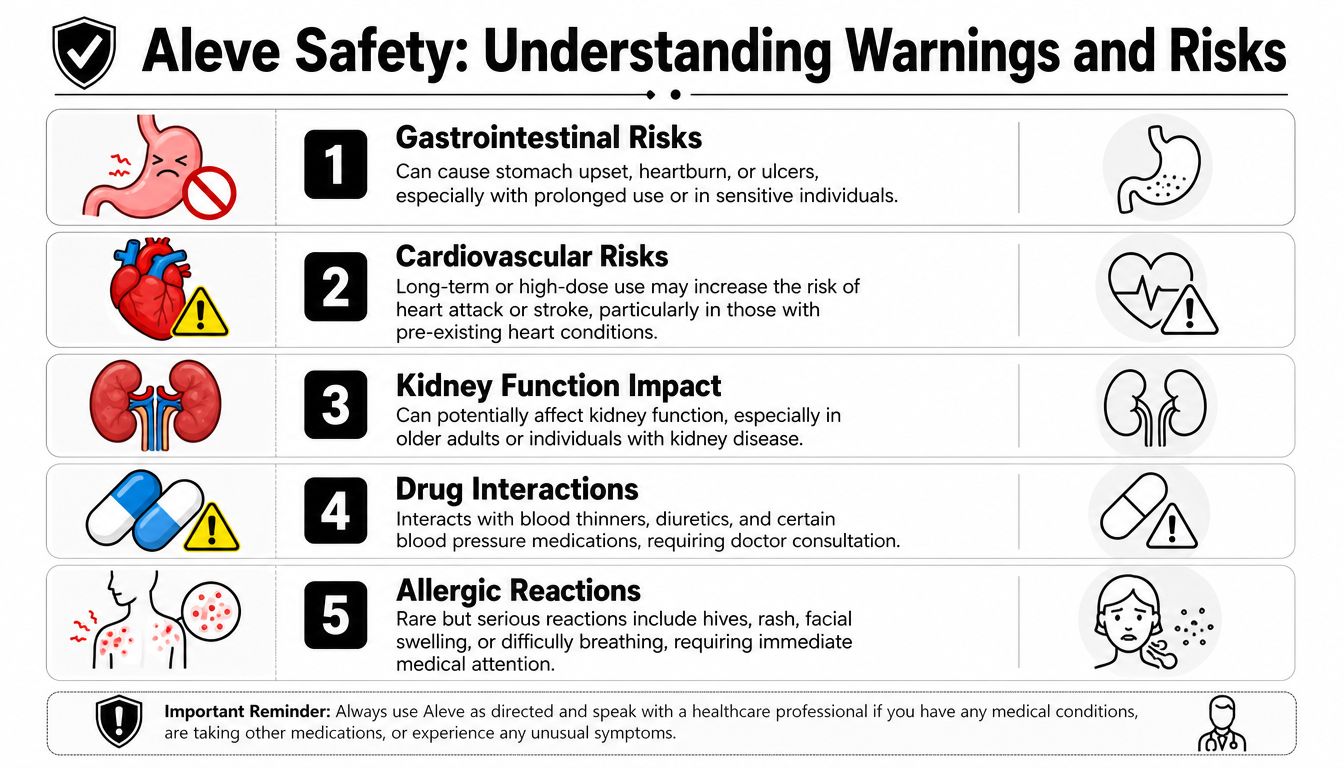
The biggest mistake people make with Aleve is assuming that over-the-counter means low-risk. It doesn't. It means you can buy it without a prescription, not that it's harmless.
The stomach is one of the clearest examples. People with prior stomach problems have a 10x increased risk of gastric ulcer recurrence when taking NSAIDs like naproxen, according to an orthopedic source discussing naproxen safety (orthopedic discussion of naproxen sodium risks). If you've ever had an ulcer, serious heartburn, stomach bleeding, or another significant stomach issue, that's not a minor footnote.
The long-term use problem people underplay
Aleve is often marketed and discussed around relief. That part is real. The less comfortable truth is that people with chronic joint pain can start using it like a daily support beam, especially when they're trying to stay mobile.
That's where risk builds. NSAIDs can irritate the stomach lining, contribute to ulcers, and lead to bleeding. Long-term use also raises concerns about kidney strain and cardiovascular problems, particularly in older adults and people who already have medical conditions.
If you need Aleve regularly for months, you don't just have a medication question. You have a long-term pain management question.
Who should be especially careful
Some people should slow down and talk to a clinician before using Aleve, especially beyond occasional short-term use:
People with a history of ulcers or stomach bleeding. Their risk is not theoretical.
Older adults with chronic joint pain. They're more likely to use NSAIDs often and more likely to have related complications.
People with kidney disease, heart disease, or high blood pressure. NSAIDs can complicate those conditions.
Anyone taking blood thinners or certain other medications. Drug interactions can make bleeding and other side effects more serious.
Pregnant people. NSAID use in pregnancy needs medical guidance.
Red flags that need medical help
Stop self-treating and get help quickly if you have signs that suggest a serious reaction or complication.
Stomach warning signs: vomiting blood, black stools, or severe stomach pain.
Allergic symptoms: facial swelling, hives, or trouble breathing.
Heart or circulation symptoms: chest pain, sudden weakness, or symptoms that feel alarming and new.
Kidney-related concerns: major changes in urination or swelling that seems unusual.
A lot of readers want one clean answer to “Can I safely use Aleve every day for chronic pain?” For many people, that's not a decision to make alone. If pain is lasting, the safer approach is usually to figure out why it's lasting and build a plan that doesn't rely only on an NSAID.
Making Smart Choices for Your Pain Management
Aleve has a clear strength. It can be useful for acute, short-term pain, especially when inflammation is part of the story. For a strained muscle, a rough headache, menstrual cramps, or a sudden arthritis flare, the pain reliever in Aleve can do exactly what many people need it to do.
The trouble starts when short-term relief subtly turns into a long-term habit. If your joint pain shows up most days, or you've started measuring your mobility by whether you've taken naproxen, it's time to widen the plan.
A better way to think about it
Instead of asking only, “What can I take today?” ask a broader question: “What's driving this pain, and what else could reduce it?” Depending on the problem, that may include physical therapy, changing activity patterns, improving sleep, weight management, heat or ice, or medical treatment aimed at the cause rather than the symptom.
That doesn't make Aleve a bad option. It makes it one tool.
For people who want to explore non-drug approaches alongside standard pain care, this guide to natural pain reliever options offers another angle to consider.
The smartest use of Aleve is targeted use. Take it for the right problem, in the right way, for the shortest useful time.
If pain keeps returning, gets worse, wakes you up regularly, or starts changing how you live, don't just switch brands and keep guessing. Get it checked.
If you're looking for a broader daily wellness approach for joint comfort, stress, sleep, and clarity, take a look at River of Life. Their educational content and supplement formula are designed for people who want to support how they feel day to day, not just react when discomfort flares up.