


A Guide to Topical Pain Reliever Cream for Fast Relief

You bend down to lift a laundry basket, turn to set it on the counter, and your low back grabs. Or your knee feels fine until the end of a long walk, when it starts throbbing on the drive home. In that moment, what's wanted is the same thing. Relief that's fast, local, and simple.
That's why a topical pain reliever cream is often the first thing I suggest for a new flare of muscle or joint pain. You apply it where it hurts. You don't have to commit to a whole-body medication right away. And if your pain is limited to one knee, one shoulder, one sore calf, that targeted approach often makes more sense than reaching for a pill first.
Interest in these products isn't small. The topical pain relief market analysis from IMARC Group valued the global market at USD 11.6 billion in 2025 and projects USD 18.1 billion by 2034, with North America holding over 35.0% of the market in 2024. That fits what I see in practice. People want non-opioid, localized pain relief they can use without overcomplicating the rest of their day.
Still, the pharmacy shelf is crowded for a reason. Some creams cool. Some heat. Some numb. Some reduce inflammation. Some are worth trying. Some sound impressive but have weak evidence behind them.
If you've been comparing labels and wondering what works, this guide will help. If you also want broader non-drug approaches for ongoing aches, this overview of natural pain relief options is a useful companion to what you'll read here.
Table of Contents
Your First Defense Against Aches and Pains
A topical pain reliever cream works best when the pain is localized and reachable. Think knee arthritis, a sore trapezius after desk work, a tender elbow, a strained calf, or an irritated patch of low back muscle. If you can point to the spot with one or two fingers, a topical often deserves first consideration.
That's because creams solve a different problem than pills do. Oral painkillers travel through your whole system. A topical aims at one area. For many people, that feels like a more sensible starting point for everyday aches.
When local treatment beats a whole-body approach
If your pain is mild to moderate and tied to movement, a cream can be enough to take the edge off so you can keep functioning. I like that strategy for people who want to stay active, return to a walk, or sleep more comfortably without immediately stacking multiple medications.
A topical is also practical when the pain isn't constant. You may not need round-the-clock treatment. You may just need help in the evening, before a workout, or after gardening.
Practical rule: Start with the least invasive tool that matches the pattern of your pain.
What these products can and can't do
Used well, a topical pain reliever cream can reduce discomfort, improve tolerance for movement, and buy you enough relief to stretch, sleep, or finish the day. That's useful. It's not trivial.
But it won't fix every pain problem. A cream won't correct poor lifting mechanics, reverse advanced joint damage, or diagnose why your shoulder pain shoots into your arm. It helps symptoms. It doesn't replace an evaluation when the pattern is concerning.
Here's the mindset I want patients to have:
Use a cream for spot treatment: One area, one flare, one clearly defined ache.
Use movement with it: Gentle walking, range-of-motion work, or basic physical therapy often matters as much as the product.
Escalate only if needed: If the cream doesn't fit the pain pattern, then consider a pill, a longer-term plan, or a medical visit.
How Creams Work Through Your Skin
Your skin acts like a bouncer at the door. It doesn't let everything through just because you put it on the surface. That's the key idea that makes topical products easier to understand.
Some ingredients mostly create a sensation on top of the skin. You feel cool, warm, or numb, and that changes how your nervous system interprets pain. Other ingredients are designed to move through the skin enough to act more directly in the tissues underneath.
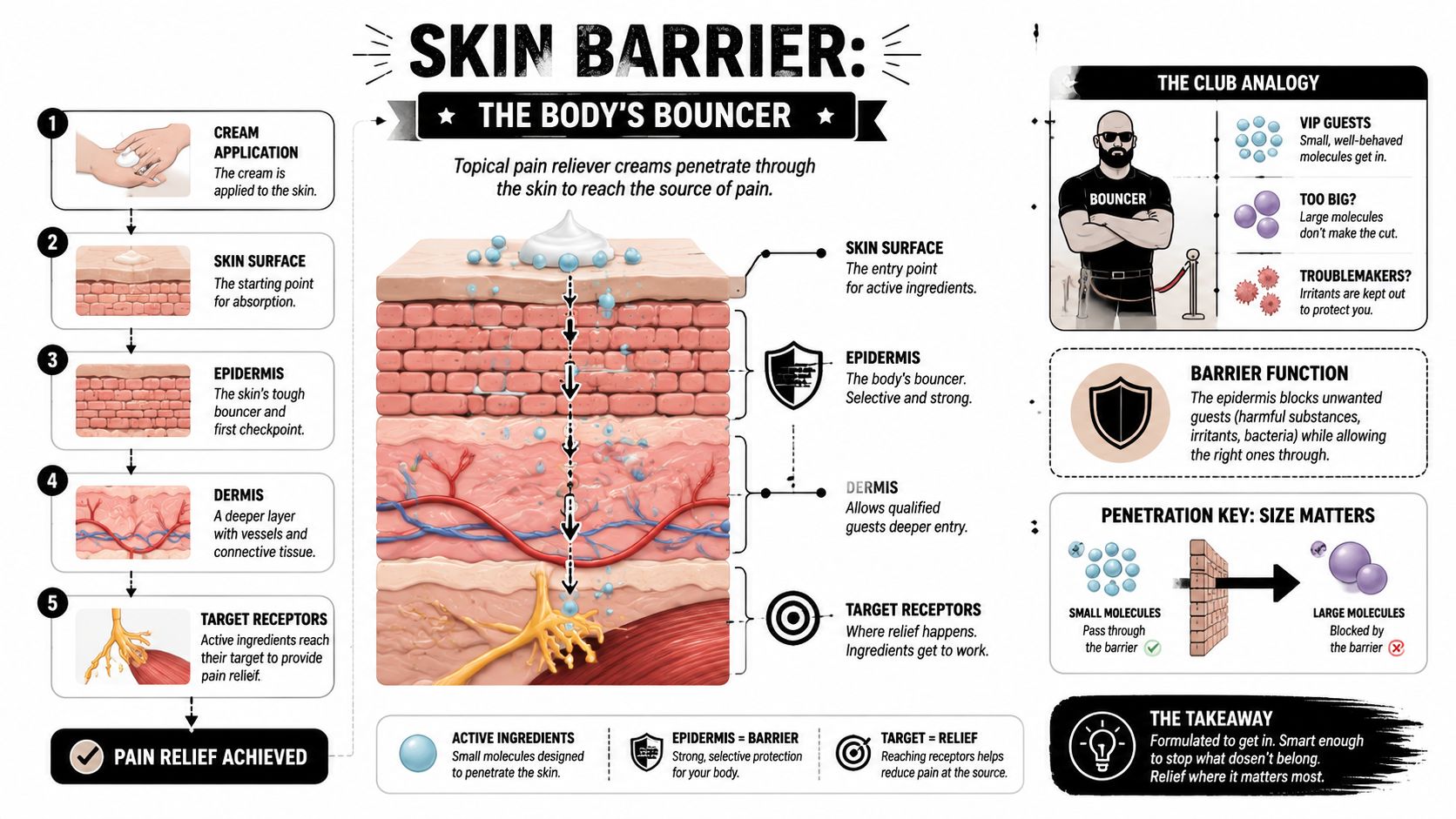
The bouncer analogy
Think of the epidermis as the velvet rope. It's protective by design. Large, poorly suited molecules don't get in easily. Smaller, better-designed ingredients have a better chance of passing through.
Once an ingredient gets beyond that barrier, it can work in different ways. It may calm local inflammation, reduce pain signaling, or create a numbing effect. But not every topical product reaches the same depth, and not every painful structure is equally accessible.
Why location matters
Topicals tend to make more sense for areas that sit relatively close to the surface. Knees, hands, elbows, and some muscle groups are common examples. Deep hip pain is a different story. A cream may still help the surrounding soreness, but it usually won't do as much for pain coming from deeper structures.
That's also why one person says, “This gel worked great on my hand,” while another says, “It did nothing for my deep buttock pain.” They may both be right.
A simple way to think about it:
Pain pattern | What a topical often does |
|---|---|
Surface-level muscle ache | Can provide quick, noticeable relief |
Inflamed joint near the skin | May reduce pain locally, depending on ingredient |
Nerve irritation in a small area | May help if the product has the right mechanism |
Deep, widespread, or radiating pain | Often not enough on its own |
A cream isn't weak because it works locally. It's useful because it works locally.
Decoding the Active Ingredients
The label matters more than the branding. Two tubes can sit side by side and both claim pain relief, but they may work in completely different ways.
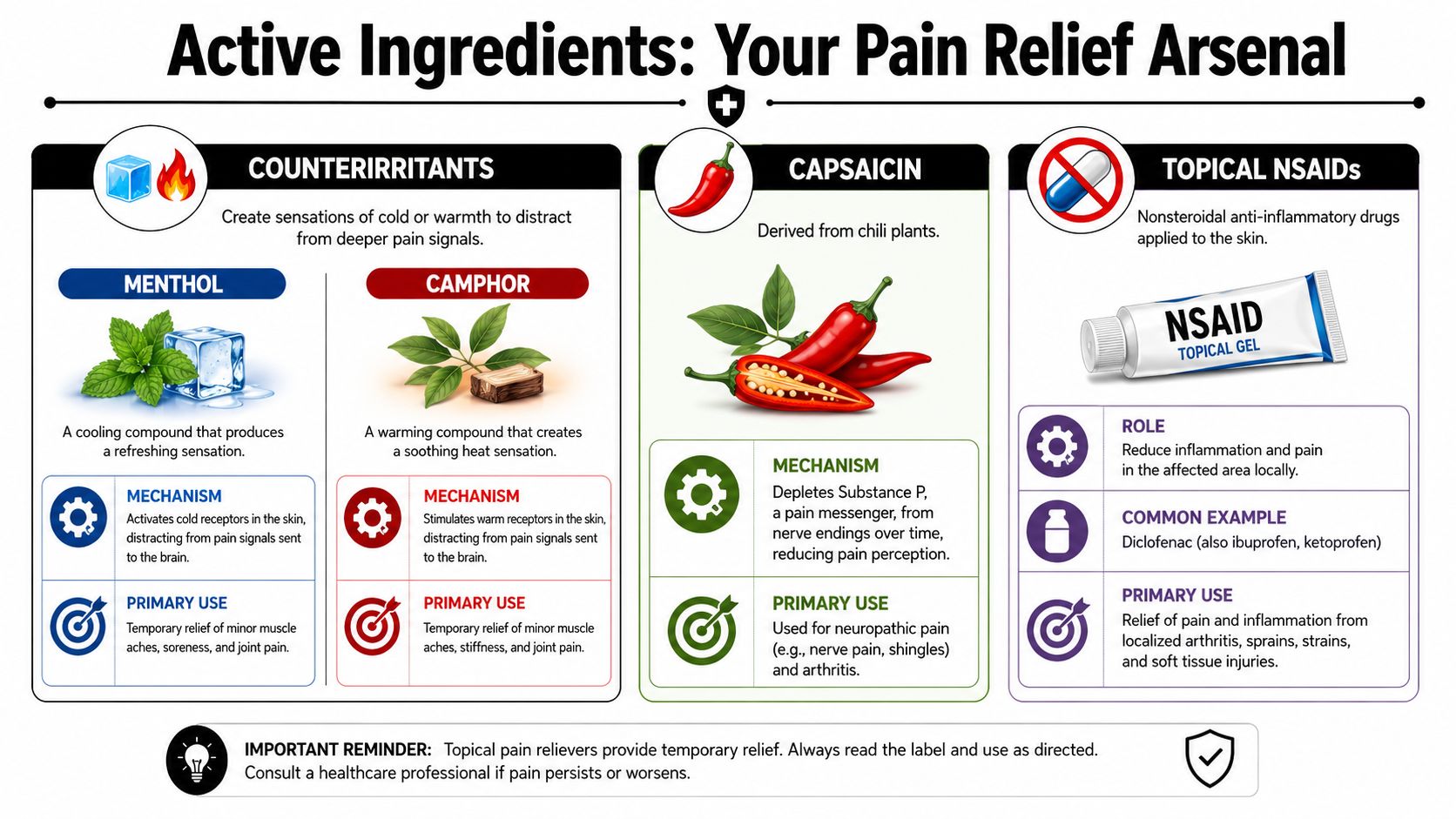
Counterirritants like menthol and camphor
Menthol and camphor are the classic “I feel it working” ingredients. They create a cooling or warming sensation that competes with the pain message. For a lot of sore muscles, that sensory effect is exactly why people like them.
They're often a good fit for:
Post-exercise soreness
Muscle tightness
Minor joint aches
Temporary relief during the day
The upside is speed. You usually notice them quickly. The trade-off is that they don't directly address inflammation in the same way a topical NSAID can.
If your upper back is knotted after computer work, or your calf feels heavy after a long run, a menthol-based cream or roll-on is a reasonable first try.
Capsaicin
Capsaicin comes from chili peppers. It works very differently from menthol. Instead of cooling or numbing, it affects pain signaling over time. That's why capsaicin tends to be more of a commitment product than an instant-relief product.
It may fit certain chronic pain patterns, especially when a person can tolerate the initial burning or stinging sensation. That said, capsaicin has a much more noticeable local side effect profile than many people expect. A Cochrane review of topical analgesics found that for chronic pain, low-concentration capsaicin caused local adverse events in 63% of users, while in acute pain topical NSAIDs had adverse-event rates of 4.3% compared with 4.6% for topical placebo. The same review also found no meaningful difference in benefit between topical NSAIDs and oral NSAIDs, with response rates of 55% and 54%, respectively.
That doesn't mean capsaicin is useless. It means you should choose it with open eyes. If you hate burning sensations on the skin, it may not be your product.
If a patient tells me, “I want fast comfort and I'm sensitive to skin irritation,” capsaicin usually isn't my first suggestion.
Topical NSAIDs like diclofenac
These are the workhorses for localized inflammatory pain. If a knee, hand, ankle, or elbow is irritated and the pattern sounds inflammatory, a topical NSAID is often the most logical cream category to reach for.
The reason is straightforward. It's not just masking sensation. It's aimed at local inflammation. That makes it a better match for osteoarthritis flares, sprains, and overuse pain around a specific joint.
This category usually makes more sense than counterirritants when:
A joint is puffy, stiff, or movement-sensitive
Pain is repetitive and mechanical
You want a product with a clearer evidence base
Anesthetics like lidocaine
Lidocaine is the numbing option. It can be useful when pain has a nerve-like quality. Burning, zapping, tingling, and hypersensitive skin are the clues I listen for.
It's less about cooling and less about inflammation. It's about dulling the area. For some people with focal nerve irritation or skin sensitivity, that's exactly what helps.
A quick comparison helps:
Ingredient type | Main effect | Best fit |
|---|---|---|
Menthol or camphor | Sensory distraction | Sore muscles, temporary aches |
Capsaicin | Changes pain signaling over time | Selected chronic pain patterns |
Topical NSAID | Local anti-inflammatory action | Joint pain, sprains, overuse pain |
Lidocaine | Local numbing | Small-area nerve-type pain |
How to Choose the Right Cream for Your Pain
Don't choose by brand first. Choose by pain type. That one shift prevents most bad purchases.
Sore muscles after activity
For the heavy, achy feeling you get after lifting, yard work, or a long workout, start with a counterirritant such as menthol. It gives quick sensory relief and can make movement feel easier.
Convenience matters. A roll-on can be handy for your neck or calves. A cream may be better when you want to massage a larger area like the low back or thigh.
Arthritis and stubborn joint pain
If your pain lives in a knee, fingers, or another joint that feels stiff and irritated, a topical NSAID is usually the more logical match. It's a better fit for recurring inflammatory pain than a simple cooling rub.
People dealing with chronic joint discomfort also sometimes want a bigger plan than “apply cream and hope.” That's reasonable. For ongoing joint issues, some readers also look at longer-term support such as turmeric and curcumin for arthritis joint pain, while still using a topical for local flares.
Sharp burning or shooting nerve pain
When the pain feels electric, burning, or unusually sensitive to touch, think about lidocaine first. Capsaicin is another option, but it requires more patience and better tolerance for skin irritation.
This is one of the easiest mistakes people make. They use a cooling sports cream for nerve pain and conclude that all topical products are ineffective. Often the issue isn't topical treatment itself. It's the wrong mechanism.
Match the product to the pain pattern, not to the marketing on the front of the box.
Cream gel patch or roll-on
Form matters, too.
Creams: Good for rubbing into a broad area and useful when you want some manual pressure with application.
Gels: Often feel lighter and dry faster. Many people prefer them over hairy areas or around joints.
Patches: Helpful when you want steady contact without reapplying by hand.
Roll-ons: Convenient for work, travel, and hard-to-reach spots with less mess.
If you're not sure, this quick guide helps:
Your situation | Most practical format |
|---|---|
Broad sore area | Cream or gel |
On-the-go use | Roll-on |
Small targeted spot | Patch or cream |
You dislike greasy residue | Gel |
Safe and Effective Application Techniques
A good product can still fail if you use it badly. Most irritation problems and underwhelming results come from application mistakes, not from the category itself.
Early in the process, a visual checklist helps more than a paragraph of warnings.
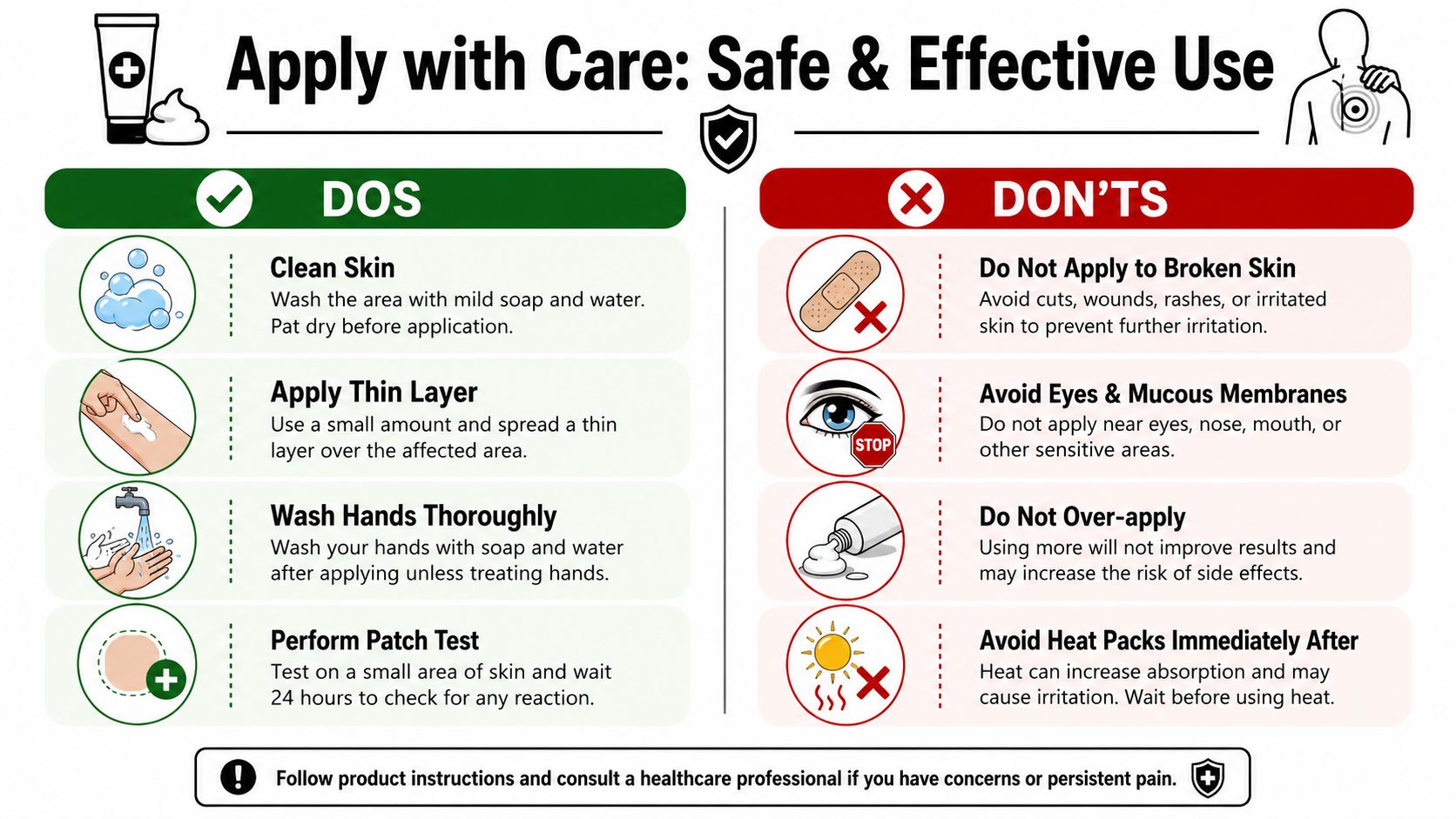
How to apply it well
Start with clean, dry skin. Sweat, lotion, and body oil can get in the way. Apply a thin layer over the painful area rather than piling on a thick blob in one spot.
Then wash your hands thoroughly unless your hands are the treatment area. That matters with all topical products, but especially with irritating ingredients. Accidentally rubbing your eye after using capsaicin is memorable for all the wrong reasons.
A careful routine looks like this:
Clean the area: Use plain soap and water if needed, then dry the skin well.
Apply a modest amount: Follow the product directions. More isn't automatically better.
Spread it evenly: Cover the full painful region, not just the most tender point.
Let it absorb: Give it a little time before dressing or sweating heavily.
Wash your hands: This reduces accidental transfer to eyes, mouth, or other sensitive areas.
Here's a practical demo you may find helpful before your first use:
What not to do
This part is not optional. WebMD's guidance on topical pain relievers warns users not to apply these products to wounds or damaged skin, not to use them under a heating pad or tight bandage, and to use caution with salicylate-containing products if they take blood thinners or have aspirin allergy concerns. The same source also notes that “topical” doesn't automatically mean risk-free.
Mayo Clinic guidance summarized in that same source also notes that common problems include skin irritation, rash, or redness, and that adults should follow product-specific dosing instructions, including limits such as using some lidocaine creams up to four times daily.
Keep these rules in mind:
Never use on broken skin: Cuts, rashes, and irritated areas absorb differently and sting more.
Never add heat: A heating pad over a topical pain reliever cream can increase irritation and risk.
Don't wrap tightly: Occlusion can change absorption and make reactions more likely.
Be careful with salicylates: If you use blood thinners, this is a conversation worth having with a pharmacist or clinician.
Stop if the skin reacts badly: Mild warmth can be expected with some products. Intense burning, severe redness, or a spreading rash is a different story.
Creams vs Pills vs Supplements A Strategic Comparison
Pain relief works better when you stop asking, “Which one is best?” and start asking, “What role does each option play?” A cream, a pill, and a supplement aren't competing for the same job.

When a cream makes the most sense
A topical pain reliever cream is spot treatment. It's useful when the pain is localized, when you want to avoid treating your whole body for one sore area, or when you need something practical for a flare.
This is often the first layer in a smart plan. For example, if your knee aches after walks, a topical may help for that specific area while you also work on load management, strength, and footwear.
When an oral painkiller may fit better
Pills make more sense when pain is widespread, deeper, or more intense, or when multiple areas hurt at once. If both hands, your back, and one ankle are all flaring, a local cream may be too narrow a tool.
That doesn't mean oral medication should be automatic. It means the pain pattern may call for systemic treatment. If you're weighing that option, this overview of ibuprofen and how it fits into pain relief decisions can help frame the trade-offs.
Where supplements belong
Supplements play a different game. They're not rescue treatment for a sudden back spasm. They're better thought of as foundational support in a longer-term strategy for people dealing with recurring joint discomfort, post-exercise soreness, or an inflammation-focused wellness plan.
That's where something like River of Life Capsules may fit for some adults. The formula includes turmeric extract with BioPerine, plus ashwagandha root, ginger, and bromelain, and it's positioned for joint comfort, stress resilience, sleep quality, and mental clarity. That's a very different role from a cream you rub on one knee before bed.
What to skip or question
Be cautious with compounded multi-ingredient pain creams just because they sound customized. The Johns Hopkins report on a randomized trial of compounded topical pain creams described a trial of nearly 400 patients in which a compounded cream containing ketoprofen, baclofen, cyclobenzaprine, and lidocaine did not outperform placebo in a clinically meaningful way. The neuropathic pain group differed by only 0.1 points on average pain reduction, and the mixed-pain group by 0.3 points.
That lines up with a simple clinical principle. If a single-ingredient topical clearly matches the pain mechanism, start there before paying for a complicated blend with a fuzzier rationale.
A practical framework looks like this:
Tool | Best role |
|---|---|
Topical cream | Local flare, one sore area, quick targeted use |
Oral painkiller | Broader or more intense pain that isn't confined to one spot |
Supplement | Long-term support as part of a routine, not a rescue option |
The strongest plan is often layered. Local treatment for local pain, systemic treatment when pain is systemic, and habit-based support for the long haul.
When You Should See a Doctor
Self-care is appropriate for a lot of pain. It's not appropriate for all pain.
If a topical pain reliever cream helps and the issue clearly settles, that's reassuring. But if the pain keeps hanging around, gets stranger, or starts limiting normal function, stop treating it like a minor nuisance.
Red flags that need medical attention
Make an appointment if you notice any of the following:
Pain that persists: If it isn't improving after several days of sensible self-care, it deserves a closer look.
Pain that worsens: Gradually increasing pain is a different pattern from a short-lived flare.
Numbness or tingling: Especially if symptoms travel down an arm or leg.
Weakness: Trouble gripping, lifting the foot, or pushing off can point to more than soreness.
Visible deformity or major swelling: This raises concern for structural injury.
Hot, red, or rapidly inflamed skin: That can suggest infection or another condition that shouldn't be managed with over-the-counter cream alone.
Situations where diagnosis matters more than symptom relief
A cream may dull pain from a sprain, tendon irritation, arthritis flare, or nerve sensitivity. It can also temporarily mask symptoms from a fracture, a significant disc issue, or an inflamed joint that needs evaluation. Relief is useful, but it shouldn't delay care when the pattern looks wrong.
If you're using products correctly and still asking, “Why does this keep coming back?” that's often the moment when a clinician, physical therapist, or pharmacist can save you time by narrowing the actual cause.
If your pain plan needs more than short-term spot treatment, River of Life offers a dietary supplement option designed for adults focused on joint comfort, recovery, stress support, sleep quality, and everyday clarity. It's one possible longer-term layer for people who want to pair local relief strategies with a broader routine.