


Natural Pain Reliever for Dogs: What Actually Works in 2026

You notice it in a small moment. Your older dog pauses at the bottom of the stairs, shifts weight away from one leg, or takes longer than usual to stand after a nap. Maybe your younger dog starts limping after an energetic hike. Perhaps a rescue dog seems guarded when you touch an area that has never felt quite right.
Searching for a natural pain reliever for dogs often begins with a loving instinct: you want to help, but you also want to avoid unnecessary medication. That instinct deserves respect. It also deserves accurate information, because “natural” describes an ingredient's origin, not its safety, strength, or ability to treat the cause of pain.
The most useful approach separates options by evidence, formulation, and risk. Some natural supports, especially omega-3 fatty acids, have meaningful veterinary research behind them. Others remain mixed, preliminary, or poorly studied. Supplements can support a veterinary treatment plan, but they shouldn't hide a serious injury or delay care for a dog in significant pain.
Table of Contents
Why Dog Owners Are Reaching for Natural Pain Relief
Maya first noticed something during an ordinary morning walk. Her senior Labrador still wanted to go out, but he no longer hurried to the gate. He climbed the porch steps one at a time and looked back at her before continuing. There was no cry, swollen joint, or obvious injury. The change was quiet, but it changed how she understood his comfort.
Many dogs with ongoing discomfort adjust their movement before their owners recognize pain. As stiffness develops gradually, families often search for a gentler way to help. They want more than a capsule. They want their dog to sleep comfortably, move with less hesitation, and keep enjoying familiar routines.
A 2022 veterinary study found that 40% of adult dogs in a large population received some type of joint supplement. Among dogs with osteoarthritis, 70% received at least one joint supplement, compared with 37.4% of dogs without an osteoarthritis diagnosis (Frontiers in Veterinary Science study). The same dataset reported that 46.7% of dogs received at least one daily supplement, and 87.8% of those supplement users took a joint-support product.
These figures show that supplement-based mobility care is already common. They do not show that every product works. A dog may receive a joint supplement because an owner hopes it will help, a veterinarian recommended it, or the product was easy to purchase. Use is not the same as efficacy.
The question beneath the search
Owners are often asking whether a gentler option can replace stronger pain medicine. The answer depends on the diagnosis, pain severity, ingredient, dose, product quality, and the dog's other medications.
A supplement may fit a veterinary plan for diagnosed osteoarthritis. It may be the wrong first response to a sudden limp, abdominal pain, spinal problem, or severe injury. The same bottle can offer modest support to one dog while delaying needed care for another.
Evidence matters because supplements are not one uniform category. Some ingredients have meaningful veterinary research, while others remain preliminary or poorly studied. Safety also depends on the dog, not just the label.
Practical rule: Treat a natural product with the same care you'd give any medication. Check its ingredients, the amount your dog receives, and whether a veterinarian should supervise its use.
What “Natural Pain Relief” Actually Means for Dogs
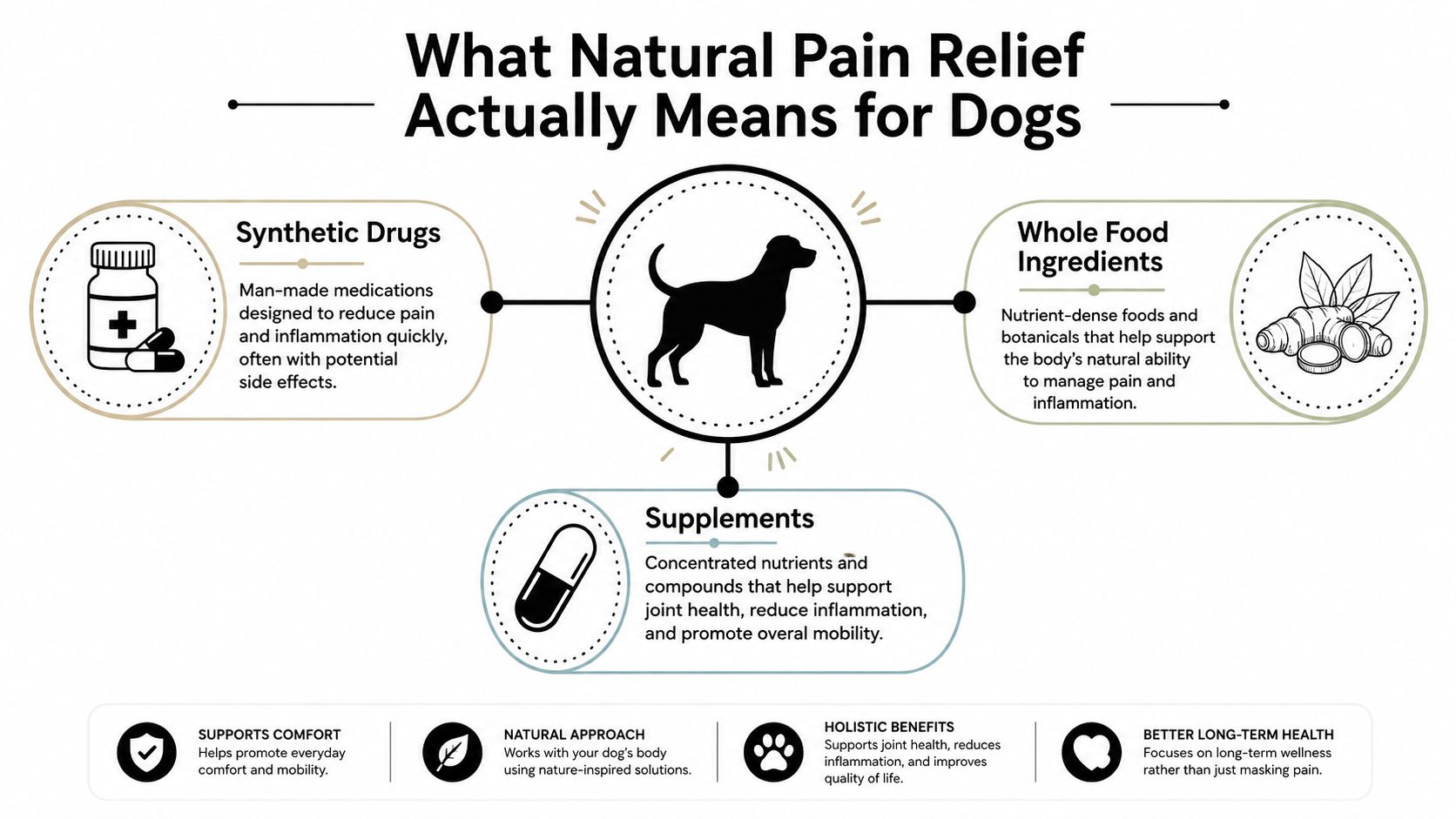
“Natural pain relief” is an umbrella phrase, not a medical category. It can refer to a concentrated botanical extract, a marine oil, a functional food ingredient, a nutraceutical, or a non-drug intervention such as controlled exercise. These options don't have identical purposes or evidence.
A pharmaceutical drug is developed and tested as a defined medicine for a specific use. A nutraceutical is a concentrated food-derived product intended to support health. A botanical extract contains selected compounds from a plant, and a functional food ingredient may be included in a diet or treat. The label tells you where an ingredient came from, not whether it can relieve pain.
A canine body isn't a small human body
Dogs process substances differently from people. Their liver enzymes, body size, diet, and ability to break down particular compounds can change how an ingredient behaves. A product that's tolerated by a person may be unsuitable for a dog, particularly when it contains human flavorings, concentrated essential oils, or a dose designed for a much larger body.
Think of the canine liver as a stricter bouncer. It may allow one compound through, slow another, and reject a third. You can't judge the outcome by looking only at the ingredient's reputation among human supplement users.
A useful evaluation framework
When someone recommends a natural product, ask four questions:
What is the intended target? Is it pain signaling, inflammation, cartilage support, muscle tension, or general wellbeing?
What evidence exists in dogs? Human research can suggest a mechanism, but it doesn't establish canine efficacy.
What does the actual formula contain? Extract type, concentration, carrier oils, and added ingredients affect results.
Could it interfere with treatment? Natural products can cause adverse effects or interact with prescription medicines.
Pain itself is also not one single process. A dog may have inflammation inside a joint, weakness around that joint, nerve-related pain, or an injury that needs stabilization. A supplement that influences inflammatory signaling won't correct a torn ligament or resolve a neurological emergency.
The Most Studied Natural Ingredients for Dog Pain
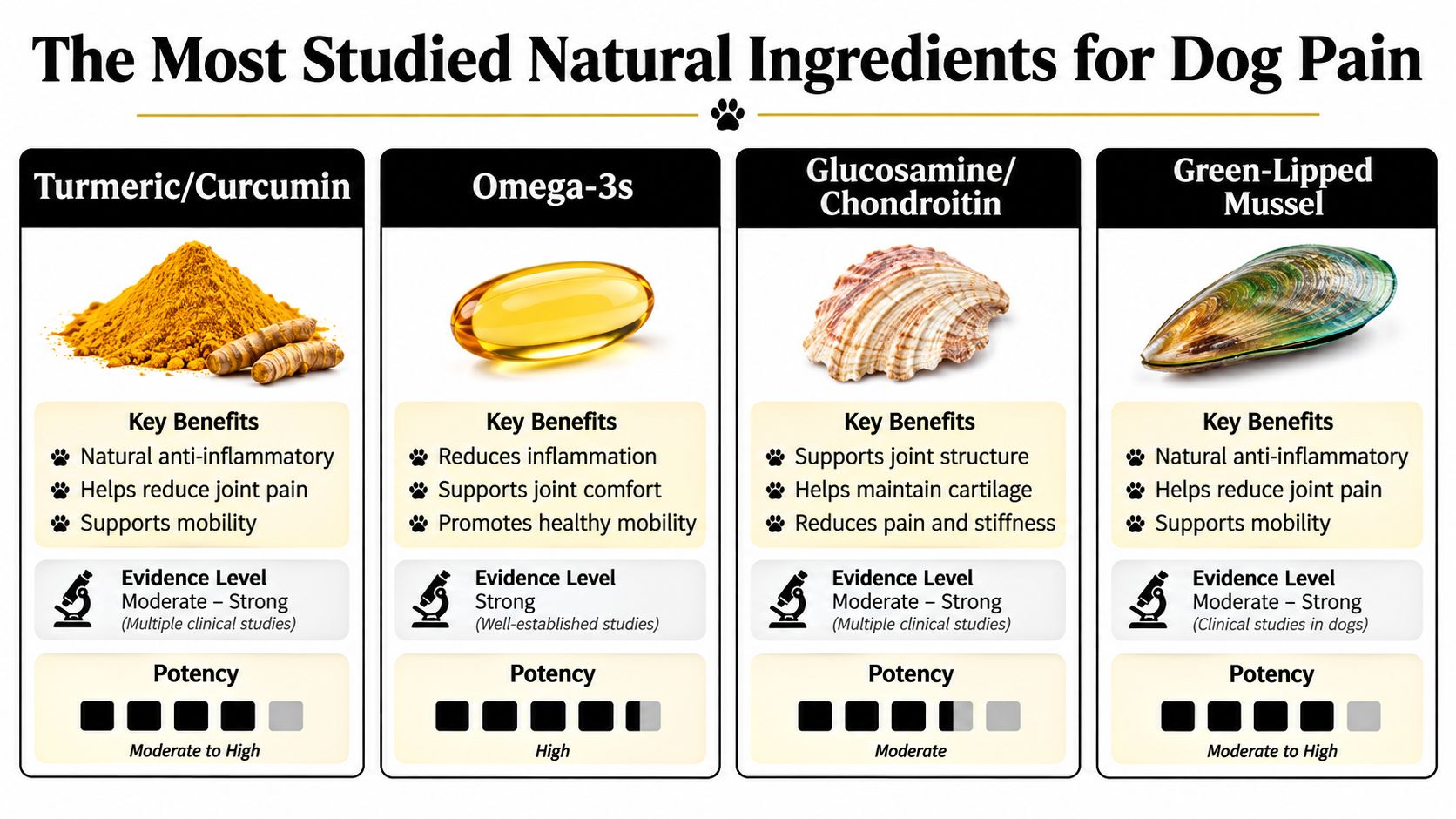
A dog that hesitates before climbing stairs may have a painful joint, reduced strength, or an injury that needs examination. Supplements can support some chronic conditions, but they do not all have the same evidence. Omega-3 fatty acids currently have a clearer canine osteoarthritis signal than several familiar joint ingredients. Turmeric is promising, while other popular options remain less certain.
Turmeric and curcumin
Turmeric contains curcuminoids, compounds studied for their effects on inflammatory pathways. In dogs, the evidence is promising but mixed. A 2017 randomized, double-blind, placebo-controlled study involving client-owned dogs with naturally occurring osteoarthritis found a significant reduction in pain during manipulation in the treatment group. Objective gait measures, however, did not clearly differ from placebo, according to a veterinary evidence review of turmeric and curcumin.
A separate veterinary trial studied 20 dogs with osteoarthritis. Dogs received a turmerosaccharide-rich Curcuma longa extract at 300 mg per 20 kg of body weight once daily for 42 days. Veterinarian and owner assessments showed significant reductions in pain and clinical signs, with no adverse events observed in that trial. Results from one extract should be treated as evidence about that formula, not every turmeric product.
Curcumin is poorly absorbed in many forms, so extract standardization and formulation affect how much active compound a dog receives. A label may list turmeric without stating its curcuminoid content. This guide to curcumin in turmeric explains why the ingredient name alone does not describe the full product.
Omega-3 fatty acids
EPA and DHA from marine sources have the clearest evidence among the options discussed here. A 2022 systematic review and meta-analysis found evident clinical analgesic benefit from omega-3-enriched diets and omega-3 supplements in canine and feline osteoarthritis (systematic review of nutraceuticals for osteoarthritis).
Omega-3s influence inflammatory lipid signaling rather than acting like an immediate painkiller. They fit ongoing management better than sudden, severe pain. Check the label for the actual amounts of EPA and DHA, because “fish oil” alone does not show how much of either fatty acid the product provides.
Glucosamine and chondroitin
Glucosamine and chondroitin are widely marketed for cartilage and joint structure, yet their reputation is stronger than their pain-relief evidence. The same 2022 systematic review found a marked non-effect for chondroitin-glucosamine in osteoarthritis pain management and recommended against relying on that combination for analgesia.
A dog may still receive a product containing these ingredients for other reasons, under veterinary guidance. Owners should not treat a familiar joint label as proof of effective pain control.
Green-lipped mussel, Boswellia, and combination formulas
Marine and botanical combinations remain under veterinary study. A multicenter, double-blind, randomized, placebo-controlled trial reported that a joint supplement containing eggshell membrane, krill meal, astaxanthin, hyaluronic acid, and Boswellia serrata improved mobility and quality of life in dogs with osteoarthritis (multicenter veterinary supplement trial).
That finding supports a mechanism-based adjunct, not a replacement for standard pain control. Green-lipped mussel and Boswellia may be useful in a carefully designed formula, but evidence for one combination cannot automatically be applied to every powder or chew.
Hemp-derived CBD, MSM, and ashwagandha
Research on hemp-derived products is developing, while certainty remains low. A clinical study reported reduced owner-assessed pain in dogs over 8 weeks, and research on cannabis-based products and palmitoylethanolamide continues to examine non-prescription pain support (PubMed record for the evidence review). Owner observations matter, but they are subjective, and product composition can vary.
MSM and ashwagandha have less established evidence for canine pain relief. Ashwagandha is better viewed as a botanical with possible stress-related applications than as a proven canine analgesic. Human formulations can contain unsuitable doses or added ingredients, so familiarity with the name is not a safety guarantee.
Evidence at a Glance for the Top Natural Options
A comparison table helps separate promising ingredients from familiar names with weaker support. It also has limits. Veterinary studies do not establish one universal dose or onset for every product, and formulations can differ substantially. Where research does not support a dependable canine dose or timeline, not established is safer than an invented number.
Ingredient | Evidence in Dogs | Typical Dose | Onset of Effect | Role |
|---|---|---|---|---|
Omega-3 EPA and DHA | Strongest signal among the options discussed, with clinical analgesic benefit reported in dogs with osteoarthritis | Follow canine product directions and veterinarian guidance, because EPA and DHA concentrations vary | Gradual support, not immediate relief | Adjunct |
Turmeric or curcumin | Encouraging but mixed. Results depend on formulation and the outcome measured | A veterinary trial used 300 mg per 20 kg once daily for 42 days in a turmerosaccharide-rich extract (trial evidence) | Studied over a sustained period, with no universal timeline | Adjunct |
Green-lipped mussel and Boswellia combinations | One controlled trial reported improved mobility and quality of life for a specific multi-ingredient formula (multicenter trial) | Formula-specific | Gradual and formula-dependent | Adjunct |
Glucosamine and chondroitin | A systematic review found no dependable pain-management effect (meta-analysis) | No evidence-based universal dose for pain relief | Not reliably established | Not a dependable analgesic |
Hemp-derived CBD | Emerging evidence, with low certainty and owner-reported benefit in some research (evidence review) | Product-specific, with veterinary guidance | Not reliably established | Adjunct only |
MSM and ashwagandha | Insufficient evidence for dependable canine pain relief | No established pain-relief dose | Not established | Supportive use should be cautious |
The practical ranking is clear. Omega-3s deserve the most confidence for an evidence-based supplement discussion. Turmeric may be reasonable when its formulation is transparent and a veterinarian agrees. Combination products may be useful, but results from one studied formula do not automatically apply to every product with a similar ingredient list. For a dog with worsening pain, supplements should support a veterinary plan, not delay diagnosis or effective treatment.
Choosing and Evaluating a Supplement Safely
A dog supplement should pass a label test before it passes a shopping test. Start with the active ingredient and its amount per serving. “Joint blend” or “proprietary complex” doesn't tell you whether the product contains a meaningful quantity of anything.

Four label questions worth asking
Can you identify the active dose? Look for EPA and DHA amounts in fish oil, curcuminoid or extract details in turmeric, and the quantity of each botanical.
Is the product made for dogs? Human-grade ingredients don't automatically make a human supplement suitable for canine use. Flavorings, sweeteners, capsule materials, and serving sizes may be wrong for dogs.
Does the company test the finished product? A certificate of analysis can help verify identity, potency, and contamination controls. It doesn't prove that the supplement relieves pain.
Can the manufacturer explain the formula? A trustworthy label should make it possible to understand the source, extraction method, and serving instructions without guessing.
Formulation changes the outcome
Two turmeric products can share the same front-label word and behave very differently. One may use plain ground root. Another may use a standardized extract with an absorption aid or a suitable carrier. The evidence from a specific extract shouldn't be used to promote a different product without qualification.
The same principle applies to fish oil. A bottle can advertise fish oil while providing little clarity about EPA and DHA. Those details matter more than the size of the softgel.
For broader label-reading guidance, see this resource on supplements for joint support. Keep a photo of the label and ingredient panel so your veterinarian can review the exact product rather than a product category.
Introduce changes carefully
Add one new supplement at a time. Otherwise, you won't know which product helped, caused diarrhea, or changed your dog's appetite. Record your dog's walking comfort, willingness to rise, stair use, sleep, and any digestive changes in a simple notebook.
Label literacy matters: A long ingredient list can look sophisticated while concealing the information you need most, the amount and form of each active ingredient.
Safety Risks and Medication Interactions Owners Miss
The phrase “natural equals safe” can lead owners into avoidable trouble. Dogs may react to ingredients that people tolerate, and supplements can affect bleeding, digestion, sedation, or the way a prescription medicine works.
Start with the product itself. Flavored chewables may contain xylitol, which is dangerous for dogs. Human products may also include concentrated essential oils, unsuitable sweeteners, or other ingredients that were never intended for canine use. Garlic and onion derivatives are another concern because they can damage a dog's red blood cells.
Medication combinations need professional review
Omega-3 products can affect bleeding risk, especially when combined with blood-thinning medication or before a procedure. Botanicals may also alter sedation or gastrointestinal tolerance. If your dog receives carprofen, gabapentin, an opioid, a corticosteroid, or another prescription treatment, tell the veterinarian about every supplement, oil, chew, and herbal product.
Don't stop a prescribed pain medicine abruptly, and don't add a natural product on top without discussing the combination. A veterinarian can decide whether the supplement is appropriate, whether the timing matters, and whether monitoring is needed.
Cannabidiol deserves particular caution. Reviews describe short-run tolerance in some dogs, but the certainty of evidence remains very low, and mild adverse events such as vomiting and alkaline phosphatase increases have been observed (review of cannabidiol safety and evidence). That is a reason for careful supervision, not a reason to treat CBD as automatically harmless.
Ashwagandha also warrants a medication review because botanical products can affect sedation, thyroid-related treatment, immune activity, or other conditions. Learn more about ashwagandha interactions before considering a human supplement for a dog.
Stop and call if your dog reacts
Discontinue a new product and contact your veterinarian if your dog develops vomiting, persistent diarrhea, marked drowsiness, agitation, weakness, appetite loss, yellowing of the gums or eyes, or unusual bruising. Keep the container available in case the clinic needs the exact ingredient panel.
Red Flags That Mean It's Time to Call the Vet
A supplement belongs in a planned support strategy, not an emergency response. If your dog suddenly refuses to bear weight, cries when lifted, or develops a hunched back, the priority is finding out what happened.
A dog that pants continuously at rest, stops eating, loses bladder control, or becomes unusually withdrawn may be experiencing more than routine joint stiffness. Pain from the spine, abdomen, urinary system, mouth, or a serious injury can look vague at first.
Don't rationalize these signs
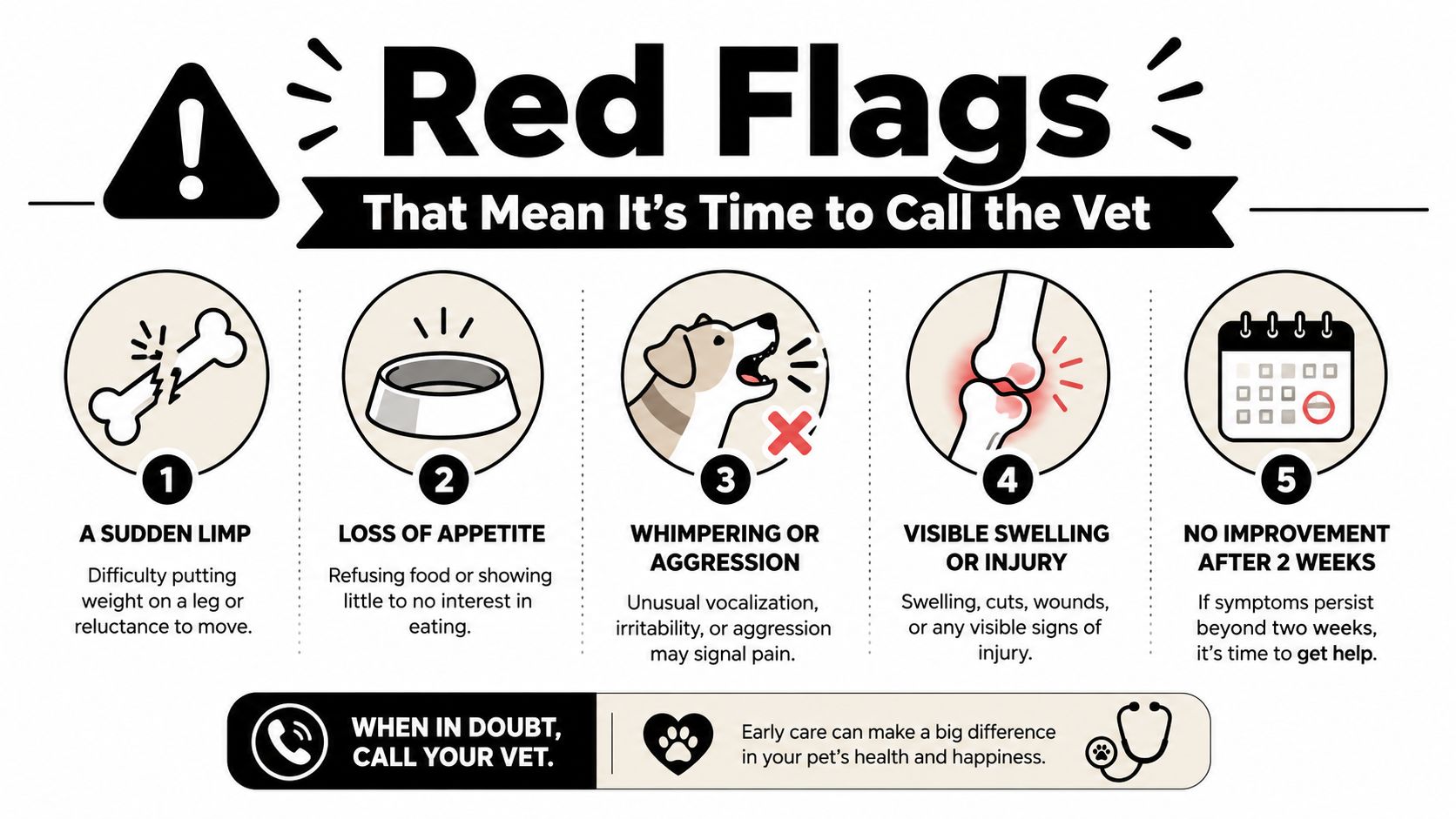
Sudden lameness: A new limp or inability to bear weight needs assessment, particularly after a fall, collision, or intense activity.
Visible swelling or injury: Heat, swelling, deformity, bleeding, or a wound isn't a supplement problem.
Severe vocalization or behavior change: Whimpering, snapping, hiding, or aggression can indicate significant pain.
Appetite or energy loss: A dog who won't eat or seems weak may have systemic illness, not uncomplicated arthritis.
Neurological changes: A hunched posture, dragging a limb, stumbling, or loss of bladder control can require urgent evaluation.
Chronic pain also deserves attention even when it looks mild. A dog who no longer jumps, plays, grooms normally, or rises easily may be adapting to discomfort rather than “getting old.”
Protective rule: Natural options may support diagnosed, stable conditions. They shouldn't delay care when pain is sudden, severe, progressive, or unexplained.
A Simple Framework for Using Natural Pain Relief the Right Way
Start with the diagnosis, not the bottle. Your veterinarian can distinguish osteoarthritis from a soft-tissue injury, ligament problem, dental pain, spinal disease, or another source that supplements cannot correct.
Then build a modest, trackable plan:
Confirm the problem. Ask what type of pain your dog has and what signs should trigger a recheck.
Choose the evidence grade. Omega-3s have the clearest support for osteoarthritis pain among the options discussed here. Turmeric is more formulation-dependent, while several familiar joint ingredients remain unproven for reliable analgesia.
Select a transparent product. Require clear active amounts, canine directions, manufacturer contact information, and finished-product testing where available.
Change one variable. Add one supplement at a time so you can recognize benefit or intolerance.
Track function, not just enthusiasm. Note how your dog rises, walks, uses stairs, sleeps, eats, and responds to gentle activity. A weekly mobility log can reveal gradual changes that memory misses.
Review the plan. Share the log with your veterinarian and decide whether to continue, adjust, or stop.
Natural pain relief works best as adjunctive care. Weight management, safe movement, supportive bedding, rehabilitation, and prescribed treatment may address different parts of the pain cycle. A supplement should make the plan more informed, not replace the clinical judgment that keeps your dog safe.
River of Life offers a human dietary supplement containing turmeric extract with BioPerine, ashwagandha root, ginger, and bromelain, but it isn't a canine pain medicine and shouldn't be given to a dog without veterinary approval. Visit River of Life to review the formulation and educational resources, then bring the ingredient list to your veterinarian before making a decision for your dog.