
Curcumin in Turmeric: Benefits, Bioavailability, Buy Smart

You're standing in the spice aisle or opening a supplement drawer, trying to answer a simple question: is turmeric in food enough, or does a capsule give you the curcumin people talk about? That confusion is normal, because the label often says “turmeric” when the decision is about curcumin content, delivery system, and whether the product can be absorbed. The difference matters more than the marketing language suggests, especially if you're looking for something beyond culinary use.
Table of Contents
Why Turmeric and Curcumin Are Not the Same Thing
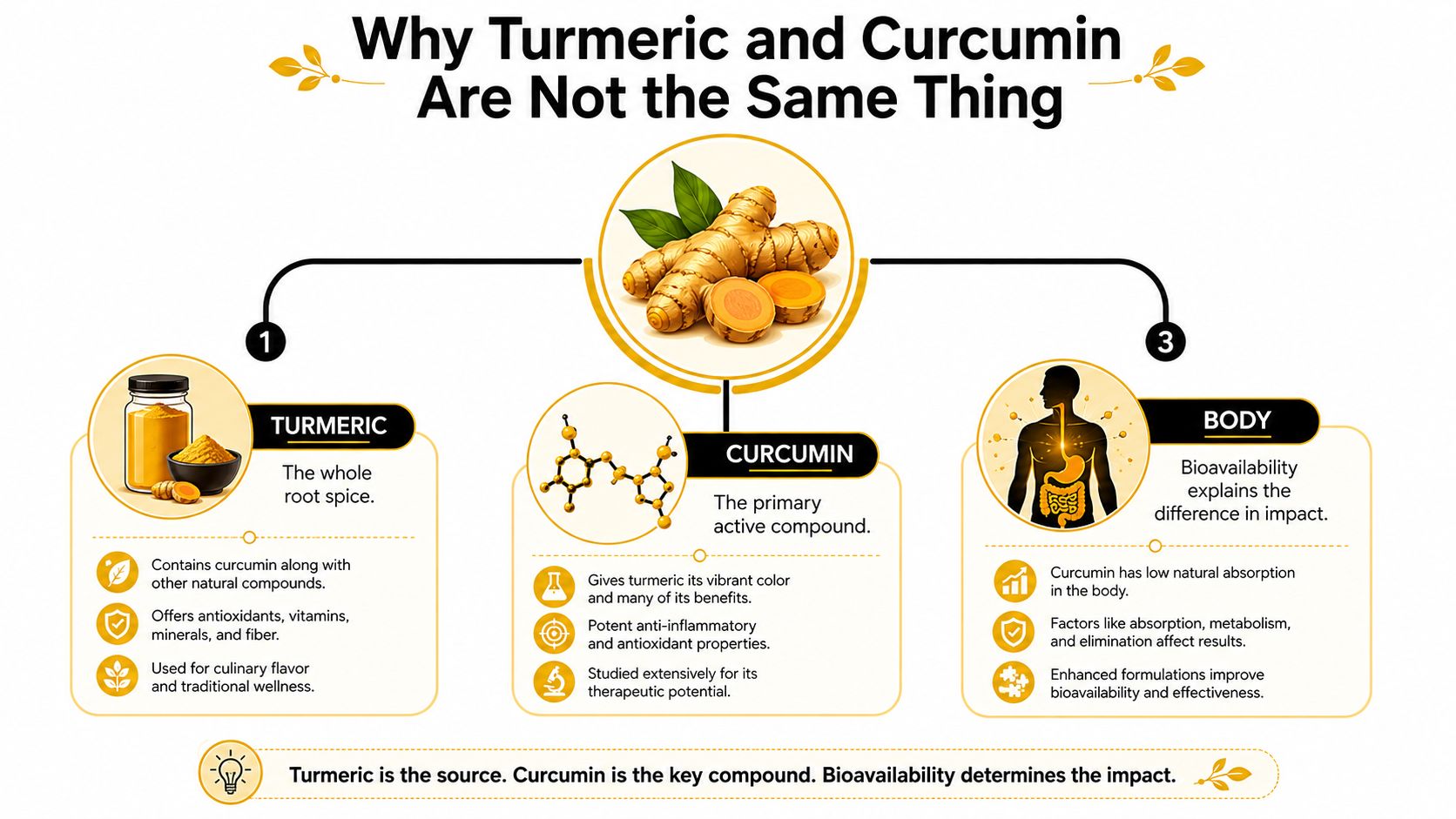
The bottle in your hand may say turmeric, but the compound many refer to when discussing benefits is curcumin. Turmeric is the plant material, usually the ground root. Curcumin is one of the main compounds inside that root, and it's the part most often standardized in supplements.
That difference sounds small until you compare kitchen use with supplement use. Turmeric in a curry gives flavor and color, but it does not give a trial-level dose of curcumin. A supplement can, if it uses an extract instead of plain root powder.
The kitchen shelf and the lab shelf
A useful way to think about it is this. Turmeric powder is like orange juice with pulp, while curcumin extract is closer to a concentrate that has been standardized for a specific compound. Both come from the same plant, but they do not behave the same way once you swallow them.
That's why the phrase “turmeric supplement” is too vague to be useful by itself. A product can contain mostly root powder, a concentrated extract, or an enhanced-absorption blend. If you don't check the label, you don't really know what you're buying.
Practical rule: treat “turmeric” as the source ingredient and curcumin as the active benchmark. If the label doesn't tell you how much curcuminoid content you're getting, you're guessing.
This is also where the form matters as much as the ingredient name. The same plant can show up as a cooking spice, a standardized extract, or a capsule built for absorption support. Those are very different choices, and they belong in different conversations. For a deeper joint-pain angle, see this arthritis-focused turmeric and curcumin overview.
How Much Curcumin in Turmeric
A spoonful of turmeric from the kitchen shelf does not deliver the same amount of curcumin as a standardized extract from the lab shelf. Authoritative reviews report that turmeric contains about 2% to 9% curcuminoids by weight, and curcumin usually makes up about 75% of that fraction, which helps explain why the spice in food stays far below the amounts used in research settings (LPI curcumin review). In plain language, the jar in your cupboard is a seasoning, not a concentrated curcumin source.
What curcuminoid means
The word curcuminoids refers to a family of related compounds, not a single molecule. Curcumin is the best-known member, while demethoxycurcumin and bisdemethoxycurcumin are the other major curcuminoids. When a supplement label says “95% curcuminoids,” it means the extract has been concentrated so that most of what it contains belongs to that curcuminoid family.
That standardization matters because whole turmeric root is naturally low potency. A capsule made from root powder can still serve as a food-style ingredient, but it will not match a standardized extract in dose or consistency. If you want to compare products, the key question is not “turmeric or not,” it is how many curcuminoids per serving.
A label comparison you can use
Form | Typical serving | Approximate curcumin content |
|---|---|---|
Ground turmeric spice | A teaspoon in food | A small fraction of a clinical dose |
Turmeric root powder capsule | One or more capsules | Usually still modest unless heavily dosed |
Standardized turmeric extract | One capsule or serving | Much higher and more consistent |
Extract with 95% curcuminoids | One capsule or serving | Highest concentration among common forms |
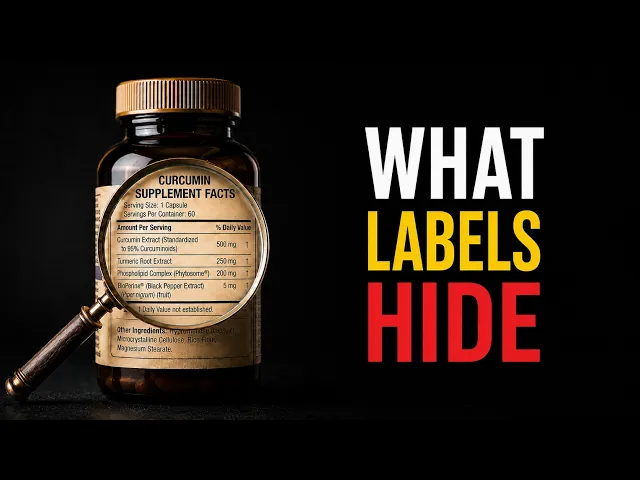
A reader who wants to interpret labels like a formulator should look for standardized extract, curcuminoids per serving, and the actual milligram amount, not just the word turmeric. A product with BioPerine or another absorption aid may use a smaller amount of curcumin than a plain extract, because the absorption support changes how much reaches circulation. If you are trying to compare that kind of blend with a clinical trial, read the label in two steps, first the milligrams of curcumin, then whether the formula includes a bioavailability enhancer that may change how that dose behaves in the body.
For product labeling that leans into this distinction, see this turmeric and curcumin supplement guide.
What the Research Shows Curcumin Can Do
A shopper standing in the supplement aisle often wants a simple answer, yet curcumin research is more useful when it is read like a formulator would read a label. The kitchen-shelf version of turmeric root and the lab-shelf version of a standardized extract do not behave the same way, so the question is really which form has enough curcuminoids reaching the body to matter.
Curcumin's strongest human research signal is in osteoarthritis and joint comfort. Review-level evidence points to improvements in pain and function, especially when the formulation gets enough compound into circulation to matter biologically (Examine curcumin overview). That does not make it a replacement for medical care, but it does explain why this ingredient keeps showing up in joint formulas. For readers looking for a practical bridge between research and everyday use, a curcumin guide for arthritis and joint pain can help connect the science to real product choices.

Stronger support versus earlier-stage interest
The evidence is not evenly distributed across every claimed use. Inflammation markers and pain-related outcomes have more support than broad claims about general vitality. Antioxidant effects are also commonly discussed, but in human nutrition that phrase often describes a mechanism rather than a guarantee you will feel a noticeable change.
The careful way to read the literature is to separate likely, possible, and still preliminary. Curcumin appears most promising where inflammation and pain are measurable, because those endpoints can be tracked in a clinical setting. For mood and cognition, the evidence base is more mixed, so those claims belong in the early category rather than the established one.
What to expect and what not to expect
A fair summary is this. Curcumin may help some people notice less stiffness, better movement, or easier recovery after physical stress. It is not a universal answer for inflammation, and it will not override sleep loss, poor diet, or a workload that keeps irritating the same joint.
Curcumin works like a tool with a narrow sweet spot. If the formulation is weak or the dose is too low, the effect may be too small to notice.
The reason this matters is simple. Benefits in human trials tend to show up when the body absorbs enough of the compound, which brings you back to the formulation problem. If you are comparing products, the next question is not just what the ingredient is, but how the manufacturer helped your body use it.
Why Curcumin Is Hard to Absorb and How Formulations Fix It
Curcumin has a classic bioavailability problem. You can take it by mouth, but the body doesn't absorb it especially well, and what does get absorbed can be metabolized and cleared quickly. It's like trying to deliver a package to a house with a locked front gate, a fast-moving pickup truck, and a driveway that sends the package back out almost immediately.
That's why formulation is such a big deal. The same ingredient can perform very differently depending on the delivery system. Dose matters, but dose alone doesn't tell you how much reaches the bloodstream.
The main enhancement strategies
Piperine, the black pepper extract used in many formulas, is one of the most studied absorption enhancers (Examine curcumin overview). It works by affecting how the body handles curcumin, which is why curcumin plus black pepper often gets discussed as a pair. The trade-off is that piperine can also affect the metabolism of several prescription drugs, so “better absorption” is not a free upgrade for everyone.
Other approaches try to solve the same problem from a different angle. Phytosomes and liposomal forms aim to move curcumin through the gut more efficiently by changing how it is packaged. Nanoparticles and micelles focus on solubility and transport, which can make the compound easier to absorb but often makes the label harder to compare directly with plain extract.
Reading enhancement claims without getting fooled
A phrase like “BioPerine-enhanced” tells you the product is trying to improve uptake, but it does not tell you everything. You still need the actual curcumin amount, because a clever delivery system can't rescue a tiny dose.
The claim you'll see most often is that piperine dramatically boosts absorption, and that can be true for a specific formulation. It is not a universal promise for every curcumin product on the shelf. Formulation details matter more than the headline.
Practical rule: if a label mentions black pepper, liposomal delivery, phytosome technology, or micelles, look for the exact curcumin amount next. Enhancement should support a real dose, not replace it.
For a formulation that combines turmeric extract with BioPerine and other botanicals, River of Life Capsules are one example of a multi-ingredient approach. The broader point is the same no matter which brand you compare, the delivery system has to earn its place on the label. You can also review this black pepper and curcumin explainer if you want a practical look at how pairing affects the supplement choice.
Extract Versus Whole Root and How to Read the Label
A shopper can hold two turmeric bottles that look nearly the same and still be looking at two very different products. One may lean on full-spectrum root, which keeps closer to the whole plant material. The other may be a standardized extract, where the manufacturer concentrates curcuminoids so each serving is easier to predict. The choice is not about which word sounds better on the front panel, it is about whether you want a kitchen-shelf ingredient or a lab-shelf formula.
What the label should tell you
Start with the form. A root-heavy product can make sense if you want something closer to culinary turmeric use. An extract makes more sense if you are trying to match the kind of intake used in studies, because the curcuminoid content is stated more clearly.
Then read the serving math. A bottle that says turmeric but does not tell you the curcuminoid amount leaves out the part that matters most. A useful label answers a simple question, how much active compound do you get per day?
Then check the bioenhancer. Black pepper extract, phytosome technology, or a similar delivery aid can change how useful the product is, but only if the label still gives you the actual amount of curcumin. A premium bottle with vague turmeric wording can be harder to evaluate than a simpler extract panel that spells everything out.
The safety background is long established. The U.S. FDA classifies curcuminoids as GRAS, and clinical reviews report good tolerability even at 4,000 to 8,000 mg/day (PMC review). International food-safety authorities use a much more conservative acceptable daily intake of about 3 mg/kg body weight, around 210 mg/day for a 70 kg adult (PMC review). That gap is a reminder that food use and supplement use are not judged by the same yardstick.
A quick label checklist
Look for standardized extract. It gives you a more consistent curcuminoid level.
Check the actual milligrams per serving. The number on the front means little without this detail.
Note the delivery system. Black pepper, phytosome, liposomal, or micelle wording can matter.
Read the source description. Root powder, extract, and full-spectrum are not interchangeable.
If you want one concrete example of how a capsule product can combine turmeric extract, black pepper, and other ingredients, this supplement overview from River of Life sits in that category. The practical takeaway is simple, read the label the way a formulator would, not the way a casual spice shopper would.
Safe Dosing, Interactions, and Who Should Be Careful
Curcumin is one of those ingredients where “natural” does not mean “automatically suitable for everyone.” For many healthy adults, the doses used in studies are well tolerated, but the right dose still depends on your goal and your medications. The shortest path to trouble is treating a joint formula like a harmless seasoning.
Who needs medical guidance
People taking anticoagulants or antiplatelet drugs should be cautious, because curcumin can overlap with bleeding concerns. Anyone with gallbladder obstruction, gallstones, or an active ulcer should check with a clinician first, since concentrated turmeric products are not the same thing as food-level spice use. Pregnant or breastfeeding individuals should also avoid assuming that high-dose supplementation has been established as safe.
Piperine deserves its own warning because it changes metabolism. That's useful if you want better curcumin uptake, but it also means the blend can affect how other prescription drugs are handled. If your medication list is already complex, the label needs a pharmacist-level read.
A practical timing framework
Take curcumin with food, ideally a meal that contains some fat. That's the simplest way to make absorption friendlier without overthinking it. If you're using a high-dose regimen, it can also help to keep it away from iron-rich meals when possible, since you don't want to layer every absorption issue at once.
For a person trying a daily routine, the safest approach is usually conservative. Start low, stay consistent, and judge the response against your actual symptom pattern, not a single good day. If the bottle adds black pepper extract, use that as a sign to be more careful about drug interactions, not less.
Best clinical habit: tell your clinician the exact product, the exact serving size, and whether it includes piperine. That one detail changes the conversation more than most shoppers realize.
Matching a Curcumin Routine to Your Goal
A good curcumin routine matches the problem you're trying to solve. Someone with persistent joint stiffness does not need the same timing or formulation as an active adult trying to calm post-workout soreness. A one-size-fits-all plan usually means the dose is too vague to be useful.
Joint stiffness and everyday mobility
If your main issue is daily stiffness, the most sensible option is a standardized extract or another bioavailable form taken consistently with a meal. The goal here is steady support rather than a quick fix. In practice, that means a routine you can repeat without turning it into a complicated protocol.
Post-workout recovery
If you're using curcumin for recovery, a formulation with enhanced absorption makes more sense than culinary turmeric alone. Timing it around food is usually easier than trying to micromanage the exact workout window. You're trying to support a recovery environment, not chase a dramatic immediate effect.
Evening calm and sleep support
For stress and sleep, curcumin is usually a supporting player, not the whole stack. It fits better as part of a broader evening routine that already includes sleep hygiene and predictable habits. A product with turmeric plus other calming botanicals may feel more relevant here than a single-ingredient extract, depending on your sensitivity and medication list.
Simple rule for all three goals: use curcumin as a consistency tool, not a rescue tool. The people who tend to get the best read on it are the ones who take the same product for long enough to notice a pattern.
That's where a brand like River of Life Capsules can fit for some adults, since it combines turmeric extract with BioPerine, plus ashwagandha, ginger, and bromelain in a capsule format. It's one option among others, and the right choice still depends on your goal, medication list, and whether the label gives you the details you need.
The Honest Takeaway on Curcumin in Turmeric
Turmeric is a useful kitchen spice. Curcumin is the compound people usually mean when they talk about supplement benefits. Those two things overlap, but they are not interchangeable, and that distinction explains most of the confusion around the ingredient.
The honest read is straightforward. Food-level turmeric can be part of a healthy pattern, but meaningful joint or recovery support usually comes from a standardized extract in a form the body can absorb. That means the front label matters less than the dose, the curcuminoid content, and the delivery system.
Ignore the claims that promise miracle cures, mega-dose transformations, or a single capsule that solves a medical condition. Those promises outrun the evidence. What does matter is consistency, because a fair trial of a good formula takes time.
Pick one well-labeled product, take it as directed with food, and give it a real 60 to 90 day trial before deciding whether it's worth keeping. If you've been comparing bottles without understanding the difference between root powder and extract, that's the point where the label finally starts to make sense.
If you want a capsule routine built around turmeric extract, absorption support, and complementary botanicals, River of Life offers a product designed for daily use and educational guidance on turmeric-related wellness topics. Visit River of Life to review the formulation details, compare your options, and decide whether it fits your joint, recovery, or evening routine.