


MSM Supplement: Joint Benefits, Dosing & More

You're standing in the supplement aisle, holding a bottle of MSM in one hand and your phone in the other, trying to answer a simple question without getting talked into a purchase you don't need. Is this just another joint-health ingredient with good marketing, or is it one of the few supplements that earns its place in a routine? The honest answer sits somewhere in the middle, and that's exactly where a smart buyer should want it.
MSM has stayed relevant because it keeps showing up in joint-support research, especially around osteoarthritis-related pain and function, yet the evidence hasn't become a blank check for every claim attached to it. The value of a good guide isn't selling you on MSM, it's helping you understand what it is, what it might do, how people usually take it, and where the label can mislead you. That matters if you're comparing a pure MSM product with blends that also include turmeric, ginger, bromelain, or ashwagandha, because the best choice depends on your goal, your budget, and how cautious you want to be.
If you want a calm walkthrough that respects your time, this is it. You'll get the chemistry in plain English, the trial data without the hype, a practical dosing approach, and a clear way to think about MSM beside other common joint ingredients. You'll also see where the biggest gaps still are, especially long-term safety and who should be a bit more careful before starting.
Table of Contents
Why So Many People Are Adding MSM to Their Routine
A lot of people discover an MSM supplement the same way they discover most supplements, by seeing it on a shelf after their joints start complaining. The bottle looks straightforward, the claims sound practical, and the ingredient has been around long enough that it doesn't feel like a fad. That mix makes it appealing to buyers who want something less flashy than a trend and more focused than a kitchen-sink formula.
The reason MSM has stayed in the conversation is simple. It has been studied for osteoarthritis for at least two decades, and the early clinical record shows enough signal to keep researchers interested. A 2006 pilot trial used 3 g twice daily and reported improvements in pain and physical function over a short period without major adverse events, and a later randomized, double-blind, placebo-controlled study enrolled 100 men and women with hip and/or knee osteoarthritis and used the same dose for 26 weeks.
That said, MSM has not turned into a miracle ingredient. A 2008 systematic review found only seven potential studies in the broader DMSO/MSM evidence base, with three randomized controlled trials, two DMSO studies, and one MSM trial totaling 326 patients, and the authors described the evidence as positive but not definitive. That is the kind of detail a careful shopper should want, because it tells you MSM is not brand-new, but it also is not backed by giant, decades-long trial programs.
Practical rule: if a joint supplement sounds too certain, it usually is. MSM is better understood as a reasonable option for some people with joint discomfort, not a universal fix.
Why the conversation keeps coming back to joints
MSM keeps showing up because joint comfort is where the evidence is most developed, while many other claims are less settled. That is why shoppers comparing options for stiffness, mobility, or workout soreness keep bumping into it. It is also why a plain-language guide matters, because the internet often blends pain relief, inflammation, recovery, and general wellness as if they were the same thing.
A good starting point is to treat MSM as a targeted ingredient, not a lifestyle cure-all. If your main question is whether it belongs in a routine for knees, hips, or everyday movement, the answer needs nuance. If your question is whether it should replace everything else you already take, that is a different decision entirely.
What MSM Is and How It's Made
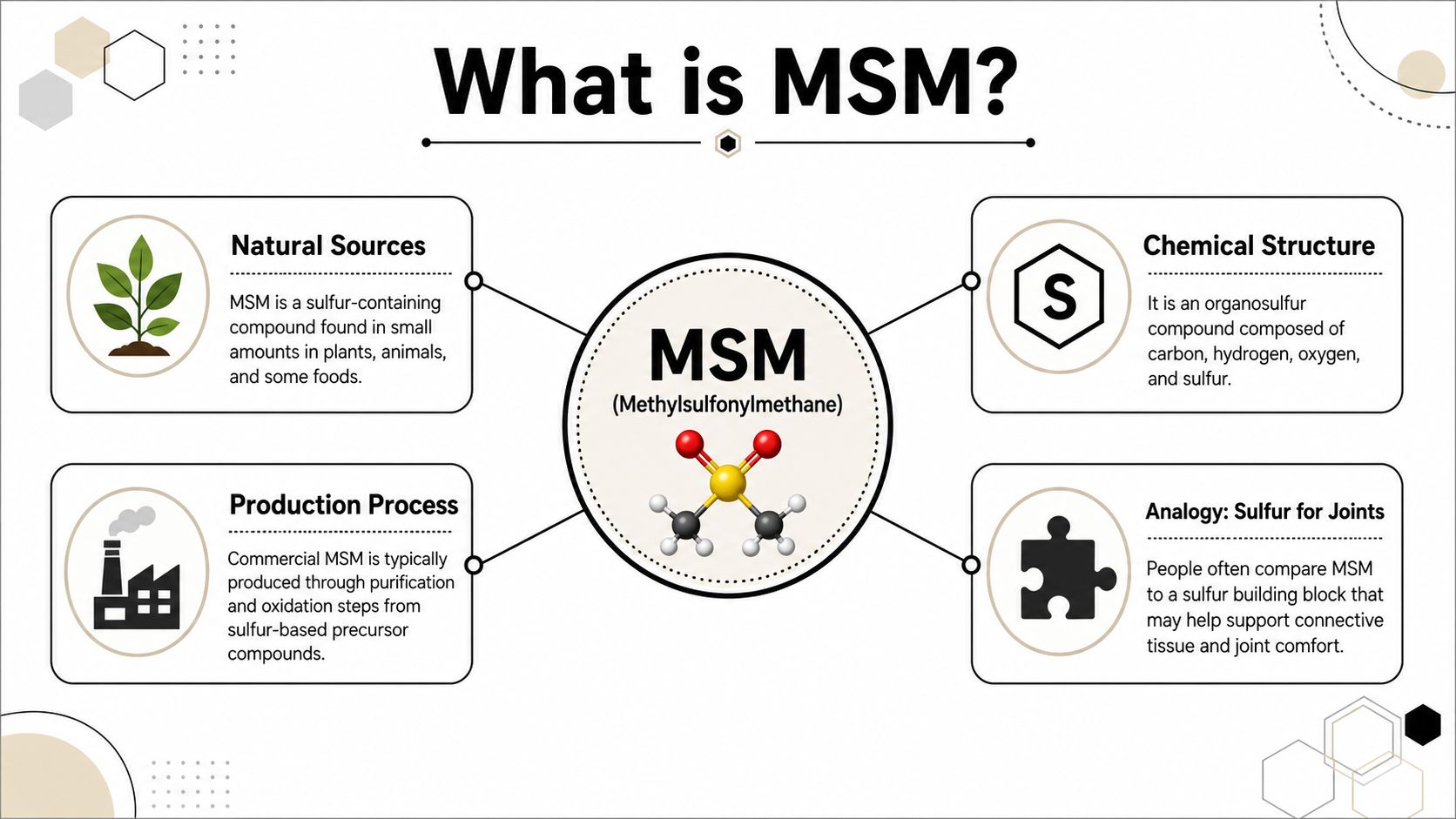
MSM stands for methylsulfonylmethane, and it's also called dimethyl sulfone. Chemically, it's a stable organosulfur compound with the formula C2H6O2S, a molecular weight of 94.13 g/mol, and a white crystalline, odorless form (Nutrients review on MSM). If chemistry usually makes your eyes glaze over, keep the plain version in mind. MSM is a small sulfur-based building block that supplement makers can isolate into a clean, consistent ingredient.
Why purity matters more than flashy packaging
For supplement manufacturing, the useful details are less about style and more about consistency. The verified chemistry source notes that purity specs commonly target >99.8%, with low moisture and tightly controlled heavy metals, because those parameters improve flowability, storage stability, and dose consistency in capsules or powders. That is why serious MSM products tend to talk about purity, testing, and stability instead of exotic-sounding extras (Nutrients review on MSM).
MSM is often confused with DMSO, a related compound, but they are not the same product in practice. That difference matters when you read labels, because a supplement shopper wants an oral product with clear sourcing and controlled manufacturing. A stable, highly purified ingredient is easier to dose consistently than a vague “sulfur blend.”
What the chemistry means in practice
The practical takeaway is not that you need to memorize a formula. MSM is valued because it is a defined, standardized compound, which makes quality control more realistic than with many plant extracts. When a bottle says MSM, you want to know that it is MSM, not a blend hiding behind the name.
A white powder in a capsule does not sound exciting, but that is part of the point. For a first-time buyer, boring can be good when boring means consistent, odorless, and easier to compare across brands. If you are also comparing it with other joint-support ingredients, a straightforward guide to joint support supplements can help you see where MSM fits without turning every bottle into a mystery.
What the Evidence Says About MSM Benefits
A smart shopper usually wants one clear answer first: what does MSM help with? The best-supported use is still joint symptoms, especially osteoarthritis, and that is where the trial record is easiest to follow. In one randomized, double-blind, placebo-controlled trial, healthy Japanese participants with mild knee pain took MSM for 12 weeks, and the primary outcome total score differed significantly from placebo with p = 0.046. The health condition score also improved with p = 0.032 (ScienceDirect trial summary).
Joints, function, and pain
A second randomized study of knee osteoarthritis gives a more practical readout. In that trial, 3.375 g/day of MSM for 12 weeks led to significant improvement in function, total WOMAC scores, and pain on a visual analog scale compared with placebo. That matters because shoppers do not experience “joint support” as an abstract idea. They feel it when walking is easier, stairs are less annoying, and everyday movement takes less effort.
The evidence is encouraging, but it is not a blank check. MSM has not produced a uniformly strong effect across every supplement review, and the broader picture is less dramatic than some marketing copy suggests. A meta-analysis of related nutritional supplements found a nonsignificant pain reduction of 6.34 mm on a visual analog scale across the included studies and concluded that the overall effect size was neither statistically nor clinically significant. That does not cancel the individual trials, but it does keep the claims in proportion.
Bottom line: MSM looks most credible for joint comfort, not for sweeping promises about inflammation, recovery, or whole-body repair.
Where the evidence gets thinner
People often ask whether MSM also helps with soreness, recovery, or general inflammation. Those questions are understandable, because supplement labels often blur those ideas together. The evidence is better described as mixed, with trial activity around common doses of roughly 3 to 6 g/day, but not a uniform proof package for every use case.
For a first-time buyer, that means MSM can fit into a joint-support plan without being treated like a miracle ingredient. A practical way to compare it with turmeric, ginger, and bromelain is to look at the role each ingredient is trying to play. MSM is the steady, simple option that shows up most often in joint-focused routines, while supplements for joint support can give you a broader frame for how those ingredients are often combined. The key is to match the claim to the evidence, then decide whether the product fits your routine and expectations.
How to Dose MSM and When to Take It
The most useful research-backed range for MSM sits around 3 to 6 g/day, based on the trials already discussed. That doesn't mean everyone should start there on day one. It means that if someone is using MSM for joint support, those are the doses researchers have tested, rather than random amounts pulled from marketing copy.
A simple starting approach
A cautious buyer usually does better by starting lower and moving up. That gives you a chance to notice how your body responds, especially if you're sensitive to supplements or already taking several medications. Some people prefer a split-dose routine with meals, while others like one larger dose for convenience, and both approaches are used in real life.
Here's a practical way to consider this.
Start modestly: use the lowest amount you can tolerate comfortably, then increase only if needed.
Split if your stomach is sensitive: taking MSM with meals can feel easier for some people.
Stay consistent: joint-focused supplements usually make more sense when they're taken daily rather than on and off.
Track how you feel: note pain, stiffness, and function so you can judge whether it's doing anything useful.
The main decision is usually capsule versus powder. Capsules are simpler and cleaner for travel, while powder gives you more flexibility if you want to adjust dose more easily. Powder can also be more cumbersome, so the right form is often the one you'll take consistently.
If you like structured guidance for daily supplement habits, the dosing principles in this dosage guide are a useful comparison point even though the ingredient is different.
Who should start more carefully
Older adults, people on multiple medications, and anyone with digestive sensitivity should be more conservative at the beginning. That's not because MSM is automatically risky, it's because a slower start makes it easier to separate the supplement's effect from your baseline symptoms. If you've ever quit a product too quickly because you felt off during the first few days, this is the moment to avoid that pattern.
How MSM Pairs With Turmeric, Ginger, and Other Ingredients
MSM is easiest to understand when you stop asking whether it's “better” than every other joint ingredient and start asking what job each ingredient is supposed to do. MSM is usually treated as a supportive structural ingredient, while turmeric, ginger, bromelain, and ashwagandha are chosen for different reasons. That makes stacking a strategy, not a gimmick, when the formula is built carefully.
Ingredient roles side by side
Ingredient | Primary Role | Strongest Evidence Area |
|---|---|---|
MSM | Support for joint comfort and osteoarthritis-related symptoms | Joint pain and function |
Turmeric | Broad anti-inflammatory support through curcumin | Joint discomfort and inflammation |
Ginger | Digestive and circulatory support, often used for comfort formulas | Nausea, digestive support, general comfort |
Bromelain | Proteolytic enzyme used in swelling-oriented blends | Recovery and soft-tissue support |
Ashwagandha | Adaptogen used for stress and sleep support | Stress resilience and sleep quality |
The point of a table like this is not to make every ingredient sound equally powerful. It's to show that each one serves a different purpose, so you can choose a blend based on the outcome you want. A person focused on knee comfort might like MSM as a core ingredient, while someone also dealing with stress or poor sleep may prefer a broader routine.
When stacking makes sense
Some buyers want a single-ingredient MSM product because they like control, simplicity, and the ability to judge what's working. Others prefer a combination formula because they don't want to build a stack one bottle at a time. Both approaches are reasonable as long as the label is honest about the doses.
If you're shopping for turmeric alongside MSM, this guide to ginger turmeric capsules can help you think through the role of the botanicals. One useful rule is this, choose a solo MSM product when you want to test MSM itself, and choose a blend when your goal is broader support across joints, stress, or recovery.
How to Choose a Quality MSM Supplement
The label on an MSM bottle should answer a few basic questions fast. What is the purity, how was it tested, is the brand transparent, and are you getting the full dose you think you're getting? If the bottle dodges those questions, that's usually a sign to keep looking.

A practical shopper checklist
Purity check: look for a clearly stated purity level, because cleaner input material usually means better consistency.
Third-party testing: favor products that show independent lab verification instead of asking you to trust the brand's internal claim.
Manufacturing standards: certifications such as GMP or NSF are a strong sign that the company takes production control seriously.
Capsule quality: vegan shoppers should check the capsule material, and all shoppers should look for unnecessary fillers.
Brand transparency: the company should explain sourcing, composition, and dose without hiding behind vague language.
A proprietary blend can be a problem if it hides how much MSM you're getting. That matters because a joint formula might look generous on the front label while giving you very little of the ingredient you came for. You want a supplement where the amount is easy to verify, not one you need a magnifying glass to decode.
Quality also affects how you compare capsule and powder formats. Capsules are easier to use, but powder can make dose adjustment simpler if you're testing tolerance. For a consumer, the right format is usually the one that balances clarity, convenience, and transparency.
Safety, Side Effects, and Long-Term Use Questions
MSM is generally discussed as a well-tolerated supplement at common doses, but “generally safe” is not the same thing as “safe for everyone in every situation.” The part that gets undercovered is duration of use. Most of the familiar trial period for MSM is still measured in weeks, not years, so the long-term picture is less certain than the casual marketing tone suggests.
The safety questions worth asking early
The verified data highlights a major gap in long-term safety and eye-risk screening. A PubMed case report described the first presumed bilateral acute angle-closure event after MSM ingestion, and reviews note that while MSM is generally considered safe at common doses, the evidence base is still limited and long-term safety can't be firmly confirmed (PubMed case report). That doesn't mean everyone will have a problem, but it does mean the supplement deserves the same common-sense caution you'd give anything you plan to use daily.
People with glaucoma history, eye-pressure concerns, polypharmacy, or a lot of moving parts in their medication list should be more careful. The same applies to pregnant or nursing individuals, where it's smart to involve a clinician before adding anything new. If you're buying MSM because it seems low-risk, it's worth remembering that rare events can matter even when the average user does fine.
A short practical check-in list helps:
Watch your eyes: stop and seek medical advice if you notice unusual eye pain or visual changes.
Respect other meds: if you're on several prescriptions, ask a clinician before adding MSM.
Don't assume daily use is trivial: a supplement can be mild and still warrant monitoring over time.
Start with caution if you're unsure: a conservative beginning makes side effects easier to spot.
Most supplement problems don't start with a dramatic reaction. They start with people ignoring early warning signs because the product is “just a vitamin-style capsule.”
Mild side effects and common sense
Many users don't report major issues, but digestive upset or headache can happen with any new supplement routine. The smart move is to introduce MSM the same way you'd introduce any daily ingredient you expect to use for a while, slowly enough that you can tell whether it suits you. If you have eye disease risk or you're already juggling medications, that caution is especially important.
Putting It All Together for Your Daily Routine
If you're a first-time buyer, start with the goal, not the bottle. A curious newcomer can test a simple MSM product, an active adult dealing with soreness may prefer a joint-focused blend, and an older adult focused on long-term comfort may care most about consistency, purity, and ease of use. In every case, the best routine is the one you can repeat without guessing.
A clean checklist helps: start low, track symptoms for 4 to 6 weeks, confirm third-party testing, and ask a clinician if you use medications or have eye-health history. That keeps MSM in the right lane, useful where the evidence is strongest, and cautious where the questions are still open.