


Dosage Aleve Guide: Safe Pain Relief Tips

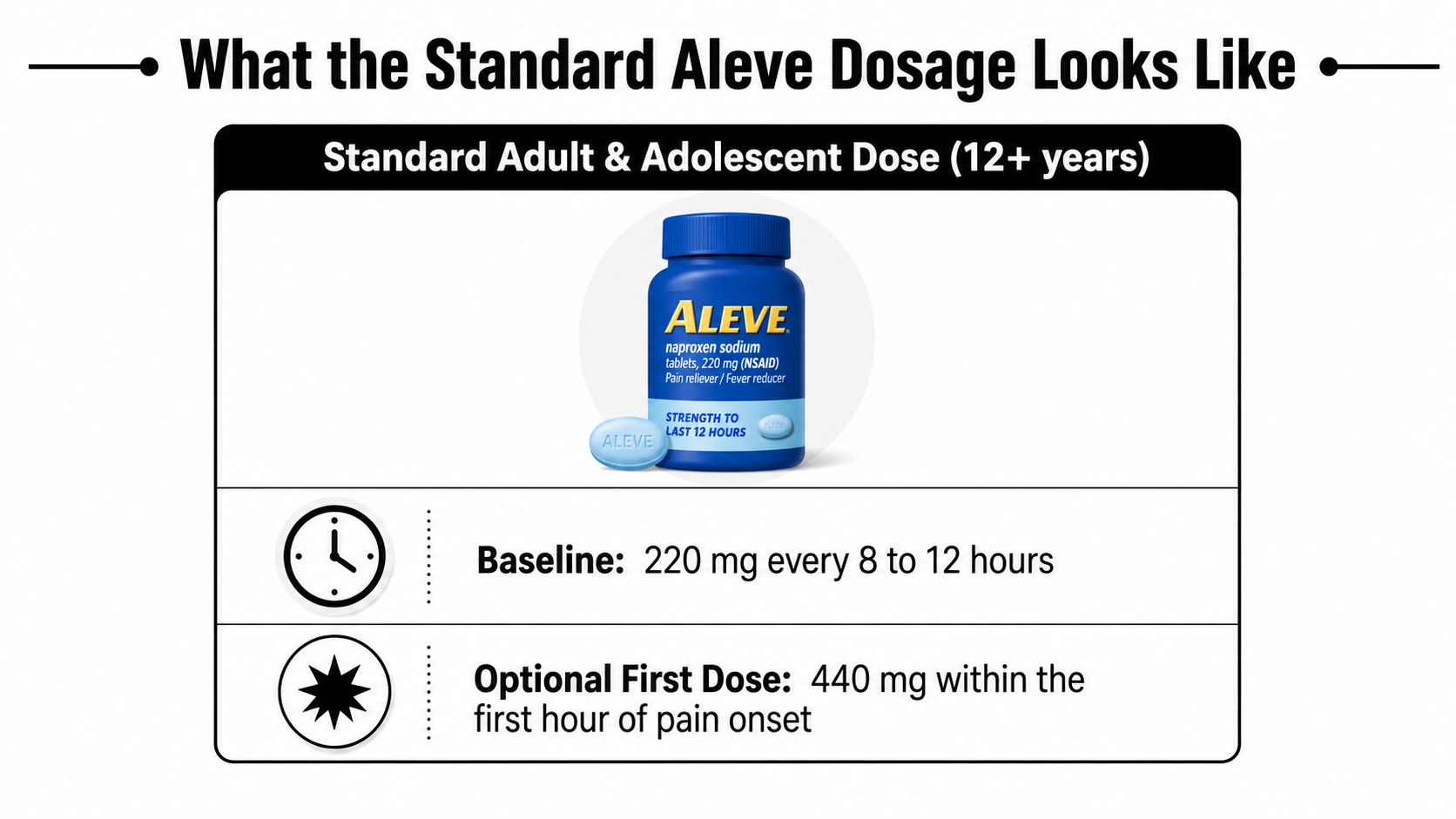
Dosage Aleve for most adults and adolescents 12 years and older is one 220 mg tablet every 8 to 12 hours, with an optional 440 mg first dose within the first hour if you need faster relief, and a maximum of 660 mg in 24 hours. If you're standing in front of the medicine cabinet right now, wondering whether you can take another tablet, those numbers are the safest place to start, and they should be the ceiling, not a target.
Maybe you've got a sore back after work, a pounding headache, or cramps that keep coming back by the clock. The bottle says “Aleve,” but the question is whether you're using the right product, at the right interval, for the right kind of pain. This guide walks through the label the way a pharmacist would, with the details people usually miss when they're trying to treat pain quickly and stay safe.
Table of Contents
What the Standard Aleve Dosage Looks Like
The simplest way to read a standard dosage Aleve label is this. For adults and adolescents 12 years and older, the usual OTC dose is 220 mg every 8 to 12 hours, with an optional 440 mg first dose if you need extra relief at the start, and a hard ceiling of 660 mg in 24 hours. That means the second tablet isn't a free bonus, it only fits into the schedule if you're still inside the daily limit and the timing makes sense. DailyMed's Aleve label
A simple way to time it
If you take one tablet at 8 a.m., the next dose belongs somewhere between 4 p.m. and 8 p.m., depending on how long your pain control lasts. If the pain comes back earlier than the next safe window, that usually means the problem isn't solved by squeezing the timing, it means you need to stop and reassess what's going on. The label is built around spacing, not stacking.
Practical rule: if you're counting hours and the next dose still feels too close, wait. Aleve is meant to last longer per dose, so taking it early just raises risk without giving you a cleaner solution.
How to self-check the bottle
Read the active ingredient line. You're looking for naproxen sodium, not a combination cold product or a second pain reliever tucked into another label. Then check the tablet strength, because a second tablet is only appropriate when you're intentionally using the 440 mg first dose option or staying within the normal schedule. The River of Life article on the pain reliever in Aleve can help if you're trying to understand what kind of medicine you're holding.
A lot of confusion happens because people expect Aleve to behave like a fast, short-acting pill. Naproxen sodium is longer acting, so the interval is wider, and that's part of why a single dose can cover more of the day. That doesn't make it stronger in every situation, it just means the timing matters more than people think.
How Age and Formulation Change the Schedule
Aleve isn't one one-size-fits-all label. The schedule changes when the product changes, and it also changes when age changes. If you're comparing products on the shelf, the safest move is to treat regular Aleve, Aleve PM, and Aleve Nighttime as separate instructions, not interchangeable versions of the same pill.
Aleve Dosing by Product and Age | ||||
|---|---|---|---|---|
Product | Age Group | Standard Dose | Interval | 24-Hour Max |
Regular OTC Aleve | Adults and adolescents 12 years and older | 220 mg, with an optional 440 mg first dose | Every 8 to 12 hours | 660 mg |
Aleve PM | Adults 12 to 65 years | 1 caplet or capsule | Every 8 to 12 hours | As labeled in the professional monograph |
Aleve PM | Over 65 years | 1 caplet or capsule | Every 12 hours | Not more than 2 caplets or capsules |
Aleve Nighttime | Adults and children 12 years and older | 2 caplets at bedtime | Bedtime dosing | 2 caplets |
The difference that surprises people most is the older-adult guidance. Bayer's professional monograph for Aleve PM shifts people over 65 years to a 12-hour interval and a maximum of 2 caplets or capsules in 24 hours. That's not a marketing tweak, it reflects that major-market labeling can change by age and by formulation. Bayer's Aleve PM and Nighttime monograph
Don't mix schedules by accident
A nighttime product already contains a full dosing plan, so adding a daytime Aleve tablet on top can create an easy overdose situation. The same problem happens when someone takes a regular Aleve tablet in the morning and then reaches for a nighttime version at bedtime without checking the total. If two products contain naproxen, their labels add up together.
Good habit: pick one naproxen product for one purpose, then follow that product's instructions only. Mixing daytime and nighttime versions without checking the labels is one of the fastest ways to lose track of your total dose.
Aleve Nighttime also has its own structure. The Canadian product monograph specifies 2 caplets at bedtime for adults and children 12 years and older, with a maximum of 2 caplets in 24 hours. That tells you the bedtime product is built for a different use case than the regular pain tablet, and it shouldn't be treated like a simple add-on.
If you're helping an older parent or grandparent, the label should be read slowly, not assumed. A dose that feels routine for a 40-year-old can be too frequent for someone over 65, especially if the product is designed for overnight use.
When Short-Term Use Stops Being Enough
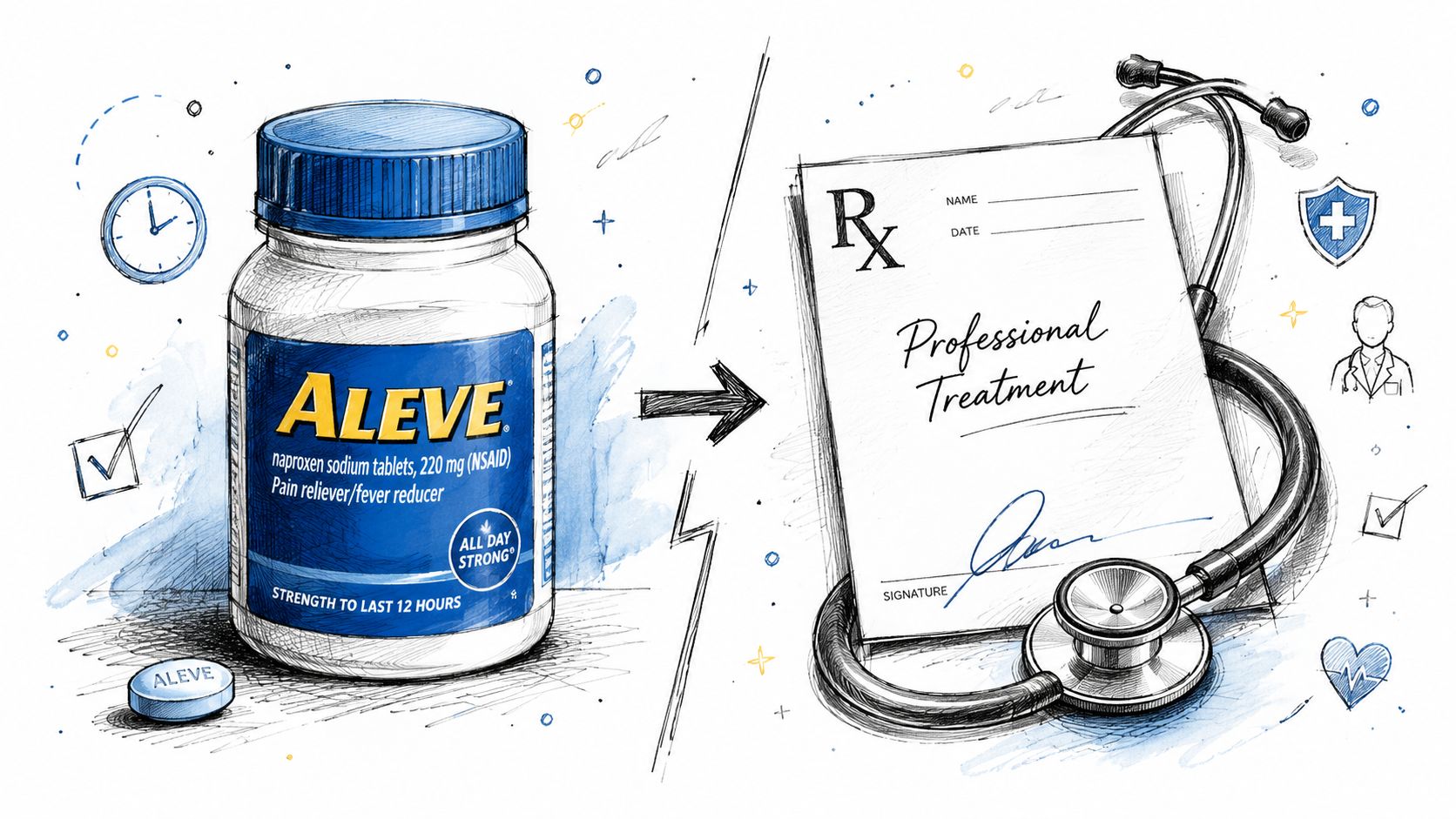
OTC Aleve is made for brief self-treatment, not for endlessly chasing pain that keeps coming back. The question is often not whether you can take another tablet, it's whether the pain pattern still belongs in self-care at all. Prescription naproxen can be used differently for arthritis, gout, dysmenorrhea, or inflammatory conditions, and supervised regimens can reach 1,000 to 1,250 mg per day, which is far beyond OTC limits. Aleve Canada dosage FAQ
When the label is no longer the answer
Pain that lingers, returns every day, or doesn't improve with the labeled schedule deserves a different conversation. The same goes for symptoms that come with fever, swelling, or persistent discomfort, because those clues can point to a problem that naproxen can't fix on its own. Taking more tablets doesn't turn OTC treatment into the right treatment.
The practical cutoff is simple. If you keep needing Aleve to push through the day, or if the pain keeps breaking through before the next safe dose, that pattern needs medical review. You may be treating the symptom, but missing the cause.
Why escalation is the wrong reflex
People often assume the answer to pain is “just take one more.” That's a risky habit with NSAIDs, because the goal is not to keep increasing the dose until something finally changes. The better move is to ask whether the pain is acute, recurring, or part of a longer condition that needs a different plan.
If you've already followed the label and relief still isn't showing up, that's a sign to step back rather than keep dosing forward. Persistent symptoms deserve diagnosis, not repetition.
Special Populations That Need a Different Plan
Some people shouldn't treat the standard Aleve schedule as a default. Older adults, pregnant users, breastfeeding parents, and people with kidney, liver, or stomach problems often need a more cautious approach because the same dose can behave differently in the body. In those groups, the chart is a starting point, not a final answer.
Older adults and slower clearance
Bayer's Aleve PM guidance already shows the logic for older adults, since people over 65 years move to a 12-hour interval and a stricter maximum. That is the kind of label shift you'd expect when the body handles medicines less predictably with age. If someone is older and also takes several medications, the margin for error gets smaller.
A plain-language rule works well here. If the person using Aleve is older, frailer, or juggling several prescriptions, don't improvise with the timing. Ask a pharmacist to review the whole list before the first dose.
Pregnancy, breastfeeding, and organ concerns
Pregnancy needs clinician input, especially later in pregnancy, and many people are safest treating naproxen as a medicine to avoid unless their clinician specifically says otherwise. Breastfeeding questions also deserve personalized advice, because the safest choice depends on the person, the baby, and the reason for treatment. Kidney, liver, and stomach conditions deserve the same caution, since NSAIDs can be harder on those systems.
Straight answer: if you're pregnant, breastfeeding, or living with kidney, liver, or stomach disease, don't use the dosing chart as permission to self-treat for long. Use it only as a reference until a clinician reviews your situation.
The simple decision framework is this. If your health history makes you pause, the label alone isn't enough. That's true even when the pain itself feels ordinary, because the risk may come from the medicine, not from the ache.
Drug, Supplement, and Alcohol Interactions
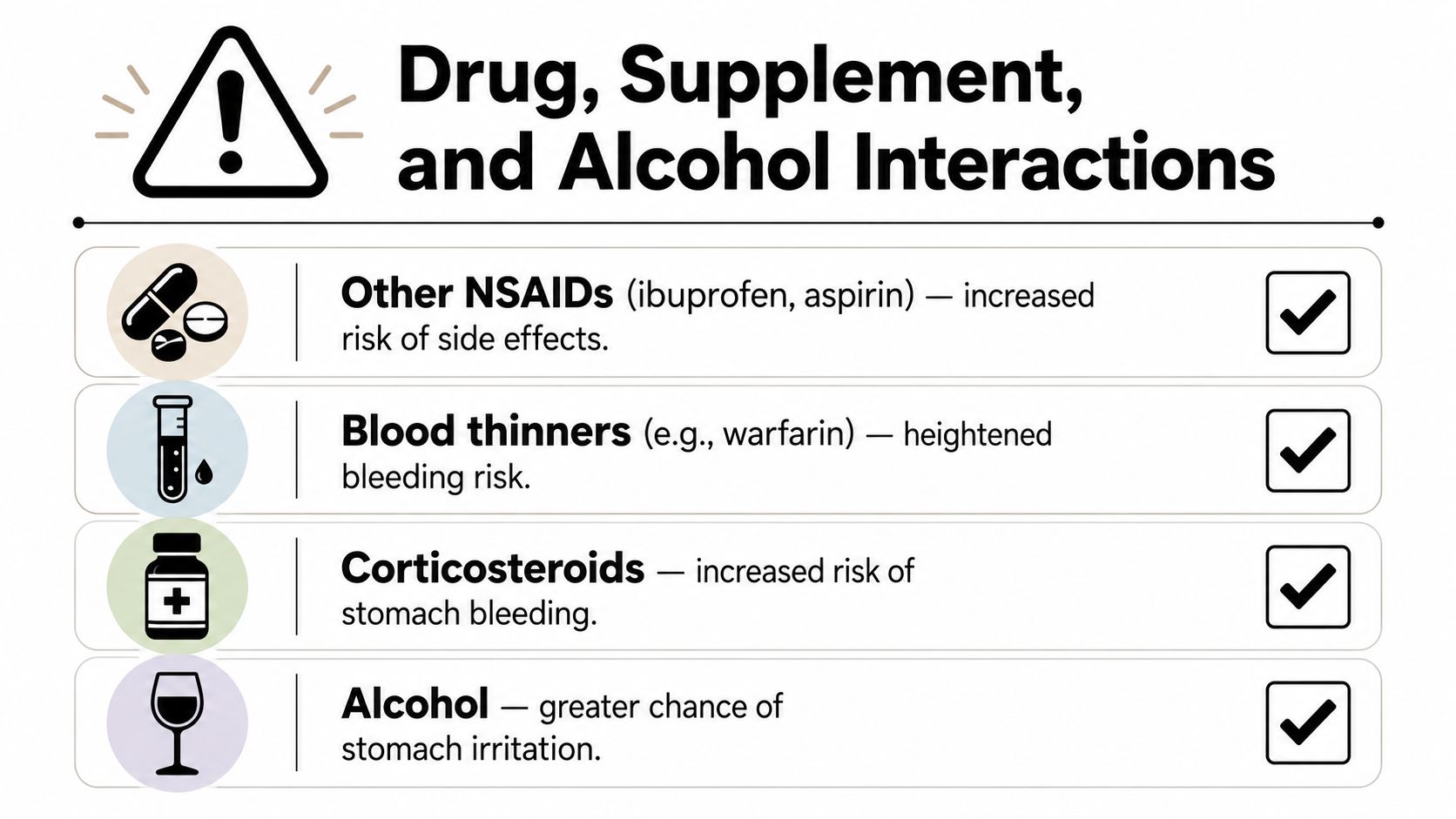
Aleve doesn't live in isolation. It can collide with other medicines, and some of those collisions raise the chance of bleeding, stomach irritation, or kidney stress. If you already take prescriptions or regular supplements, the safest assumption is that the naproxen label might not be the whole story. The interaction-focused alcohol guide is a useful reminder that timing and combination choices matter.
The combinations to check first
Other NSAIDs like ibuprofen or aspirin are the first thing to avoid unless a clinician tells you otherwise. Blood thinners such as warfarin, corticosteroids, and SSRIs can change the safety picture too, because they can make bleeding problems more likely or harder to manage. ACE inhibitors deserve a check as well, since NSAIDs can complicate blood-pressure and kidney-related care.
Supplements can matter too. Fish oil, turmeric, and ashwagandha may seem gentle, but they still belong on the list your pharmacist should see before you start Aleve. “Natural” doesn't mean “interaction-free.”
Alcohol deserves its own warning. It can irritate the stomach lining and make the GI side effects of an NSAID harder to ignore. If you're drinking regularly, or planning to drink at all around the time you take Aleve, that's a conversation worth having before the dose, not after discomfort starts.
A quick pharmacy rule
Bring the whole list, not just the pain reliever name. Prescription drugs, over-the-counter meds, vitamins, and herbal products all belong in the same review. If you can't tell whether a product is an NSAID, stop and ask.
Best practice: if you're on any prescription medication, confirm Aleve use with your pharmacist before you start. That one check can prevent a lot of avoidable side effects.
Comparing Aleve With Other Pain Relief Options
A person with a sore back at the end of a long day might reach for Aleve first, while someone with a headache that needs faster relief may choose a different OTC option. The right choice depends on what kind of pain is showing up, how long you need relief to last, and whether inflammation is part of the problem. That is why it helps to compare Aleve with ibuprofen, aspirin, and acetaminophen before you assume one pain reliever fits every situation.
Where Aleve fits
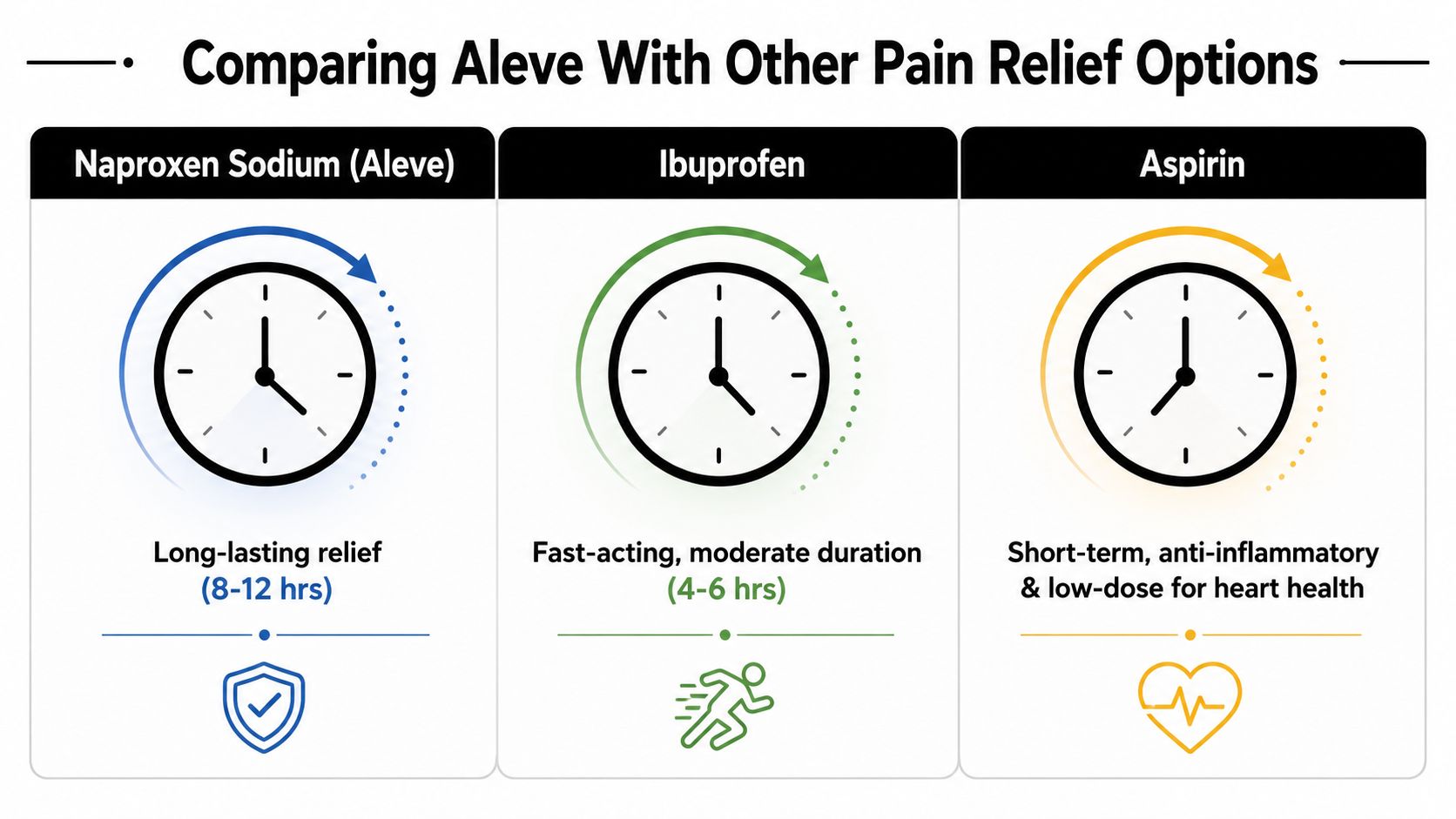
Naproxen sodium is the longer-lasting NSAID in this group, which is why Aleve often makes sense when pain stretches across a work shift or keeps showing up overnight. Ibuprofen is also an NSAID, as detailed in our guide on ibuprofen usage, but it is usually chosen when someone wants relief that wears off sooner and can be taken more often. Aspirin sits in a different part of the shelf, since it has pain-relief uses and also appears in low-dose heart-health regimens.
That difference matters in practice. A longer-acting tablet can be easier for steady pain, while a shorter-acting one may fit someone who wants more flexible timing during the day.
The non-NSAID option
Acetaminophen works through a different pathway than Aleve. It may be a better fit for people trying to avoid extra stomach irritation, but it does not treat inflammation the same way an NSAID does. For sore joints, sprains, and other pain patterns where swelling is part of the picture, that difference can change which product makes more sense.
Botanical products like turmeric, ginger, and bromelain tend to play a support role rather than replace an OTC pain reliever. They are usually better suited to everyday comfort, post-exercise soreness, or a broader wellness routine. They do not take the place of the dosing rules on the label, and they are not the same kind of short-term fix as Aleve, ibuprofen, aspirin, or acetaminophen.
The more useful question is whether the pain is inflammatory, short-lived, and manageable with OTC directions, or whether it keeps returning enough to deserve a different plan. A label can only do so much. If the same pain keeps coming back, or if you need medicine again and again to get through routine activities, self-management may no longer be the right answer.
Quick Reference and Final Safety Reminders
Keep these basics in front of you when you're taking Aleve. Standard dose, 220 mg, optional first dose, 440 mg, maximum, 660 mg in 24 hours, and spacing, every 8 to 12 hours. If you're using a nighttime or age-specific product, follow that label instead of the regular tablet rules.
Watch for red flags that need prompt care, not another dose. Black stools, sudden swelling, shortness of breath, severe stomach pain, unusual bleeding, or symptoms that keep worsening should push you toward medical help. Taking Aleve with food or milk can be easier on the stomach, and you shouldn't stack it with other NSAIDs unless a clinician tells you to.
Hydration helps, too. Taking the tablet with a full glass of water and staying alert to how your body feels is a better habit than chasing pain with extra pills. If the same ache keeps returning, that's your cue to ask a professional what's driving it.
If you want help choosing a safer pain plan, River of Life offers educational resources that can help you think through pain relief, daily comfort, and supplement use in a more informed way. Visit River of Life to explore their guidance and see how a thoughtful wellness routine can fit alongside smart medication decisions.