


Benefits of Berberine: A 2026 Metabolic Guide

Berberine gets called a lot of things online, including “natural Ozempic.” That label is catchy, but it oversells what the evidence supports. The story is more useful: berberine has credible research behind blood sugar support, cholesterol support, insulin sensitivity, and some liver-related benefits, while the case for dramatic weight loss in otherwise healthy adults is still much weaker than the hype suggests.
That distinction matters because people usually don't need another miracle promise. They need a supplement they can understand, use wisely, and fit into a bigger plan that still includes food, movement, sleep, and medical guidance when needed.
Table of Contents
Beyond the Hype What Berberine Actually Does
Berberine did not become interesting because social media made it trendy. Researchers kept finding that it moved several metabolic markers in the right direction at the same time. A 2021 meta-analysis of 18 studies found that berberine alone improved triglycerides, total cholesterol, LDL cholesterol, fasting plasma glucose, and HOMA-IR, and the review also noted effects in healthy participants, which suggests broad metabolic activity rather than a narrow one-condition remedy (PMC8107691).
That still does not make it a cure. Berberine looks more like a metabolic adjunct, a support tool for the body's handling of fuel and lipids, especially when those systems are already under strain. Mainstream clinical sources keep the tone measured for a reason. The strongest evidence is for blood sugar and lipids, not for dramatic cosmetic change.
What the evidence supports most
The clearest pattern is straightforward. Berberine tends to show benefits where insulin resistance, dyslipidemia, and metabolic stress are part of the picture. That is why many clinicians and educators start with glucose control and cholesterol management, then treat weight as a secondary or mixed outcome.
Practical rule: if a supplement claims to melt fat on its own, be skeptical. If it appears to help the markers that drive metabolic risk, that is a more believable and more useful claim.
A helpful way to sort the hype from the biology is to ask what problem is being addressed. Berberine may help the systems that influence energy use and blood sugar, but it still works best inside a broader routine, not as a standalone rescue plan. That broader routine can also include diet, movement, sleep, and, for some people, targeted support such as digestive enzymes and probiotics when gut comfort or tolerance is part of the bigger picture.
How Berberine Works in Your Body
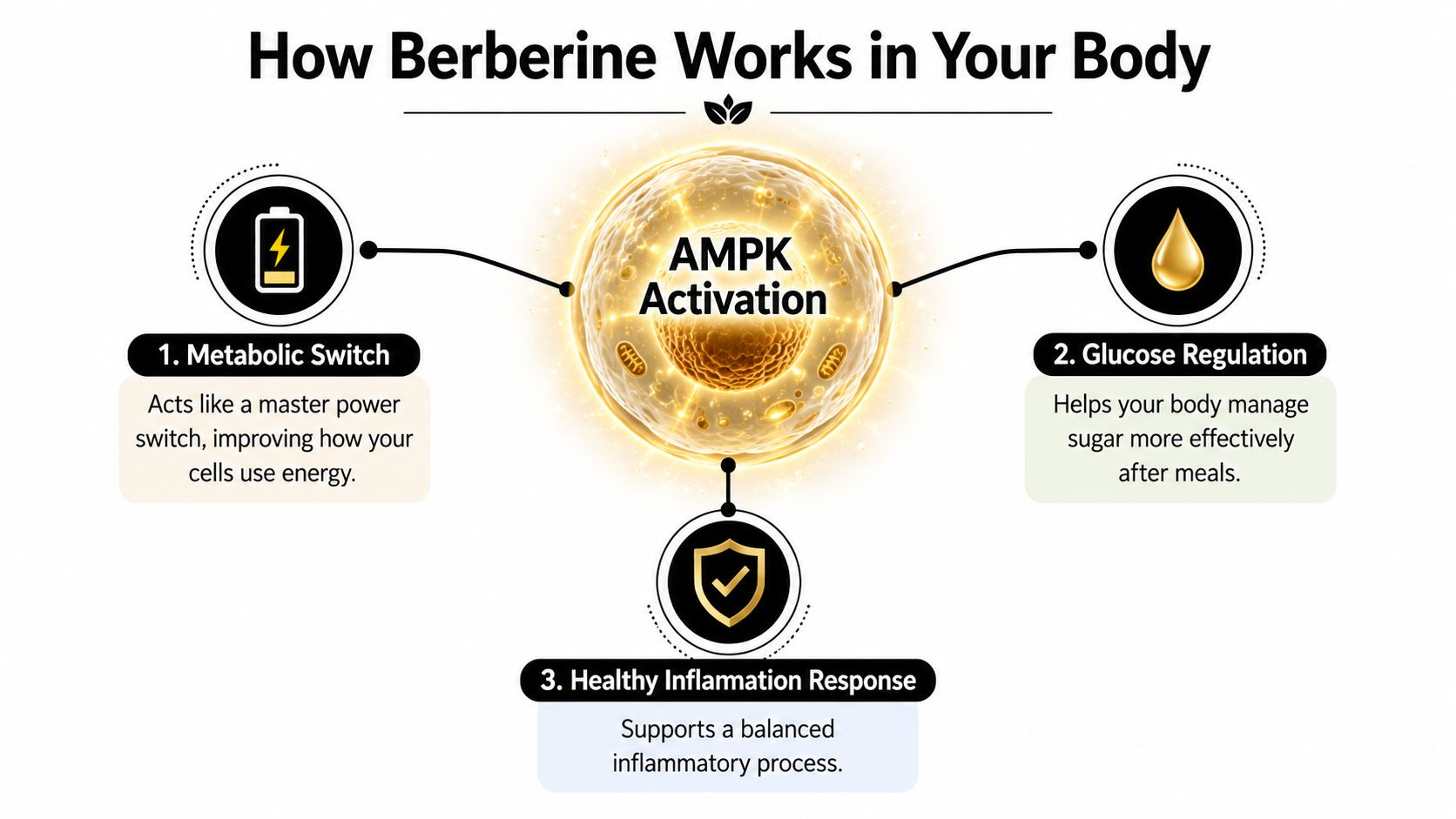
Think of your cells like offices that need to decide how to spend their energy budget. Berberine is often discussed because it influences AMPK, a protein involved in cellular energy regulation. A useful way to picture AMPK is as a metabolic switchboard, not a magical switch that fixes everything, but a coordinator that nudges the body toward better energy handling.
AMPK and cellular energy
When AMPK is active, cells tend to behave more efficiently with glucose and fuel. That helps explain why berberine shows effects across several markers instead of just one. It's also why people sometimes compare it with prescription medications that affect metabolism, although that comparison shouldn't be stretched into claiming they're the same thing.
The point is coordination. A single compound can influence how cells handle sugar, how the liver manages fat and glucose output, and how the body responds to the metabolic strain that often travels with excess weight or poor glycemic control. That multi-pathway behavior is one reason berberine has attracted serious attention in clinical research.
Why one compound can affect several markers
The mechanism matters because it makes the research look less random. If a supplement only touched one isolated lab value, the story would be simpler but less convincing. Berberine's pattern is broader. It shows up in glucose markers, lipid markers, and body-composition measures in a way that suggests overlapping metabolic effects rather than a single trick.
For readers who like practical mental models, here's the simplest one. Imagine a thermostat that doesn't just control temperature. It also affects how often the furnace runs, how quickly the room settles after a spike, and how much energy gets wasted. Berberine isn't a thermostat, of course, but that's closer to the kind of coordinated effect researchers are trying to capture.
To keep the big picture balanced, it helps to pair this with other digestive and metabolic foundations. A healthy eating pattern, gut support, and consistent meal timing still matter. If you're also exploring digestive support strategies, this guide on digestive enzymes and probiotics can help you think about the gut side of the equation without turning every supplement into a stand-alone fix.
Metabolic and Cardiovascular Benefits
Berberine's strongest support comes from metabolic health, not from the hype around quick fixes. A 2022 dose-response meta-analysis in adults found significant reductions in total cholesterol, triglycerides, LDL, fasting blood glucose, insulin, HbA1c, HOMA-IR, systolic blood pressure, weight, BMI, and waist circumference, along with an increase in HDL (PMC5871262). Those markers matter because they sit near the center of the risk profile clinicians watch when they are trying to lower long-term cardiometabolic strain.
A simple way to read that pattern is this. Berberine appears to support the systems that manage sugar and fat, so the benefits show up most clearly when someone already has a metabolic problem to address. Better glucose control or a healthier lipid panel is not just a lab change. It usually means the body is under less pressure to keep up with poor metabolic handling.
What the numbers can look like in practice
Earlier clinical work gives a concrete example of the size of the effect. In one study of 32 patients taking 500 mg twice daily for 3 months, LDL fell by 25%, triglycerides by 35%, and total cholesterol by 29% from baseline (PMC5871262). Those numbers do not guarantee the same response for every person, but they help explain why berberine keeps coming up in conversations about cholesterol and blood sugar support.
The same point shows up in day-to-day health habits too. If someone is also working on fiber intake, a practical guide like how organic psyllium husk fits into a metabolic routine can help place berberine in a broader plan instead of treating it like a stand-alone answer.
Berberine's Impact on Key Metabolic Markers | Berberine Effect | Clinical Significance |
|---|---|---|
Triglycerides | Lowered in meta-analysis and earlier clinical work | Helps address a lipid pattern tied to metabolic strain |
Total cholesterol | Lowered in meta-analysis and earlier clinical work | Supports a healthier overall lipid profile |
LDL cholesterol | Lowered in meta-analysis and earlier clinical work | Relevant for cardiovascular risk management |
Fasting blood glucose | Lowered in meta-analysis | Supports day-to-day glycemic control |
Insulin and HOMA-IR | Improved in meta-analysis | Points to better insulin sensitivity |
HbA1c | Lowered in meta-analysis | Suggests longer-term blood sugar support |
HDL | Increased in meta-analysis | A favorable shift in lipoprotein balance |
Why these markers matter together
It is easy to read these as separate numbers on a lab report. They are connected. When insulin sensitivity improves, glucose handling often improves too. When that pressure eases, lipid handling can improve as well.
That is why berberine is most convincing as a supportive tool for metabolic syndrome and related risk patterns, not as a one-note supplement. It fits best when the goal is to improve the terrain, not chase a single vanity metric. For that reason, it makes sense to place berberine alongside diet, movement, sleep, and other targeted supports, rather than using it in place of them.
Liver Health and Weight Management Reality Check
Berberine's liver research matters because it broadens the conversation beyond blood sugar alone. An umbrella review and a focused meta-analysis reported improvements in liver enzymes, dyslipidemia, insulin sensitivity, body weight, and waist circumference in people with metabolic syndrome or nonalcoholic fatty liver disease, and the NAFLD review covered 10 randomized controlled trials and 811 patients (PubMed 36999891). That suggests a gut-liver-metabolic link, not just a change on a lab report.
The practical takeaway is narrower than the hype. Berberine may be more useful when fatty liver appears alongside insulin resistance, because NAFLD often shows up with high triglycerides and poorer glucose handling. In that setting, the liver findings fit the same metabolic pattern already seen in blood sugar and lipid research.
Weight loss is where people get misled
Berberine can coincide with lower weight or a smaller waist in some studies, but major clinical sources stay cautious because the evidence for weight loss in otherwise healthy adults is still limited and inconsistent. Mayo Clinic notes that there still are not enough high-quality studies on weight loss, and it says berberine is not a “magical weight loss solution” (Mayo Clinic and Cleveland Clinic summary).
That distinction matters. A supplement that modestly improves metabolic health is not the same as a medication-level fat-loss tool. The Cleveland Clinic comparison also places the hierarchy clearly, berberine is not as effective for weight loss as GLP-1 medications.
Practical rule: if the main goal is a lower number on the scale, berberine should not be the first or only strategy. If the main goal is better metabolic markers with possible secondary changes in body weight, the case is stronger.
Who tends to notice more
The research pattern is fairly consistent. People with insulin resistance, metabolic syndrome, raised triglycerides, or fatty liver are more likely to match the outcomes seen in studies. Someone who is already metabolically healthy has less room to improve, so the effect may look modest.
That is why berberine fits best as part of a broader plan, not a stand-alone answer. If you want a different kind of support to compare within that plan, organic psyllium husk works through a different pathway and may be easier to pair with food and meal habits when the goal is steadier metabolic support.
Dosing Quality and Safety Considerations
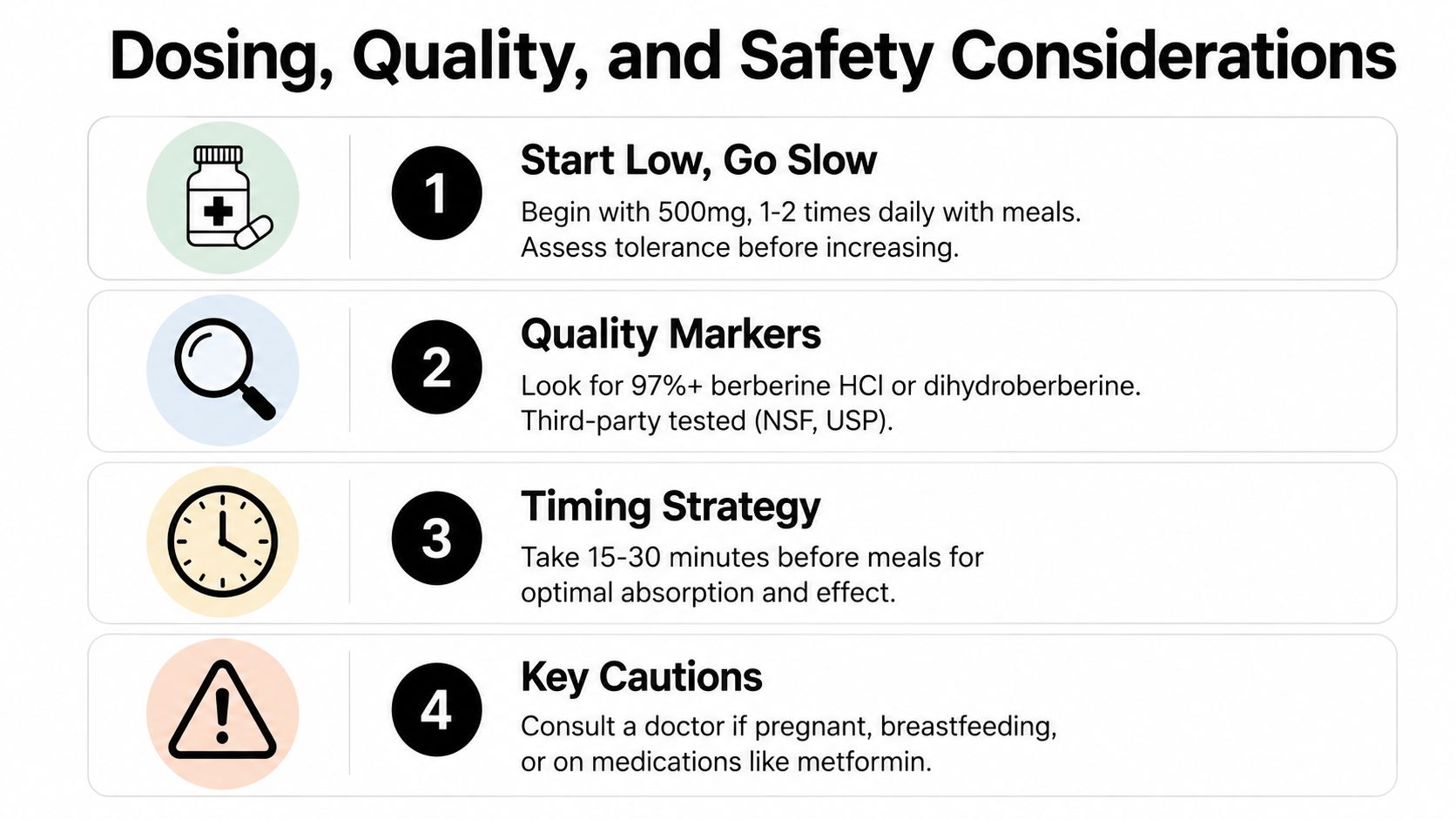
Berberine works best when the routine is boring and consistent. Start with an amount your stomach can handle, take it regularly, and notice how you feel after meals. Many people tolerate it better with food, especially if digestive upset is a concern, but the right schedule still depends on your medications and health goals, so a clinician should help set that up when needed.
Quality matters just as much as dose. Supplements are not interchangeable, and berberine products can differ in how they are sourced, formulated, and tested. A careful label review, third-party testing, and clear ingredient disclosure matter more than bold marketing claims. If you are also comparing curcumin formulas, this guide to curcumin with black pepper explains why BioPerine is used to support turmeric uptake.
A practical checklist
Start conservatively: use a lower amount first so you can judge digestive tolerance before building a routine.
Check the label: look for clear sourcing, transparent dosing, and third-party testing.
Watch for interactions: talk with a clinician if you already take glucose-lowering or other prescription medicines.
Track the response: if your goals are metabolic, follow your labs and symptoms, not the hype.
A supplement only earns its place if it fits your actual situation. If your body is already under medication management, or if you're pregnant or breastfeeding, that is a conversation for your healthcare provider, not a comment thread. The same caution applies if you are combining berberine with other metabolic supports, because stacking products without a plan can create confusion instead of clear benefit.
Video guidance can help, but it should not replace judgment.
Berberine fits best inside a broader routine. Food quality, sleep, activity, and stress load still set the baseline. River of Life Capsules, for example, is a separate supplement line built around turmeric, BioPerine, ashwagandha, ginger, and bromelain, which shows how some brands position botanicals for a different kind of support than metabolic supplements.
Who Benefits Most from Berberine
A patient with high fasting glucose, high triglycerides, and a busy schedule will usually think about berberine differently from a healthy runner who just wants a quick cut before summer. The reason is simple. Its value depends on the problem you are trying to address. When the concern is metabolic dysfunction, berberine is much easier to justify.
Consider three common situations. First, someone with insulin resistance who wants support alongside diet changes may be a reasonable fit. Second, a person with mixed dyslipidemia looking for help with cholesterol and triglycerides has a clearer evidence-based reason to consider it. Third, someone with early fatty liver or metabolic syndrome may also align with the strongest research pattern, as detailed in the sections above.
When it's probably not the first move
If someone's only goal is a dramatic drop on the scale, berberine should not be treated as the main event. The weight-loss evidence is too mixed for that kind of promise. If someone is already well managed on medication and wants to swap out proven treatment for a supplement, that is also a poor trade.
Good candidates usually want reinforcement of their metabolic plan, not a replacement for it. Berberine fits best when the goal is to strengthen a broader plan that already includes food, activity, and medical guidance where needed.
People also ask whether berberine belongs with other supplement strategies. It can, but the combination should make sense. If someone is using other botanical formulas, they should think about the goal of each product instead of collecting capsules at random. A supplement stack should answer a specific need, not just feel more complete.
Making Your Decision Key Takeaways
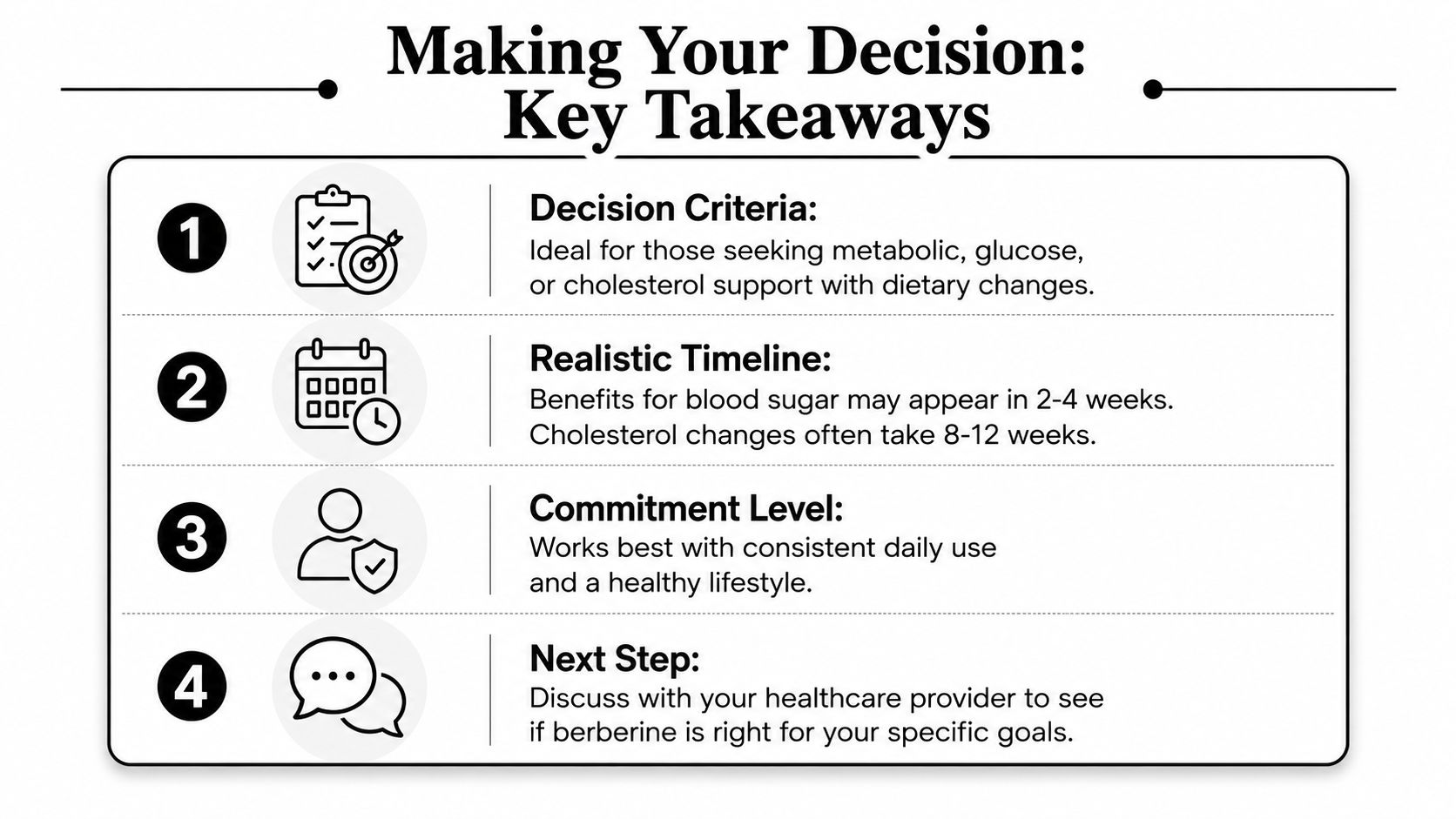
Berberine makes sense when the goal is metabolic support, especially for glucose control, cholesterol balance, insulin resistance, or related liver concerns. It makes less sense when the promise is rapid cosmetic weight loss or when someone wants a shortcut around the basics of nutrition and activity. The research is promising, but the honest version is more useful than the viral version.
A good decision starts with your current health pattern. If your labs, waist measurements, or physician conversations point toward metabolic syndrome, berberine may deserve a place in your plan. If your health is otherwise stable and your only goal is fat loss, the case is weaker.
What to track
Glucose-related markers: watch whether your fasting numbers and long-term glycemic measures are moving in the right direction.
Lipid markers: pay attention to cholesterol and triglycerides, since those are among berberine's strongest research-backed areas.
Waist and weight trends: treat these as secondary signals, not the only measure of success.
Tolerance and consistency: if your stomach hates the supplement or your routine is erratic, the plan probably needs adjusting.
Berberine isn't a miracle, and that's exactly why it's worth understanding. Used thoughtfully, it can be one part of a practical, evidence-aware metabolic strategy. If you want supplement guidance that keeps science and real life in the same conversation, explore River of Life and choose products that match the problem you're trying to solve.