
Methyl B12 1000 Mcg: A Plain-English Guide for 2026

Some folks end up here after a very ordinary week. You've been sleeping enough, or at least trying to. You've cut back on late-night scrolling. You've had your coffee. Still, by midmorning, your brain feels like it's moving through syrup. You lose your train of thought. Your hands or feet may feel a little odd. You chalk it up to stress, age, a busy season, maybe all three.
That's when a supplement like Methyl B12 1000 mcg starts showing up in searches, on store shelves, and in conversations with friends who swear it helped them feel more like themselves again.
The tricky part is that B12 talk gets confusing fast. One label says methylcobalamin. Another says cyanocobalamin. One bottle has a tiny dose. Another has a much bigger one. Then comes the question almost nobody explains clearly: if you start with 1000 mcg, are you supposed to stay there forever, or is that more like a catch-up dose before shifting into maintenance?
That's what this guide is for. Plain English. No hype. Just a practical walk-through of what methyl B12 1000 mcg is, who might benefit, what the science does and doesn't support, and how to think about the full lifecycle of using it responsibly.
Table of Contents
Feeling Drained? Your Body Might Be Asking for B12
A lot of people don't think “maybe it's B12” right away. They think, “I'm just stretched thin,” or “I'm not as young as I used to be.” That's understandable. Low B12 can blend in with everyday life so easily that it doesn't wave a big flag.
A Baton Rouge way to say it is this. Sometimes your body isn't broken. It's just missing a part it needs to keep the engine running smoothly.
Common signs people notice first
For some people, the first clue is fatigue that doesn't match their effort. You haven't run a marathon. You've just handled work, errands, and regular life, yet you feel wrung out.
For others, it's more subtle:
Mental fog that makes ordinary tasks feel harder
Forgetfulness that seems a little more frequent than usual
Tingling or odd sensations in the hands or feet
Mood shifts that are tough to pin on one clear cause
None of those signs automatically means low B12. They can overlap with a lot of things. Still, they're common enough that they're worth paying attention to instead of brushing off for months.
Sometimes the biggest clue is not one dramatic symptom. It's a steady feeling that your usual spark just isn't there.
Groups that often need a closer look
Some people have a higher chance of needing more B12 support because of how they eat or how their body handles it.
A few examples come up again and again in real life:
Vegans and vegetarians often pay more attention to B12 because food sources are commonly animal-based.
Older adults may not absorb B12 as easily as they once did.
People with digestive issues sometimes have trouble getting enough from food alone.
People who've had weight-loss surgery may need more targeted support.
The point isn't to self-diagnose from a blog post. It's to recognize a pattern. If you've been feeling off and you fit one of those groups, Methyl B12 1000 mcg may not be random shelf noise. It may be a clue that deserves a better look.
What Exactly Is Methyl B12 1000 mcg
The name sounds more complicated than it is. Once you break it into parts, it starts to make sense.

Breaking down the name
B12 is a vitamin your body needs for important jobs like red blood cell production, DNA synthesis, and nervous system support. If you think of your body as a busy kitchen, B12 is one of those tools you may not notice until it's missing. Then everything gets slower and clumsier.
Methylcobalamin is one form of vitamin B12. People often call it the active form. A simple way to picture it is a key that's already cut correctly for the lock. Some other forms of B12 need more conversion work before the body uses them in the same way.
That's why many shoppers specifically look for Methyl B12 on the label instead of just any B12.
Why the dose looks so high
The 1000 mcg part throws people off. But B12 gets a little sneaky here.
Clinical trials indicate that about 1% of crystalline vitamin B12 is absorbed passively, which is why high oral doses such as 1,000 mcg per day are used to raise levels through mass action, according to this clinical review of vitamin B12 use and efficacy.
That means the number on the front of the bottle is not the same as the amount your body will take in.
Imagine watering a plant with a hose that has a very narrow nozzle. You don't blast extra water because you're trying to be dramatic. You do it because only a small amount gets through at a time. Methyl B12 1000 mcg is often chosen for that practical reason.
Here's the plain takeaway:
Methyl tells you the form
B12 tells you the nutrient
1000 mcg tells you this is a high oral dose commonly used when people need stronger support
That's why this exact label shows up so often. It isn't automatically the right choice for every person. But it isn't overkill by default either.
Who Might Need a B12 Boost
This is the part where many people start subtly nodding. They've seen the label before, but now they're wondering if it applies to them.
Low B12 doesn't always arrive with a dramatic warning. Sometimes it creeps in slowly. You adapt to it. You normalize it. Then one day you realize feeling worn down has become your baseline.
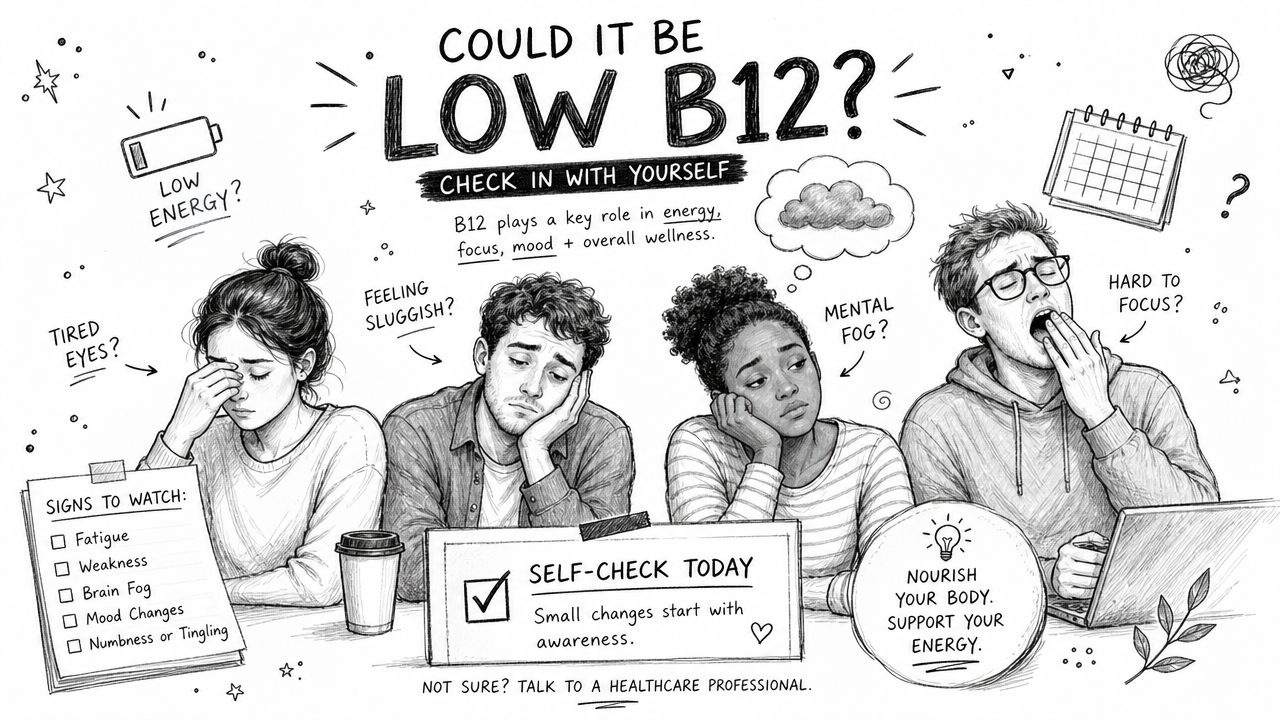
Common signs people notice first
A few patterns show up often enough to deserve attention.
You're tired in a way rest doesn't fix. This isn't just one rough day.
Your thinking feels slower. You read the same sentence twice. Names don't come quickly. Focus slips.
Your hands or feet feel strange. Tingling, prickly feelings, or “pins and needles” can get people's attention.
Your mood feels flatter or more irritable. You may not connect it to nutrition at first.
Again, those signs can come from many causes. The value of the list is not certainty. It's awareness.
Groups that often need a closer look
Some people have more reasons than others to talk with a clinician about B12.
Group | Why B12 can become an issue |
|---|---|
Vegans and vegetarians | Food intake may be lower if animal foods aren't part of the diet |
Older adults | Absorption can become less efficient over time |
People with digestive conditions | Gut-related problems can make absorption harder |
People after gastric or weight-loss surgery | Normal absorption pathways may be disrupted |
There's another group worth mentioning. People who've been told their B12 is borderline low or that another marker looks mildly off may be advised to use a stronger daily dose for a while, then reassess. That detail matters because it changes how you think about the supplement. It may be a short-term correction tool, not just a forever habit.
Practical rule: If your symptoms and your risk factors line up, don't guess from the label alone. Use the supplement conversation as a reason to ask better questions.
That's especially true if you've already tried “energy” products that didn't help. If the underlying issue is B12 status, generic stimulants won't fix the root problem.
Evidence-Based Benefits for Your Nerves Energy and Mood
You feel tired, foggy, and a little off. Then maybe your feet start tingling, or your mood gets shorter than usual. That is usually the point where people stop asking, “What is methyl B12?” and start asking, “What can it do for me?”
The answer depends on whether low B12 is part of the problem. If it is, methyl B12 1000 mcg can support three areas people care about most. Nerves. Energy. Mood. Just as important, a higher dose often makes the most sense during the correction phase, then gets revisited once levels are back in range.
Why nerve support gets so much attention
Nerve symptoms often get the spotlight because they are hard to ignore. Tingling, numbness, burning, and odd “pins and needles” feelings can make everyday life feel unsettled.
A review of methylcobalamin and neuropathic pain reported that methylcobalamin showed clinically meaningful analgesic effects in some neuropathic pain settings, with findings linked to better nerve conduction and support for repair in injured peripheral nerves. That helps explain why methylcobalamin keeps coming up in conversations about diabetic neuropathy, low back pain, and nerve-related discomfort.
In plain English, nerves need clear signaling. When that signaling is under strain, messages can arrive late, get scrambled, or fire when they should stay quiet. That can feel like pain, tingling, numbness, or a strange “disconnected” sensation that is hard to put into words.
If nerve pain is one reason you are looking into B12, it also helps to look at natural pain relief options for a broader support plan. One supplement rarely has to do the whole job by itself.
Energy support is real, but it has context
B12 has a big reputation for energy. Sometimes the marketing gets ahead of the science. Methyl B12 does not act like a stimulant. It does not create artificial buzz.
What it can do is help remove one possible bottleneck. B12 helps with red blood cell formation and supports processes involved in turning food into usable energy. If your levels are low, correcting that gap can help you feel steadier and less worn down over time.
That “over time” part matters.
People with low or borderline-low B12 may start with 1000 mcg daily because it gives the body a stronger push while stores are being rebuilt. After symptoms improve and follow-up labs look better, the next smart question is whether that dose still fits. Some people stay on it. Others step down to a lower maintenance routine based on diet, absorption, symptoms, and medical guidance.
Mood and brain function are part of the picture too
Mood changes are easy to brush off at first. You may blame stress, bad sleep, or a busy week. Sometimes that is true. Sometimes low B12 is adding to the load.
The National Institutes of Health notes in its Vitamin B12 fact sheet that B12, along with folate and vitamin B6, helps regulate homocysteine levels. That matters because higher homocysteine levels have been associated with cardiovascular and neurologic concerns. It does not mean methyl B12 is a mood cure. It does mean B12 is involved in pathways that affect brain and nervous system health.
So the practical benefits usually fall into three buckets:
Support for nerve signaling and nerve comfort
Steadier energy if low B12 has been dragging you down
Support for brain and mood-related pathways linked to healthy B12 status
The word “support” is the right word here. Methyl B12 1000 mcg can be a useful tool when B12 is part of the issue. Then comes the often-missed part of the plan. Recheck, reassess, and adjust after restoration instead of assuming the higher dose has to stay the same forever.
Methyl B12 vs Other B12 Forms
Walk down the supplement aisle and the labels can look like alphabet soup. Methylcobalamin. Cyanocobalamin. Adenosylcobalamin. Hydroxocobalamin. Most people don't want a chemistry lecture. They just want to know which one makes sense.
A simple side-by-side view
B12 form | Active form | General idea | Why someone might choose it |
|---|---|---|---|
Methylcobalamin | Yes | Commonly used when people want a body-ready form | Popular for nerve-focused support |
Cyanocobalamin | No | Very common synthetic form | Often easy to find and widely used |
Adenosylcobalamin | Yes | Another active form of B12 | Sometimes used in combination products |
Hydroxocobalamin | Not usually how people think of daily store-bought supplements | Often discussed in medical settings | Sometimes chosen when injections come up |
This table keeps things simple on purpose. Real use depends on the person, their labs, their symptoms, and what their clinician recommends.
How to think like a smart shopper
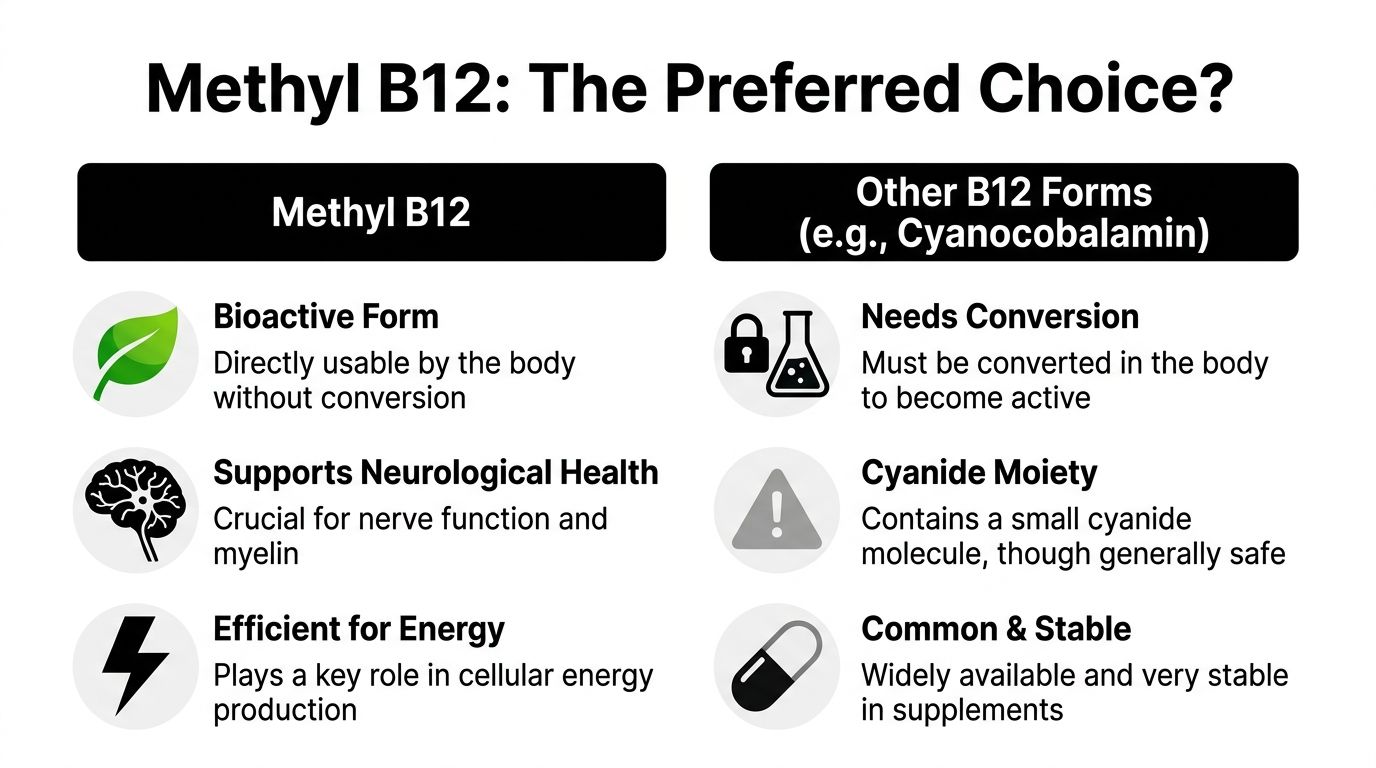
One useful distinction is this. Methylcobalamin is often chosen because it is already in an active form, while cyanocobalamin is common and widely available.
According to the stated evidence in this video reference on methylcobalamin and cyanocobalamin, methylcobalamin in 1000 mcg doses exhibits superior bio-retention rates and lacks the cyanide moiety inherent to cyanocobalamin, which is one reason people interested in long-term neurological support often prefer it.
That doesn't mean cyanocobalamin is “bad.” It means labels matter.
A practical shopping checklist looks like this:
Check the actual form. Don't just read “Vitamin B12.” Look for methylcobalamin if that's what you want.
Match the form to the goal. If nerve support is a main concern, many shoppers lean toward methylcobalamin.
Read the full supplement facts panel. Some products blend forms together.
Keep expectations grounded. The best B12 form for you is the one that fits your health needs and that you'll use consistently.
The shelf has a lot of noise. The most useful label detail is often the small print under “Vitamin B12,” not the flashy words on the front.
How to Take Methyl B12 1000 mcg Correctly and Safely
This is the part most articles rush through. They tell you why Methyl B12 1000 mcg exists, then they leave you hanging on the everyday decisions. Morning or night? With food or without? Stay on it forever or not?
A little structure helps.
A simple routine that works
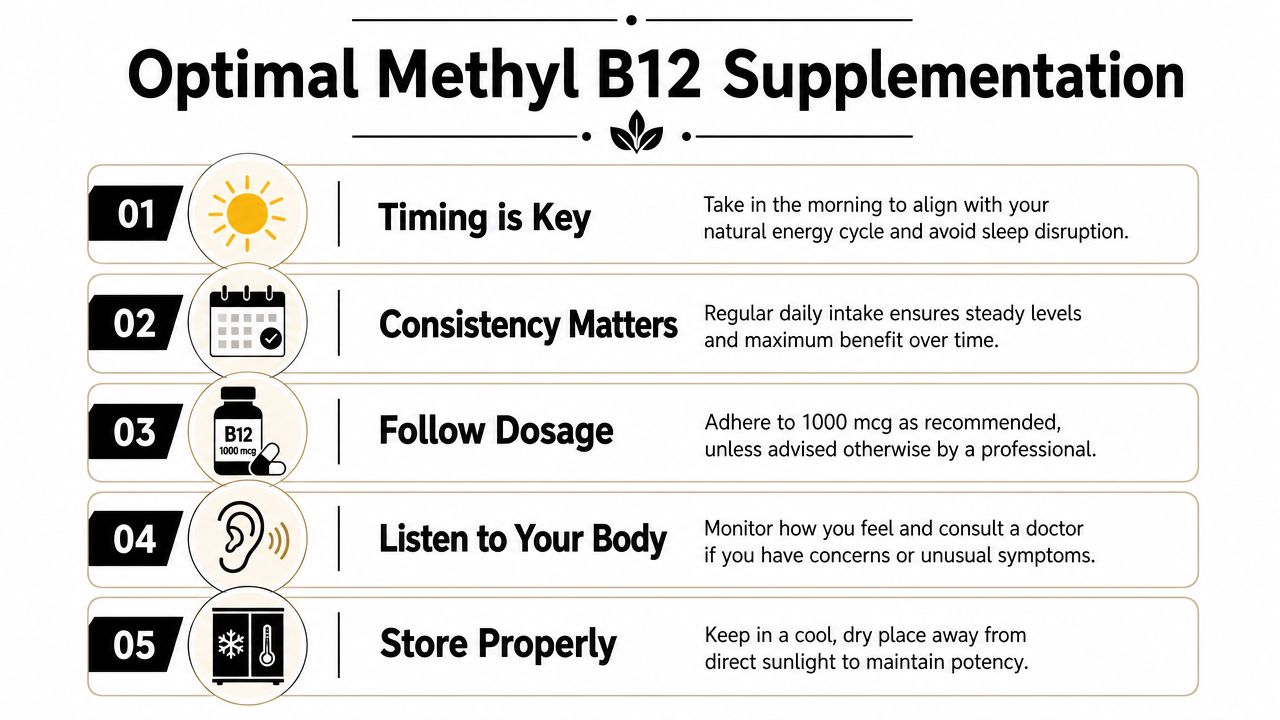
Many people prefer taking B12 in the morning, especially if they're using it as part of an energy-support routine. Some take it with breakfast because that's easiest to remember. Others do fine without food. Consistency matters more than creating a perfect ritual you won't stick with.
A practical approach looks like this:
Pick one time of day and stay with it. Morning is often easiest.
Use the label exactly as directed unless your clinician tells you otherwise.
Give it time. Nutrient repletion is usually not an overnight event.
Track how you feel, especially if you started because of fatigue, tingling, or brain fog.
If you also take other supplements or medications, it's smart to check for overlap and timing questions. For example, people who manage multiple products often find it helpful to review broader supplement safety topics such as common ashwagandha interaction questions, to get in the habit of reading labels and checking combinations carefully.
Here's a quick visual summary you can refer back to:
When to lower the dose
This is the overlooked part, and it's important.
According to Harvard Health's guidance on vitamin B12 supplementation, doctors may recommend 1,000 mcg daily for borderline low B12, but the plan often involves reducing the dosage once levels normalize. The same guidance points to biomarkers that can help frame that decision, including serum B12 below 200 to 250 pg/mL or methylmalonic acid above 0.271 µmol/L.
That changes the whole conversation.
Instead of thinking, “I found my dose and that's that,” think in phases:
Repletion phase when you're correcting low or borderline-low status
Recheck phase when you look at symptoms and lab markers
Maintenance phase when a lower dose may be enough
That tapering idea is one of the most responsible parts of B12 use. It keeps the supplement connected to a real purpose instead of turning it into autopilot.
Your Top Questions Answered
You've read the labels, looked at the dose, and maybe started wondering what happens after the first bottle. That's a smart question. B12 use works best when you treat it like a road trip. You need a starting point, a reason for the trip, and a plan for when you get where you're going.
Quick answers that clear up the usual confusion
How do I choose a quality supplement?
Check the Supplement Facts panel for methylcobalamin. That is the active form you're looking for. A good product also tells you the dose clearly, avoids vague proprietary blends, and comes from a brand that explains its testing and manufacturing practices in plain English.
How long does it take to feel a difference?
It depends on why you're taking it. If low B12 is part of the problem, some people notice improvement fairly soon. Others need more time, especially if symptoms have been hanging around for a while. Give it longer than a couple of days, and match how you feel with follow-up from your clinician when needed.
Can a vegan diet provide enough B12 on its own?
It can, but only if B12 is intentionally included through fortified foods or supplements. B12 is different from nutrients you can easily patch together from plants alone. For many vegans and vegetarians, it helps to treat B12 like a routine bill. If you forget it for too long, the problem can sneak up on you.
Is 1000 mcg generally safe?
For many adults, this dose is commonly used, especially during a repletion phase. B12 is water-soluble, so the body usually does not hold on to large extra amounts the way it does with some other nutrients. Even so, “safe” does not mean “take the same high dose forever without a reason.” Once your levels and symptoms improve, it makes sense to revisit whether you still need 1000 mcg daily or whether a lower maintenance dose fits better.
That last part gets missed all the time.
How do I know when to lower the dose?
Use the same logic you used to start. If a doctor recommended 1000 mcg because your labs were low, the next step is usually rechecking labs and symptoms after a period of treatment. If things have improved, the dose may be reduced to maintenance instead of staying in catch-up mode. It's like filling a gas tank. Once the tank is full, you stop pumping.
Where can I get more general supplement answers?
If you want a simple place to check common product and usage questions, the River of Life supplement FAQ is a helpful starting point.
Here's the bottom line. Methyl B12 1000 mcg can make sense for the right person at the right time. The responsible approach is to use it with a purpose, check whether it's working, and adjust after your levels are restored. That full cycle is what turns supplementation from guesswork into a plan.