

Ashwagandha Stress and Mood

A randomized, double-blind trial found that daily sustained-release ashwagandha reduced perceived stress scores by 38.6% and 41.6% after 60 days, depending on the dose group, while also improving sleep and psychological well-being compared with placebo. The study involved 135 healthy adults experiencing stress, and the higher dose produced a significant cortisol reduction as well. Read the trial report
That result sounds simple: take ashwagandha, lower cortisol, feel calmer. Real life is less tidy. Cortisol is a useful biological signal, but a change in a laboratory marker doesn't automatically mean your mood will feel lighter, your worries will stop, or your sleep will become effortless. The most useful way to understand ashwagandha stress and mood research is to keep both facts in view: the herb has encouraging human evidence, and the experience of feeling better can vary.
Table of Contents
What Ashwagandha Does to Stress and Mood
Ashwagandha, or Withania somnifera, is a botanical traditionally used in Ayurvedic medicine. Modern research examines its effects on perceived stress, anxiety-related symptoms, sleep, cortisol, and aspects of emotional well-being. The goal is not just to make someone more alert or sedated. Researchers are exploring whether it can help the body respond to pressure in a steadier way.
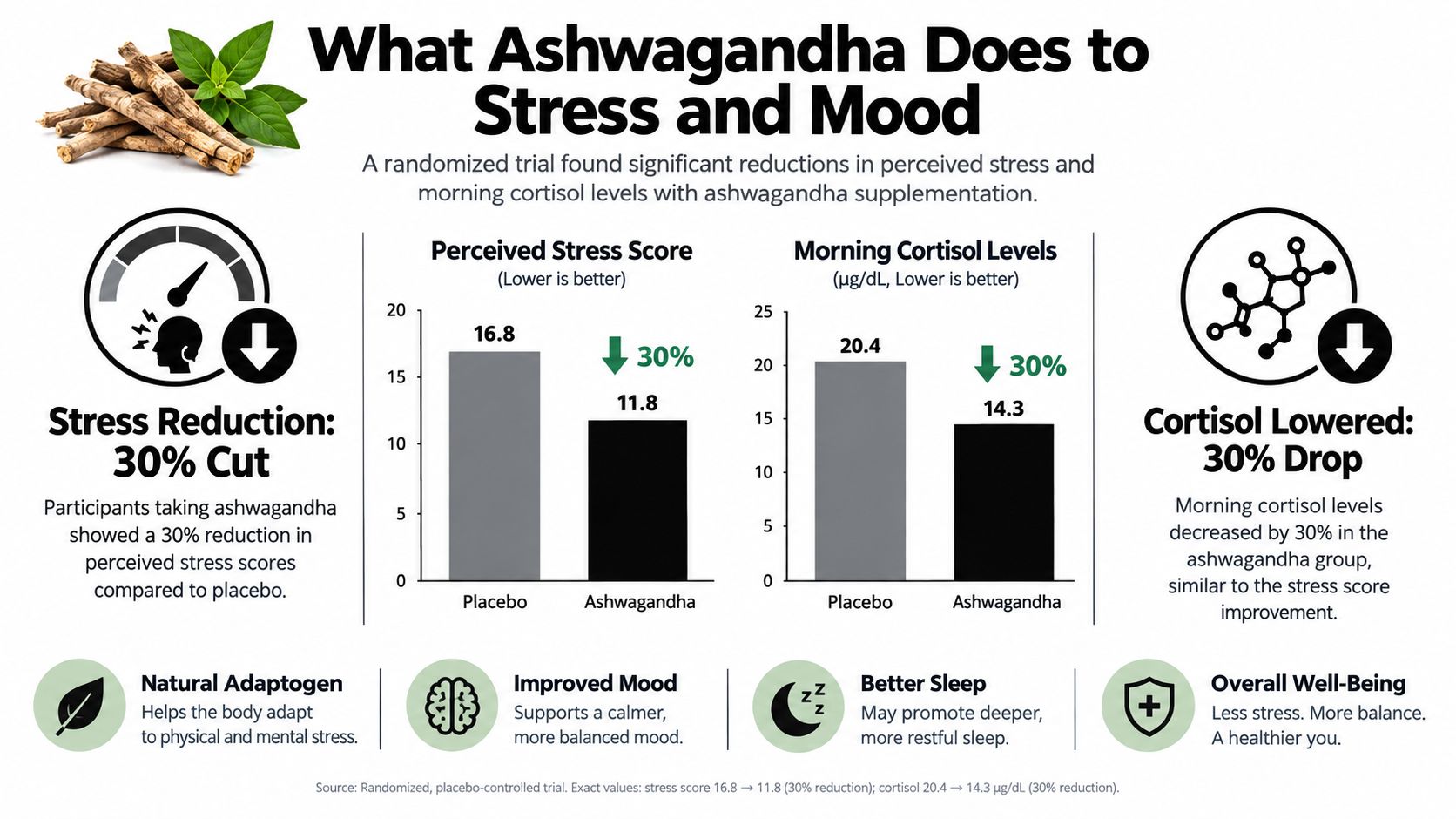
The earlier trial result needs careful interpretation. A lower Perceived Stress Scale score does not mean a person becomes carefree. It can indicate fewer feelings of being overwhelmed, greater confidence in handling demands, or less sense that ordinary problems are unmanageable. Cortisol measures something different. Because this hormone participates in the stress response, a lower reading suggests a biological change, but it cannot show exactly how someone felt during a difficult meeting, restless evening, or demanding week.
Stress and anxiety are different measures
Perceived stress describes how demanding a person experiences their circumstances. Clinical anxiety is a broader mental-health concept involving persistent fear, worry, physical symptoms, and impairment. Improvement in a stress questionnaire should not be presented as proof that a supplement treats an anxiety disorder.
A 2024 systematic review of nine studies involving 558 participants reported improvements versus placebo in perceived stress, Hamilton Anxiety Scale scores, and serum cortisol. Four included studies also observed mild to moderate adverse events, so potential benefit and safety belong in the same discussion. The PubMed record for this review
Practical rule: Treat cortisol as one piece of the picture, not a verdict on your mood.
Biomarkers and lived experience can change at different speeds, or point in different directions. Someone may record lower cortisol while still sleeping poorly and feeling tense. Another person may notice easier sleep or steadier reactions without having cortisol measured.
That gap is the central point. A laboratory marker can suggest that the stress system has shifted, while mood depends on sleep, circumstances, expectations, and individual biology. The useful question is whether a particular extract, dose, and duration help a particular person feel more resilient or less stressed without creating avoidable risks. A cortisol result may support that story, but it cannot tell the whole story by itself.
How Ashwagandha Works in the Body
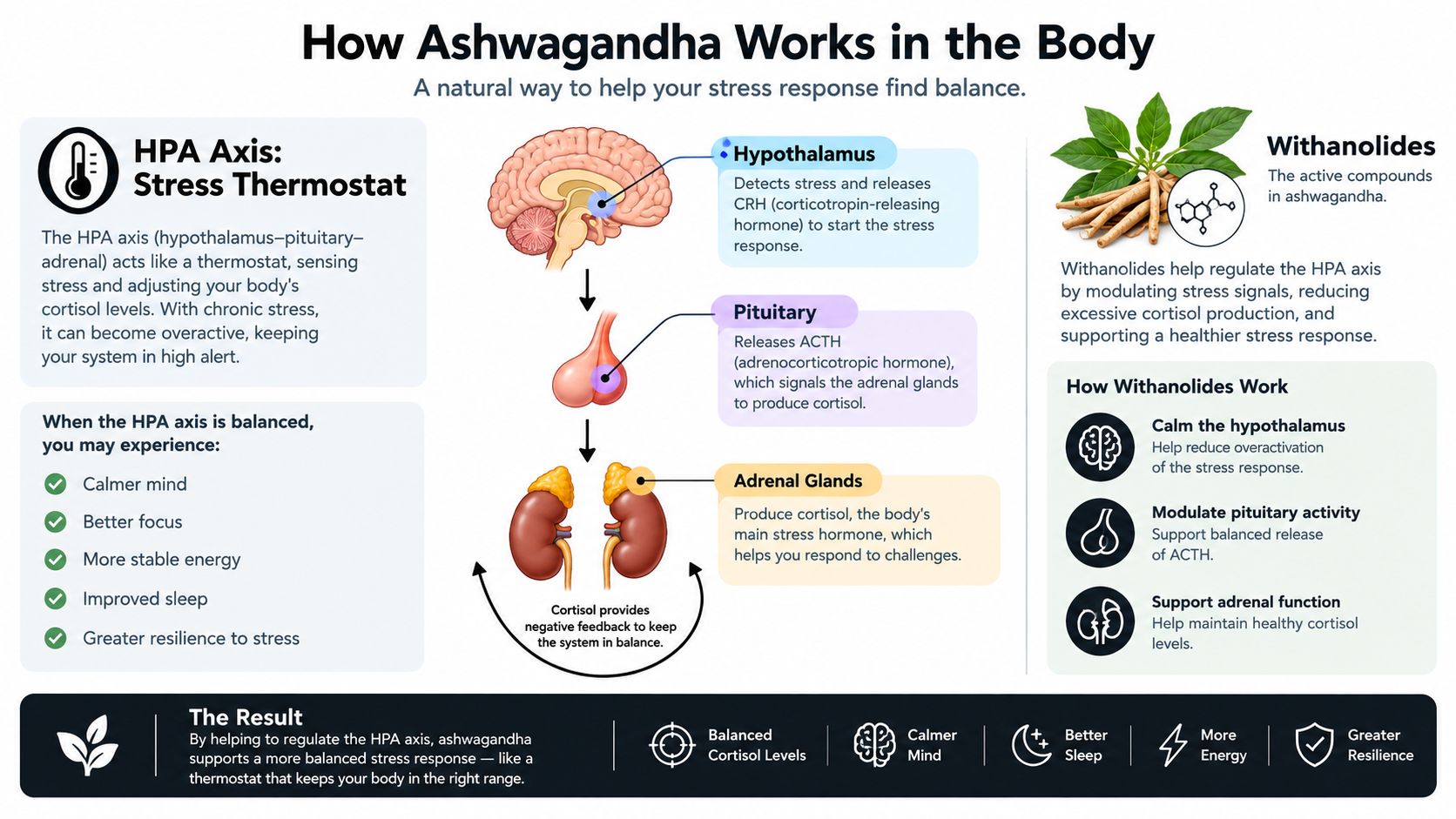
Think of the HPA axis, short for the hypothalamic-pituitary-adrenal axis, as the body's stress thermostat. The hypothalamus detects a challenge and signals the pituitary gland. The pituitary communicates with the adrenal glands, which release cortisol and other stress-related hormones. Once the demand passes, feedback signals help turn the response down.
A thermostat isn't meant to keep a room at maximum heat. It adjusts output according to conditions. Chronic pressure, poor sleep, illness, and emotional strain can keep the stress system activated or make its responses feel poorly matched to the situation. Ashwagandha is studied for whether it can help moderate that response, although the precise human mechanism remains under investigation.
The compounds researchers study
Ashwagandha contains withanolides, a family of plant compounds associated with much of its pharmacological activity. Research discussions often mention compounds such as withanoside IV and withaferin A, but an extract isn't defined by one molecule alone. The plant part, extraction process, concentration, and standardization can all affect what a capsule delivers.
Several pathways offer plausible explanations for the observed effects:
GABAergic signaling: GABA is one of the brain's calming chemical systems. Researchers have explored whether ashwagandha can influence this braking network, which could help explain interest in relaxation and sleep.
Stress-hormone regulation: Human trials have measured cortisol, while laboratory research has examined related inflammatory and cellular pathways. This doesn't mean every product produces the same hormonal response.
Thyroid signaling: Ashwagandha may influence thyroid hormones, including T3 and T4. That possibility is relevant to people with thyroid conditions or those taking thyroid medication, not just to mechanism enthusiasts.
Cellular resilience: Antioxidant and mitochondrial research suggests possible effects on how cells manage oxidative stress and energy production. Much of this work doesn't directly predict how a person will feel after taking a supplement.
The thermostat analogy helps prevent a common mistake. Ashwagandha isn't a universal “calm switch” that overrides every source of stress. It may influence several systems involved in stress adaptation, but a proposed mechanism isn't the same as a guaranteed outcome.
This explainer on the HPA axis and cortisol balance offers a visual way to follow the brain-to-adrenal communication pathway.
What the Clinical Trials Actually Show
Controlled human studies provide the clearest test of whether ashwagandha affects stress and mood. In the 2024 review, nine studies involving 558 participants showed statistically meaningful differences in perceived stress, Hamilton Anxiety Scale scores, and serum cortisol. The pooled mean differences were −4.72 on the Perceived Stress Scale, −2.19 on the Hamilton Anxiety Scale, and −2.58 for serum cortisol, with confidence intervals reported by the review. See the full meta-analysis details
These are group averages, not predictions for one person. The studies also used different preparations, protocols, and participant groups. A pooled result can show a pattern across selected trials, but it cannot establish that one capsule will produce the same response as every extract included in the analysis.
A sustained-release randomized trial offers a more specific example. In 135 healthy stressed adults, researchers compared 150 mg or 300 mg daily for 60 days with placebo. Both active groups showed significant improvements in stress, sleep quality, psychological well-being, and eating behavior. By day 60, perceived stress scores had fallen by 38.6% and 41.6%, while cortisol reduction reached significance at the higher dose. Review the randomized trial
The result illustrates an important distinction: a measurable biomarker change and a noticeable mood change are related questions, not identical ones.
What the evidence doesn't settle
Cortisol and perceived stress do not always move together. A review discussed in NIH safety guidance found significant cortisol reduction without significant improvement in perceived stress. The NIH Office of Dietary Supplements notes uncertainty about how consistently a cortisol change translates into a person's felt stress response.
Study | Dose | Duration | Key Outcome | Limitation |
|---|---|---|---|---|
2024 systematic review and meta-analysis | Varied across included studies | Varied across included studies | Lower perceived stress, anxiety scores, and serum cortisol versus placebo | Combines different extracts and study designs |
Sustained-release randomized trial | 150 mg or 300 mg daily | 60 days | Lower perceived stress, better sleep and psychological well-being, with cortisol significance at the higher dose | Conducted in healthy stressed adults and used one sustained-release extract |
The evidence is encouraging, yet it does not establish ashwagandha as a definitive treatment for every mood concern. Many studies were short, participant groups were limited, and outcomes may depend on the extract. Read trial findings as evidence about specific preparations and contexts, rather than as a guarantee that lowering a stress marker will produce the same improvement in how you feel.
Dosing, Forms, and What to Look for on a Label
A label can make two ashwagandha products look similar when they aren't equivalent. One capsule may contain a concentrated root extract, while another may contain a less concentrated powder or a blend of root and leaf. The number printed beside “ashwagandha” tells you the material's weight, not necessarily its active-compound profile.
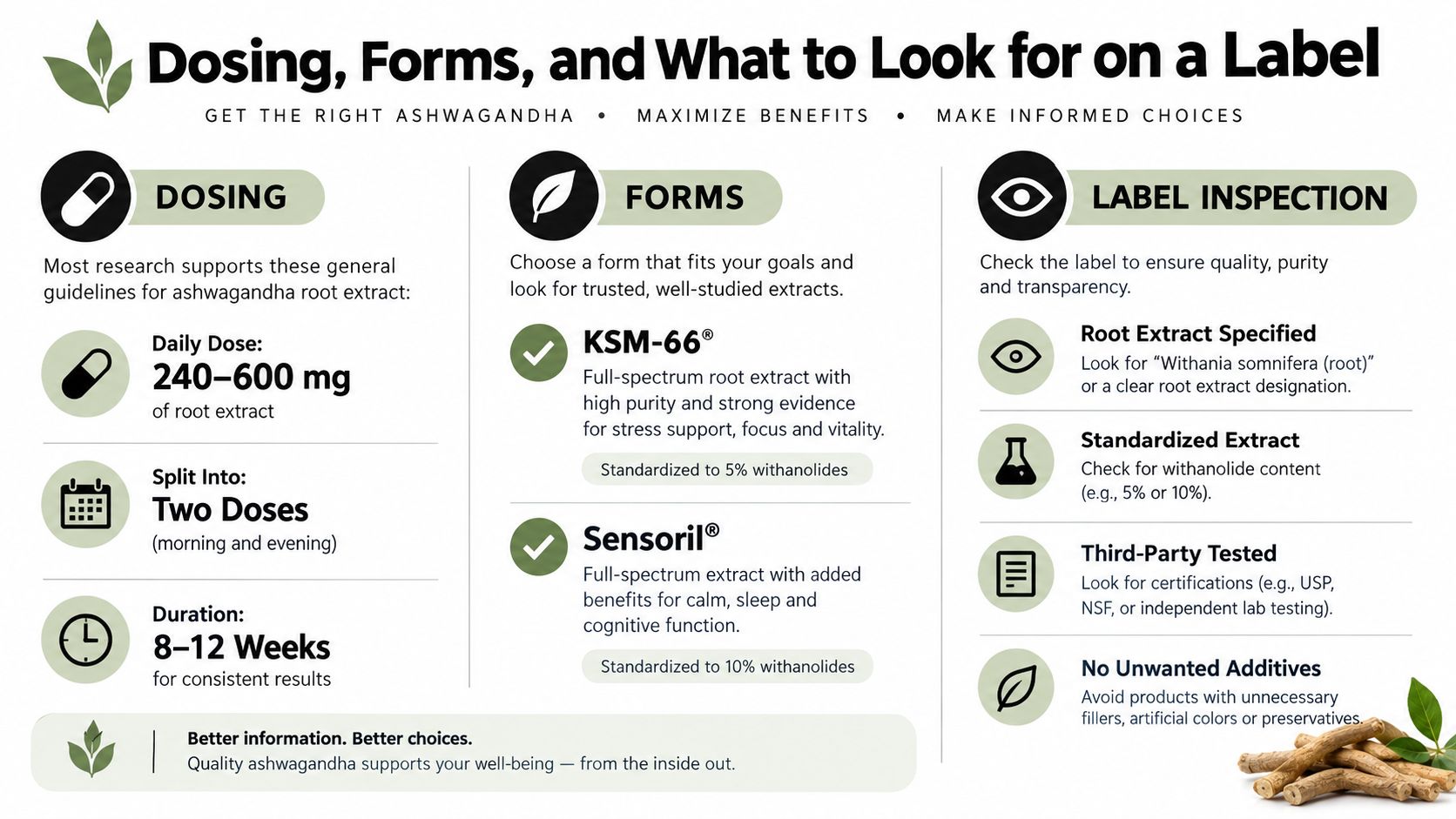
Clinical research has used different preparations and doses, so there isn't one universal dose that fits every product. The sustained-release trial described above tested 150 mg and 300 mg daily for 60 days, while the broader evidence base includes a wider range of standardized extracts. Don't convert a trial dose directly to a different product without checking its extract specification.
Read the ingredient panel in order
Start with the plant part. A root extract is easier to compare with trials that specifically studied root material. KSM-66 is commonly described as a root-only extract, while Sensoril is a root-and-leaf extract. Those are different formulations, not interchangeable brand names.
Next, check whether the label states that the extract is standardized to withanolides. Standardization aims to keep the concentration of a defined group of compounds consistent from batch to batch. It doesn't prove that a product will work for you, but it gives you more information than a label that lists only “ashwagandha powder.”
Look for independent quality testing when available. Seals or verification from organizations such as USP, NSF, or ConsumerLab can provide additional information about identity and manufacturing quality, although a seal doesn't establish that the product will improve your mood.
A practical label checklist:
Plant part: Confirm whether the product specifies root, leaf, or both.
Extract amount: Compare the extract quantity, not just the capsule size.
Withanolide disclosure: Note whether the label gives a standardization level.
Added ingredients: Pay attention to piperine, sedating herbs, or other compounds.
Testing information: Look for credible independent verification and batch details.
Timing depends on your goal and your response. Some people prefer morning use, while others choose early evening when they want support during the wind-down period. If you want a plain-language guide to amount and timing, see this overview of ashwagandha daily dosage.
Avoid stacking several ashwagandha products. More capsules don't guarantee more benefit, and combining products can make side effects or interactions harder to identify.
Ashwagandha Compared to Other Adaptogens
Ashwagandha isn't automatically the right choice for every stress pattern. A person who feels depleted and unfocused during the day may want a different profile from someone whose main problem is evening tension. L-theanine isn't technically an adaptogenic herb, but people often compare it with adaptogens because it is used for calm and focus.
The evidence also isn't equally developed across every comparison. Ashwagandha has the clearest set of findings in this article for perceived stress, anxiety-related measures, sleep, and cortisol, but that doesn't make it a universal winner. Rhodiola, holy basil, and L-theanine have different traditional uses, research questions, and subjective profiles.
Adaptogen | Best Evidence For | Typical Onset | Best Use Case |
|---|---|---|---|
Ashwagandha | Stress-related measures, anxiety scores, sleep, and cortisol | Usually assessed over consistent use rather than as an immediate effect | Ongoing stress with sleep or recovery concerns |
Rhodiola rosea | Stress-related fatigue and mental performance | Often selected when daytime support is the priority | Pressure accompanied by low energy or mental fatigue |
Holy basil, or tulsi | Stress support with broader wellness and metabolic interest | Better suited to a gradual routine than an acute effect | People seeking a gentler botanical approach |
L-theanine | Calm attention and reduced tension without a heavy sedating profile | Commonly considered for same-day use | Acute situational calm, such as a demanding work period |
Choose according to the problem you want to solve
If your main complaint is a persistent sense of overload combined with poor sleep, ashwagandha may be the more relevant candidate to discuss with a clinician. If your problem is daytime fatigue under pressure, rhodiola may fit the question better. If you need a same-day calming option while staying mentally engaged, L-theanine is a different category of choice.
Combination formulas can be appealing, but they reduce clarity. If several ingredients change at once, you won't know which one helped or caused an unwanted reaction. Start with a defined goal, record your sleep and stress experience, and change only one major variable at a time.
For a broader discussion of selecting botanicals by anxiety pattern, see this guide to adaptogens for anxiety. It shouldn't replace individualized medical advice, especially if you take prescription medication or have a diagnosed condition.
Safety, Side Effects, and Who Should Avoid It
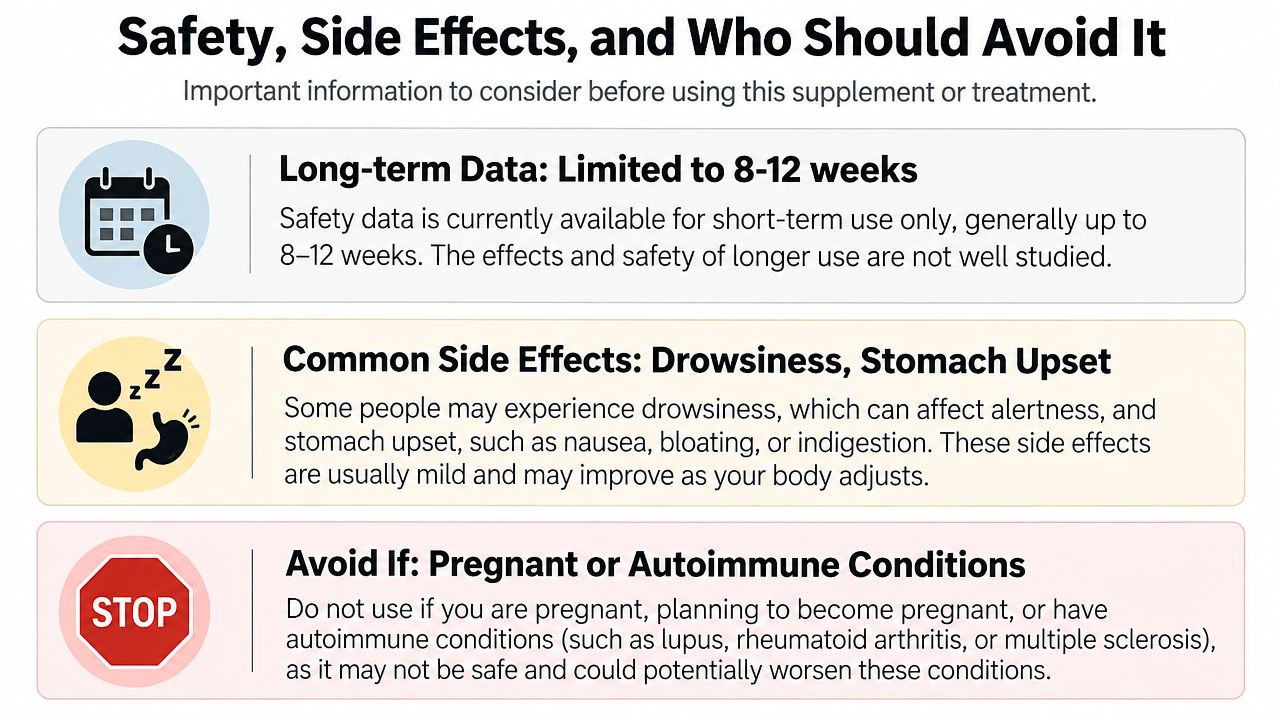
The evidence does not support calling ashwagandha “safe forever.” Short-term use is better studied, while long-term safety remains uncertain. Reported adverse effects include drowsiness, stomach upset, diarrhea, vomiting, and rare liver injury. Information beyond three months is limited. Read the NIH safety guidance
That uncertainty does not mean a healthy adult will necessarily have a problem. It means duration is part of the safety question. A short study cannot show what continuous use might do over a much longer period, especially when products vary in plant parts, extraction methods, and compound concentrations.
Get medical advice before starting if you
Take thyroid medication: Ashwagandha may affect thyroid hormones, making medication management less predictable.
Use sedatives or sleep aids: Combining calming substances may increase drowsiness.
Take immune, blood-pressure, or blood-sugar medication: Overlapping effects may require review by a clinician or pharmacist. For a detailed list of medicines and supplements that may interact, see this overview of ashwagandha interactions.
Are pregnant or nursing: Avoid self-directed use and seek professional guidance.
Have an autoimmune, thyroid, or liver condition: An herb that may affect immune or hormonal activity could require extra caution.
Have symptoms of liver trouble: Stop using the supplement and seek medical care if concerning symptoms appear.
Safety boundary: “Natural” describes an origin, not an interaction profile.
Choose a clearly labeled product, begin at the lower end of its studied range, and avoid stacking several products that contain ashwagandha. If you take it continuously, discuss duration and possible monitoring with a healthcare professional. A planned break does not automatically make every regimen safe. Also remember that a change in a stress biomarker, such as cortisol, does not guarantee an improvement in mood. New symptoms deserve attention even when the intended goal is better calm or sleep.
Putting Ashwagandha into a Real Daily Routine
Ashwagandha works best as one layer in a recovery routine, not as a replacement for sleep, food, movement, or mental-health care. Start with the basics that shape stress physiology every day: get morning daylight, eat a protein-forward breakfast, move your body, and keep your sleep and wake times reasonably consistent.
Choose a dosing time you can repeat. Morning may suit someone who wants daytime stress support, while early evening may fit a person whose tension rises as the day winds down. Late-night use isn't ideal for everyone, particularly if the product makes you feel alert, unsettled, or overly drowsy the next morning.
Build the routine around an existing habit
Attach the capsule to breakfast or dinner rather than relying on memory. Take it with food if that feels gentler on your stomach, and keep a simple note of sleep quality, daytime tension, digestion, and any unusual symptoms. This turns vague impressions into useful observations.
Other supplements may fit different parts of the day. Some people discuss magnesium glycinate for evening use or a B-complex in the morning, but adding several products at once makes it difficult to identify effects and interactions. Ask a pharmacist or clinician to review the full list, including alcohol, sleep aids, and prescription medicines.
River of Life Capsules combine ashwagandha root with turmeric extract, BioPerine black pepper extract, ginger, and bromelain in a multi-ingredient capsule positioned for stress resilience, sleep quality, mental clarity, and joint comfort. Because it contains several active ingredients, treat it as a complete formula rather than adding separate products automatically.
Short FAQ
How long should I try it?
The human evidence is concentrated in short-term studies, so discuss an appropriate trial period with a healthcare professional. Don't assume that continuing indefinitely is evidence-based.
When might I notice a change?
Some people may notice changes in sleep or tension earlier, while study outcomes are commonly assessed after sustained daily use. Track your own response instead of judging the product by cortisol claims alone.
Should I take it with food?
Food may make the routine easier on your stomach and can help you remember the dose. Follow the product label unless a clinician gives you different instructions.
Do I need to take it every day?
The controlled trial described earlier used daily dosing. Whether daily use is appropriate for you depends on the extract, your health history, medications, and intended duration.
The most honest summary is modest but useful: ashwagandha may help some adults manage stress-related symptoms, and the evidence is stronger when you consider standardized extracts and defined outcomes. Lower cortisol can be encouraging, but your sleep, mood, and day-to-day functioning are the measures that matter most.
River of Life offers a multi-ingredient capsule that includes ashwagandha root alongside turmeric, BioPerine, ginger, and bromelain for adults seeking combined support for stress resilience, sleep, mental clarity, and joint comfort. Review the formulation and use it as one part of a broader routine by visiting River of Life.