


Natural Sleep Aid Pregnancy: A Safe & Simple Guide 2026

It's 2:13 a.m. You've shifted from one side to the other so many times that the sheets feel twisted. Your hips ache, your mind won't stop planning, and just as you get comfortable, you need to pee again. By morning, people may tell you to “sleep while you can,” which is almost funny when sleep feels harder now than ever.
If you're searching for a natural sleep aid during pregnancy, you're not overreacting and you're not doing anything wrong. Pregnancy insomnia is common, exhausting, and emotionally draining. The safest way through it is rarely a single tea, pill, or supplement. It's a layered plan that starts with the lowest-risk tools first, then looks very carefully at anything marketed as “natural.”
Table of Contents
The Exhausting Reality of Pregnancy Insomnia
Pregnancy insomnia rarely looks dramatic from the outside. It looks like lying down tired and still staying awake. It looks like falling asleep, then waking up uncomfortable, hungry, anxious, congested, overheated, or mentally wide open. It often looks like trying to be “good” all day and then feeling defeated at night.
This is extremely common. Sleep problems rise across pregnancy and can affect up to 60% of women in the third trimester, according to a review in PMC on sleep pharmacotherapy in pregnancy. The same review describes a frustrating gap in care. No sleep aids are officially considered both safe and efficacious for pregnancy insomnia, yet more than 90% of pregnant women self-treat with OTC products.
That mismatch matters. When someone is worn down enough, “natural” starts to sound automatically safer than prescription medicine. In practice, that isn't how pregnancy safety works.
Practical rule: When you're pregnant, the safest sleep support usually starts with behavior, environment, and body positioning, not supplements.
Some readers come in hoping for a shortlist of teas, gummies, or capsules that will knock them out. What usually helps more is a calmer plan. Reduce the triggers you can control. Ease the physical strain. Stop expecting your body to sleep like it did before pregnancy.
That shift often brings relief on its own. Not perfect sleep. But more realistic sleep, and safer choices.
Why Sleep Is So Elusive During Pregnancy
You finally get into bed, and your body is tired enough to drop. Then the baby shifts, your hips start talking, your nose feels blocked, your mind wakes up, and sleep slips further away. That pattern is frustrating, but it also makes sense. Pregnancy disrupts sleep through several systems at once, which is why a safety-first plan starts by identifying the driver before reaching for any pill, tea, or gummy.
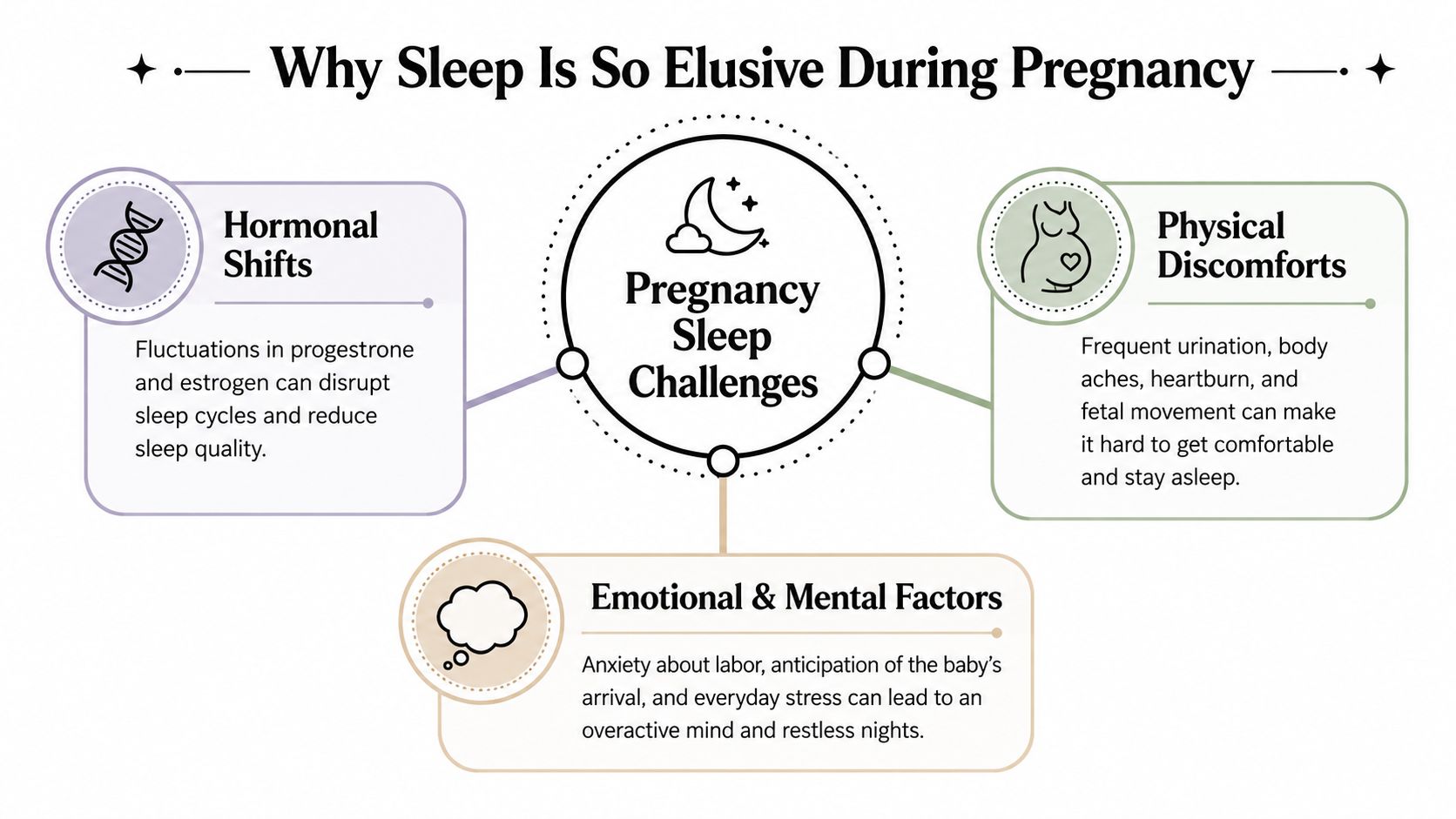
Hormonal shifts
Pregnancy hormones change how sleepy you feel, how soundly you sleep, and how often your body pulls you back into lighter sleep. Many women notice a strange mismatch. They feel exhausted during the day, then more alert than expected at night.
These shifts also affect temperature regulation, breathing, digestion, and muscle tone. A small issue at bedtime can quickly stack into a bigger one. Mild reflux can make it hard to settle. Congestion can make mouth breathing more likely. Overheating can turn a light sleep stage into a full awakening.
Progesterone is part of this picture, but it is not a simple sleep solution. It can increase daytime sleepiness while still leaving nighttime sleep broken. That is one reason pregnancy sleep often feels confusing.
Physical discomforts
Physical strain becomes a bigger sleep disruptor as pregnancy progresses. The position that felt fine a few nights ago may suddenly pull on the hips, pelvis, lower back, or abdomen. Rolling over can wake you fully. Frequent urination, leg cramps, heartburn, and fetal movement add more interruptions.
In practice, many women who describe "insomnia" are dealing with repeated physical wake-ups that keep the brain from settling back down. The fix is often mechanical before it is chemical. Better pillow support, meal timing, hydration timing, and treatment for reflux or congestion usually matter more than a supplement.
This is also where the melatonin conversation gets complicated. Readers who are specifically looking for a natural sleep aid without melatonin during pregnancy are usually sensing a real concern. Melatonin has growing research interest, but routine use in pregnancy is still not standard clinical advice, so caution is appropriate.
Emotional and mental factors
Bedtime can get mentally loud during pregnancy. Anticipation, previous loss, work stress, fear about labor, body changes, and the constant awareness of responsibility can all keep the nervous system on alert, even in a wanted pregnancy.
That does not mean the problem is "just anxiety." It means the brain is doing what protective brains do. If the body is uncomfortable and the mind is scanning for problems, sleep becomes lighter and easier to interrupt.
This is why the safest approach works from the ground up. Lower stimulation. Reduce discomfort. Address the specific trigger keeping you awake. Sedation is not the first goal in pregnancy. Rest is.
Your Safest Path to Better Sleep Without Pills
At 2 a.m., the problem usually does not feel abstract. Your hips ache, your mind is awake before your body is ready, and the idea of taking "something natural" starts to sound tempting. Safety comes first in pregnancy, so the best place to start is the lowest-risk approach: change the conditions that are keeping sleep shallow and broken before you consider any product.

Build a bedroom that works with your body
A good sleep setup should reduce heat, reduce stimulation, and support the joints and muscles that are under extra strain.
Start with the physical environment:
Keep the room cool: Many pregnant women run warmer at night. A cooler room, breathable bedding, and lighter sleepwear often help.
Cut light and noise: Use dim lighting in the hour before bed. Silence notifications and remove bright screens from reach if possible.
Set up pillows before you lie down: Waiting until you are already uncomfortable usually leads to more tossing and frustration.
For many women, the most useful pillow pattern is simple: one under the belly, one between the knees, and one behind the back. That arrangement often improves pelvic alignment and lowers the small twisting movements that keep waking you up.
Use sleep habits that fit pregnancy, not perfection
Pregnancy is not the time to chase a flawless bedtime routine. The goal is a repeatable pattern that tells the nervous system, "we are winding down now."
A few habits give the best return:
Keep a consistent sleep window: Try to go to bed and wake up at roughly the same time.
Be careful with late meals: Going to bed overly full can worsen reflux and make lying down miserable.
Create a transition into bed: Stop work, chores, and scrolling before your head hits the pillow.
Readers who want sleep support ideas that avoid melatonin can get a broader overview in this guide to sleep approaches that do not rely on melatonin. During pregnancy, even gentle-sounding remedies need a higher safety bar.
Clinical mindset: Start with strategies that improve comfort and lower stimulation without adding ingredients your prenatal clinician would need to review.
Support your body instead of pushing through discomfort
I see this often. A woman tries to force sleep while her body is signaling that position, tension, or temperature is wrong. In pregnancy, practical adjustments usually work better than trying to override discomfort.
Use the body-first options first:
Reset your side-lying position: If one side starts to ache, switch sides calmly and rebuild your pillow support.
Do gentle stretching before bed: Hips, calves, chest, and low back are common tension points.
Take a warm bath or shower: Warmth can reduce muscle guarding and make it easier to settle.
Use a brief relaxation practice: Slow breathing, prenatal yoga, body scan meditation, or quiet guided relaxation can help lower bedtime alertness.
For a simple guided reset, this short video can help slow the pace before bed:
This safety-first order matters. Fix comfort, light, timing, and nervous-system arousal first. Supplements sit lower on the list for a reason, especially in pregnancy, where "natural" does not automatically mean well studied or low risk.
Evaluating Common Natural Sleep Supplements
Pregnancy is the wrong time to treat a supplement aisle like a self-service sleep clinic. The safety-first framework puts these products below body-positioning, bedtime routine changes, and nervous-system calming practices for one reason. Pregnancy safety data is often thin, product quality varies, and a label that says "natural" does not tell you whether an ingredient is appropriate for you or your baby.
A quick comparison of common options
Supplement | General Evidence for Sleep | Pregnancy Safety Verdict | Key Concern |
|---|---|---|---|
Magnesium | Commonly used to support muscle relaxation and nervous system calm | Possible only with clinician guidance | Oral dosing can cause diarrhea and fluid and electrolyte problems if intake is too high |
Topical magnesium cream | Used for localized muscle relaxation without the same gastrointestinal burden as oral forms | One of the more practical lower-risk options | Discuss with your prenatal clinician, especially if you also use oral magnesium or magnesium in other products |
Chamomile | Often used as a calming tea | Use caution, not a default recommendation | Late-pregnancy safety concerns have been raised, so it should not be treated as automatically safe |
Kava | Marketed for calming | Avoid | Linked to liver damage |
L-tryptophan | Sometimes marketed for relaxation or sleep support | Avoid | Associated with a rare white blood cell disorder |
Melatonin | Commonly used outside pregnancy for sleep timing and onset | Nuanced, but not routine | Human safety signals are still limited and formal guidance remains cautious |
Valerian root | Commonly marketed for sleep | Not recommended without explicit medical approval | Lack of strong pregnancy safety data |
Lavender products and herbal blends | Popular in “natural sleep” products | Case-by-case and often not worth the uncertainty | Ingredient quality and pregnancy-specific data are often weak |
Magnesium deserves a careful, practical discussion because it sits in a gray area that patients ask about often. A pregnancy sleep aid review from The Bump describes magnesium supplementation as a commonly discussed option in pregnancy and notes that topical magnesium cream is often viewed as a way to avoid the digestive side effects that some people get from oral products. That does not make magnesium automatic. Dose, reason for use, kidney health, constipation or diarrhea patterns, and total magnesium intake from all products still matter.
In practice, topical magnesium is usually easier to justify than adding another pill, especially if the main complaint is tight calves, hip tension, or bedtime restlessness tied to muscle discomfort. Oral magnesium can still be reasonable in some pregnancies, but it should be chosen with a clinician who can review the full picture.
If you are reading broader wellness advice about supplements for sleep, this article on sleep and recovery hacks and ashwagandha's role in rest may be useful for general context outside pregnancy. During pregnancy, a product does not earn a place in your routine just because it may help sleep in the general adult population.
The melatonin safety paradox
Melatonin creates genuine confusion for pregnant women because the research conversation has become more nuanced while routine clinical advice has remained conservative. A Perelel Health discussion of emerging melatonin data describes a 2024 review that reported no adverse events among pregnant women using melatonin and explains why some current summaries sound less alarmed than older guidance.
That still leaves an important gap. Reassuring signals from limited human data do not automatically justify routine self-prescribing in pregnancy, especially for a hormone that crosses the placenta and has not reached broad clinical acceptance for pregnancy insomnia. Earlier guidance in this article already noted that no sleep aid has been clearly established as both safe and effective for pregnancy-related insomnia, and CBT-I remains the preferred first-line approach.
This is the paradox patients deserve to hear plainly. Melatonin may turn out to be lower risk than many people feared, but current evidence is still too incomplete for a casual green light.
My practical advice is firm here. If a pregnant patient is considering melatonin, the decision belongs with the prenatal clinician managing that pregnancy, particularly if there are complications, other medications, fertility treatment history, mood symptoms, or severe insomnia. Self-starting it because it is sold over the counter is not a pregnancy-safe standard.
Sleep Aids and Ingredients to Strictly Avoid
Pregnancy is the wrong time to test a “natural” sleep product and hope for the best. If an ingredient has poor safety data, known toxicity, or possible effects on hormones, the liver, or uterine activity, it does not belong in a self-directed sleep plan.
This is the strict end of the safety-first framework. Start with the lowest-risk tools first, and treat over-the-counter sleep blends with real caution, not wellness marketing optimism.
Why herbal doesn't mean harmless
Many plant-based sleep aids are sold as if they are gentle by default. They are not. In practice, the biggest problem is uncertainty. Mixed teas, tinctures, capsules, and gummies often combine several active ingredients, and pregnancy safety information is often incomplete or absent.
Some ingredients raise clearer concerns. Kava has been linked to liver injury. Chamomile is widely viewed as mild, but concern has been raised about use late in pregnancy, which is enough reason not to treat it as an automatic nightly remedy without clinician guidance. Products marketed for relaxation also frequently contain multiple herbs in one formula, which makes risk harder to judge.
If you want something food-based rather than an herbal sedative, reading about tart cherry gummies for sleep support is a safer direction than buying a mystery “sleep blend.” Even then, pregnancy is the time to keep choices simple and review supplements with your prenatal clinician.
A firm do-not-use list
Avoid these unless the clinician managing your pregnancy has given you a specific reason to use them:
Kava: Liver safety concerns make this a clear no in pregnancy.
L-tryptophan: It has been linked to a rare but serious blood disorder and is not a reasonable self-start supplement during pregnancy.
Chamomile in late pregnancy: Do not assume bedtime chamomile tea is automatically safe near the end of pregnancy.
Valerian root: There is not enough pregnancy safety evidence to support routine use for insomnia.
Ashwagandha: It is heavily marketed for stress and sleep, but pregnancy is not the setting to experiment with an herb that may affect hormones or uterine activity.
Use extra caution with products labeled “sleep,” “calm,” or “stress relief.” Those formulas often stack ingredients together, sometimes in proprietary blends that do not make dose and risk easy to judge. For pregnant patients, that is not reassuring. It is a reason to put the bottle back.
Your Simple Nightly Routine for Restful Sleep
Most women sleep better when the evening feels predictable. Not rigid. Predictable. The body does well with repeated cues, especially when pregnancy has made sleep more fragile.
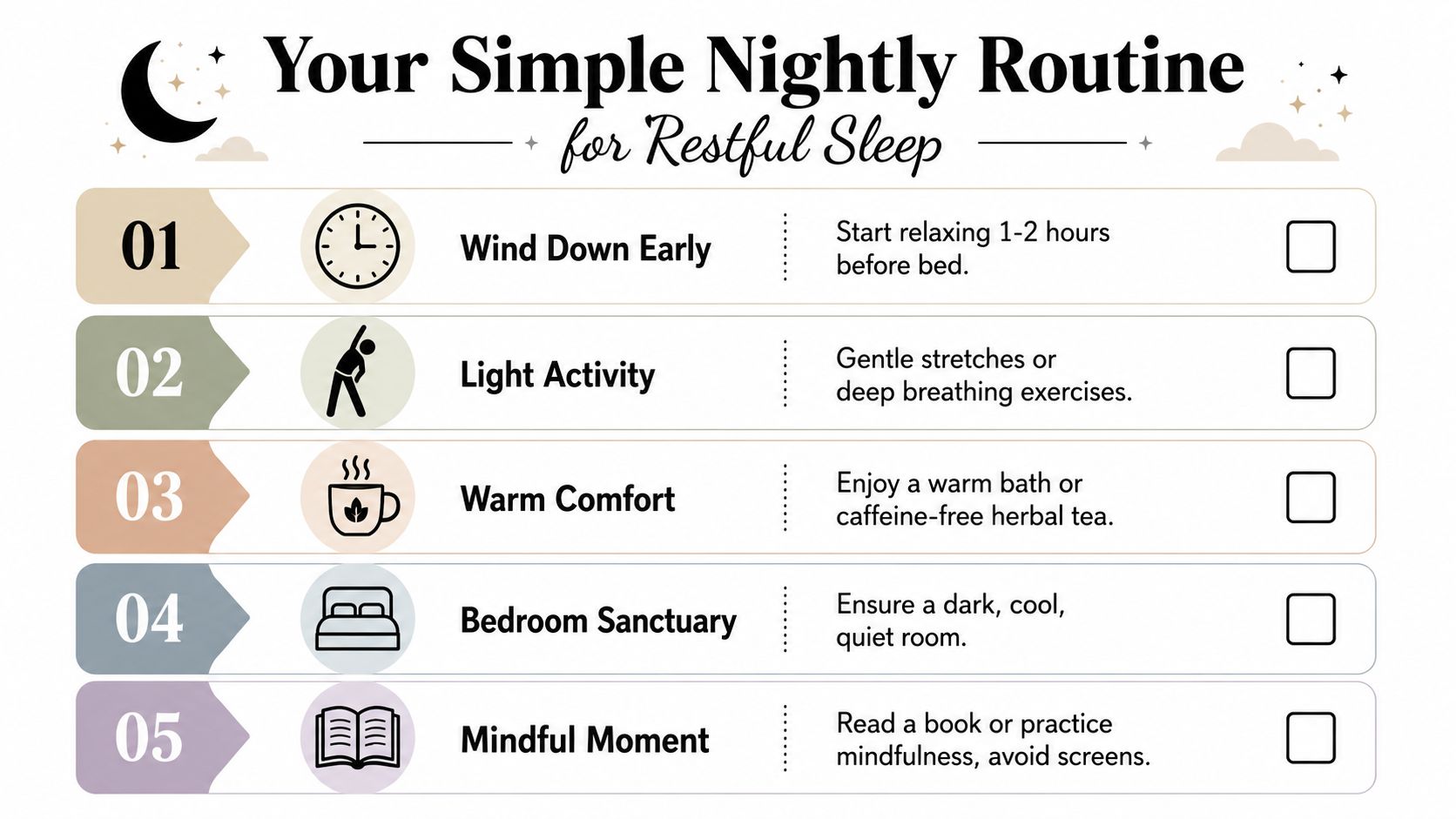
A realistic evening checklist
Use this as a template and adjust it to your energy, trimester, and symptoms.
Start winding down early
Give yourself a transition before bed. Lower the lights, stop problem-solving, and let the pace of the house slow down.Do light movement
Choose gentle stretching, a few prenatal yoga poses, or slow breathing. The goal isn't exercise. It's releasing the physical tension that keeps your body braced.Add warm comfort
A warm bath, shower, or a clinician-approved caffeine-free drink can help signal safety and rest. Keep it simple rather than turning bedtime into a long wellness project.Set up the room
Cool, dark, quiet, and supportive wins. Put your pillows in place before you're too tired to fuss with them.Choose a quiet final activity
Read something light, listen to a calming audio track, or sit with a short mindfulness practice. If you want a non-pregnancy-specific read about tart cherry products, this article on tart cherry gummies gives general background, but don't add new supplements in pregnancy without medical approval.
If you're awake in bed and getting frustrated, switch from “trying harder” to “getting calmer.” That change often matters more than the clock.
A routine like this won't erase every interruption. It does something more realistic. It lowers the number of things working against your sleep at the same time.
When to Talk to Your Doctor About Sleep
Bring sleep concerns to your doctor or midwife once they start affecting how you function during the day. If you are too tired to drive safely, work clearly, care for other children, or keep up with basic daily tasks, that has crossed out of the "normal but frustrating" category and into something that needs medical attention.
Some symptoms deserve a faster call. Loud snoring, waking up gasping, choking awake, a racing heart at night, severe restless legs, or sleep loss tied to ongoing anxiety or low mood should not be brushed off. Pregnancy can uncover sleep apnea, iron problems, mood symptoms, reflux, or other medical issues that need treatment rather than more bedtime tips.
Ask before you buy any sleep product, even if the label says natural. As noted earlier, standard clinical guidance remains cautious. No over-the-counter sleep aid has been clearly established as safe in pregnancy, and behavioral treatment such as CBT-I is still the preferred first step because it addresses the pattern causing insomnia without adding drug or supplement exposure.
This is also where the melatonin question gets complicated. Early research has created interest, but that is not the same as a green light for routine use in pregnancy. I tell patients to treat melatonin as a clinician-guided decision, not a casual supplement, because the standing advice is still conservative and the quality and dosing of over-the-counter products vary.
Asking for help is good prenatal care.
If you're looking for wellness education beyond pregnancy, River of Life offers articles and supplement information focused on stress, recovery, and sleep-related topics. During pregnancy, keep your standard high. Bring any product, even a natural one, to your prenatal clinician before using it.