

Supplements for Healthy Aging Evidence Guide That Works

You're trying to keep doing the things you enjoy: walking without stiffness, sleeping through the night, managing stress, and staying mentally sharp. Yet the supplement aisle makes those goals feel harder, not easier. One bottle promises joint comfort, another supports calm, a third targets memory, and a multivitamin claims to cover everything.
The better question isn't, “What's the biggest stack I can take?” It's, “What specific job do I need help with?” Supplements for healthy aging can be useful tools, but they aren't substitutes for movement, adequate food, restorative sleep, medical care, or treatment for an underlying condition.
Supplement use is already well-established among older adults. Repeated NHANES data covering 63,442 adults found that dietary supplement use among U.S. adults aged 65 and older rose from 62% in 1999–2000 to 78% in August 2021–August 2023 (NHANES analysis). That popularity makes careful selection more important, especially because many older adults combine supplements with prescription medicines.
This guide follows a practical path. You'll learn how aging can affect inflammation, oxidative stress, stress regulation, sleep, and tissue recovery, then compare supplement classes by their intended job. You'll also learn how to assess bioavailability, label quality, consistency, and interaction risk, so you can decide whether a product belongs in your routine or whether a food, exercise habit, laboratory test, or clinician conversation makes more sense.
Table of Contents
How Aging Changes Inflammation Oxidative Stress and Resilience
Your Next Steps for Choosing Supplements for Healthy Aging Wisely
Introduction to Supplements for Healthy Aging Today
Consider a typical morning. You wake after a lighter night of sleep, notice some stiffness when you stand, and wonder whether yesterday's walk helped or left you more sore than expected. You take a few medicines, perhaps already use a multivitamin, and now you're considering something for joints, stress, or focus. None of those decisions exists in isolation.
Older adults often use more than one product. CDC data report that among U.S. adults aged 20 and over, 13.8% used four or more dietary supplements in the previous 30 days, while 42.4% used none (CDC dietary supplement data). In a separate study of older U.S. adults, 70% reported using at least one supplement, 54% used one or two products, and 29% used four or more. Women reported use more often than men, 76% versus 62%, in that study (CDC data brief and cited older-adult study).
Those figures describe behavior, not a recommendation. Common use doesn't prove that a product is necessary or effective for every person. It does show why a one-size-fits-all approach can create confusion, duplication, and avoidable interaction risks.
Practical rule: Start with the outcome, not the ingredient.
If your priority is joint comfort, you'll evaluate an ingredient differently than if your priority is sleep continuity. If you have a suspected vitamin deficiency, testing and clinician guidance may be more useful than buying a broad longevity formula. A supplement may fill a nutritional gap, support a defined function, or complement an active lifestyle. It shouldn't carry the entire burden of healthy aging.
Use capsules as tools, not guarantees
A useful routine begins with foundations. Regular movement helps preserve function, a balanced diet supplies protein and micronutrients, and consistent sleep habits support recovery. Stress management also matters because poor sleep and prolonged stress can influence energy, mood, and day-to-day resilience.
The rest of this guide gives you a way to make narrower decisions:
Inflammation and recovery: Which ingredients are considered for these jobs, and what limits their evidence?
Stress and sleep: Why standardized ashwagandha root extract is a different proposition from an acute stimulant.
Nutrient gaps: Why vitamin D, vitamin B12, folate, protein, or a multivitamin may make sense mainly when intake or status is low.
Product quality: How standardization, transparent dosing, testing, and absorption technology affect comparison.
Safe use: When medication interactions or medical conditions should change your plan.
By the end, you should be able to narrow your choices to a specific goal, identify what evidence can and can't establish, and decide when professional guidance belongs before the first dose.
How Aging Changes Inflammation Oxidative Stress and Resilience
Healthy aging isn't one biological process. Several systems have to keep adjusting to activity, illness, stress, nutrition, and sleep. With age, those systems may become less flexible, which can show up as slower recovery, more stiffness, lighter sleep, or reduced tolerance for stress.
Four connected jobs inside the body
Low-grade inflammation is like a small warning light that stays on. It isn't the same as the acute response that helps you recover from an injury. Instead, persistent inflammatory signaling can place repeated demands on tissues and metabolism. That's why people often connect turmeric or omega-3 products with a healthy inflammatory response, although a supplement's practical value depends on the person, the formulation, and the outcome being measured.
Oxidative stress is another balance problem. Cells naturally produce reactive molecules during normal energy production and physical activity. Protective systems help keep them in check, but the balance can become harder to maintain when recovery, nutrition, illness, or sleep are compromised. Antioxidant ingredients are often marketed as if more is automatically better. It isn't. The useful question is whether a product addresses a demonstrated need without encouraging an unnecessarily large stack.
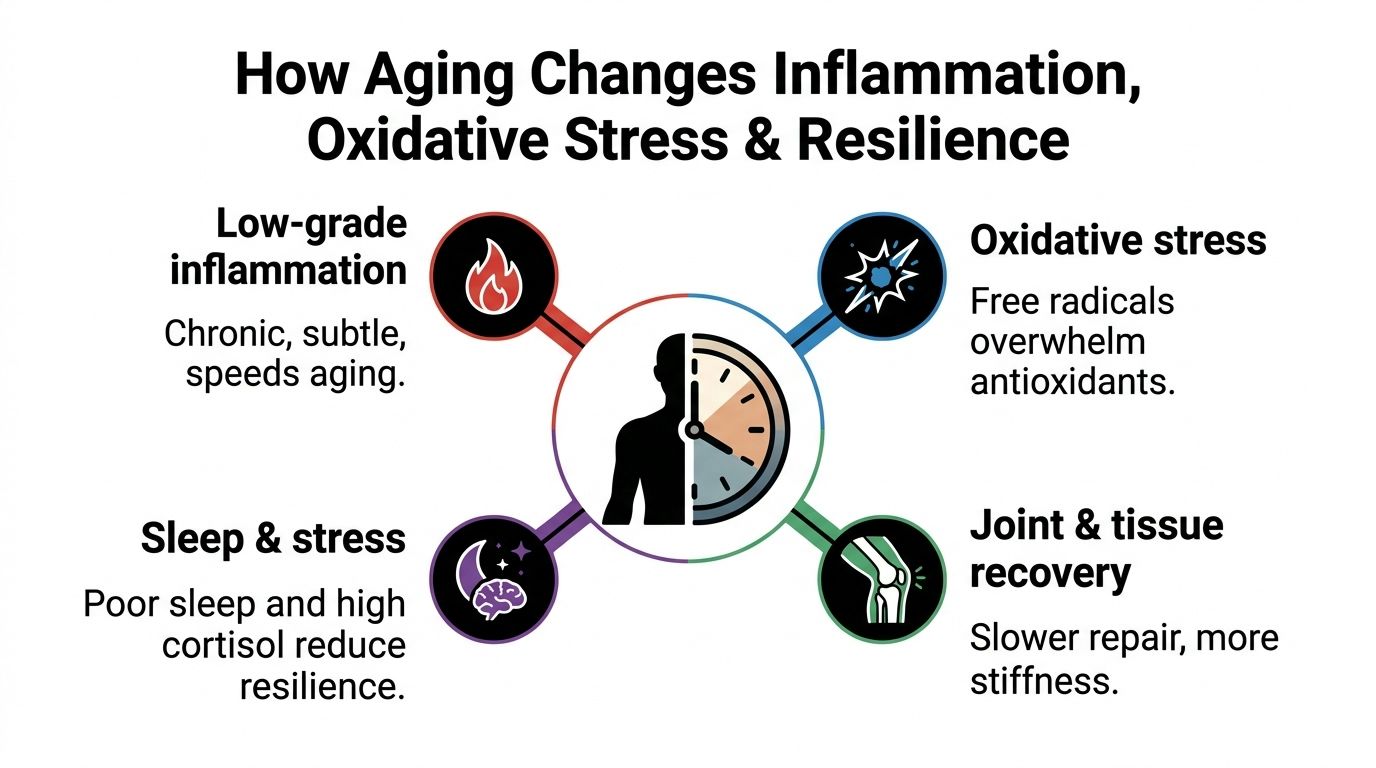
Sleep and stress regulation work as a feedback loop. A stressful day can make it harder to settle at night, while poor sleep can leave you less resilient the following day. Botanicals such as ashwagandha are studied for stress-related outcomes, but they aren't sleeping pills or replacements for evaluating persistent insomnia, anxiety, medication effects, or sleep-disordered breathing.
Joint and tissue recovery also depend on several inputs. Movement loads muscles, tendons, cartilage, and connective tissue. Nutrition supplies building blocks, while rest allows repair and adaptation. As recovery becomes less predictable, ordinary activities may produce stiffness that lasts longer than expected.
Match the product to the job
These mechanisms overlap, but they shouldn't be treated as one target. A product designed around inflammatory signaling may not improve sleep. A stress-support ingredient may not address a nutrient deficiency. Collagen may be relevant to connective-tissue structure, but it isn't a universal answer for pain.
This job-based view prevents a common mistake: choosing a product because its ingredient list sounds broad, then attributing every normal fluctuation in comfort, mood, or energy to the capsule. A narrower goal gives you a clearer way to assess whether the choice is reasonable and whether it's doing anything useful.
Key Supplement Classes Evidence Dosing and What to Expect
Evidence for supplements for healthy aging varies widely. Some ingredients have a plausible mechanism but a formulation problem. Others have human studies relevant to a specific outcome, yet the results remain mixed or apply only to people with a particular deficiency or risk.
Supplement class | Primary job for aging | Evidence signal |
|---|---|---|
Curcumin with piperine | Inflammation and recovery support | Bioavailability is a major technical issue; human evidence is formulation-dependent |
Ashwagandha root extract | Stress resilience, sleep, and quality of life | Emerging human evidence, with results tied to standardized repeated use |
Omega-3 fatty acids | Dietary support for cardiovascular, brain, and joint health | Useful when dietary intake is low, but outcomes vary by population and formulation |
Vitamin D | Bone and immune support when status is low | Best considered in relation to measured status, intake, and clinical context |
Collagen | Connective-tissue and joint structure | Relevant to structure and comfort, but not a universal treatment for pain |
Probiotics | Gut-related support | Effects are strain-specific and shouldn't be generalized across products |
Antioxidant blends | Broad oxidative-stress positioning | Often difficult to evaluate because combinations, doses, and outcomes vary |
Curcumin and turmeric
Plain curcumin's central limitation is poor oral bioavailability. Human studies and reviews report that standard curcumin can be undetectable or present at extremely low levels in serum after a 2 g dose, while piperine can raise exposure substantially. One classic human study reported approximately a 20-fold increase, and a review summarizes increases of up to 2,000% in bioavailability (curcumin bioavailability review).
That doesn't mean every turmeric product produces the same result. The meaningful comparison is between a transparent, validated extract with an absorption strategy and an unlabeled powder that gives little information about active compounds. Expected benefits should remain modest and goal-specific, such as support for a healthy inflammatory response or everyday joint comfort, rather than a promise to reverse aging.
Ashwagandha and stress resilience
Ashwagandha root extract is studied less as an energy jolt and more as a stress-resilience ingredient. A report involving elderly men and women concluded that root extract may support general health and quality of life, while a separate long-term safety study found a standardized root extract was well tolerated over 12 months (ashwagandha review and safety evidence).
Consistency matters more than occasional use. The evidence described in the available research is connected with repeated use and broad functional outcomes, not a single-dose performance effect. Standardization also matters because different extracts can contain different concentrations and chemical profiles.
Nutrients and other classes
Vitamin D, vitamin B12, folate, and multivitamins are best approached through diet, risk factors, laboratory status, and clinician advice. A 2026 review summary says evidence doesn't support universal supplementation for every older adult. It identifies vitamin D, vitamin B12, folate, and sometimes multivitamins or protein as potentially useful mainly when deficiency or low intake is present (review summary on supplements for older adults).
Protein, creatine, and vitamin D have stronger support in discussions of sarcopenia, while evidence for sleep and cognition is more mixed. The same review summary describes moderate support for melatonin, insufficient evidence for valerian, and a need for more research before recommending magnesium, vitamin D, or B vitamins broadly for cognition.
Omega-3s, collagen, probiotics, and antioxidant blends may fit particular dietary or functional goals, but they shouldn't be treated as interchangeable. A product's ingredient category tells you what it might support. It doesn't tell you whether it addresses your actual need.
For a broader, ingredient-focused overview, see this guide to supplements backed by science.
A short educational overview can also help you see how these classes are commonly compared:
How to Evaluate Quality Bioavailability and Product Choices
Two bottles can list the same ingredient and still be meaningfully different. One may disclose the extract type, active compounds, serving amount, and independent testing. The other may hide several ingredients inside a proprietary blend, leaving you unable to tell how much of each one you're taking.
Read the label in a fixed order
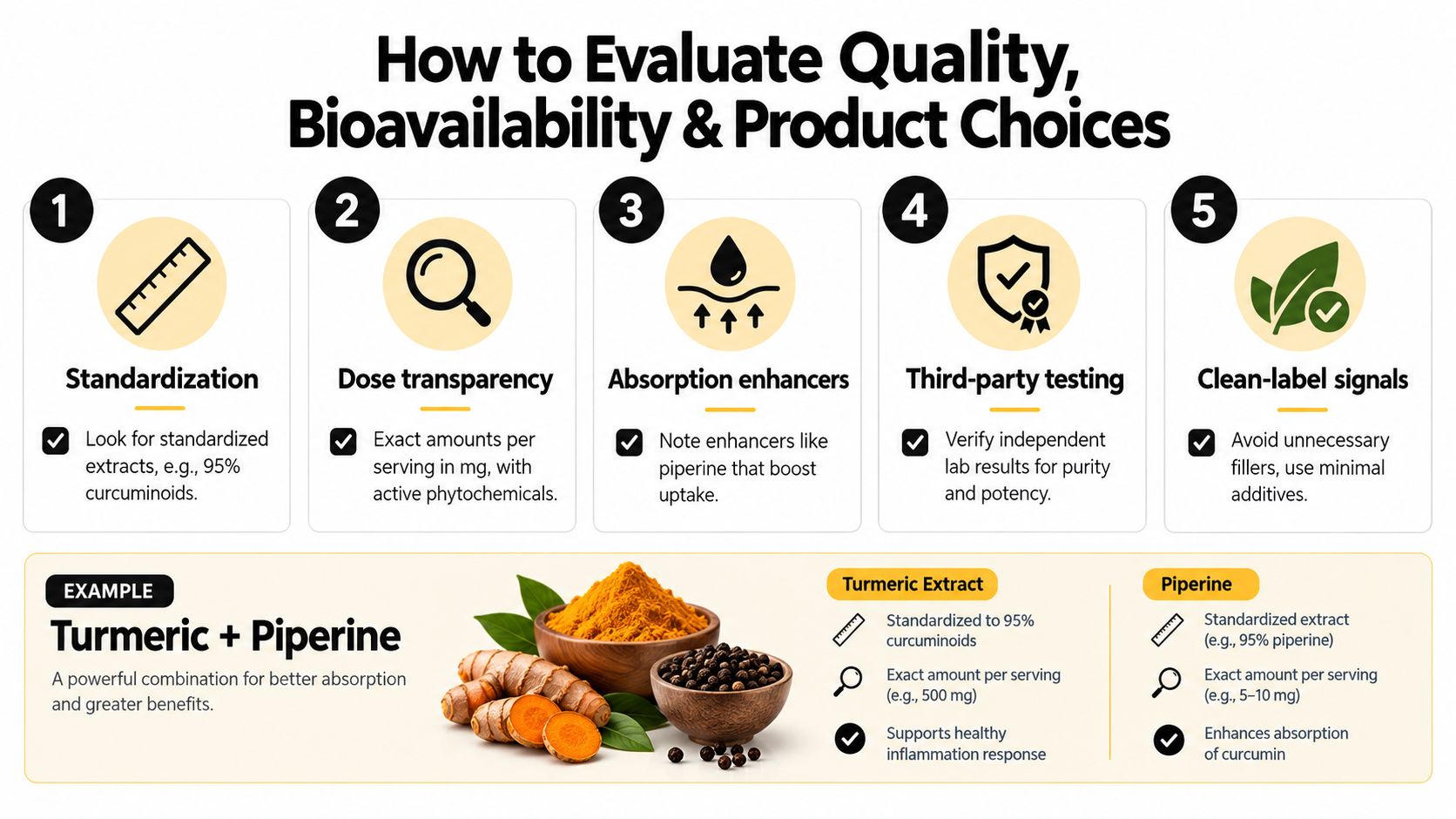
Start with the serving size. Then identify the exact amount of each active ingredient, the extract ratio or standardization, and any added absorption technology. “Turmeric” alone tells you less than a label that identifies a turmeric or curcumin extract and explains its active constituents.
Curcumin illustrates the point clearly. Plain curcumin often reaches the bloodstream poorly, while piperine can increase exposure dramatically, as described in the curcumin bioavailability research. In practical terms, the question isn't whether a product contains turmeric. It's whether the formula addresses the absorption problem in a documented, transparent way.
Label comparison: An exact dose is more useful than a long ingredient list.
The same principle applies to botanical extracts. A standardized ashwagandha root extract gives you more information than a label that lists “ashwagandha” without identifying the plant part, extraction approach, or active markers. Standardization doesn't guarantee a result, but it makes the product easier to evaluate and compare.
Quality signals worth checking
Use this checklist before buying:
Dose transparency: Look for exact amounts per serving rather than a combined proprietary blend.
Extract identity: Check whether the label names the plant part and standardization.
Bioavailability strategy: Identify whether the formula uses a validated enhancer, delivery system, or other absorption approach.
Independent testing: Look for credible third-party verification of purity and potency, with enough information to understand what was tested.
Simple formulation: Unnecessary fillers, unclear “complexes,” and excessive overlapping ingredients make a routine harder to assess.
Practical serving plan: Choose a format you can take consistently without creating confusion with medicines or other products.
A clean label isn't proof of effectiveness, and a premium appearance isn't proof of quality. Treat both as screening signals. Then ask whether the dose, evidence, and intended job line up.
For a practical walkthrough of label terminology, use this guide on how to read a Supplement Facts panel.
Putting Supplements Into a Daily Healthy Aging Routine
A supplement routine works best when it attaches to something you already do. Put the bottle beside a meal you reliably eat, use a weekly organizer if appropriate, and keep a current list of every medicine and supplement for appointments. Habit design matters because even a well-formulated product can't help if you take it sporadically or forget what you've already used.
Build around the outcome
Choose one priority first. Joint comfort might pair with strength training, walking, mobility work, and adequate protein. Sleep quality may require a regular bedtime, morning light exposure, reduced evening stimulation, and a review of medicines or health conditions that disturb sleep. Stress resilience can benefit from breathing practice, social connection, moderate activity, and realistic workload boundaries.
Take products according to the label, especially if food is recommended or if the product may cause drowsiness. Don't change prescription timing or separate medicines from supplements without asking a pharmacist or clinician. A written schedule can prevent accidental duplication when several products contain the same vitamin or botanical.

Track without overinterpreting
Write down the job you're trying to support, how consistently you use the product, and a few practical observations. For example, you might record morning stiffness, ease of walking, nighttime awakenings, or perceived stress. Keep other major changes in mind, such as travel, illness, training volume, sleep disruption, or a new medicine.
Ashwagandha is a useful example of why patience matters. The available evidence supports standardized root extract used consistently over months, rather than sporadic dosing for an immediate boost (ashwagandha evidence and safety review). That still doesn't prove that every person will notice a benefit.
Reassess the routine rather than automatically adding another product. If the original goal remains unclear, the dose is not transparent, or no meaningful change appears, discuss whether continuing makes sense. More capsules can create more uncertainty without improving the result.
Safety Interactions and When to Talk With Your Clinician
“Natural” doesn't mean interaction-free. Concentrated turmeric and ginger may raise bleeding risk when combined with blood thinners or antiplatelet drugs. Ashwagandha may add to drowsiness with sedatives, lower blood pressure alongside antihypertensives, and interfere with thyroid treatment, according to independent safety guidance on Ayurvedic herbs after age 60.
Older adults deserve extra caution because many manage several prescriptions at once. A supplement that seems mild on its own can change the overall effect of a medication regimen, especially when it affects sedation, blood pressure, bleeding, blood sugar, or thyroid function.
Pause before adding a botanical
Ask a clinician or pharmacist before using concentrated turmeric, ginger, or ashwagandha if you:
Use blood thinners or antiplatelet medicines: Discuss bleeding risk and whether the product should be avoided.
Take sedatives or sleep medicines: Check for additive drowsiness and impaired alertness.
Use antihypertensives: Ask whether the supplement could add to blood-pressure lowering.
Take thyroid treatment: Confirm compatibility before using ashwagandha.
Manage several conditions: Bring the complete product label, not just the front of the bottle.
Have a planned procedure: Tell the relevant clinician about all supplements well in advance.
You'll find more detail about these considerations in this resource on ashwagandha interactions.
Evidence also has limits beyond safety. Healthy-aging reviews repeatedly describe heterogeneous studies, mixed cognition findings, and a need for better standardized randomized trials. Don't use a supplement to postpone evaluation of persistent pain, worsening sleep, memory changes, unusual fatigue, falls, or other new symptoms. A clinician can help distinguish a nutritional gap from a condition that requires diagnosis and treatment.
Your Next Steps for Choosing Supplements for Healthy Aging Wisely
A thoughtful plan can be simple:
Name the job. Choose one priority, such as joint comfort, sleep continuity, stress resilience, or a suspected nutrient deficiency.
Check the foundation. Review movement, diet, protein intake, sleep habits, and stress load before adding a capsule.
Match the evidence. Select an ingredient class that has a reasonable connection to your goal, while recognizing where findings are mixed.
Verify the product. Look for transparent doses, identified extracts, appropriate bioavailability support, and independent testing.
Review safety. Compare the label with your medicines, medical conditions, allergies, and upcoming procedures.
Monitor deliberately. Track the original outcome, avoid adding several new products at once, and reassess with a clinician when needed.
Older adults are already the most supplement-intensive segment of the U.S. market, with use reaching 78% among adults aged 65 and older in August 2021–August 2023 (repeated NHANES analysis). That popularity doesn't make broad stacks the best answer. Targeted use is easier to evaluate, safer to coordinate, and more likely to complement the habits that carry the greatest daily value.
Start by writing down the one function you want to support. Then check whether a food change, exercise adjustment, laboratory test, medication review, or targeted supplement is the most logical next step. If you do choose a product, use the label and interaction checklist before you begin.
River of Life offers a vegan, capsule-based formula combining standardized turmeric with BioPerine, ashwagandha root, ginger, and bromelain for people focused on joint comfort, stress resilience, sleep quality, and mental clarity. Visit River of Life to review the formulation, usage options, and educational resources before deciding whether it fits your healthy-aging routine.