


Best Natural Joint Support Supplements 2026 Guide

You wake up, swing your legs out of bed, and your knees or hips need a minute before they agree with the plan. Stairs feel different than they used to. A workout that once felt normal now leaves you stiff the next day. Or maybe you've already bought one or two joint products and you're still not sure what is important on the label.
That uncertainty is common. The supplement aisle makes joint support sound simple, but it rarely is. Some ingredients aim to calm irritation. Others try to support the tissues inside the joint. Some formulas look impressive on the front of the bottle and fall apart when you read the fine print.
A better approach is to use a clear decision-making framework. When you understand what your joints may need, how certain ingredients work, and how to judge quality, you can make calmer, smarter choices about natural joint support supplements.
Table of Contents
What Are Natural Joint Supplements
Joint discomfort usually doesn't show up all at once. It creeps in during ordinary moments. You stand after sitting too long. You carry groceries. You kneel in the garden. You finish a walk and notice your body taking inventory.
Natural joint supplements are products made with ingredients that aim to support joint comfort, mobility, and day-to-day function. That sounds broad, so it helps to think in simpler terms. Most joint formulas try to help in one of two ways.
Inflammation reduction
The first job is calming irritation inside and around the joint. If a joint feels puffy, warm, achy, or stiff after activity, inflammation is often part of the picture. Ingredients that work on this side of the problem act a bit like firefighters. They don't rebuild the structure of the joint overnight. They try to cool things down so movement feels easier.
Often, for many people, natural joint support supplements become the most sensible approach. If the main complaint is “my joints feel angry,” anti-inflammatory support is usually the first lens to use.

Cartilage support
The second job is supporting the tissues that help joints move smoothly. Cartilage acts like padding. Other structures around the joint help with cushioning, glide, and stability. Ingredients in this category are more like a repair crew. They're not the same as firefighters. Their purpose is to support the materials and environment that joints depend on.
Many readers often get confused. They assume every joint supplement does everything at once. It doesn't. A turmeric-focused product and a cartilage-focused product may both say “joint support,” but they're solving different parts of the problem.
Practical rule: Before buying anything, ask yourself whether your main issue feels more like irritation, wear-and-tear support, or a mix of both.
Why this distinction matters
When people say a supplement “didn't work,” the product may not have been wrong. It may have been mismatched. Someone with mostly activity-related soreness may do better with ingredients chosen for calming inflammation. Someone focused on longer-term support may want a different formula or a broader one.
A useful first filter is this short checklist:
Morning stiffness: Think about ingredients aimed at calming inflammatory tension.
Creaky movement after activity: Look at formulas that combine anti-inflammatory support with tissue support.
Long-standing joint wear concerns: Pay closer attention to the type of ingredient, not just the marketing words on the bottle.
Whole-body recovery needs: A blend may make more sense than a single ingredient.
Once you understand the firefighters-and-repair-crew model, labels start to make more sense. You can stop treating supplements like mystery pills and start judging them like tools.
The Evidence Behind Common Ingredients
A joint supplement label can read like a crowded toolbox. The useful question is not “How many ingredients are in here?” It is “Which job is this formula trying to do, and is there decent evidence behind the ingredients chosen for that job?”
That shift helps you judge supplements more clearly. Some ingredients are studied for calming inflammatory pathways tied to pain and stiffness. Others are sold for supporting cartilage and joint structure over time. A few play a supporting role by helping with recovery, stress load, or whole-body inflammatory balance.
How to read the evidence without getting lost
Start by separating ingredients into their main role.
Inflammation-focused ingredients include turmeric or curcumin, ginger, bromelain, and Boswellia. These are usually chosen for people whose main complaint is stiffness, soreness after activity, or joints that feel irritated.
Structure-support ingredients often include glucosamine and chondroitin. These are usually marketed for cartilage support and longer-term joint maintenance.
Then there are ingredients that sit off to the side of those two buckets. Ashwagandha is one example. It is better known for stress and recovery support than for direct joint effects. Omega-3s also come up often because they support a healthy inflammatory response across the body, not just in one knee, hip, or hand.
Ingredients with clearer support
Curcumin has some of the strongest support among widely used plant-based joint ingredients. A 2022 meta-analysis, summarized in this evidence-based guide to joint supplements, reported that curcumin extract helped with knee osteoarthritis pain and compared favorably with ibuprofen in the studies reviewed, with fewer stomach-related side effects discussed in that summary.
The practical lesson is just as important as the ingredient itself. Curcumin is known for poor absorption on its own. Formulation changes that problem. As noted in the same review, absorption aids such as BioPerine may improve how much your body can use. That is why two turmeric products can look similar on the front label and perform very differently in real life.
If you want a closer look at that issue, River of Life has a helpful article on how turmeric curcumin helps with arthritis and joint pain.
Boswellia also stands out. A clinical discussion in this joint supplement trial review describes Boswellia serrata as one of the more credible plant ingredients for knee osteoarthritis, with findings that support reductions in pain and improvements in function. If you prefer a botanical formula, Boswellia is one of the names worth recognizing.
Ingredients that need a more careful read
Glucosamine and chondroitin are familiar, but familiar does not always mean clear-cut. They have been studied for years, and some trials suggest benefit. Other reviews are less convincing, especially when researchers look at whether the combination produces meaningful improvement across larger groups of people.
That mixed picture matters. It does not mean these ingredients never help. It means you should treat them as ingredients with variable results, not automatic winners just because they have been around a long time.
Ginger, bromelain, omega-3s, and ashwagandha often make more sense as supporting players. Ginger and bromelain are commonly added to blends aimed at soreness and recovery. Omega-3s may be more useful for someone who also wants broader inflammatory support. Ashwagandha may fit better when stress, poor sleep, and muscle tension seem to make pain harder to manage.
The best-supported ingredient is not always the best ingredient for you. The better question is whether the ingredient matches the pattern of symptoms you are trying to address.
Comparing Natural Joint Support Ingredients
Ingredient | Primary Function | Evidence Level |
|---|---|---|
Curcumin from turmeric | Inflammation support and pain relief | Strong among commonly used botanicals |
Boswellia serrata | Inflammation support and function support | Promising and well-supported |
Ginger | Inflammation support | Traditionally used, often included in blends |
Bromelain | Enzyme-based recovery and inflammation support | Often used in combination formulas |
Glucosamine | Cartilage-related support | Mixed |
Chondroitin | Cartilage-related support | Mixed |
Omega-3s | Broad inflammatory balance | Context-dependent |
Ashwagandha | Stress and recovery support | Indirect joint support role |
A simple way to use this table is to rank ingredients by three filters. First, does the ingredient match your type of joint complaint? Second, is there credible human research behind it? Third, does the formula include a form and amount that give it a fair chance to work? That is the mindset behind smarter supplement choices, and it lines up with the River of Life approach of looking past marketing and paying attention to what a formula is designed to do.
How to Choose a Quality Supplement
You are standing in the supplement aisle, holding two joint formulas that both promise comfort, mobility, and healthy aging. One has a long ingredient list and bold claims on the front. The other looks simpler, but the label gives clearer details. In that moment, the better choice usually comes down to reading the bottle like a clinician, not like a shopper.

Start with the Supplement Facts panel
The front label is marketing. The Supplement Facts panel is the part that helps you judge quality.
Start there first. It tells you what is in the formula, how much you get per serving, and whether the company is being clear or vague.
Look for a few basic signals:
Named ingredients: “Turmeric extract” is more useful than a broad phrase like “joint support blend.”
Specific forms: Standardized extracts, named compounds, and absorption aids give you more information than a plant name by itself.
Clear serving size: You should know whether the listed amount is for one capsule, two capsules, or a full daily serving.
Minimal use of proprietary blends: If amounts are hidden, you cannot judge whether the formula is properly dosed or just dressed up for the label.
This step matters because two products can contain the same ingredient name and still behave very differently in real life.
Look for formulation details that affect results
Ingredient choice is only part of the story. Form matters. Delivery matters. Dose matters.
Curcumin is a good example. Many readers see turmeric on a label and assume all turmeric formulas work the same way. They do not. Curcumin is known for poor absorption on its own, so a product that includes black pepper extract or another bioavailability strategy is making a meaningful formulation choice.
That same label-reading habit applies beyond turmeric. Boswellia can vary by extract quality and standardization. Collagen products differ by type and intended use. If you want to compare that category more carefully, this guide to undenatured type II collagen for joint support can help clarify what to look for.
A useful way to think about bioavailability is cooking. Raw ingredients on a counter are not the same as a finished meal your body can use. A supplement formula also needs the right preparation, pairing, and structure to give the ingredient a fair chance to do its job.
One example of this formulation-first approach is River of Life Capsules, which combine turmeric extract with BioPerine, along with ashwagandha root, ginger, and bromelain in a vegan capsule. That does not make it the right fit for every person, but it does show the kind of label logic worth noticing. The ingredients are there for a reason, not just to make the bottle look busy.
Buyer insight: A shorter formula with well-chosen forms often gives you more confidence than a long label with hidden amounts and weak disclosure.
A quick visual can help if you're newer to label reading:
Use a simple shopping checklist
If you want a practical framework, use this checklist every time you compare products online or in a store:
Third-party testing: Look for evidence that purity and potency were checked by an independent lab.
Absorption support: For turmeric formulas, black pepper extract or another absorption strategy can make a real difference.
Standardized extracts: This helps you compare products more fairly and understand what the formula is built around.
Clean label: Fewer unnecessary fillers, clear capsule type, and plain ingredient disclosure are good signs.
Fit for your values and needs: Vegan capsules, allergen concerns, and sourcing transparency all matter if you want a supplement you will feel comfortable using consistently.
You do not need a perfect product. You need a product with a clear purpose, a transparent label, and a formula that matches your goals. That is the mindset behind smarter supplement choices, and it closely matches the River of Life philosophy of looking past hype and paying attention to what a formula is designed to do.
Practical Tips for Daily Use
Buying a supplement is one decision. Taking it in a way that gives it a fair chance is a different one.
Make consistency easy
Natural joint support supplements usually work best when you take them consistently. That doesn't mean taking more than the label suggests. It means building a routine your real life can handle.

Try one of these anchors:
With breakfast: Helpful if your mornings are predictable.
With your main meal: A practical choice for people using ingredients that absorb better with food.
Next to an existing habit: Keep the bottle near your coffee setup, toothbrush, or lunch container.
Inside a weekly organizer: Useful if you already manage multiple pills or supplements.
The best supplement routine is the one you'll actually repeat.
Many readers also ask whether they should take joint supplements with food. For formulas built around turmeric or other fat-soluble compounds, taking them with a meal is often a sensible choice. A meal also tends to be gentler for people with sensitive stomachs.
Support the supplement with daily habits
Supplements do more when your daily habits stop working against them. If your joints are constantly irritated by poor recovery, long stretches of sitting, or too much impact too quickly, even a well-formulated product can only do so much.
A supportive routine often includes:
Gentle movement: Walking, mobility work, or strength training that matches your current ability.
Recovery habits: Better sleep, rest days, and paying attention to how your body responds after activity.
Food choices that help: Many people do better when meals include whole foods, healthy fats, and less of the highly processed patterns that leave them feeling inflamed.
Patience: Natural approaches usually reward consistency more than urgency.
Some people expect immediate relief and keep switching products too fast. A steadier approach works better. Pick a reasonable routine, track how you feel, and give the supplement a fair trial while keeping the rest of your habits stable.
Safety and Potential Drug Interactions
It is common to think of supplements as automatically gentle because they're natural. That's understandable, but it's not always safe thinking. Natural ingredients can still affect the body in meaningful ways, and that's exactly why people take them.
Talk to your doctor if any of these apply
A short check-in with a clinician is especially important if you fall into one of these groups:
You take blood thinners or medicines that affect clotting: Turmeric and ginger are common examples people discuss with a clinician before use.
You take multiple prescriptions: Ingredients that improve absorption can also affect how your body handles medications.
You're pregnant or breastfeeding: Even common plant ingredients may not be appropriate without guidance.
You have gallbladder, digestive, immune, or liver concerns: Product choice may need more care.
You're preparing for surgery or recovering from a major procedure: Timing matters with many supplements.
If stress support is part of why you're considering a formula, it's also smart to review ingredient-specific questions such as ashwagandha interactions.
How to start more safely
Start with one new supplement at a time. That makes it easier to notice benefits, side effects, or stomach upset without guessing which ingredient caused what.
Also keep your label and medication list in the same place. When you talk with your pharmacist, doctor, or nurse practitioner, they can only give useful guidance if they can see the exact product and serving size.
Bring the bottle, not your memory.
A careful approach isn't fear-based. It's practical. The safer you are on the front end, the easier it is to use supplements with confidence.
Tailoring Supplements for Your Needs
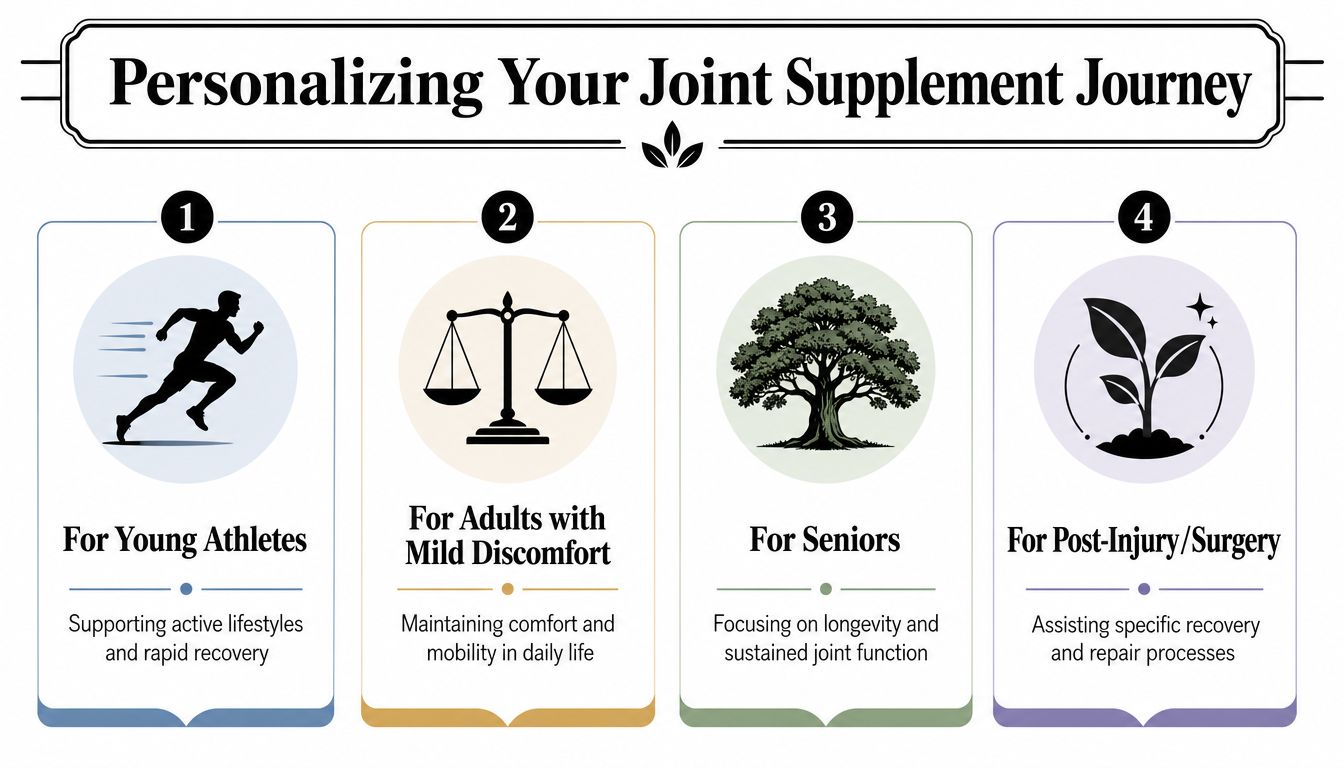
Two people can both say “my joints hurt” and need very different support. Your age, activity level, stress load, and recovery demands all shape what makes sense.
Different goals call for different priorities
A younger athlete dealing with post-workout soreness may care most about recovery, short-term comfort, and staying consistent with training. In that situation, ingredients such as ginger or bromelain may be more relevant to the conversation.
An older adult with persistent stiffness often has a different goal. The priority may be ongoing comfort, easier movement in daily life, and less friction getting through ordinary tasks like walking, standing, or climbing stairs. That usually calls for a steadier, long-range view.
Adults in the middle often fall somewhere between those two. They may not identify as athletes or seniors. They just want to move without paying for it later.
When a combined formula makes sense
A multi-ingredient formula can be useful when your needs overlap. Joint discomfort rarely lives alone. Stress can worsen tension. Poor sleep can make pain feel sharper. Recovery can feel slower when life is already demanding.
That's why some people prefer a formula that combines joint-focused ingredients with broader recovery support, rather than managing several separate bottles. It can also reduce the friction of remembering multiple products.
Consistency matters here more than novelty. If you find a product that fits your needs and your body tolerates it well, staying on a steady schedule is often more helpful than constantly chasing a new ingredient. For some people, a subscription can support that consistency by removing the “I forgot to reorder” problem.
Your Path to Better Joint Health
Good joint support decisions rarely come from one flashy claim. They come from a few grounded questions. What kind of discomfort are you dealing with. Does the formula match that need. Is the ingredient supported by credible evidence. Does the product help your body absorb it. Can you take it consistently and safely.
That's the framework that helps natural joint support supplements make sense.
When you shop this way, you stop guessing. You start reading labels with purpose. You notice the difference between a marketing-heavy product and one built around thoughtful formulation. And you give yourself a better chance of finding support that fits real life, not just a promise on a bottle.
If you want a practical example of a formulation built around turmeric absorption support, plant-based recovery ingredients, and simple daily use, take a look at River of Life.