
Curcumin and Turmeric Explained: A Practical Guide

Most advice flattens curcumin and turmeric into one idea, then tells you to “just take more.” That shortcut misses the underlying issue. Turmeric is the spice, curcumin is one of its active compounds, and the way a product is formulated often matters more than the raw milligram number on the front of the bottle.
Table of Contents
Turmeric and Curcumin Are Not the Same Thing
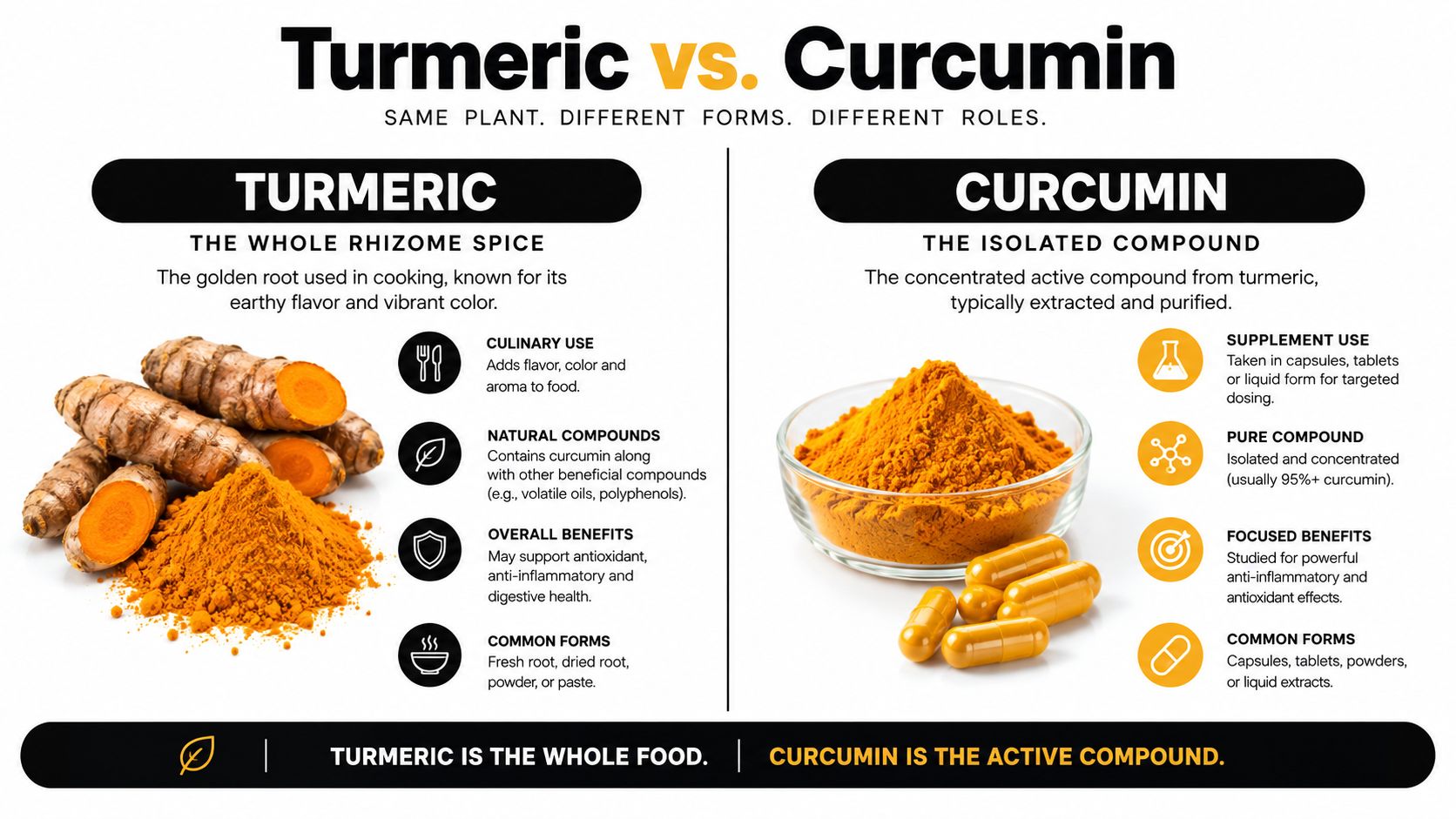
Turmeric is the whole rhizome spice, the golden powder people cook with, stir into soups, and add to curries. Curcumin is a specific compound inside turmeric, and it's one of several curcuminoids, alongside demethoxycurcumin and bisdemethoxycurcumin. That difference matters because the spice itself and the isolated compound behave very differently in the body.
A simple way to think about it is this. Turmeric is like an orange, while curcumin is more like vitamin C. The fruit contains useful compounds, but if you want a concentrated amount of one of them, you need to look beyond the whole food.
What's actually in kitchen turmeric
Ground turmeric used in cooking contains only a small percentage of curcuminoids by weight, so a teaspoon in food is not the same as a studied supplement dose. That's why culinary turmeric is great for flavor and routine use, but it usually doesn't deliver the kind of concentrated curcumin exposure used in clinical research.
Turmeric also brings along other plant components, including volatile oils and polysaccharides. Some products keep more of that natural matrix, while others isolate and standardize curcuminoids to a higher percentage. Both approaches exist for a reason, but they serve different goals.
Practical rule: if you're cooking, think turmeric spice. If you're comparing supplements, think curcuminoid content and formulation, not just the word “turmeric” on the label.
What the Evidence Actually Supports
Curcumin research tends to cluster around a few questions people do ask: joint comfort, inflammation, stress and sleep, and cognition. The honest answer is that the evidence is mixed by outcome, and the strongest results usually come from trials using standardized extracts rather than kitchen spice.
For joint comfort, the literature is the most mature, especially for osteoarthritis and related discomfort. For inflammation markers, results depend heavily on the study design and the exact product. For stress, sleep, and mood, the signal is promising but smaller, and for cognition, the studies are still early and often short. The main lesson is that “curcumin works” is too broad to be a useful statement.
A useful anchor comes from a meta-analysis in chronic inflammatory diseases that found turmeric or curcumin did not significantly reduce CRP, with a pooled mean difference of -2.71 mg/L and a 95% CI of -5.73 to 0.31. It also did not lower hsCRP. That doesn't mean every product fails, it means outcomes vary enough that you need to match the product to the goal, and the trial to the claim. PubMed meta-analysis on chronic inflammatory disease trials
Curcumin Evidence by Outcome | Evidence Strength | Typical Trial Length | Notes |
|---|---|---|---|
Joint comfort | Moderate | Short to medium | Strongest practical use case, especially with standardized extracts |
Inflammation markers | Mixed | Short | Results vary by marker, population, and formulation |
Stress and sleep | Preliminary to promising | Short | Smaller studies, often subjective outcomes |
Cognition | Early | Short | Interesting, but not settled |
One reason the results stay uneven is that poor oral absorption can blur the effect even when the biology looks promising on paper. That's why the next question is never just “Does curcumin help?” It's “Which form was used, and how well did anyone absorb it?”
Why Bioavailability Changes Everything
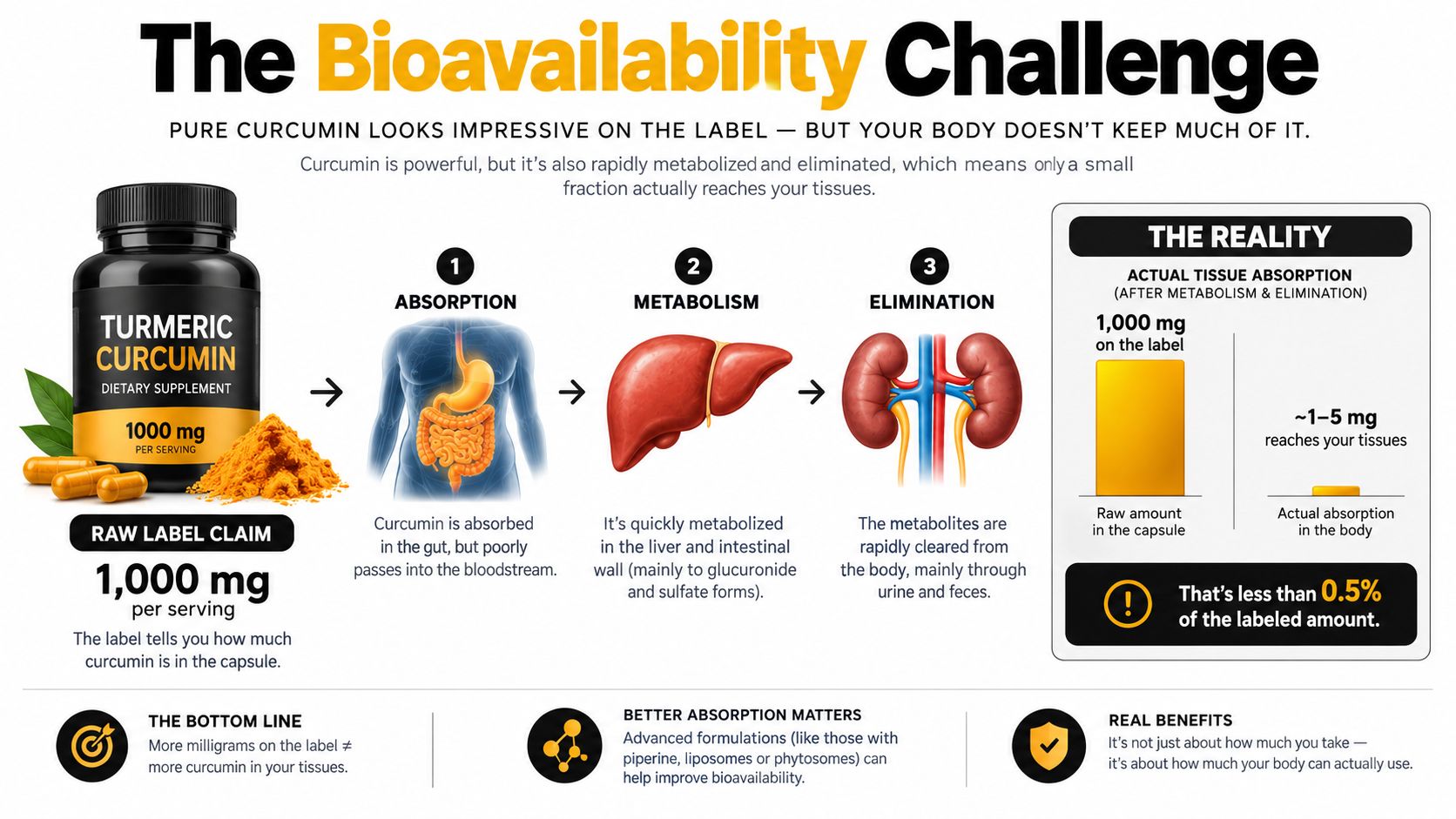
Curcumin looks simple on a label, but the body handles it differently. Human evidence shows very low systemic exposure, with reviews describing bioavailability in the low single-digit range and some literature placing it around 0.16% to 1%. One clinical source noted that curcumin and its metabolites were not detectable in plasma at doses below 3.6 g/day, while another review reported that unformulated oral curcumin often reaches only about 1% bioavailability in practice. Oregon State review on curcumin bioavailability, Frontiers review on low oral bioavailability
Why form matters more than raw milligrams
Curcumin does not stay in the body for long. In a human pharmacokinetic study, adding pepper extract increased the elimination half-life from 2.2±0.79 hours to 4.5±0.80 hours and raised 24-hour urinary curcumin excretion from 49.45±12.94 μg to 218.14±94.98 μg. That change shows the formulation affected how much the body could absorb and retain. Human pharmacokinetic study on pepper extract and curcumin
That is why the label has to be read like a recipe, not just a number. A plain capsule, a pepper-enhanced product, and a lipid-based formula may all list similar milligram amounts, yet they can behave very differently once swallowed. For a closer explanation of delivery formats, this guide to curcumin bioavailability is a helpful reference.
The main formulation strategies shoppers see
Piperine or black pepper extract: used to slow breakdown and improve absorption.
Lipid-based carriers: used to help fat-soluble compounds dissolve more effectively.
Micellar or nanoparticle systems: used to improve dispersion and surface area.
Full-spectrum extracts: used to keep more of turmeric's natural matrix intact.
Practical rule: if two products both say “500 mg curcumin,” they may not behave anything alike in the body.
Formulation studies have also changed how curcumin research is interpreted. Some reviews note that selected formulated products can deliver more than 100-fold better absorption than unformulated curcumin, and a curcumin-piperine combination has been reported to increase bioavailability by 2000%. In practice, that means a well-designed supplement can feel much more active than a plain powder capsule, even when the label looks similar.
How to Read a Turmeric Supplement Label
A good label doesn't just say “turmeric.” It tells you how much curcuminoid you're getting, how the product is built, and whether the company is being transparent about testing. Without that, you're mostly guessing.
Start with the standardization. A product made from raw turmeric powder is not the same as a concentrated extract. Then look for what the formula includes alongside it, because a curcumin product with black pepper extract or a lipid carrier usually behaves very differently from a plain capsule. For label literacy, this supplement facts guide is a useful companion.
A simple label checklist
Label Field | What to Look For | Why It Matters |
|---|---|---|
Curcuminoid percentage | A standardized extract rather than vague “turmeric blend” language | Tells you how concentrated the active compounds are |
Full-spectrum or isolated | Whether the product keeps more of the turmeric matrix or isolates curcumin | Helps you match the product to your preference |
Co-ingredients | Clear amounts for piperine, phospholipids, or oils | These can change absorption and tolerance |
Capsule material | Gelatin, pullulan, or HPMC | Matters if you want a vegan shell |
Third-party testing | USP, NSF, ConsumerLab, or an identified lot number | Improves trust and traceability |
A practical comparison helps. A capsule with a 95% standardized extract and a clearly stated black pepper co-ingredient is much easier to evaluate than a “proprietary turmeric blend” with no amounts listed. The first gives you a workable dose, the second gives you marketing language.
Smart shortcut: if the label hides the dose of the enhancer, it's harder to judge what's actually in the capsule.
Dosing and Timing That Match the Research
The most useful dosing advice is simple. Match the amount to the form, and don't expect a single capsule of raw turmeric to behave like a studied extract. Trials that show the clearest effects usually use standardized curcuminoids, not just kitchen spice.
For joint comfort and inflammation-focused use, the practical range commonly seen in research sits around 500 to 1000 mg of curcuminoids daily, often split into two doses. For stress, mood, and sleep, studies often sit lower, sometimes around 500 mg total curcuminoids once daily. For cognition, tested doses have often fallen between 400 and 900 mg. The exact product still matters more than the number alone.
A realistic daily routine
Take it with food: a meal that includes some fat helps because curcumin is fat-soluble.
Split the dose if needed: morning and evening dosing can make the routine easier to tolerate.
Follow the product's enhancer instructions: if it already contains piperine or a lipid carrier, don't add extra unless a clinician tells you to.
Give it time: a fair trial is usually 8 to 12 weeks before judging a joint-comfort product.
If you want one concrete example, a formula like River of Life Capsules combines turmeric extract with BioPerine alongside other botanical ingredients. That doesn't make it right for everyone, but it shows how a supplement can be built around absorption rather than raw herb weight.
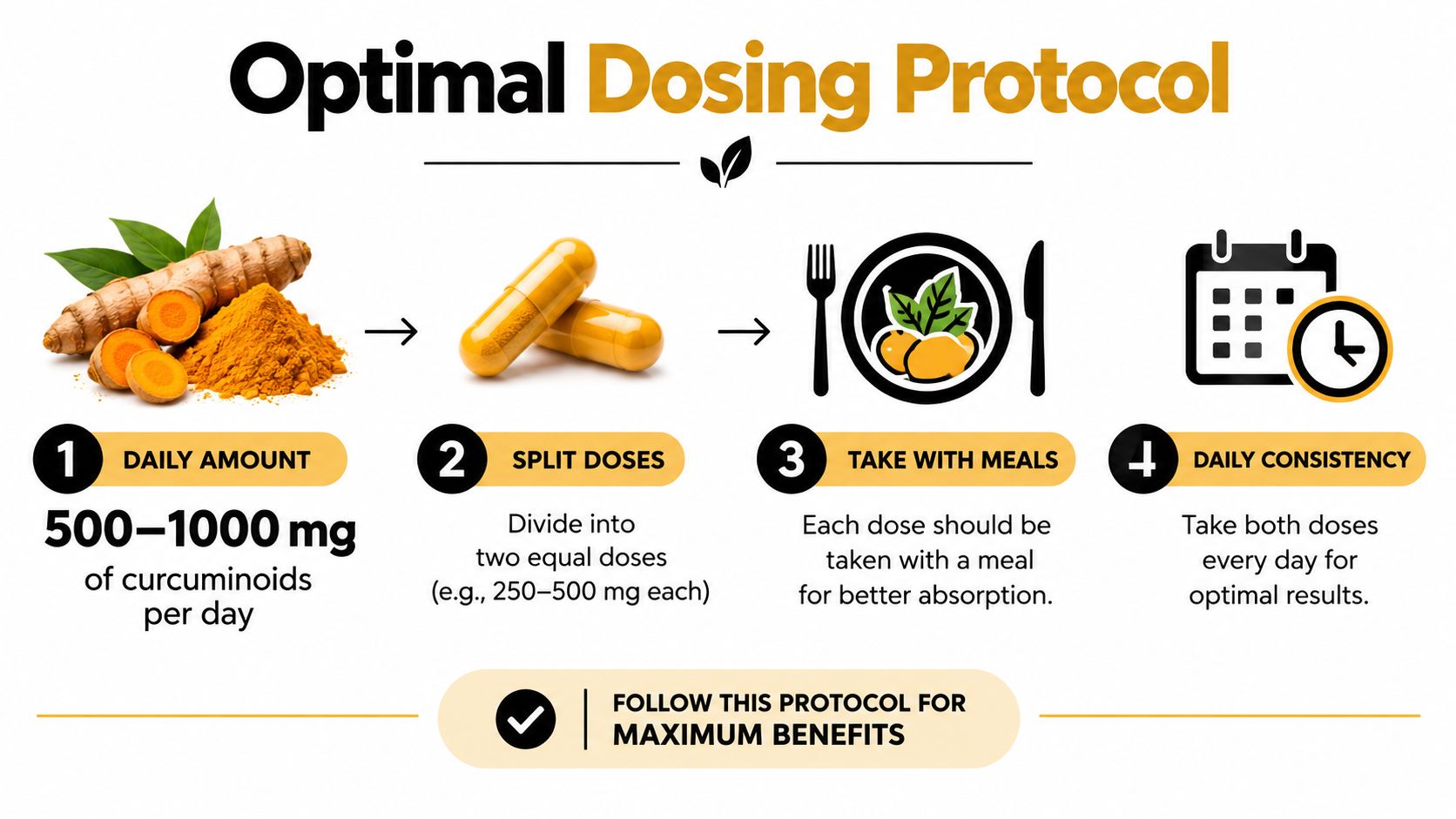
The reason timing matters is exposure. A swallowed capsule on an empty stomach is easy to overlook in the body, while the same formula taken with a meal can act more consistently. That's also why many people judge supplements too early, before the slow buildup in comfort has had time to show itself.
Safety, Contraindications, and Interactions
Turmeric in food is one thing. A highly bioavailable curcumin supplement is another. That distinction matters because the safety profile depends on formulation, dose, and duration, not just the ingredient name.
The National Center for Complementary and Integrative Health notes that conventional oral turmeric or curcumin is likely safe in recommended amounts for only 2 to 3 months, and that common side effects can include nausea, reflux, diarrhea, and constipation. It also advises special caution during pregnancy and when liver symptoms appear. NCCIH turmeric safety guidance
Where caution is most important
Enhanced-bioavailability products deserve extra attention because they can raise circulating curcumin more than plain turmeric. That means their interaction profile can be more relevant for people on medication, especially when the product is paired with piperine or another absorption enhancer. If someone takes prescription drugs, has liver concerns, or is pregnant, the product and dose need a clinician's review.
Turmeric can also be a poor fit for people with active gallbladder disease, bile-duct obstruction, or a history of obstructing kidney stones. In those settings, a supplement that increases bile flow may not be a good idea.
Practical rule: if you already take a blood thinner, a diabetes drug, or you've got surgery coming up, clear the exact product with your clinician first.
For people who want a broader read on combined botanical formulas, the discussion of ginger and turmeric capsules is useful because it shows how multi-ingredient products can change both effect and caution level. That matters more with enhanced extracts than with culinary turmeric.
Common Questions and Smart Next Steps
Should you choose turmeric or curcumin? For cooking, turmeric is enough. For a targeted supplement goal, curcumin or a standardized turmeric extract is the more relevant choice because the active compounds are concentrated and the formulation can be optimized for absorption.
How long should you wait before judging results? For joint comfort, give a stable product 8 to 12 weeks. For stress or sleep, some people notice changes sooner, but the evidence is still smaller and more subjective. If the label doesn't show a clear dose or enhancer, the product is harder to evaluate.
Does cooking with turmeric meaningfully compare with supplements? Not really if the goal is a clinical-style curcumin dose. Food use is still worthwhile, but the amount of curcuminoids in a kitchen serving is far below what most supplement trials use.
A simple decision map helps:
Joint comfort: standardized curcuminoids, taken with food, trial for 8 to 12 weeks.
Stress and sleep: look for a product with a clear dose and good tolerability.
Cognition: keep expectations cautious, since the evidence is still early.
General inflammation support: prioritize bioavailability and transparent labeling.
If you're deciding between ordinary turmeric powder and a supplement, start with your goal, not the bottle front. And if you take medication, or you're unsure how a specific formula fits your situation, talk with a clinician before you start.
River of Life offers a turmeric-based capsule with BioPerine and other botanical ingredients, so it fits into the wider conversation about absorption, label transparency, and everyday use. If you want to compare formulation choices and see how that approach fits your own routine, visit River of Life.