
Best Rated Turmeric Supplement: What to Look For

Most advice about the best rated turmeric supplement is shallow. People chase the highest star count, the biggest milligram number, or a bottle that looks clinical, then wonder why nothing changes. That's the wrong filter. The right question is whether the formula gets curcuminoids into the body, whether it includes ingredients that fit your goal, and whether it's safe for your medication list and health history.
Turmeric is a real category with real market demand, not a fad. A 2026 market report projects the global turmeric supplements market will rise from USD 347.62 million in 2025 to USD 506.09 million by 2031, with North America at 22.28% share in 2025 and Asia-Pacific growing faster than the overall market at 8.38% CAGR (Mordor Intelligence market report). Another industry source estimated the market at USD 1.9 billion in 2024 and projected USD 2.9 billion by 2030 (same market report). That kind of scale tells you one thing clearly, the category is crowded enough to be full of weak products and strong ones.
Table of Contents
Decoding the Best Rated Turmeric Supplement Hype
A high rating doesn't mean a turmeric supplement is effective. It often means the bottle arrived intact, the label looked clean, and the checkout experience was smooth. That's not the same thing as a formula that supports joint comfort or recovery.
What shoppers confuse with quality
The biggest mistake is treating crowd popularity as evidence of performance. A supplement can be well-packaged, easy to swallow, and review-friendly while still being underdosed, poorly absorbed, or padded with marketing language. You'll see the same pattern over and over, vague “advanced” claims, oversized capsule counts, and a back panel that never says enough to judge what's inside.
What matters more is formulation context. Curcumin is the active compound people want from turmeric, but the body doesn't handle it well in plain form. That's why the strongest products usually focus on standardized extracts, absorption support, and transparent dosing instead of just total turmeric powder weight.
Practical rule: if a label leads with star ratings, celebrity language, or “maximum strength” phrasing, treat that as a sales pitch, not evidence.
Why rating-driven roundups mislead buyers
Most “best rated” listicles reward what's easy to compare, not what's biologically useful. A capsule with a bigger number on the front can still underperform a smaller capsule if the smaller one uses a more efficient delivery system. That's especially true in turmeric, where absorption is the bottleneck.
The category is big enough to support premium, formulation-led brands, but that also means a lot of products can coast on generic claims. Don't let the popularity game distract you from the job, finding a supplement that gets curcuminoids where they need to go. For a deeper formulation lens, this curcumin bioavailability guide is a useful technical reference.
The Bioavailability Reality Check
Curcumin's weak spot is absorption. Plain turmeric powder, and even a basic extract, can look convincing on a label while doing very little in the body. Start with delivery, not dose.
Why black pepper changed the market
Black pepper extract, usually called piperine, changed the category because it slows curcumin's breakdown. A recent review notes that black pepper contains piperine, typically 2 to 7 percent by dry weight, and reports that piperine can raise curcuminoid bioavailability by up to 154% (PMC review). A separate pharmacokinetic paper also reports a much larger rise in curcumin exposure with black pepper, and earlier work has shown a meaningful boost when piperine is paired with turmeric.
That sounds impressive because it is. It also explains why piperine-enhanced formulas took over the supplement aisle. If a label includes piperine, the dose should be stated clearly, and the turmeric extract should be standardized. If either point is vague, the product is asking you to guess.
Enhancement Method | Mechanism of Action | Real-World Efficacy |
|---|---|---|
Piperine | Slows metabolism of curcumin and raises exposure | Strong support for many products, but it is only one variable |
Advanced delivery systems | Improves how curcuminoids move through the body | Can outperform standard extract by a wide margin |
Food matrix with lipids | Helps absorption when taken with fats | Useful, especially with a meal |
Why dose alone can mislead you
The biggest milligram count does not always win. One pharmacokinetic study found a colloidal suspension delivered 24-fold higher relative bioavailability than a 1,500 mg standard extract in healthy volunteers, and it produced more plasma curcuminoids at 300 mg than the much higher-dose standard extract (pharmacokinetic study). That is clear proof that formulation can matter more than raw dose.
There is also a practical limit to the pepper story. A pharmacokinetic reappraisal found piperine may not meaningfully improve curcumin bioavailability or systemic uptake in humans, and a 2025 study reported that food matrices with lipids can improve curcuminoid absorption versus capsules (pharmacokinetic reappraisal). So yes, piperine matters. No, it does not get to be the only thing that matters.
If you want a useful technical overview of formulation differences, read this curcumin bioavailability guide.
Take turmeric with food if the label suggests it, and do not mistake a black pepper add-on for proof of a good formula.
Beyond Curcumin The Power of Synergistic Blends
A good turmeric supplement doesn't have to act like a single-ingredient purist. That's old thinking. If your goal is joint comfort plus day-to-day resilience, a multi-ingredient formula can make more sense than curcumin alone, especially when discomfort and stress show up together.
Why blends can make more sense than isolation
Turmeric is the anchor, but it doesn't have to do every job. Ashwagandha is commonly used for stress support, ginger is a familiar comfort ingredient, and bromelain is often chosen for digestive or recovery support. A formula built around several complementary ingredients can target the whole daily picture instead of pretending one compound solves everything.
That matters because real people don't experience discomfort in neat compartments. Joint stiffness can mess with sleep. Poor sleep can make stress feel louder. Stress can make recovery feel slower. A multi-ingredient capsule is useful when it respects that chain instead of selling one-dimensional relief.
Where River of Life fits
One option in this category is River of Life Capsules, which combine standardized turmeric extract with BioPerine, along with ashwagandha root, ginger, and bromelain. That doesn't make it automatically right for everyone, but it does show the difference between a plain turmeric product and a formula built around absorption plus broader daily support. If you want a related ingredient pairing, their ginger and turmeric capsule overview is worth a look.
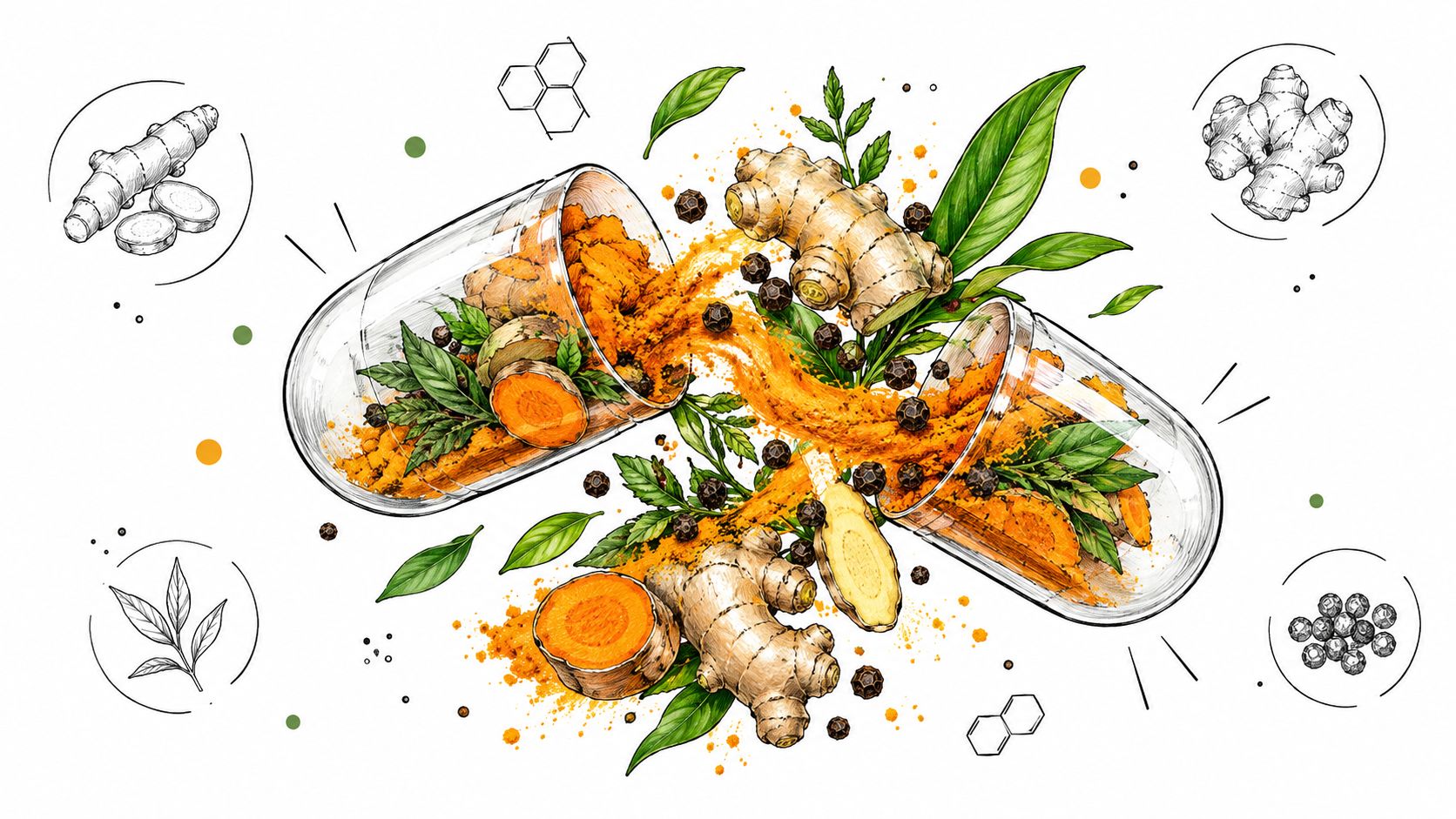
The point isn't that every formula needs every botanical. The point is that the best rated turmeric supplement for a stressed, sore, busy adult is often the one that solves more than one problem at once, without hiding the dosing logic. A capsule that supports absorption, routine comfort, and calmer daily function is more useful than a bottle that only shouts about curcumin content.
Reading Labels and Spotting Red Flags
Most supplement labels try to look precise while staying vague. That's the game. If you know how to read the panel, you can spot the difference between a serious formula and a marketing exercise in seconds.
What to verify first
Start with standardization. If the bottle doesn't tell you whether the turmeric is standardized extract or plain root powder, you're not seeing the full picture. Standardized curcuminoid content matters because raw root weight and active compound delivery are not the same thing.
Then look for piperine disclosure if black pepper is used. A label that says “black pepper blend” without a dose is asking you to trust the front of the bottle instead of the facts on the back. That's lazy formulation, and it's not good enough.
Standardized extract: Look for clear curcuminoid content, not just a large turmeric number.
Explicit absorption support: If piperine is included, the amount should be visible.
Third-party testing: You want evidence of purity screening, not a promise in marketing copy.
Short ingredient list: Fewer unnecessary fillers usually means less hiding.
For a label-by-label breakdown, this supplement facts guide is practical.
Red flags you should not ignore
Proprietary blends are a problem because they hide the actual dose of each ingredient. That makes the formula impossible to judge. “Miracle cure” wording is another warning sign, because a company that overpromises on the front panel usually cuts corners somewhere else.
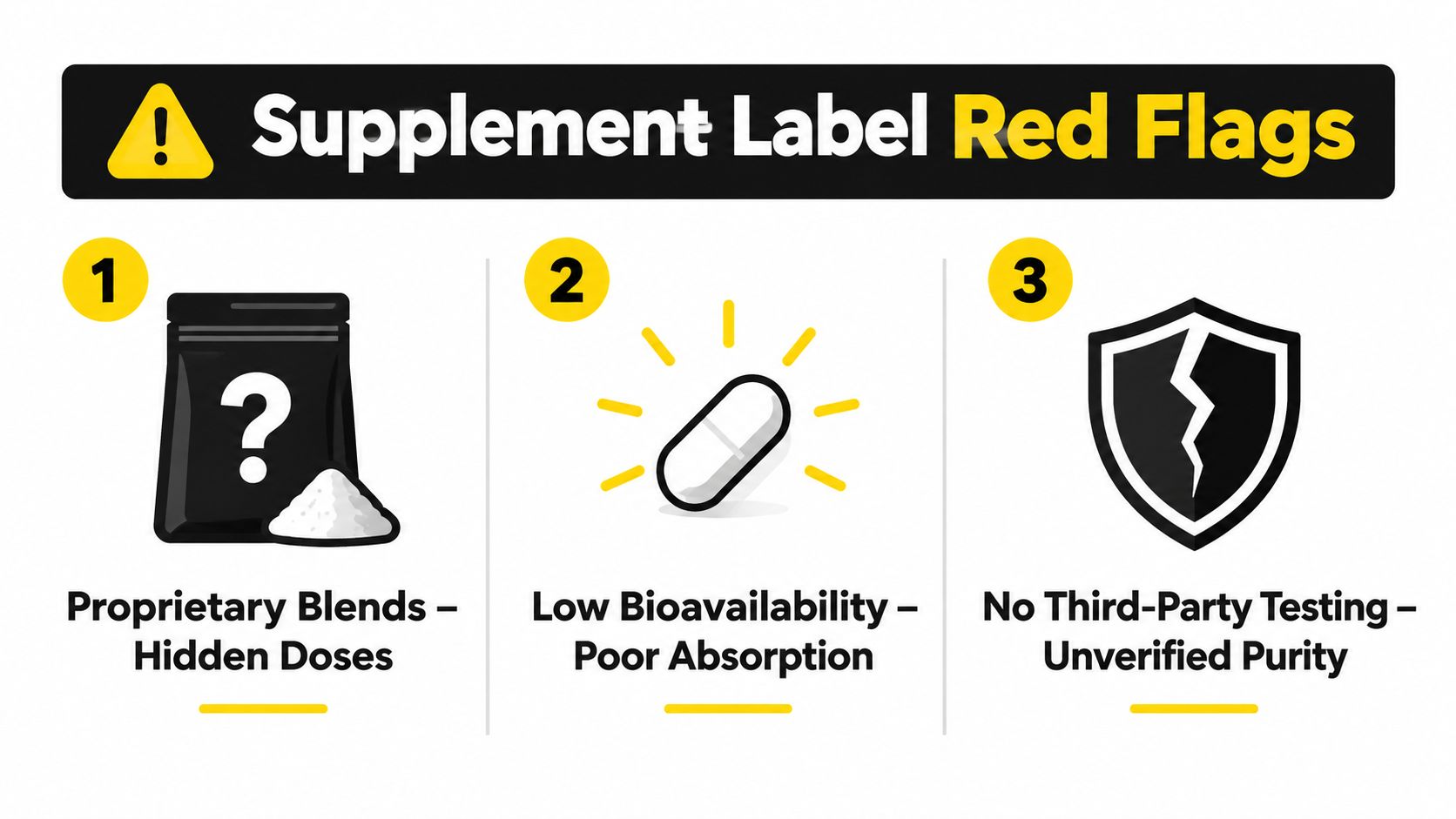
If the label looks polished but won't tell you what matters, pass on it. A strong product makes scrutiny easy.
Safety Screening and Medication Interactions
Safety is the part turmeric marketing skips. High-bioavailability products deserve more caution, not less, because the same design that improves absorption can also make side effects and drug interactions more relevant.
Who needs to slow down
Recent sources have raised concern about rare but potentially serious liver injury reports with enhanced-bioavailability turmeric or curcumin products, and 2026 guidance is increasingly considering liver-problem warnings for turmeric and curcuminoid monographs (ACSH summary of guidance concerns).
The “natural means harmless” mindset is wrong. People with gallbladder disease, kidney stones, or anyone taking blood-thinning or blood sugar-lowering medicines should treat turmeric like an active supplement, not a kitchen spice. If you have a history of liver problems, do not guess your way through it.
Practical rule: if the label promises unusually high absorption, be more cautious, not less.
When to get medical input
Talk to a clinician before starting turmeric if you take multiple medications, have liver concerns, or already manage gallbladder or stone-related issues. Stronger absorption can mean stronger biological effects, and that changes the risk profile fast.
That is why the smartest buyer does not chase the flashiest formula. The best supplement is the one that fits your biology and your medication list. Safety screening comes before everything else.
Evaluating Brand Transparency and Purchasing Models
Where you buy matters almost as much as what you buy. A transparent brand makes its formula, shipping, and return terms easy to understand. A sloppy one hides behind retail noise and generic product pages.
What a trustworthy seller looks like
Direct-to-consumer brands can be better when they explain the formula clearly and keep the buying process simple. River of Life, for example, sells a capsule formula with turmeric, BioPerine, ashwagandha, ginger, and bromelain, and it offers one-time purchase plus 30-day and bi-monthly subscription options, along with a 30-day return policy for unopened bottles and shipping to more than 40 countries. That kind of setup is useful because it makes replenishment predictable and keeps product handling more controlled.
Climate-resistant packaging also matters more than people think. Supplements that travel internationally need protection from heat and transit stress, or the product integrity can suffer before the bottle ever reaches you. Educational resources help too, because a brand that teaches customers usually cares more about long-term trust than quick volume.
How to compare buying models
Third-party marketplaces can be convenient, but they often make it harder to verify freshness, handling, and seller consistency. Direct brands give you more control over the source, while the better ones give you a clearer paper trail on policies and product design. If you're buying turmeric for daily use, that transparency should matter.
Use this simple filter:
Formula clarity before checkout.
Shipping and storage protections before delivery.
Return terms before you commit.
Education and support before you reorder.
A brand doesn't earn trust because it looks polished. It earns trust when it removes confusion.
Your Ultimate Turmeric Buying Checklist
If you're standing in an aisle or comparing tabs online, use this list and ignore the noise.
Standardized curcuminoids: The label should specify what's in the extract, not just “turmeric.”
Bioavailability support: Look for piperine, a delivery system, or a clearly explained food-compatible formula.
Transparent dosing: No proprietary blends, no hidden active amounts.
Synergy that makes sense: Turmeric plus ingredients like ashwagandha, ginger, or bromelain can be useful when the formula is intentional.
Third-party testing: Purity matters as much as potency.
Safety fit: Check medications, gallbladder history, kidney stone risk, and liver concerns before you buy.
If you want the short version, here it is. Don't buy turmeric for the biggest number on the label. Buy it for formulation quality, clear absorption support, and safety compatibility with your body and your meds.
River of Life makes a turmeric-based capsule with BioPerine, ashwagandha, ginger, and bromelain, which puts it squarely in the conversation for people who want absorption support plus broader daily comfort. If you want to compare that kind of formula with your own priorities, visit River of Life and judge the label with the same standards you'd use for any serious supplement.