
Benefits for CoQ10: Evidence-Based Guide

You've probably seen CoQ10 mentioned in three very different places, heart health advice, statin side effect discussions, and “energy” supplement ads. That mix makes it hard to tell whether it's useful for you, or just another capsule with a strong reputation and a fuzzy promise.
The key question isn't whether CoQ10 has benefits in theory. It's who notices them, and under what conditions. If you're older, taking a statin, or dealing with a condition that raises cellular energy demand, the answer may be different from that of a healthy adult looking for a general wellness boost.
Table of Contents
What CoQ10 Actually Is and Why People Take It
A lot of people first hear about CoQ10 when they're already looking for answers. Maybe a pharmacist mentioned it after a statin prescription, maybe a friend takes it for heart support, or maybe a family member swears it helped with tiredness. That's usually the moment the same question shows up: is this something my body needs, or just a popular supplement?
Coenzyme Q10, often shortened to CoQ10, is a compound your body makes on its own and uses in nearly every cell. It matters most in places that burn a lot of energy, which is why the heart comes up so often in CoQ10 discussions. It's also one of the supplement ingredients that has moved from general wellness talk into serious clinical research, especially because its levels can fall with age and certain medications. The Mayo Clinic notes that CoQ10 levels decline with aging and may be reduced by statins, while also pointing out that the strongest evidence is concentrated in migraines, heart failure, and statin-related muscle symptoms Mayo Clinic's CoQ10 overview.
Why it matters more for some people than others
That age and medication pattern is the key decision rule. A younger, healthy adult with no known deficiency is much less likely to feel anything dramatic. Someone older, someone taking a statin, or someone whose body is under higher oxidative stress may have a very different experience.
Practical rule: if your main question is “Will I feel this?”, the answer depends more on your baseline status than on marketing claims.
That's why a good benefits for CoQ10 guide shouldn't treat every possible use as equally compelling. The smarter question is whether you fit one of the groups most likely to benefit, or whether your expectations should stay modest. If you're already thinking in those terms, keep reading. If not, that's the filter this topic needs.
How CoQ10 Works Inside Your Cells
Think of each cell as a small power plant. The mitochondria are the machinery that turns fuel into usable energy, and CoQ10 is one of the pieces that keeps that system moving. Without it, the cell can still have fuel available, but converting that fuel into ATP, the usable energy currency of the body, becomes less efficient.

The energy courier role
CoQ10 sits in the electron transport chain, which is the final stretch of cellular energy production. A simple way to picture it is as a courier moving energy along an assembly line. If the courier is missing or slowed down, the line keeps working, but not as smoothly. That's one reason CoQ10 comes up in fatigue discussions and in conditions where cells are under more strain.
The other part of the story is oxidative stress. CoQ10 is also a fat-soluble antioxidant, so it helps protect cell membranes from damage while energy is being made. That dual role, energy production plus antioxidant defense, explains why the heart, liver, and kidneys are often discussed in connection with CoQ10. Those organs are constantly working and have high energy demand.
The idea isn't that CoQ10 is a stimulant. It doesn't behave like caffeine, and it doesn't force the nervous system to feel more awake. It supports the machinery that makes energy in the first place. That distinction matters because it sets realistic expectations. If you're deficient or your demand is increased, the support may be noticeable over time. If you're already in a good range, the change may be subtle or nonexistent.
For readers who want to understand broader nutrient support alongside CoQ10, this explainer on methyl B-12 and energy support is a useful companion piece.
Why deficiency risk rises with age
Aging can reduce the body's ability to maintain or recycle CoQ10 efficiently, which is why older adults often get more attention in this conversation. Statins can also lower CoQ10 availability by affecting the same biochemical pathway involved in production. That doesn't mean everyone on a statin needs a supplement, but it does explain why this group shows up so often in the evidence.
Clinically Supported Benefits for CoQ10
A useful way to judge CoQ10 is to ask a simple question, who is most likely to notice a difference? The answer is usually not “everyone.” Benefits show up most clearly in people with a specific medical need, a higher likelihood of low CoQ10 status, or a medication that affects CoQ10 biology.
Heart failure has the strongest signal
If you sort CoQ10 claims by evidence strength, heart failure sits at the top. The landmark Q-SYMBIO randomized trial enrolled 420 patients with chronic heart failure and used 100 mg three times daily for 2 years. In that trial, the composite endpoint of cardiovascular death, heart-failure hospitalization, mechanical support, or transplant occurred in 30 people on CoQ10 versus 57 on placebo, which is why this study is often cited as a meaningful clinical signal.
A later clinical summary hosted by NIH also notes that CoQ10 has been associated with lower all-cause mortality, fewer heart-failure hospitalizations, and improvements in NYHA class, BNP, left ventricular ejection fraction, and 6-minute walk distance, without major safety concerns NIH-hosted review. That makes heart failure the clearest case where CoQ10 is more than a general wellness supplement.
The practical takeaway is narrow but important. If someone has heart failure, CoQ10 is one of the few supplements with enough clinical support to discuss seriously with a clinician, especially when standard therapy is already in place.
Statin muscle symptoms are a practical use case
The next most practical use case is statin-associated muscle symptoms. StatPearls reports that 50 mg twice daily reduced mild-to-moderate statin myalgias and improved daily functioning, and that randomized-trial meta-analysis data support 100 to 600 mg/day for lowering statin-associated muscle symptoms StatPearls CoQ10 review. That is the kind of situation where readers usually want a concrete answer, not a vague promise.
The reason this group comes up so often is straightforward. Statins can affect the same production pathway the body uses for CoQ10, so a supplement may be more relevant here than it is for someone with no medication-related depletion risk.
Practical rule: if a statin is causing muscle discomfort, CoQ10 is one of the few supplement options with enough clinical support to discuss seriously with a clinician.
Fatigue reduction is promising, but not universal
Fatigue is another area with real evidence, but it is not the same as a quick burst of energy. A 2022 meta-analysis of randomized trials found CoQ10 significantly reduced fatigue scores versus placebo, with Hedges' g = -0.398, a 95% confidence interval of -0.641 to -0.155, and p = 0.001 Frontiers meta-analysis. That points to a genuine effect, yet it does not mean every tired person will feel better.
Baseline status matters. Someone who is older, under chronic physiologic strain, or more likely to have reduced CoQ10 availability has a better chance of noticing a difference than a healthy adult who already makes and uses CoQ10 normally.
CoQ10 Benefits by Evidence Strength
Benefit | Evidence Strength | Typical Dose | Time to Effect |
|---|---|---|---|
Heart failure support | Strongest | 100 mg three times daily in Q-SYMBIO | Over months, not days |
Statin-associated muscle symptoms | Solid | 100 to 600 mg/day | Usually gradual |
Fatigue reduction | Moderate | Doses vary across trials | Gradual |
Migraine prevention | Moderate | Commonly discussed in clinical summaries | Gradual |
Exercise recovery | Mixed | Varies | Unclear |
Anti-aging claims | Weak | Varies | Unclear |
Where the evidence gets thinner
Migraine prevention, exercise recovery, fertility support, and anti-aging claims are discussed often, but they do not carry the same weight. Some clinical summaries mention potential benefits for migraines, fibromyalgia-related pain, and tiredness, while other popular uses remain less certain Frontiers review. The honest takeaway is simple. CoQ10 has a real evidence base, but its strongest role is narrower than its marketing footprint.
Ubiquinone vs Ubiquinol and Other Formulation Choices
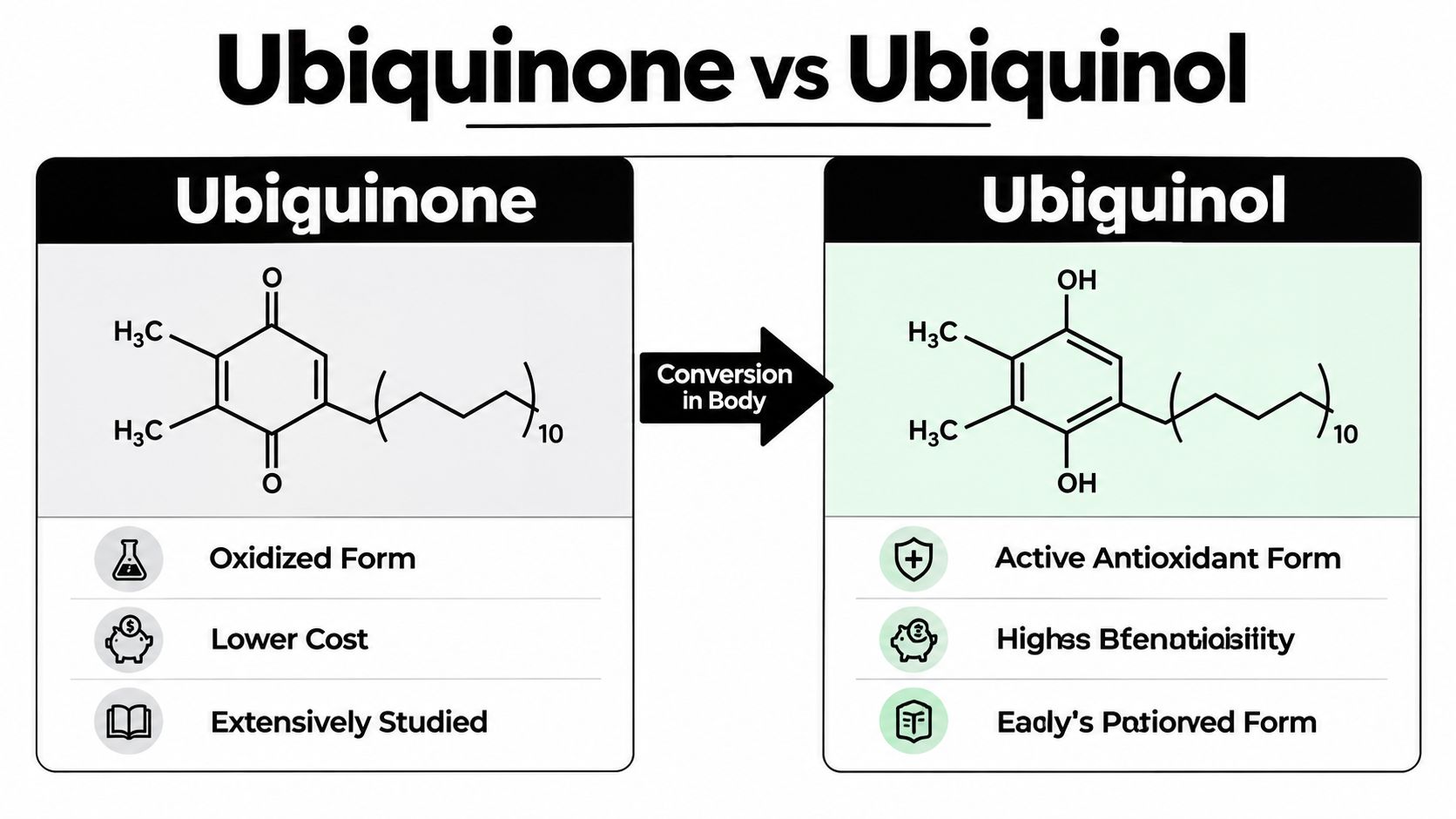
CoQ10 supplements usually come in two forms, ubiquinone and ubiquinol. Ubiquinone is the oxidized form. Ubiquinol is the reduced, active antioxidant form. Your body can convert between them, but that conversion can become less efficient with age, which is part of why older adults often get steered toward ubiquinol.
When the premium form makes sense
If someone is older, taking a statin, or dealing with absorption problems, ubiquinol may be worth the higher price because the body may not have to work as hard to convert it. That said, the cheaper form is still the one with the longer track record in supplement shelves and in many studies. For a healthy adult who just wants to try CoQ10 without overpaying, ubiquinone is often enough.
The label details matter too. Oil-based softgels tend to be easier on absorption than dry capsules, because CoQ10 is fat-soluble. Particle size, emulsification, and the presence of carrier oils can also change how much your body uses. Those details don't make a product magical, but they do separate a thoughtful formulation from a bare-minimum one.
What to read on the label
Form name: Look for ubiquinone or ubiquinol, not just “CoQ10” by itself.
Delivery type: Softgel formulas are often designed with absorption in mind.
Fat-friendly base: Oil-containing formulas usually fit CoQ10's chemistry better.
Clear dosing: You want the actual milligram amount, not a vague proprietary blend.
Choosing without overthinking it
The simplest rule is this. If you're younger, cost-conscious, and trying CoQ10 for a first pass, ubiquinone is a reasonable place to start. If you're older, on a statin, or suspect absorption is a problem, ubiquinol may be the more practical choice. The form matters, but it matters less than taking the supplement consistently with food.
For readers comparing supplement styles more broadly, this article on curcumin with black pepper is a good example of how formulation can change real-world absorption.
Dosage Guidelines and Absorption Strategies
A CoQ10 label can look straightforward, yet the amount on the bottle is only part of the decision. A person who takes it with a meal usually gets more out of it than someone who swallows it on an empty stomach and expects a clear effect right away.

Use case matters more than a single universal dose
The research and clinical summaries cover a wide daily range, with different ranges used for different goals. For statin-associated muscle symptoms, the evidence base commonly places CoQ10 in the 100 to 600 mg/day range StatPearls review. For fatigue, trial results vary, and the overall effect appears modest rather than dramatic. Heart failure studies have also used higher, divided doses in specific settings AHA report.
That is why the right amount depends on the reason someone is taking it. A person looking for general antioxidant support is not automatically in the same dosing lane as someone taking it for a statin-related issue or a heart-related reason. Age and baseline status matter too. Younger adults who are not deficient may notice little, while older adults or people whose levels are already strained may have a clearer reason to try it.
Absorption habits that actually matter
Take it with fat: CoQ10 is fat-soluble, so meals that contain fat usually improve uptake.
Split larger amounts: Divided doses often make more sense than one large dose, because absorption is limited.
Use consistency: The benefits that do show up tend to build gradually, not overnight.
Avoid bedtime if you're sensitive: Some people report insomnia when they take it late.
Practical rule: if you want the best chance of noticing CoQ10, pair it with a meal you would consider satisfying, not a rushed snack.
The main thing to avoid is treating it like a stimulant. It is not coffee, and it will not create a sharp same-day lift. It works over time by supporting the cellular machinery that helps make energy, which is why the experience is often subtle rather than immediate.
For another example of how formulation changes real-world absorption, see curcumin with black pepper.
Who Should Not Expect Results from CoQ10
The biggest mistake people make with CoQ10 is assuming that “good for energy” means everyone should feel something. Healthy younger adults often already make enough of it to meet normal demand, so supplementation may not produce a clear subjective change. If you don't have a deficiency, don't take a statin, and aren't dealing with a condition that raises oxidative stress or energy demand, the benefit can be hard to notice.
The weak spots in the evidence
Exercise performance is the classic overpromised use. Some summaries mention possible support, but the evidence stays inconclusive, which is a long way from proven. Diabetes is another area where results conflict, and general anti-aging claims usually move faster in marketing than in the data Mayo Clinic overview.
That's why a skeptical reader isn't being negative, just careful. CoQ10 isn't a cure-all, and it isn't a shortcut around sleep, nutrition, or medical treatment. It's a targeted tool, not a universal upgrade.
What it won't do
It won't behave like caffeine, and it won't deliver a quick lift the first time you take it. It also won't replace treatment for a real cardiovascular problem or muscle symptoms that need medical attention. If your expectation is an immediate buzz, you're shopping for the wrong mechanism.
Bottom line: CoQ10 is most convincing when baseline demand is high or baseline levels are lower than ideal.
That makes the decision rule pretty simple. If you fit one of the higher-likelihood groups, CoQ10 may be worth a thoughtful trial. If you don't, the money may be better spent elsewhere.
Safety Profile and Drug Interactions to Know
If you are weighing CoQ10 against a long medication list, safety is usually the first question to answer. CoQ10 has a good general safety record, which is part of why it remains widely used. Most side effects are mild. Digestive upset and appetite changes can happen, and some people notice insomnia if they take it too late in the day.
The interactions that deserve respect
The bigger issue is medication interaction. CoQ10 may reduce the effect of warfarin and other blood thinners, because its structure is similar to vitamin K. It can also add to the blood-pressure lowering effect of antihypertensive drugs, so people already managing low or variable blood pressure should be cautious. For chemotherapy, the concern is more theoretical, but antioxidant supplements should still be discussed with the oncology team before use.
The safest move is simple. If you take prescription medication regularly, ask a clinician or pharmacist before starting CoQ10. That matters even more if you already take several drugs and are not sure how they may overlap.
What to look for in a brand
Third-party testing: Look for evidence the product was independently checked.
GMP certification: Good manufacturing practice matters for consistency.
Transparent labeling: The bottle should state the form and the milligram amount clearly.
For readers who also manage other botanicals or adaptogens, the interaction logic discussed in ashwagandha interactions is a useful reminder that “natural” does not mean interaction-free.