

Clean Label Supplements: What They Really Mean for You

You're standing in the supplement aisle with two nearly identical bottles in your hands. One says “clean label” in large letters. The other makes no such promise, but its Supplement Facts panel looks just as simple. The clean-label bottle costs more, and you're left wondering whether you're paying for better ingredients or just a better front label.
That uncertainty is reasonable. Clean label supplements can reflect thoughtful sourcing, transparent dosing, and a restrained excipient list. They can also use a fashionable phrase without giving you enough information to verify what makes the formula different. This guide will help you tell those situations apart.
Table of Contents
What You Will Get From This Guide
The phrase clean label sounds clear until you turn the bottle around. It might refer to recognizable ingredients, plant-based capsules, no artificial colors, fewer processing aids, or a brand's preferred way of describing its formula. Because the term has no universal threshold, you need a method that looks beyond the marketing panel.
You'll learn how to:
Define the claim: Understand what shoppers usually expect from clean label supplements and what the phrase does, and doesn't, legally verify.
Read the details: Compare serving size, individual ingredient doses, capsule materials, carriers, binders, and other excipients.
Spot weak signals: Recognize vague language, hidden proprietary blends, unexplained “natural” ingredients, and claims that sound stronger than the evidence behind them.
Check quality evidence: Know what to ask about lot numbers, Certificates of Analysis, manufacturing controls, and third-party certification.
Judge performance fairly: Separate a shorter ingredient list from a better-performing formula, especially when absorption or stability depends on a purposeful excipient.
A clean label isn't automatically an effective label, and a longer label isn't automatically a poor one. Some ingredients that look unfamiliar support capsule filling, flow, stability, or absorption. The useful question is whether the manufacturer tells you what each ingredient is doing and gives you enough information to assess the finished product.
For a broader look at how to judge evidence behind supplements, you can also read supplements backed by science. By the end, you'll have a practical five-minute shelf audit and a worked curcumin-piperine example that shows why formulation choices can matter more than the word “clean.”
What Clean Label Really Means in Supplements
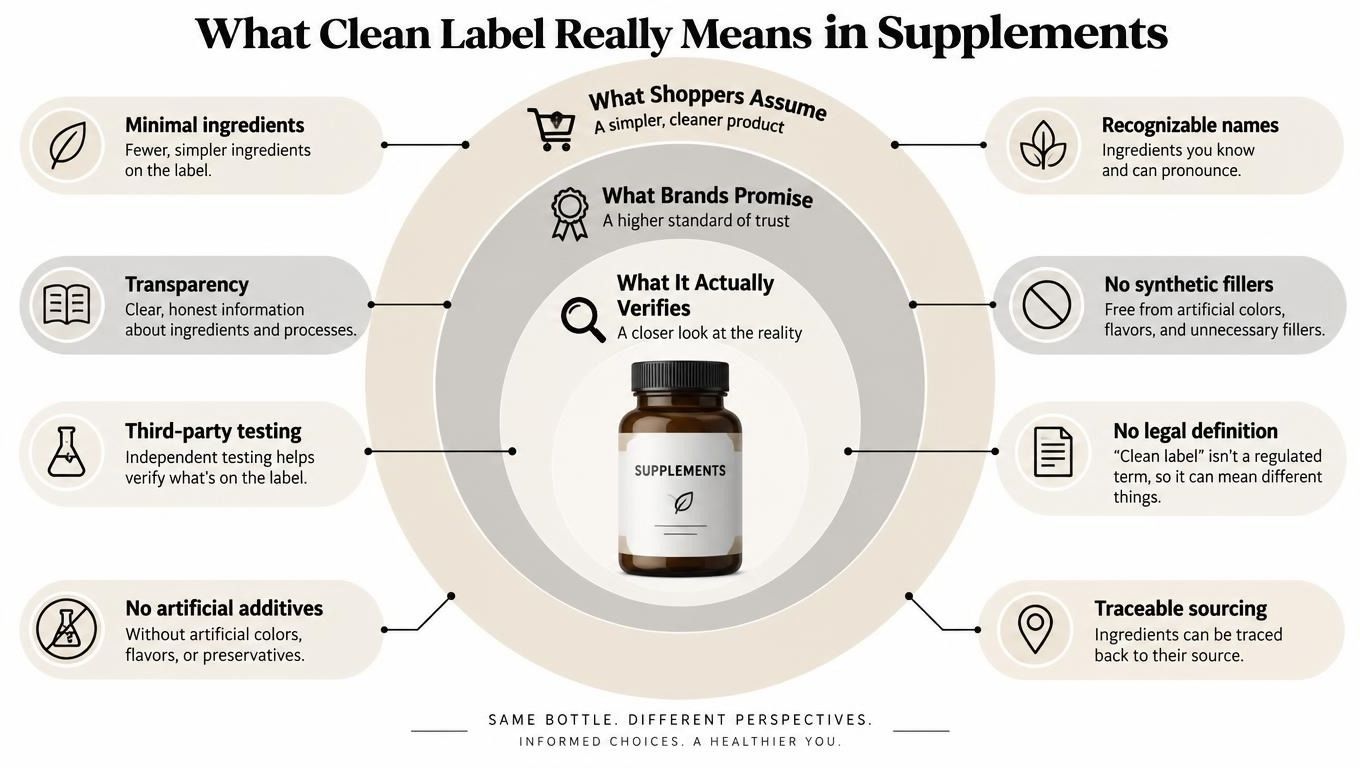
Start with the shopper's interpretation. Shoppers expect a clean-label supplement to have a short ingredient list, familiar names, fewer artificial colors and flavors, and no unnecessary additives. They may also associate the phrase with vegan capsules, recognizable plant ingredients, responsible sourcing, and a product that explains itself without requiring a chemistry degree.
Those expectations are useful, but they aren't a complete definition. In technical terms, clean label is better understood as a transparency and formulation philosophy. It asks whether the brand discloses the active ingredients, their amounts, capsule materials, carriers, flow agents, allergens, and other excipients clearly enough for a buyer to make an informed choice.
Three layers of the claim
The first layer is what shoppers assume. A person sees “clean” and expects fewer ingredients and less artificial processing. The second is what brands promise, which may include traceable sourcing, plant-based capsules, or the removal of synthetic colors and flavors.
The third layer is what the label lets you verify. A credible product should make it possible to inspect:
Active ingredients: Each meaningful ingredient appears separately, with its amount per serving.
Capsule material: The shell is identified as gelatin, HPMC, pullulan, or another material rather than being described only as “capsule.”
Excipients: Carriers, binders, flow agents, and processing aids are named rather than hidden behind broad wording.
Testing: The brand explains how it checks identity, potency, contaminants, and batch quality.
Clean label is not the same as organic, non-GMO, or natural. Those terms address narrower attributes and may require specific documentation or certification, depending on the claim and market. Clean label is broader and more process-oriented, but it isn't a universal legal standard. Independent guidance on clean-label supplements notes that brands can use the phrase without meeting one shared threshold.
A practical working definition is simple: a clean-label supplement uses a transparent ingredient statement, minimizes unnecessary excipients, and explains purposeful formulation choices. That definition is more useful than judging a bottle by its front-panel language alone.
Why Shoppers Are Demanding Cleaner Labels
A shopper comparing two supplement bottles may see similar benefit claims, then notice that only one explains where its ingredients come from. That small difference can influence the purchase. Ingredient transparency has moved beyond specialist circles and become a mainstream consideration.
In a Lonza and Natural Marketing Institute survey of 3,000 U.S. consumers, 80% of dietary supplement shoppers said ingredient source matters when they buy, compared with 71% in 2013. The same survey found that 77% look for products from natural sources, up from 66% in 2013. The survey findings are reported by Nutraceutical Business Review.
These figures point to two related questions at the shelf: where did the ingredient come from, and what else was added to make the product? A shopper may prefer a recognizable plant source, yet still need to check the full ingredient panel for carriers, colors, or other formulation details. The front label starts the conversation. The ingredient list supplies the evidence.
The survey also found that 43% of millennials preferred supplements derived from natural sources, compared with about one-third of older supplement users. Younger shoppers may therefore pay closer attention to origin and formulation, while the broader findings show that this interest extends across age groups.
Distinct survey detail | Practical interpretation |
|---|---|
43% of millennials preferred supplements derived from natural sources | Origin and recognizable ingredients may carry extra weight when younger shoppers compare products |
Retailers are responding with more shelf space for products built around simpler positioning, visible certifications, and clearer sourcing stories. Those signals can make comparison easier, but they do not establish that a reformulated supplement works better. A product can remove a color or use a plant-based capsule while delivering the same active ingredient, dose, and intended function.
The useful question is whether the label gives you enough information to judge the formula without contacting the manufacturer. Look for a clear explanation of the active ingredients, the product's source claims, and the purpose of less familiar components. Marketing language may attract attention, while these details help you decide.
Practical rule: Treat clean label as a request for evidence, not as evidence by itself.
The Regulatory Gap and Why It Matters to You
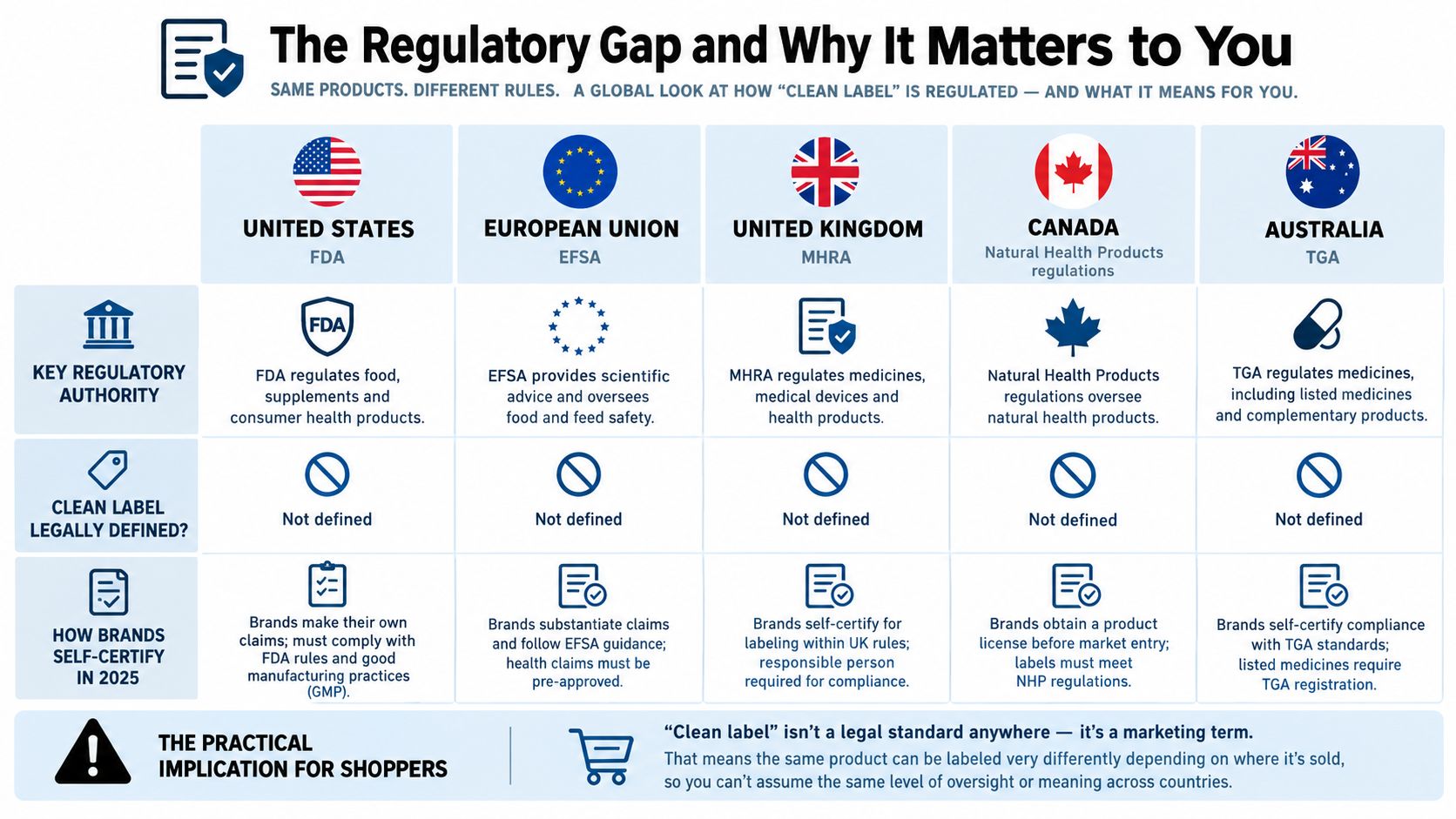
The central problem is straightforward: clean label isn't a legally standardized term in supplements. A brand may use it to describe minimal excipients, plant-based capsules, natural colors, transparent sourcing, or a general marketing philosophy. Another brand may use the same phrase while providing little detail about what makes its product different.
That gap matters because some label fields are concrete and inspectable, while others depend on trust. You can usually examine the ingredient statement, serving size, allergen declaration, capsule material, lot number, expiry information, and the form of each active ingredient. You can't confirm a claim such as “pure,” “premium,” or “clean” because it appears in large type.
What regulation can and can't tell you
Regulatory systems still matter. They can govern ingredient use, permitted claims, manufacturing practices, safety documentation, and required label information. The practical point for shoppers is that compliance with those rules doesn't automatically create a universal definition of “clean.”
The European supplement market illustrates why formulation transparency deserves attention. Industry reporting describes a 2025 revision of the European Union Supplement Directive that tightened permitted-ingredient rules, increasing the importance of ingredient disclosure and market-access review for products that rely on synthetic excipients. The same nutritional supplements market reporting places the global market at USD 178.00 billion in 2025, with a projection of USD 261.19 billion by 2031. Those figures describe market scale, not proof that any individual clean-label product works better.
Ask a manufacturer specific questions instead of asking whether the product is clean:
What is the capsule shell made from?
Why is each excipient included?
Are the active ingredients listed separately with their amounts?
Can you provide batch-specific testing for identity and contaminants?
Does the natural or plant-based claim apply to every ingredient, including carriers and colors?
A vague claim becomes useful only when the company translates it into verifiable formulation details.
How to Audit a Supplement Label in Five Minutes
You don't need to memorize every chemical name. You need a repeatable sequence that separates the promise on the front from the information on the back.

Start with the front, then turn the bottle around
Step one, scan the headline. Words such as “natural,” “pure,” “whole food,” and “clean” describe positioning, not necessarily a verified formulation. Note the promise, then ignore it temporarily.
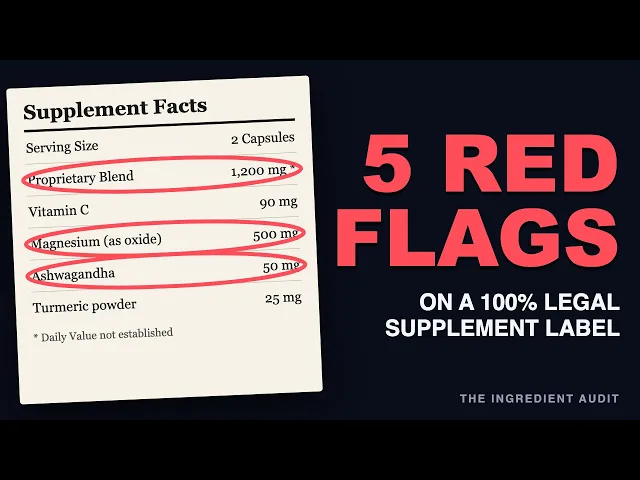
Step two, read the Supplement Facts panel. Look for each active ingredient, its form, and its amount per serving. A product can list many attractive ingredients but provide only token amounts. If it uses a proprietary blend, you may know the combined weight without knowing how much of each ingredient you'll receive.
Step three, check the serving size. A serving may require several capsules, even if the front panel makes the product sound like a one-capsule routine. Compare the labeled serving with the amount you would realistically take. The relevant question is not “How many ingredients are listed?” but “How much of each ingredient is supplied at the stated serving?”
Step four, inspect the other ingredients. Look for capsule material, fillers, binders, flow agents, colors, oils, and coatings. Ingredients such as magnesium stearate, silicon dioxide, titanium dioxide, artificial colors, hydrogenated oils, and shellac aren't automatically disqualifying in every context, but you should know why they're present and whether the brand discloses their source.
Step five, look for quality verification. Find the lot number and expiry date. Then check whether the brand explains its testing process or provides a batch-specific Certificate of Analysis. A logo alone isn't enough if you can't identify what the certification covers.
For a visual explanation of the Supplement Facts panel, use this guide to reading supplement facts. The routine should leave you with three answers: what am I taking, how much am I taking, and what else is in the capsule?
The video below offers another way to reinforce the label-reading process.
Comparing Two Label Philosophies on the Shelf
Consider two multivitamins with the same headline purpose. The first uses a long excipient list, groups several ingredients into proprietary blends, and gives limited information about carriers. The second lists individual doses, identifies its capsule material, and uses a shorter group of disclosed excipients.
Neither label wins automatically. The first may contain well-established vitamin forms and manufacturing aids that support consistent production. The second may be easier to audit, but a short list alone doesn't prove that the doses are meaningful or that the formula remains stable throughout its shelf life.
Label element | Conventional formula | Clean-label formula |
|---|---|---|
Active ingredient disclosure | May use proprietary blends or grouped ingredients | Lists individual ingredients and amounts |
Capsule material | May identify the shell generally or use gelatin | Clearly identifies plant-based material such as HPMC or pullulan when applicable |
Flow agents | May include a conventional processing aid | May use a disclosed plant-based or food-derived alternative |
Color | May use an artificial color for appearance | May avoid color or identify a recognizable color source |
Fillers and carriers | May use several excipients for manufacturing convenience | Uses fewer excipients where practical and explains their purpose |
Dosing clarity | Requires careful interpretation of serving size | Makes serving size and per-ingredient amounts easier to compare |
Auditability | The shopper may need to ask follow-up questions | The label answers more questions directly |
The important distinction is disclosure versus absence. A carrier isn't automatically a problem, and a product with no obvious filler may still be underdosed or poorly tested. A transparent conventional formula can be a more informed choice than an opaque product that uses the word “clean.”
Buying Tips, Red Flags, and Certifications Worth Trusting
Use a simple shopping routine. First, compare the active dose and serving size. Next, read the full other-ingredients statement. Finally, check whether the manufacturer connects its claims to testing, certification, or documentation you can inspect.
Red flags that deserve a pause
Hidden doses: Proprietary blends prevent you from judging the amount of each component.
Unclear adjectives: “Pure,” “natural,” and “clean” need supporting details.
Unspecified sources: Ask where magnesium stearate, colors, carriers, and capsule materials come from.
Whole-food overreach: A “whole-food” label doesn't explain whether synthetic vitamins or processing aids are also present.
Missing batch information: A product without a visible lot number or expiry date is harder to verify.
Marketplace inconsistency: Compare an online marketplace listing with the brand's official label, because product descriptions can be incomplete or outdated.
Third-party marks at a glance
Certification | What it verifies | Best for clean-label shoppers |
|---|---|---|
USP | Look for the specific scope of the USP mark and its quality requirements | Shoppers prioritizing documented product quality |
NSF | Check whether the mark applies to the product and what testing or facility review it covers | Buyers seeking an external quality check |
ConsumerLab | Review the product-specific test information and limitations | Shoppers comparing independent testing results |
Vegan Society trademark | Supports an animal-free claim within the trademark's stated requirements | People checking whether the complete product aligns with vegan preferences |
Treat certification logos as questions to investigate, not instant proof of every benefit you care about. A mark may address identity, potency, contaminants, manufacturing controls, or animal-free status, but those categories aren't interchangeable. If the brand won't explain the scope, contact the certifier or choose a product with clearer documentation.
A higher price can reflect better raw-material specifications, testing, or a more carefully controlled supply chain. It can also reflect packaging and positioning. Pay more only when the label, documentation, and formulation rationale give you something concrete in return.
River of Life Health offers a reference example in this context, with a vegan capsule formula that uses transparent dosing, vegan certification, and GMP-compliant manufacturing. Its relevance here is the formulation information a shopper can examine, not a claim that clean labeling guarantees a particular result.
Do Cleaner Formulas Actually Work Better
Removing an unnecessary color or reducing a filler can make a formula easier to understand. It doesn't automatically improve the biological effect of the active ingredient. Clean label is a formulation choice, not an efficacy score.
The more useful question is whether an excipient or companion ingredient changes delivery. Turmeric provides a clear example. Oral curcumin is poorly absorbed and rapidly metabolized, so a formula may need an absorption strategy rather than a shorter ingredient list.

The curcumin and piperine example
Peer-reviewed evidence reports that piperine can inhibit glucuronidation and extend curcumin's half-life from 2.2 ± 0.79 hours to 4.5 ± 0.80 hours. Review literature also reports up to a 2000% relative bioavailability increase when curcumin is combined with BioPerine. The peer-reviewed evidence on curcumin and piperine shows why the pairing is a formulation decision, not decorative label language.
That example changes how you audit the bottle. If a brand removes every unfamiliar ingredient but also omits a purposeful absorption aid, the formula may look cleaner while offering a less considered delivery system. Conversely, a product that includes piperine should explain the ingredient and disclose its amount or standardized form clearly enough for you to assess it.
Other excipients can serve real technical functions. Surfactants and solubilizers may help disperse poorly soluble compounds, while naturally derived alternatives such as sunflower lecithin may support a different formulation approach. Removing one ingredient can affect absorption, blend uniformity, capsule fill, or shelf stability, so “fewer” isn't a sufficient design brief.
Cleaner doesn't mean emptier. It means every ingredient has a visible purpose.
There's also a genuine trade-off. Some people may prefer established synthetic nutrient forms because their dosing and behavior are predictable for a particular nutritional need. Someone managing iron deficiency or B12 malabsorption shouldn't choose a product solely because its ingredients sound natural. A clinician can help match the nutrient form and dose to the person's circumstances.
A useful Clean Evidence Statement would explain the active dose, the role of each meaningful excipient, the reason for an absorption aid, and the testing used to confirm quality. That kind of document turns a marketing philosophy into an auditable formulation record.
If you want to explore this topic further, this guide to supplement bioavailability provides useful context for why ingredient delivery matters.
River of Life offers vegan capsules built around turmeric extract with BioPerine black pepper, alongside ashwagandha, ginger, and bromelain, with one-time and subscription purchase options. Visit River of Life to review the ingredient information and decide whether its transparent, absorption-focused approach fits your supplement checklist.