
Turmeric vs Ashwagandha for Inflammation: A Practical Guide

A 2024 review identified 54 meta-analyses of randomized controlled trials on curcumin and inflammation, with repeated reductions in markers including C-reactive protein, interleukin-6, tumor necrosis factor-α, and malondialdehyde across those reviews (Nutrients review of curcumin and inflammation). That gives turmeric a level of inflammation-specific evidence ashwagandha hasn't yet matched.
The practical conclusion behind turmeric vs ashwagandha for inflammation isn't that one herb wins every comparison. Turmeric is better established for joint-focused and measurable inflammatory load, while ashwagandha has a more indirect, stress-linked role. The right choice depends less on which bottle makes the stronger promise and more on where inflammation enters your physiology.
Table of Contents
Why People Compare Turmeric and Ashwagandha for Inflammation
You're standing in front of two supplement bottles. One says turmeric or curcumin, perhaps with black pepper. The other says ashwagandha, perhaps naming a branded extract such as KSM-66. Both appear in anti-inflammatory roundups, both are popular in wellness circles, and both are often presented as interchangeable solutions for pain, recovery, stress, and general inflammation.
That comparison creates a real problem. Inflammation isn't one single condition or pathway. The biology involved in a stiff, overloaded knee isn't identical to the biology associated with prolonged stress, poor sleep, or sustained fatigue. A supplement that acts closer to inflammatory signaling may therefore fit one situation better than an herb that primarily influences the stress response.
Start with the pathway, not the marketing label
Turmeric's active research focus is curcumin and related curcuminoids. Researchers have studied these compounds directly in inflammatory outcomes, especially joint-related conditions and biomarkers. Ashwagandha's inflammation literature is smaller and more closely connected to cortisol, stress physiology, and immune-cell activity.
That difference doesn't make ashwagandha irrelevant. It changes the question. Instead of asking which herb is universally stronger, ask:
Is the main issue joint or tissue load? Turmeric has the clearer direct evidence.
Is inflammation occurring alongside chronic stress, poor sleep, or exhaustion? Ashwagandha is a more plausible pathway match, although its direct inflammation evidence remains thinner.
Are both patterns present? A carefully selected combination may make more sense than forcing an either-or decision.
Practical rule: Match turmeric to the inflammatory burden you want to measure or manage, and match ashwagandha to the stress response that may be helping sustain that burden.
This article treats the comparison as a decision problem. It separates joint-centered inflammation, broader inflammatory markers, exercise-related discomfort, and stress-coupled inflammation, while keeping an important boundary in view: neither herb should replace diagnosis or treatment for persistent swelling, unexplained pain, or a known inflammatory disease.
The Evidence Base for Each Herb at a Glance
The useful detail lies in the biomarker pattern, not only in the number of reviews. The 2024 Nutrients review of curcumin and inflammation found that curcumin lowered C-reactive protein in 7 of 10 meta-analyses, interleukin-6 in 5 of 8, tumor necrosis factor-α in 6 of 9, and malondialdehyde in 5 of 6. The signal therefore spans inflammatory and oxidative-stress markers, although results varied across outcomes and formulations.
These findings support turmeric as the more established option for direct inflammation support. They do not mean that every turmeric product will produce the same result, especially because curcumin preparations differ in absorption and composition. The evidence is strongest as a category-level signal, not as a guarantee for one supplement or one person.
Ashwagandha has a smaller and more indirect evidence base. A ClinicalTrials.gov pilot study on ashwagandha, stress, inflammation, and immune-cell activation measured inflammatory cytokines and cortisol at 24 hours and again after 5 days. That design places ashwagandha within research on stress biology, immune-cell activation, and inflammatory signaling rather than treating it as a direct substitute for an anti-inflammatory drug.
Reviews of the available ashwagandha literature describe laboratory, animal, and clinical research. A randomized trial reported lower morning cortisol and dehydroepiandrosterone after an ashwagandha extract intervention. Those findings make ashwagandha relevant when stress physiology is part of the picture, while leaving its joint-specific evidence thinner than curcumin's.
Metric | Turmeric / Curcumin | Ashwagandha |
|---|---|---|
Research volume | Multiple meta-analyses of randomized trials | Smaller, emerging literature |
Main evidence pattern | Inflammatory biomarkers and joint-related outcomes | Stress, cortisol, immune activation, and inflammatory biomarkers |
Practical fit | Joint-centered inflammation and broader inflammatory load | Stress-linked inflammation and stress physiology |
Main limitation | Formulations vary, and native curcumin absorbs poorly | Evidence is more indirect and less joint-specific |
The decision is pathway-based. Turmeric has the larger and more direct inflammation record, making it the clearer fit for joint symptoms or a measurable inflammatory burden. Ashwagandha has a developing record that fits stress-coupled inflammation, particularly when sustained stress, poor recovery, or disrupted sleep accompanies the concern. When both patterns are present, a carefully selected blended strategy may be more rational than treating the choice as strictly either-or.
How Turmeric and Ashwagandha Work in the Body
Turmeric and ashwagandha are not two versions of the same intervention. Their research profiles suggest that they influence different points in the inflammation process.
Curcumin is discussed as acting closer to inflammatory signaling itself. It has been investigated in relation to inflammatory cytokines, oxidative stress, and inflammatory outcomes in joints and other tissues. That helps explain why turmeric repeatedly appears in studies involving osteoarthritis, systemic inflammatory markers, and physical recovery.
Ashwagandha is better understood as a stress-axis modulator. Its withanolides have been studied in relation to cortisol and the body's response to stress, with inflammatory changes appearing as a secondary part of that shift. This distinction matters for someone whose symptoms flare during periods of poor sleep, emotional strain, or sustained workload.
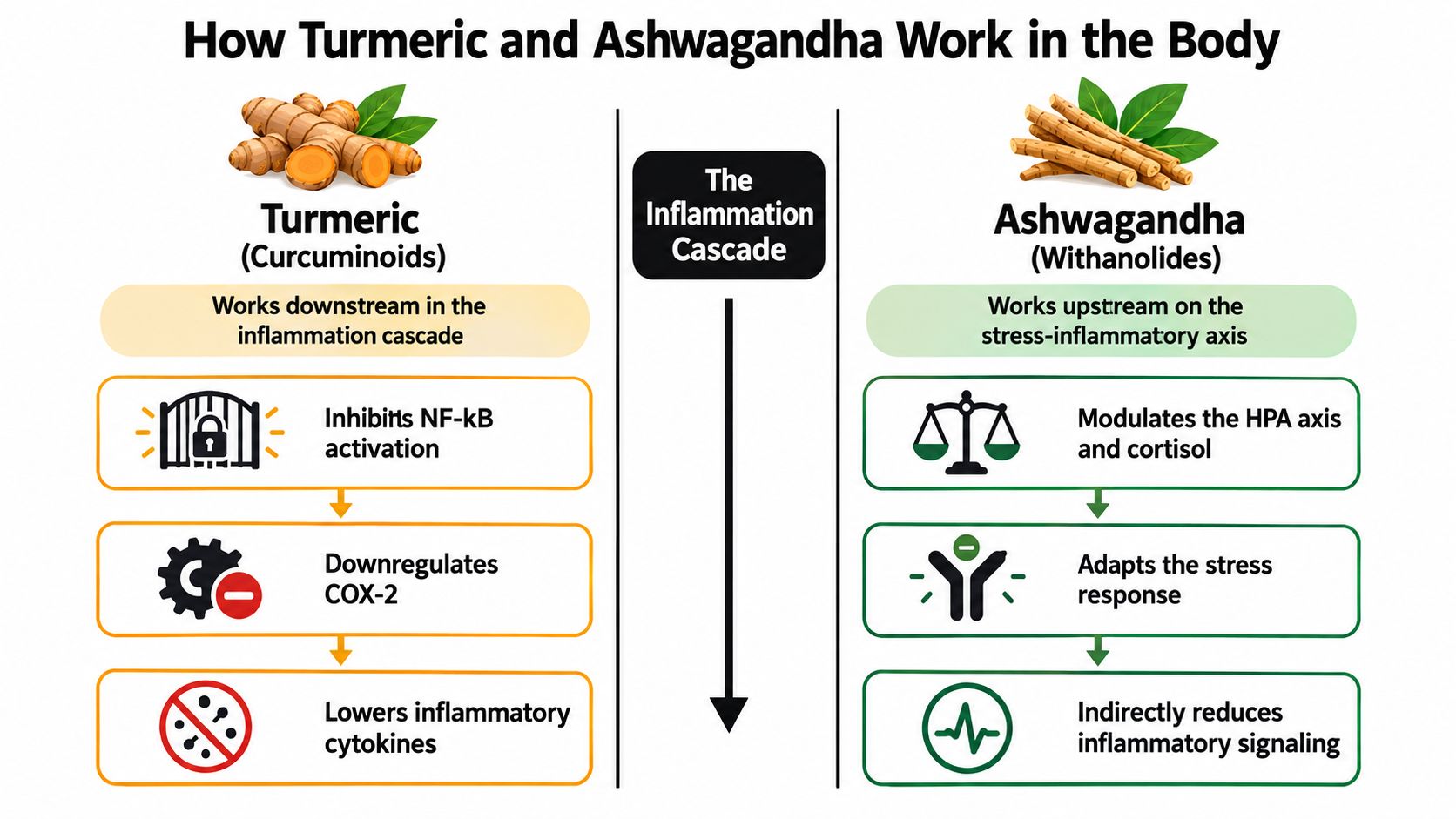
Two different intervention points
Turmeric, downstream emphasis
Curcuminoids are studied for their relationship with inflammatory signaling and oxidative stress.
Human research has examined changes in markers such as C-reactive protein, interleukin-6, and tumor necrosis factor-α.
The clearest application is a measurable inflammatory burden, especially when joint discomfort is part of the picture.
Ashwagandha, upstream emphasis
Withanolides are studied in the context of cortisol and stress-response regulation.
Changes in inflammatory markers may follow improvements in stress-related physiology rather than direct suppression of a joint inflammatory process.
The more plausible application is inflammation that travels with chronic stress, poor sleep, or fatigue.
This distinction also explains why combining them can be rational. Turmeric addresses the inflammatory signal more directly, while ashwagandha may address a condition that helps keep that signal active. Combination use still requires attention to tolerability, medication interactions, and the fact that evidence for the pairing itself is not the same as evidence for each herb separately.
What the Research Shows for Real Conditions
The strongest condition-specific case for turmeric is joint-centered inflammation, particularly osteoarthritis. Reviews from 2024 and 2025 continue to describe curcumin as having clearer clinical evidence for osteoarthritis and inflammatory markers, while ashwagandha remains less joint-specific (review of anti-inflammatory Ayurvedic medicines).
That doesn't mean turmeric has equally strong evidence for every painful or inflamed condition. Results can vary by extract, formulation, dose, study population, and outcome measure. Exercise-related soreness is a more mixed area, and a supplement should not be judged only by whether it changes a laboratory marker. The reader still needs to ask whether pain, mobility, stiffness, or recovery improves.
Ashwagandha fits a different human evidence pattern. Studies and reviews have reported reductions in markers such as hs-CRP, interleukin-6, and tumor necrosis factor-α, with the most coherent explanation involving stress-endocrine modulation. A review of ashwagandha's inflammation research also describes a foundational study in chronically stressed adults in which C-reactive protein fell by over 30% (review of ashwagandha and inflammation).
Condition | Turmeric / Curcumin | Ashwagandha | Evidence strength |
|---|---|---|---|
Osteoarthritis and joint stiffness | More direct clinical support for inflammatory markers and joint-related outcomes | Less joint-specific evidence | Stronger for turmeric |
Rheumatoid or systemic inflammatory conditions | Studied, but results depend on the condition and formulation | Not a direct substitute for disease-focused care | Turmeric has the clearer supplement evidence |
Exercise-related soreness | Some human research, but outcomes are mixed | Less direct evidence for acute post-exercise inflammation | Turmeric is the more plausible first option |
Stress-coupled inflammation | May help inflammatory load, subject to absorption and formulation | Better pathway fit when stress and poor sleep are prominent | Ashwagandha is more relevant, but evidence is thinner |
Joint symptoms plus chronic stress | Can address the joint-centered side of the pattern | Can address the stress-related side | A cautious combination may be reasonable |
For readers focused on joint comfort, the practical background on how turmeric curcumin may support arthritis and joint pain can help translate the research into a more specific use case. The candid verdict is straightforward: choose turmeric first for joint-centered inflammatory concerns, and consider ashwagandha when stress physiology is a central part of the problem.
Dosing, Bioavailability, and Formulation Choices
A turmeric label can be misleading if it lists only the weight of turmeric root powder. The clinically relevant question is how much standardized curcuminoid material the product provides and whether the formulation helps the body absorb it.
Independent reviews describe native oral curcumin as poorly absorbed, rapidly metabolized, and low in systemic bioavailability. The same evidence summary reports that piperine can increase curcumin plasma exposure by about 2,000% by inhibiting glucuronidation and intestinal efflux (review of curcumin pharmacokinetics and clinical studies).
Clinical studies summarized across 20 randomized controlled trials commonly used curcumin in the range of 500 to 1,500 mg per day, with piperine at 5 to 15 mg per day, over 1 to 12 weeks. Those figures describe study patterns, not a universal personal prescription. They also show why comparing products by capsule count alone is inadequate.
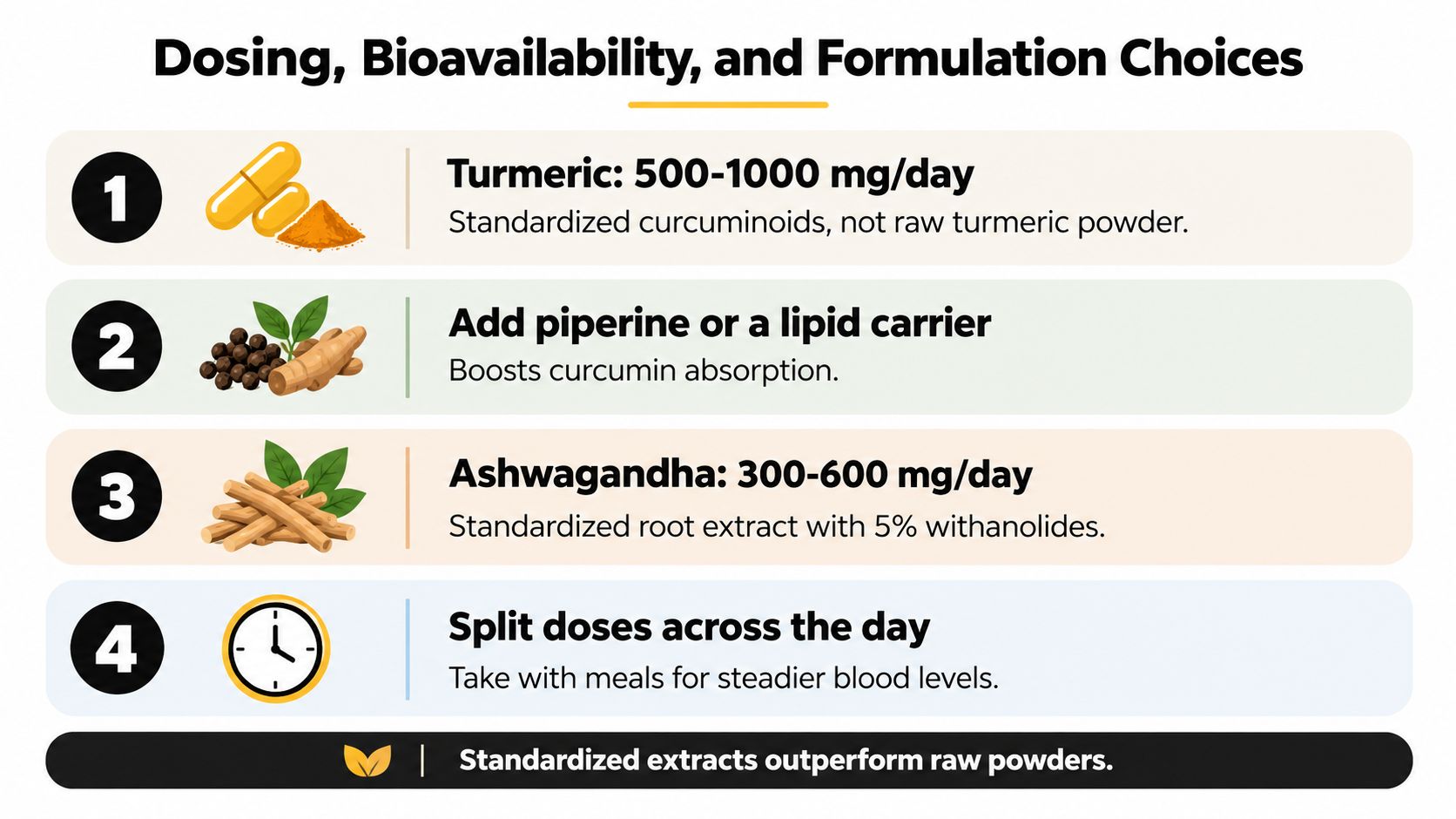
What to inspect on each label
For turmeric, look for:
Standardized curcuminoids: This is more informative than a large raw-root number.
A delivery system: Products may use piperine, phospholipid complexes, micellar systems, or nanoparticle approaches.
Meal instructions: Taking curcumin with food can improve practical tolerability, while formulation determines much of the absorption story.
For ashwagandha, the important label details are different. The trial described earlier used an extract standardized to withanolides, so buyers should look for a named plant part, an extract specification, and a stated withanolide amount rather than an undefined “ashwagandha blend.”
This guide to curcumin bioavailability is useful for understanding why two products with similar turmeric wording may not be equivalent. Third-party testing can also help verify identity, contaminants, and label accuracy, although a testing seal doesn't prove that a product will work for every user.
The practical dosing lesson is simple. Standardization and delivery matter more than the largest number printed on the front of the bottle. Ashwagandha's evidence also depends on the extract used, so a product with a transparent withanolide specification is easier to evaluate than an unlabeled root powder.
Safety, Side Effects, and Drug Interactions
Both herbs are widely used, but their risk profiles aren't identical. Turmeric supplements can cause gastrointestinal discomfort, particularly in concentrated forms, while ashwagandha may cause drowsiness or digestive symptoms in some users. Rare liver problems have also been reported with ashwagandha in case literature, so new jaundice, dark urine, unusual fatigue, or abdominal symptoms warrant prompt medical attention.
Piperine deserves special attention because improving absorption can also change interaction risk. It may affect drug-metabolizing enzymes and transport systems, potentially altering exposure to some medicines. A turmeric product with piperine therefore shouldn't be treated as equivalent to culinary turmeric or a curcumin product without an absorption enhancer.
Questions to resolve before starting
Prescription medicines: Ask a pharmacist to review the exact product, especially if you take medicines affected by liver enzymes, blood pressure, sedation, immune function, or blood clotting.
Thyroid conditions: Ashwagandha may influence thyroid hormones, so people with hyperthyroidism or thyroid treatment need clinical guidance.
Pregnancy and nursing: Don't start either concentrated supplement without advice from a qualified healthcare professional.
Liver disease: Existing liver problems make self-directed use less appropriate because supplements can complicate liver monitoring.
Surgery: Tell the surgical team about both herbs and follow its instructions about when to stop them.
Safety boundary: “Natural” describes an origin, not an interaction profile. A clinician or pharmacist can evaluate the product, dose, medications, and medical history together.
The detailed interaction considerations in this ashwagandha interactions guide are particularly relevant for people using sedatives, antihypertensives, thyroid medicines, or immunosuppressants. Don't use a supplement to self-manage unexplained swelling, severe pain, or an inflammatory diagnosis that has not been medically assessed.
Choosing the Right Herb for Your Situation
The most useful recommendation changes with the symptom pattern. A physically active adult with morning joint stiffness has a different starting point from a sleep-deprived person whose aches worsen during prolonged stress.
For joint stiffness, early osteoarthritis concerns, or a clear mechanical load pattern, turmeric is the more defensible first choice. Its evidence is more directly connected to joint outcomes and inflammatory biomarkers. It also has a more substantial research record for inflammation overall, although a well-absorbed formulation and realistic expectations remain important.
Ashwagandha becomes more logical when the person describes a connected cluster of stress, poor sleep, fatigue, and tension. The herb's inflammation evidence is not as direct, but its research position aligns more closely with the stress-inflammatory axis. That makes it a pathway match, not a stronger general anti-inflammatory.
Athletes dealing with exercise-related soreness may reasonably look first at curcumin because it has more direct investigation in physical recovery and inflammatory outcomes. The evidence is not uniformly positive, and soreness can also reflect training load, inadequate nutrition, sleep disruption, or injury. Persistent swelling or loss of function deserves assessment rather than escalating supplements.
Reader profile | Primary herb | When to combine both |
|---|---|---|
Joint stiffness or suspected osteoarthritis | Turmeric / curcumin | When chronic stress and poor sleep are also prominent |
High stress with fatigue and disrupted sleep | Ashwagandha | When joint discomfort or physical inflammatory load is present |
Exercise-related soreness | Turmeric / curcumin | When recovery problems occur alongside sustained stress |
Joint symptoms plus burnout-like stress | Turmeric first, with clinical guidance | A combined strategy may address both pathways |
Unknown cause of swelling or pain | Neither as a substitute for evaluation | Seek diagnosis before building a supplement stack |
A combined approach can be rational for someone who has both joint symptoms and stress-linked discomfort, but it shouldn't become an excuse to add several products at once. Staggering introductions makes it easier to identify side effects, and monitoring gastrointestinal tolerance is sensible. The goal is a clearer experiment, not a larger supplement cabinet.
Decision Framework and Common Questions
Use three questions:
Where is the pattern? Joint and tissue load points toward turmeric. Stress, poor sleep, and fatigue point toward ashwagandha.
Which herb has the stronger evidence for that pathway? Turmeric has the broader inflammation record. Ashwagandha's evidence is more indirect.
Does the situation justify combining them? Consider both only when both pathways are clearly present and safety has been checked.
How quickly do inflammatory markers change? Studies have measured outcomes across different timeframes, including 24 hours, 5 days, and 15 days for specific ashwagandha research designs. Those timeframes shouldn't be treated as a personal guarantee.
Is either herb appropriate during pregnancy? Don't use concentrated turmeric or ashwagandha supplements during pregnancy without qualified medical advice.
Can ashwagandha help acute injury swelling? Its evidence is more closely tied to stress-related inflammation, so it isn't the obvious first choice for acute swelling.
Does curcumin interfere with culinary turmeric? Culinary turmeric and concentrated curcumin supplements aren't equivalent exposures. The interaction question concerns the supplement formulation, especially added piperine and concurrent medication use.
River of Life offers a vegan capsule that combines standardized turmeric extract with BioPerine black pepper and ashwagandha root, alongside ginger and bromelain, for people seeking joint comfort and stress-related wellness support. Review the formulation and safety considerations, then visit River of Life to decide whether its combined approach fits your needs.