

Brain Fog Supplement Guide: What Works in 2026

You open your laptop to answer one email, then stare at the screen trying to remember why you opened it in the first place. You reread the same sentence three times. Names sit on the tip of your tongue. By midafternoon, your brain feels like a browser with too many tabs open.
That's the experience people usually mean when they say brain fog. It isn't a formal diagnosis. It's a frustrating mix of mental fatigue, poor focus, forgetfulness, and that dull feeling that your thinking just isn't as sharp as it should be.
A brain fog supplement can sometimes help. But the hard part is knowing what kind of help aligns with the reason you feel foggy in the first place. Some people need better sleep. Some are running on stress. Some have nutrient gaps. Others are drawn into a supplement market that promises clarity in a capsule without explaining the basics.
Table of Contents
Feeling Lost in the Fog?
If you've searched for a brain fog supplement lately, you've probably seen the same pattern. Big promises. Sleek bottles. Long ingredient lists. Very little clarity.

That confusion makes sense when you look at the market. In the United States, 26% of adults aged 50 and older take at least one vitamin or dietary supplement for brain health, mainly to maintain or improve memory (71%) and mental sharpness (60%), yet the Global Council on Brain Health said it couldn't endorse any specific formulation because the evidence wasn't definitive, according to AARP's summary of the Global Council on Brain Health review.
That one fact tells you almost everything you need to know. Interest is high. Confidence should be lower.
The problem with quick-fix thinking
People often shop for mental clarity the way they'd shop for a stronger cup of coffee. They want one ingredient that flips the switch back on. But brain fog rarely works that way. It usually comes from something upstream, like stress, poor sleep, inflammation, or a nutrient deficiency.
A better question isn't “What's the best supplement?” It's “What's most likely making my brain feel slow?”
Practical rule: Don't judge a brain fog supplement by the front label. Judge it by whether its ingredients match a believable cause of your symptoms.
Why this guide is different
You don't need another list of trendy pills. You need a filter.
This guide starts with the root causes of brain fog, then connects those causes to ingredients with the strongest support. It also shows you how to read labels, spot weak formulas, and think more clearly about what's worth trying and what probably isn't.
Understanding What Causes Brain Fog
You slept enough. You made coffee. You sat down to work. Then a simple task took twice as long because your thoughts felt slow and slippery.
That is what makes brain fog so frustrating. It feels like a brain problem, but it often starts somewhere else in the body.
Brain fog is a signal
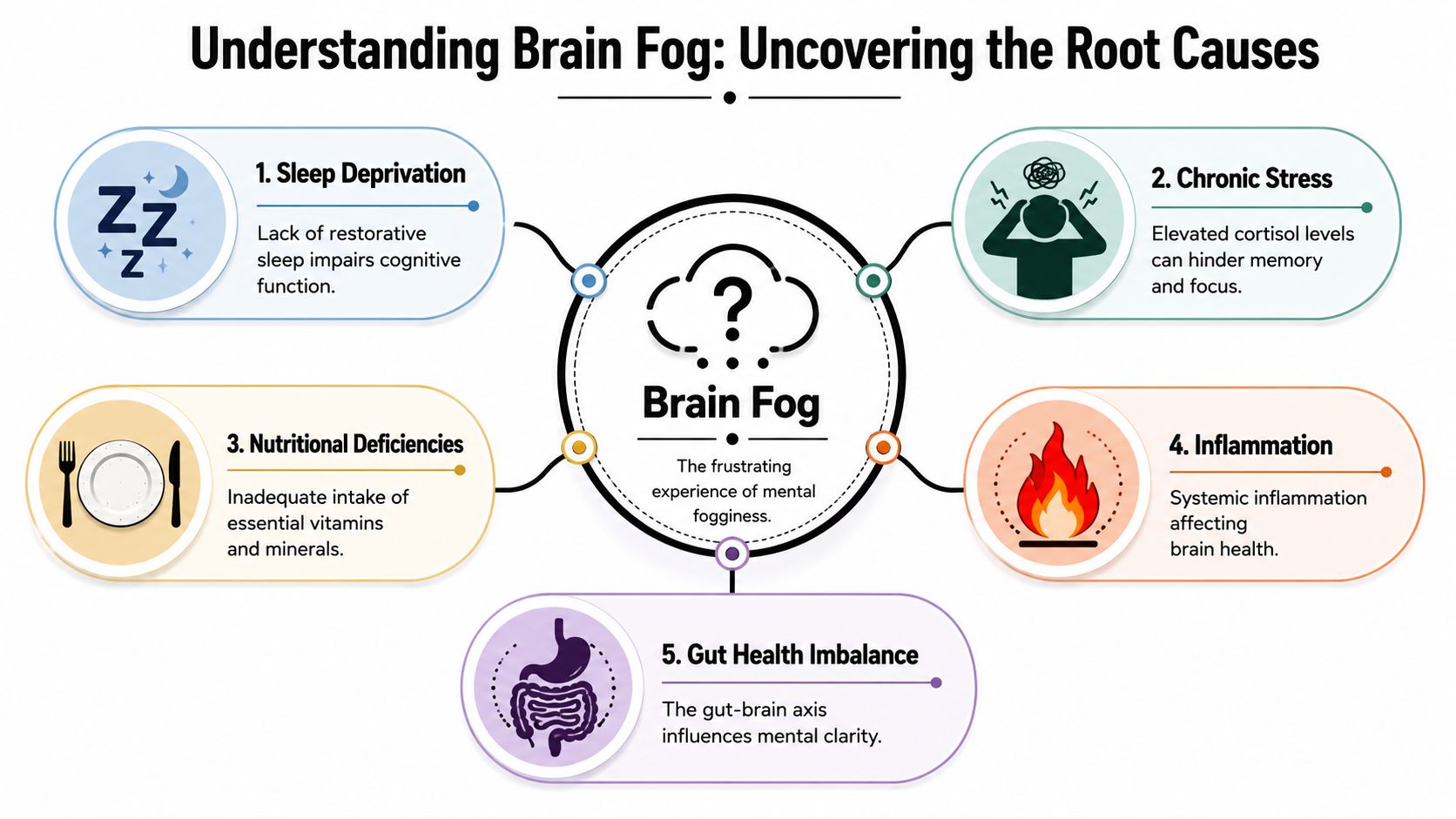
Brain fog is not one disease with one fix. It is a symptom. The same mental haze can show up when your brain is short on recovery, short on nutrients, or stuck in a stress-heavy state.
That distinction matters because it gives you a better way to judge any brain fog supplement. Start with the likely cause. Then ask whether the ingredients match that cause.
The main causes tend to follow a pattern
Sleep problems are one of the clearest examples. Sleep works like your brain's overnight maintenance window. It helps with memory, attention, and mental reset. If that process gets cut short for days or weeks, clear thinking usually goes with it.
Stress is another major driver. Stress is your body's alarm system. In short bursts, that is useful. If the alarm stays on, your attention gets pulled toward urgency instead of focus, planning, and recall. That is one reason people under pressure often feel both tired and mentally restless.
Inflammation can play a role too. Inflammation is part of normal defense and repair. But if that signal stays active for too long, it can create the mental equivalent of background noise. You may not feel acutely ill, yet concentration can still feel harder than usual. If you want more context on how ingredients such as turmeric and ashwagandha fit into that picture, this guide to brain health support with turmeric and ashwagandha explains the connection in plain English.
Nutrition is the fourth big piece. Your brain needs raw materials to make neurotransmitters, support nerve function, and produce energy. If you are low in nutrients such as B vitamins, vitamin D, magnesium, or iron, foggy thinking can be one of the signs. In those cases, a supplement helps most when it corrects a real gap rather than adding random extras.
Then there is overload. Irregular meals, digestive issues, burnout, dehydration, and constant context switching can all pile on. None of them has to be dramatic on its own. Together, they can leave your system overworked and your thinking less sharp.
Brain fog often acts more like a maintenance warning than a standalone condition.
Why the cause matters more than the label
A “focus” supplement can look impressive on the bottle and still miss the mark. If your real issue is poor sleep, a stimulant-heavy formula may leave you more wired. If the problem is low vitamin D or B12, calming herbs alone may not do much. If chronic stress is driving the fog, a generic memory blend may solve nothing.
This cause-and-match approach is the filter that matters. It is also why strong supplements are usually built around a clear job instead of a long list of trendy ingredients.
Improvement usually takes time
People often expect a supplement to work like caffeine or a pain reliever. Brain support rarely works that way. If a formula is addressing stress load, inflammation, or a nutrient shortfall, results usually depend on consistency and on whether you chose the right target in the first place.
That is the practical takeaway here. Before you compare products, get specific about what may be causing the fog. That one step makes the rest of the decision much easier.
Key Supplement Ingredients for Mental Clarity
A better way to judge any brain fog supplement is to ask a simple question first. What problem is this ingredient trying to solve?
Mental clarity usually slips for a reason. Sometimes the issue looks like stress. Sometimes it looks like low nutrient status. Sometimes it looks like inflammation, which works like your body's alarm system stuck on and draining energy in the background. The best ingredients make more sense once you match them to one of those patterns.
Match the ingredient to the likely cause
Stress-related fog often feels like a browser with too many tabs open. Your brain still works, but it does not switch tasks cleanly. In that case, ingredients that support calm focus may fit better than a generic memory blend.
If the problem is a nutrient gap, the goal changes. You are not trying to "boost" the brain so much as restore normal function. B vitamins, vitamin D, magnesium, and vitamin C belong in that conversation because they help cover systems tied to energy, nerve signaling, and resilience.
Inflammation is a different lane. It is less about quick stimulation and more about lowering background friction so thinking feels smoother again. That is one reason turmeric and omega-3s keep showing up in brain health discussions. If you want a brand-side example of how those ingredients are commonly framed, see this River of Life article on turmeric and ashwagandha for brain health support.
Here are the ingredients with the clearest support from the verified research set, organized by the problem they are more likely to address.
Omega-3 fatty acids support brain structure and function. A meta-analysis published in the Journal of Alzheimer's Disease found that omega-3 supplements significantly improved memory in adults with mild memory complaints, with the strongest results in the range of 1000 to 2000 mg of combined DHA and EPA, according to GoodRx's evidence review.
B vitamins, especially B6, B12, and folate, matter most when intake or absorption is low. They help with energy production and nervous system function, so they are a practical fit when fog comes with fatigue, low dietary quality, or a known deficiency.
Vitamin D makes the most sense when blood levels are low. In that setting, correcting the shortfall may help support concentration and mental energy over time.
Magnesium is often relevant when stress, poor sleep, or low intake are part of the picture. It does not act like a mental stimulant. Its role is closer to helping the system settle and recover.
Ashwagandha is usually used for stress support. Study doses often fall in the 225 to 600 mg range, as noted earlier. The practical point is not instant focus. It is helping lower the stress load that may be clouding focus in the first place.
L-theanine is commonly used for calm attention, often on its own or paired with caffeine. Research summaries discussed earlier note that up to 250 mg per day is generally recognized as safe.
Vitamin C is easy to overlook because it is usually filed under immune health. Yet a review in this NIH-indexed paper on vitamin C and cognitive function describes evidence linking vitamin C supplementation with better mood in people with depression and cognitive benefits connected to that mood shift.
Phosphatidylserine deserves a mention because it often appears in more serious cognition formulas. Its main use is memory support, and it has stronger independent evidence than many trendy add-ons.
Evidence for Popular Brain Fog Supplement Ingredients
Ingredient | Primary Target | Level of Evidence | Common Daily Dose |
|---|---|---|---|
Omega-3s | Memory support, brain structure | Supported by a meta-analysis for adults with mild memory complaints | 1000 to 2000 mg combined DHA and EPA |
B vitamins | Deficiency-related fatigue and concentration issues | Most relevant when a deficiency is present | Varies |
Vitamin D | Deficiency-related cognitive sluggishness | Most relevant when levels are low | Varies |
Magnesium | Stress, recovery, nerve function support | Strongest rationale when intake or status is low | Varies |
Ashwagandha | Stress resilience | Some supportive evidence | 225 to 600 mg |
L-theanine | Calm focus | Supportive but not universal | Up to 250 mg |
Vitamin C | Mood-linked cognitive support and antioxidant protection | Supportive review evidence | Varies |
Phosphatidylserine | Memory support | Among the stronger independent evidence for supplements | Varies |
What people often get wrong
The common mistake is treating every brain fog supplement like it should do every job.
A sleep-driven problem, a stress-driven problem, and a deficiency-driven problem can all feel similar from the inside. They all show up as "I cannot think clearly." But the ingredients that fit each one are different. That is why long labels are not always better labels.
Use a simple filter. If the formula looks stimulant-heavy, ask whether your issue is really low energy or whether you are already over-revved. If it is packed with botanicals but light on core nutrients, ask whether it ignores a basic deficiency problem. If it includes anti-inflammatory ingredients, ask whether your daily pattern points in that direction.
Choose ingredients that match the pattern you see. That is how you judge whether a formula is thoughtful or just crowded.
The Surprising Power of a Daily Multivitamin
The supplement conversation usually revolves around single ingredients. Curcumin. Ginkgo. Omega-3s. Magnesium. One bottle, one promise.
The stronger idea may be simpler.
Why the broad approach matters
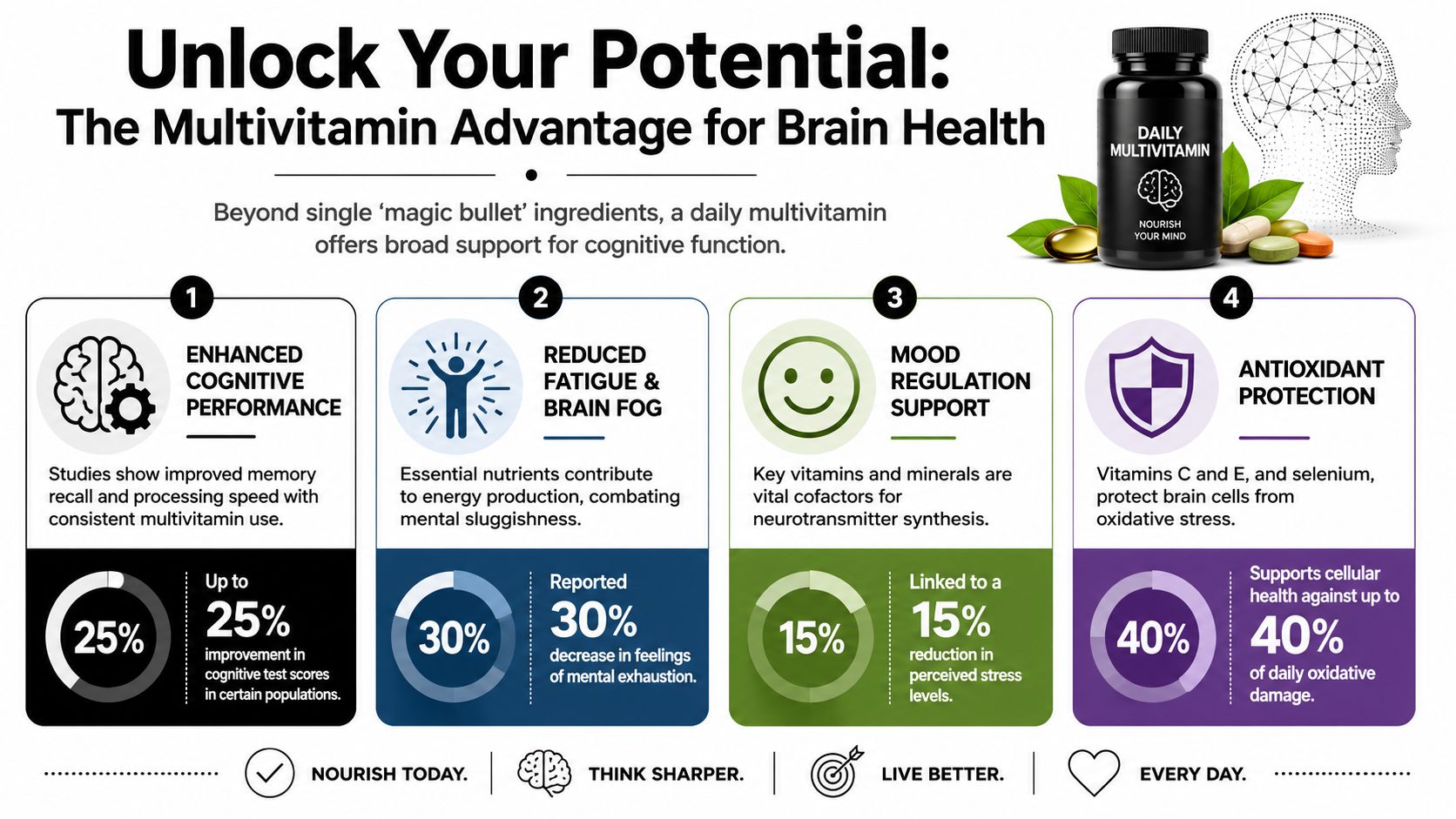
The Harvard-led COSMOS trial found that taking a daily multivitamin for about two years improved episodic memory in adults aged 60 and older, with effects roughly equivalent to slowing cognitive aging by two years, according to Harvard Health's summary of the COSMOS findings.
That finding changes the usual supplement script. Instead of asking which exotic ingredient boosts the brain the most, it suggests that covering broad nutritional bases may be one of the most practical starting points.
This makes intuitive sense. If brain fog can stem from multiple small nutrient gaps, a broad-spectrum approach can be more logical than chasing one “hero” compound.
When a multivitamin makes more sense than a trendy stack
A multivitamin won't solve every cause of brain fog. It won't replace sleep. It won't undo burnout. It won't magically lower stress from an overloaded schedule.
But it can serve as a foundation.
That's especially useful for people who:
Eat inconsistently: Busy schedules often create small nutrient shortfalls over time.
Don't know where to start: A broad formula is often a cleaner first move than buying four separate bottles.
Want a base before going targeted: Foundation first, then add a more specific supplement if your symptom pattern points in a clear direction.
If you want to understand one key nutrient often discussed in that broader foundation, this River of Life article on methyl B-12 1000 mcg is a useful example of how brands explain a single nutrient's role within the larger picture.
A multivitamin is less exciting than a “genius pill.” That may be exactly why it deserves more attention.
How to Choose a High-Quality Supplement
Two products can use the same ingredient name and still be very different in practice. One may be carefully formulated. The other may be mostly marketing.
Read the label like a skeptic
Start with the ingredient list. You want to know what is in the product, how much is in it, and what form it uses.
If a label hides behind a “proprietary blend,” that's a problem. It tells you the formula has multiple ingredients, but not whether any of them are present in meaningful amounts. It's like ordering a meal and being told the chef won't reveal the ingredients.
You should also look for signs that the brand paid attention to bioavailability, which is just a technical way of asking whether your body can absorb and use the ingredient well. Curcumin is a good example. It's widely discussed, but absorption matters. A formula that pairs turmeric extract with a black pepper component is at least showing awareness of that issue.
A simple quality checklist
When comparing a brain fog supplement, use this short filter:
Transparent dosing: The label should show exact ingredient amounts. Hidden blends make smart decisions harder.
Thoughtful forms: Some ingredients work better in certain forms. If a brand talks clearly about extract type, standardization, or ingredient form, that's usually a good sign.
Third-party testing: Independent testing helps confirm purity and potency. Without it, you're relying mostly on trust.
No filler-heavy feel: A long list of unnecessary extras can signal a formula built for label appeal instead of function.
A believable purpose: Every ingredient should have a reason to be there. “Everything for everyone” usually means nothing is targeted well.
To gain a quick understanding, consider this:
Label Feature | Good Sign | Red Flag |
|---|---|---|
Dosage disclosure | Exact amounts listed | Proprietary blend only |
Ingredient choice | Matches a clear goal | Trendy pile of unrelated add-ons |
Absorption support | Includes supportive pairing where relevant | Ignores known absorption issues |
Testing | Mentions independent quality checks | No discussion of verification |
Formula design | Focused and readable | Overstuffed and vague |
The smartest question to ask
Don't ask, “Is this ingredient popular?”
Ask, “Would I understand why this ingredient is here if the front label were covered up?”
If the answer is no, move on.
Putting It All Together A Look at River of Life
A framework is only useful if you can apply it to a real product. River of Life works as a practical example because the formula is focused enough to evaluate without guessing.

How the formula fits the framework
River of Life Capsules combine standardized turmeric extract, BioPerine black pepper, ashwagandha root, ginger, and bromelain. That's not a classic nootropic formula. It's more of a targeted wellness blend built around two drivers that often sit under brain fog: inflammation and stress.
That gives the formula a coherent identity.
Turmeric is there for its anti-inflammatory role. BioPerine is included to support absorption. Ashwagandha is there for stress resilience. Ginger and bromelain fit the broader support theme rather than turning the formula into a random kitchen-sink mix.
What stands out in practical use
A few details make the formula easier to trust on paper.
It has a clear logic: The ingredients point in the same direction instead of chasing every brain-health trend at once.
It avoids the mystery-blend feel: The brand positions the product around a small set of recognizable ingredients.
It supports consistency: Because supplements usually need regular use, a refill model matters more than many people realize. River of Life offers a 30-day subscription option, which fits the reality that brain-support supplements tend to work, if they work at all, through steady use rather than one-off dosing.
This doesn't mean every person with brain fog should take the same formula. It means the product passes an important test: you can explain why each major ingredient belongs there.
That's rare.
Your Action Plan for Lasting Mental Clarity
Brain fog gets easier to deal with when you stop treating it like a mystery and start treating it like a clue.
First, clean up the obvious basics. Protect sleep. Eat real meals regularly. Lower stress where you can. Hydrate. Move your body. Those changes aren't glamorous, but they often do more than people expect.
Second, cover the foundation. If your diet has been inconsistent or you suspect nutrient gaps, a daily multivitamin may be a more evidence-backed starting point than a trendy single-ingredient stack.
Third, go targeted only when the pattern is clear. If your symptoms line up with stress, look at ingredients chosen for stress resilience. If they seem tied to low intake or deficiency, focus on nutritional support. If inflammation seems to be part of the picture, choose a formula built with that logic in mind.
The goal isn't to find the most exciting brain fog supplement. It's to find the most sensible one for your situation.
Mental clarity usually comes back the same way it drifted away. Through daily inputs.
If you want a focused formula built around stress support and inflammation-conscious ingredient design, River of Life is worth a look. Its capsule blends turmeric extract with BioPerine, ashwagandha root, ginger, and bromelain in a straightforward formula that's easier to evaluate than most “brain booster” products.