

Best Turmeric Powder Supplement: 2026 Buyer's Guide

The best turmeric powder supplement isn't always the one with the biggest milligram count. Curcumin has notoriously low oral bioavailability, so a formula with an absorption enhancer like piperine can outperform plain turmeric powder even at a lower dose.
If you've been comparing bottles by the number on the front label, that's the wrong first question. The better question is: how much curcumin gets into your bloodstream?
Formulation type | Absorption reality | What to look for | Main trade-off |
|---|---|---|---|
Plain turmeric powder | Often weak without an enhancer | Standardized curcuminoids, contaminant testing | Lowest systemic delivery |
Curcumin extract | More concentrated than root powder | Label accuracy, clean excipients | Can still absorb poorly |
Curcumin + piperine | Stronger delivery than plain powder | Black pepper extract or BioPerine | Possible interaction concerns |
Enhanced delivery formats | Designed to improve uptake | Lipid, colloidal, or other delivery system | Usually costs more |
Multi-ingredient capsules | Built for broader wellness goals | Absorption support plus complementary botanicals | More complex label |
Table of Contents
Why Most Turmeric Supplements Fail Before You Swallow Them
Why does one turmeric bottle look powerful on paper, yet barely deliver once it reaches your gut? The answer is absorption. A product can contain plenty of curcumin and still underperform if the body cannot move it into circulation efficiently. A peer-reviewed human pharmacokinetic review found that adding piperine from black pepper increased curcumin bioavailability by more than fourfold in comparative testing, and another clinical summary reported an increase of 2,000% in the first 0.25 to 1 hour after administration, while a separate human study found a 3-fold increase when 2 g of curcumin was paired with 5 mg of piperine (source).
That is why the front label can be misleading. A bottle may list a large curcumin amount, but the body treats it like a parcel with no delivery address. The result is simple: plenty of ingredient on the label, little reaching the bloodstream.
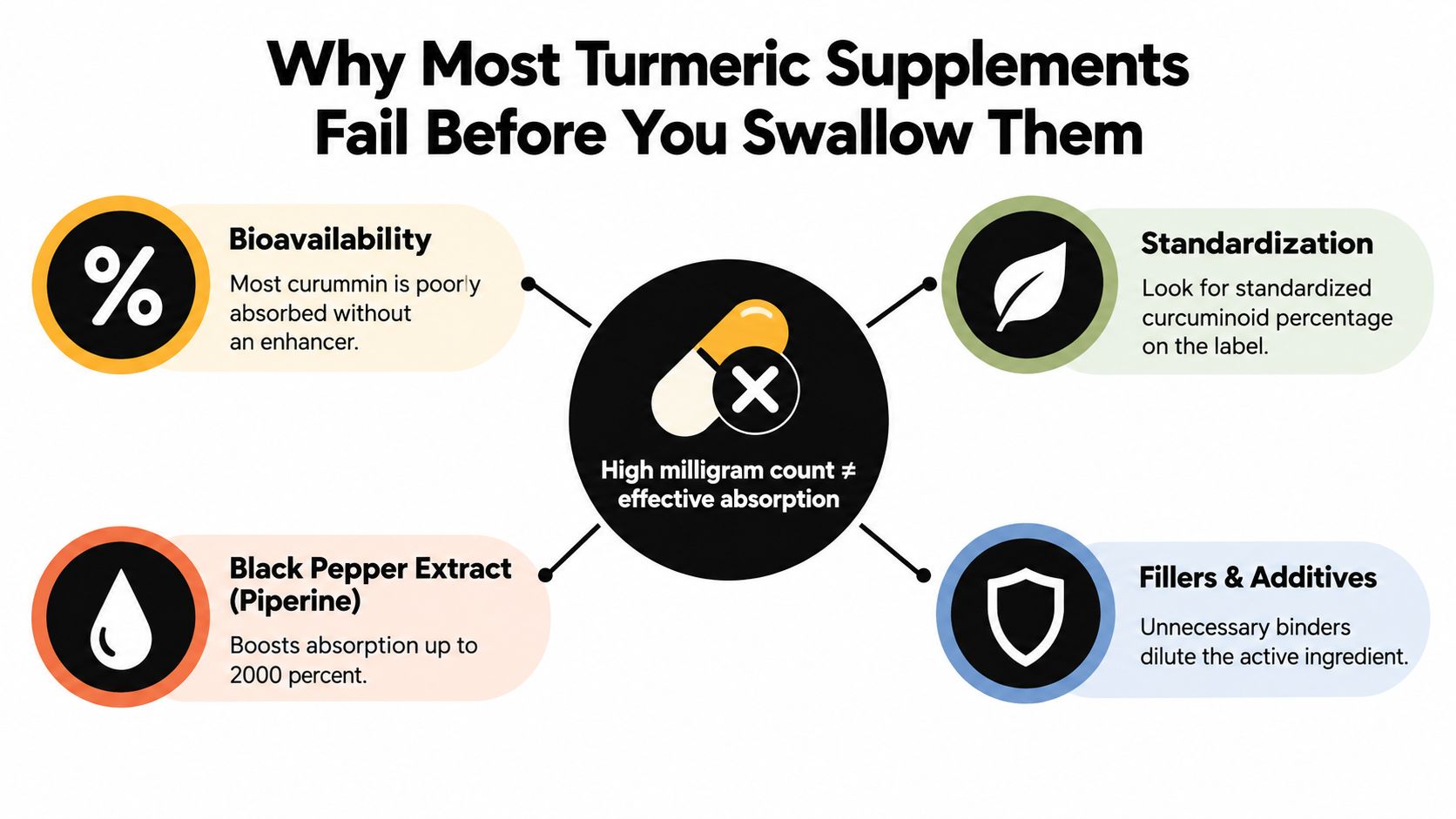
Why the label can mislead you
Turmeric root is only part of the picture. ConsumerLab's review shows why buyers should look for standardized curcuminoid content and independent contaminant testing, because the tested products varied widely in serving amounts and one product contained lead (ConsumerLab review). A formula earns attention when it matches its label and gives you a clear path to absorption, not when it merely advertises a bigger powder count.
Practical rule: before comparing prices, check for a standardized curcuminoid percentage and a named absorption enhancer. If neither appears on the label, the milligram count is marketing, not medicine.
The Science of Curcumin Absorption Made Simple
Why does one turmeric capsule seem to do far more than another? The answer is absorption. Curcumin is a stubborn molecule, and it does not dissolve well in water, so the gut has a hard time moving it into the body efficiently. A review of curcumin pharmacokinetics notes that oral bioavailability is around 1%, which means most of it never makes it across the digestive barrier (review).
How piperine raises curcumin blood levels
Black pepper extract, especially piperine, changes that picture. Piperine works by blocking the enzymes and transporters that normally flush curcumin out of the gut wall before it reaches the bloodstream. A review explains that it inhibits glucuronidation and efflux transporters, which raises systemic exposure, and human data show the effect can be large enough to matter in real buying decisions (review).
Why delivery format matters
Some formulas try to improve uptake with lipid-based or colloidal systems instead of relying only on pepper extract. That matters because the delivery system can matter as much as the ingredient itself. The same pharmacokinetics review notes that some commercial formulations outperform standard extracts by large margins, which is why a smaller capsule can sometimes be more useful than a larger powder-heavy one.
A clear label should answer one question first: what helps this get absorbed? If the formula does not explain that, the milligram count is doing the marketing, not the body.
For a deeper technical breakdown of absorption mechanics, see this guide on curcumin bioavailability.
Comparing Mainstream Turmeric Formulation Approaches
Why do two turmeric supplements with similar label claims behave so differently once they reach the gut?
The answer is formulation. Plain turmeric root powder, standard extracts, and enhanced-absorption products can all look similar on a shelf, yet they do not travel through the body the same way. That is the core buying problem, because the number on the front label matters less than what the body can use.
Here is the practical comparison.
Formulation | What it is | Why people buy it | Trade-off |
|---|---|---|---|
Plain turmeric powder | Ground root | Familiar, simple, inexpensive | Weak systemic delivery |
Standard curcumin extract | Concentrated curcuminoids | More potent than root powder | Still limited by absorption |
Curcumin with piperine | Extract plus black pepper | Better uptake than plain extract | May interact with some medications |
Liposomal or colloidal formulas | Delivery system designed to improve uptake | Often more efficient per serving | Can cost more |
Patented enhanced formulas | Proprietary absorption method | Convenience and performance | Harder to compare across brands |
What you are really paying for
A 500-milligram capsule of plain powder is not automatically more useful than a smaller capsule with a smarter delivery system. The practical difference is similar to sending mail in a padded envelope instead of loose paper. Both contain the message, but one reaches the destination more reliably.
Some commercial products released less than 40% of total material in dissolution testing, and a colloidal turmeric formulation produced 24-fold higher exposure than a standard extract at a much lower dose (review). That gap shows why dosage alone is a weak buying signal.
For a concrete example of a piperine-based format, this overview on turmeric with piperine explains why black pepper extract keeps appearing in stronger products.
How to read the trade-offs
Plain powder still makes sense for cooking, where flavor is the goal. A supplement is different. If you want systemic support, you need a product built for uptake, not just bulk. That is the true split between kitchen spice and functional supplement.
The Five Non-Negotiable Criteria for Quality
A turmeric supplement should clear five checks before you trust it. Miss even one, and the bottle starts to look like marketing wrapped around plant material.
1. Standardization
Look for standardized curcuminoid content. That tells you the product is designed for consistency, not just bulk. Without it, two bottles can look similar on the shelf and behave very differently in use.
2. Absorption support
A meaningful formula should include BioPerine, piperine, or another delivery system that addresses poor uptake. Curcumin is a hard ingredient to absorb, so a strong label has to solve that problem instead of assuming the body will do the work for it. The pharmacokinetic review linked earlier shows that piperine can materially change blood levels (pharmacokinetic review).
3. Contaminant control
Turmeric products deserve tighter contaminant screening than many shoppers expect. Look for a certificate of analysis, or a third-party seal such as USP or NSF, on the product page or label. That kind of proof tells you the brand has checked for more than just curcumin content.
4. Form choice
Whole root, extract, and enhanced formulas are not interchangeable. Root powder can be fine in food, but a supplement should earn its place with better delivery, clearer standardization, or both. If the product cannot explain why that form was chosen, the formula is probably doing less than the label suggests.
5. Capsule quality and fillers
The capsule matters too. Vegan shells, minimal additives, and a clean excipient profile show that the brand paid attention to what goes into the bottle and what is there only to fill space.
Quality check: If a product leans on a big milligram number but will not explain standardization, absorption, and testing, it has not earned your trust.
Matching the Right Turmeric Supplement to Your Goals
Your goal should drive the formula, not the other way around. Someone managing daily joint stiffness doesn't need the same product as someone trying to build a broader wellness routine around sleep, recovery, and stress.

Joint comfort and routine use
For ongoing joint support, consistency matters more than chasing a dramatic dose once in a while. A formula with better absorption is the smarter choice because the goal is steady exposure over time, not a one-day spike.
Recovery and post-exercise use
After workouts, people often want something that fits into an existing recovery routine. Turmeric can be part of that routine, but only if the formula is absorbable enough to be useful instead of symbolic.
Stress, sleep, and broader wellness
Some buyers want one capsule that supports several needs at once, which is where multi-ingredient formulas can make sense. In that case, the question becomes whether the turmeric is doing real work inside a broader blend rather than sitting there as a label decoration.
A balanced way to think about it is this, choose the form that matches your real-life goal. A joint-focused shopper, a recovery-focused athlete, and a sleep-minded wellness buyer are not solving the same problem.
Why River of Life Capsules Meet the Highest Standards
River of Life Capsules fit the criteria that matter most for a turmeric supplement because the formula includes standardized turmeric extract plus BioPerine black pepper extract, which directly addresses absorption. The capsule also adds ashwagandha root, ginger, and bromelain, so it isn't just a turmeric-only product trying to carry too many goals on one ingredient.
The brand's model is straightforward, it sells directly online through River of Life, offers one-time and subscription options, and provides a 30-day return policy for unopened bottles. It also ships to 40+ countries, which matters if you want a consistent routine and don't want to keep hunting for the same bottle in different places.
Why that combination matters
The absorption piece comes first. Once that's handled, the other botanicals can support a broader routine around comfort, recovery, and daily balance. A formula like this is more coherent than a plain powder bottle that never solves the delivery problem.
The video below shows the product and its positioning in more detail.
The practical value is simple. If you're shopping for a turmeric supplement because you want something you'll take every day, a capsule with standardized turmeric and absorption support is a cleaner answer than a loose powder whose potency depends on guesswork.
Practical Usage Tips and Safety Considerations
Take turmeric with a meal, especially one that includes some fat, because that usually fits better with how curcumin behaves in the gut. Consistency matters more than dramatic timing tricks, so the people who benefit most are usually the ones who use it regularly and give it time to fit into their routine.
Safety comes next. Neutral consumer reviews note that higher doses can cause gastrointestinal side effects and may be a poor fit for people with gallbladder disease, kidney stones, or those taking blood-thinning or blood sugar-lowering medications, and LiverTox continues to monitor turmeric-related liver concerns, including rare acute injury cases (ConsumerLab safety review).
If you use anticoagulants, diabetes medication, or have a history of gallbladder problems, talk with a healthcare professional before starting.
The safest approach is boring but effective, choose a formula that fits your body, your medications, and your routine. If you're unsure, bring the label to your clinician and ask them to review it with you.
River of Life makes a turmeric-based capsule with BioPerine, plus complementary botanicals for people who want a more complete daily routine than plain powder can offer. If you're ready to compare a standardized, absorption-focused formula with the usual high-dose bottles, visit River of Life and review the product details for yourself.