
Best Supplement for Anti Inflammatory Needs in 2026

The popular answer to “what's the best supplement for anti-inflammatory support?” is usually turmeric. That answer is incomplete. Curcumin can be a strong choice, but the formula carrying it may matter more than the headline ingredient or the impressive milligram number on the front of the bottle.
A plain turmeric powder and a standardized curcumin extract aren't interchangeable. Native curcumin has low oral bioavailability because the body absorbs little of it, metabolizes it quickly, distributes it imperfectly through tissues, and clears it with a short half-life, as explained in this peer-reviewed review of curcumin formulations. The practical question isn't which ingredient sounds most anti-inflammatory. It's which formulation delivers a useful amount, fits your goal, and makes sense for your health situation.
Table of Contents
Why the Best Anti Inflammatory Supplement Is Not One Ingredient
Why Multi-Ingredient Formulations Outperform Single Compounds
How to Choose the Right Supplement and When to See a Clinician
Why the Best Anti Inflammatory Supplement Is Not One Ingredient
Inflammation isn't a single switch that a supplement turns off. It's a coordinated immune response involving chemical messengers, enzymes, tissue signals, and repair processes. Acute inflammation can help the body respond to injury or infection. Persistent activation is different, and the right intervention depends on what's driving it.
That's why I'm skeptical of “best of” lists that crown one ingredient for everyone. Curcumin has the deepest evidence among the botanicals discussed here, but ginger has human evidence for selected inflammatory biomarkers, while omega-3 fatty acids may suit people whose dietary intake is low or whose clinician is managing an inflammatory condition. A compound can be useful without being universally appropriate.
The ingredient is only half the formula
Supplement labels encourage a simple comparison. One bottle lists a large turmeric number, another lists a smaller standardized curcumin amount, and shoppers assume the larger number wins. That comparison ignores extract standardization, delivery technology, absorption enhancers, capsule design, and the form of the active compound.
A plain turmeric powder may contain much less curcumin than a concentrated extract. Even a concentrated extract can underperform if its delivery system doesn't address curcumin's absorption limitations. The evidence supporting enhanced curcuminoid products is therefore more relevant than a label that merely advertises a large amount of undifferentiated turmeric.
Formulator's rule: Don't compare the front-label milligrams until you know what those milligrams actually represent.
A thoughtful multi-ingredient formula can also target different parts of the inflammatory response. Curcumin and ginger have different botanical profiles and different evidence patterns. Bromelain brings enzymatic activity to the blend, while an adaptogen such as ashwagandha may be selected for stress-related support rather than treated as a direct replacement for a concentrated anti-inflammatory ingredient.
What “best” should mean
For practical use, the best supplement is the one that clears four tests:
Relevant ingredient: It matches your actual goal, such as joint comfort, exercise recovery, or general inflammatory support.
Credible form: The label identifies the extract, standardization, and delivery system instead of hiding behind a proprietary blend.
Usable routine: You can take it consistently and tolerate it.
Appropriate expectations: You're assessing symptoms and function, not assuming a laboratory change guarantees relief.
Curcumin often comes out on top when these criteria are applied, but only when the product solves the bioavailability problem. That distinction separates a defensible formula from a marketing-led one.
How Inflammation Works and Where Supplements Intervene
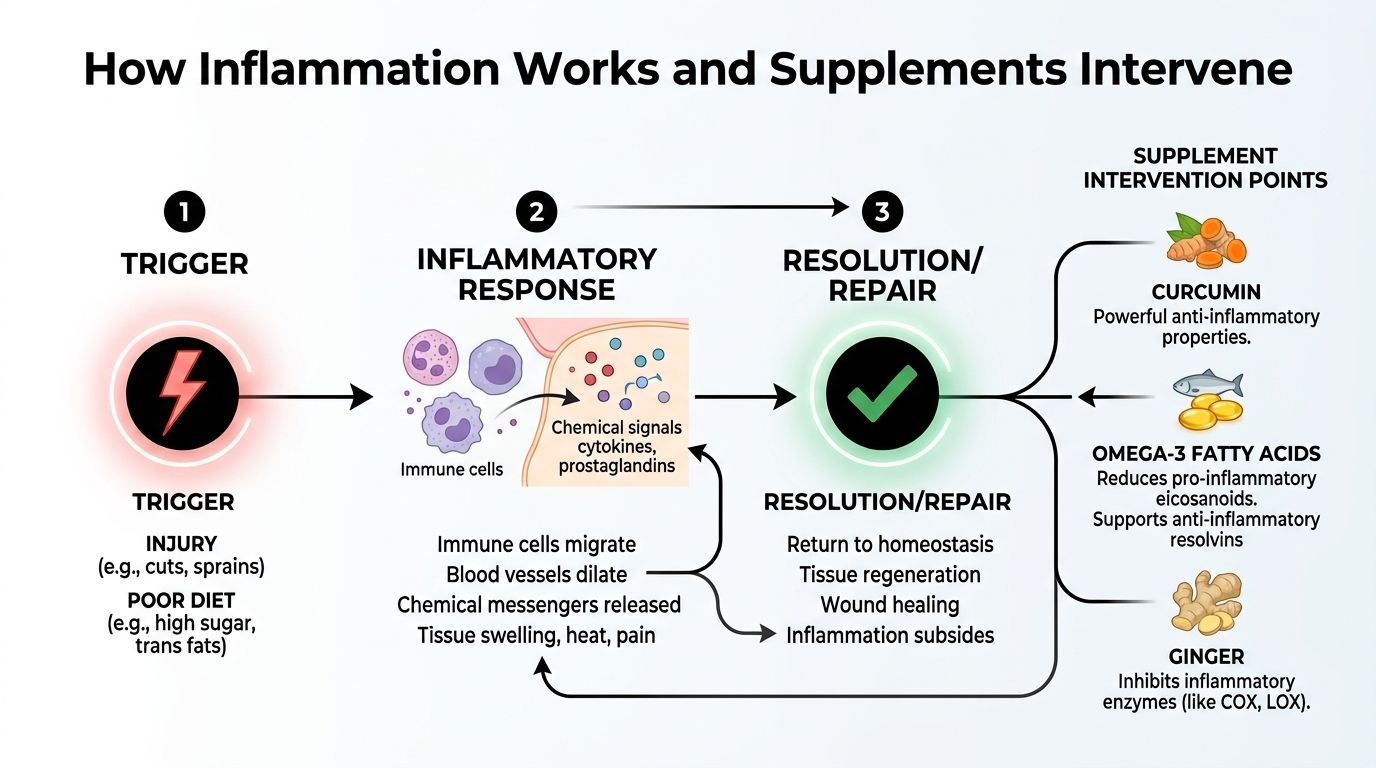
Inflammation operates like a fire alarm. An injury, infection, or other trigger activates immune activity and begins repair. If that signal continues after the original problem settles, the response can become disruptive rather than helpful.
Researchers commonly track inflammation through C-reactive protein, tumor necrosis factor alpha, and interleukin-6. These biomarkers represent only part of the process, and a lower blood marker does not guarantee better movement or less pain. They still give human trials a shared way to assess whether an intervention affects systemic inflammatory signaling.
The three useful stages
Trigger starts the sequence. Tissue stress, injury, or an immune challenge can prompt the body to release signals that change blood flow and recruit immune cells.
Inflammatory response is the active alarm phase. Chemical messengers coordinate immune activity, while CRP, TNF-alpha, and IL-6 may rise. Botanical compounds can influence some enzymes and signaling pathways, but they do not remove the underlying trigger.
Resolution and repair receives less attention. The body must lower the response, restore tissue balance, and adapt to the original stress. A supplement that shifts one marker can still fall short of improving the wider process.
Curcumin has enough human evidence to merit serious consideration. A 2024 systematic review covering multiple meta-analyses reported measurable reductions in inflammatory biomarkers with 60 to 2000 mg per day of curcumin, 150 to 1500 mg per day of curcuminoids, or 900 to 3000 mg per day of turmeric. Across pooled studies, CRP declined by about 0.58 mg/L, TNF-alpha by 3.48 pg/mL, and IL-6 by 1.31 pg/mL. The changes were statistically significant in the 2024 systematic review.
Why ginger deserves separate attention
Ginger is more than a warming digestive ingredient added for label appeal. A 2020 meta-analysis of randomized controlled trials found significant reductions in CRP, hs-CRP, and TNF-alpha after supplementation. The largest pooled effects were reported for CRP, with an SMD of -5.11, and hs-CRP, with an SMD of -0.88, in the published meta-analysis.
The analysis found no significant change in IL-6 or sICAM. Ginger's effect is therefore biomarker-selective, not universal. It can earn a place as a targeted component, but marketing should not present it as a compound that corrects every inflammatory pathway.
Comparing the Top Anti Inflammatory Ingredients
The strongest choice depends on the job. Curcumin is the most compelling botanical starting point for broad inflammatory support, ginger has useful human data for selected markers, and omega-3s may make sense in an overall dietary strategy. Bromelain and ashwagandha can fit a combination formula, but their roles shouldn't be confused with the most directly studied endpoints.
Ingredient | Evidence Strength | Typical Dose | Key Biomarkers Affected | Best For |
|---|---|---|---|---|
Curcumin or turmeric extract | Broad human evidence, but formulation and trial results vary | Study doses range from 60 to 2000 mg per day of curcumin, 150 to 1500 mg per day of curcuminoids, or 900 to 3000 mg per day of turmeric | CRP, TNF-alpha, IL-6 | General inflammatory support and joint-focused formulas |
Ginger | Meaningful human meta-analysis evidence with selective effects | Dose varies by preparation and study | CRP, hs-CRP, TNF-alpha | Targeted inflammatory support and recovery-oriented blends |
Omega-3 fatty acids | Useful context-dependent option, especially when dietary intake is inadequate | No single dose recommendation is established in the verified data | Inflammatory signaling may be relevant, but no specific verified biomarker result is provided here | Dietary gap support and clinician-guided plans |
Bromelain | Often used in combination formulas, but the supplied evidence doesn't establish a specific human anti-inflammatory dose | No verified dose provided | No specific verified biomarker result is provided here | Enzyme-focused combination products |
Ashwagandha | Relevant to stress-resilience formulas, but the supplied evidence doesn't establish a specific anti-inflammatory dose | No verified dose provided | No specific verified biomarker result is provided here | Stress-related support alongside, not instead of, direct anti-inflammatory ingredients |
Curcumin deserves the lead position because it has the clearest biomarker-backed case in the supplied evidence. Still, don't mistake statistical significance for guaranteed symptom relief. A recent review concluded that human randomized controlled trial findings remain inconsistent overall, with low certainty linked to heterogeneity, publication bias, and uncertainty around the optimal dose and formulation. That review of curcumin trials also reported the strongest signals with unformulated curcumin and higher doses at or above 1 gram per day, while emphasizing the need for larger, higher-quality trials.
That finding isn't a reason to buy an old-fashioned plain powder. It's a reason to read the study design and product label together.
For more background on the distinction between turmeric and its active compounds, see this explanation of curcumin in turmeric. The practical takeaway is straightforward: ingredient identity, extract form, and delivery system must be evaluated as one decision.
The Bioavailability Problem Most Labels Ignore
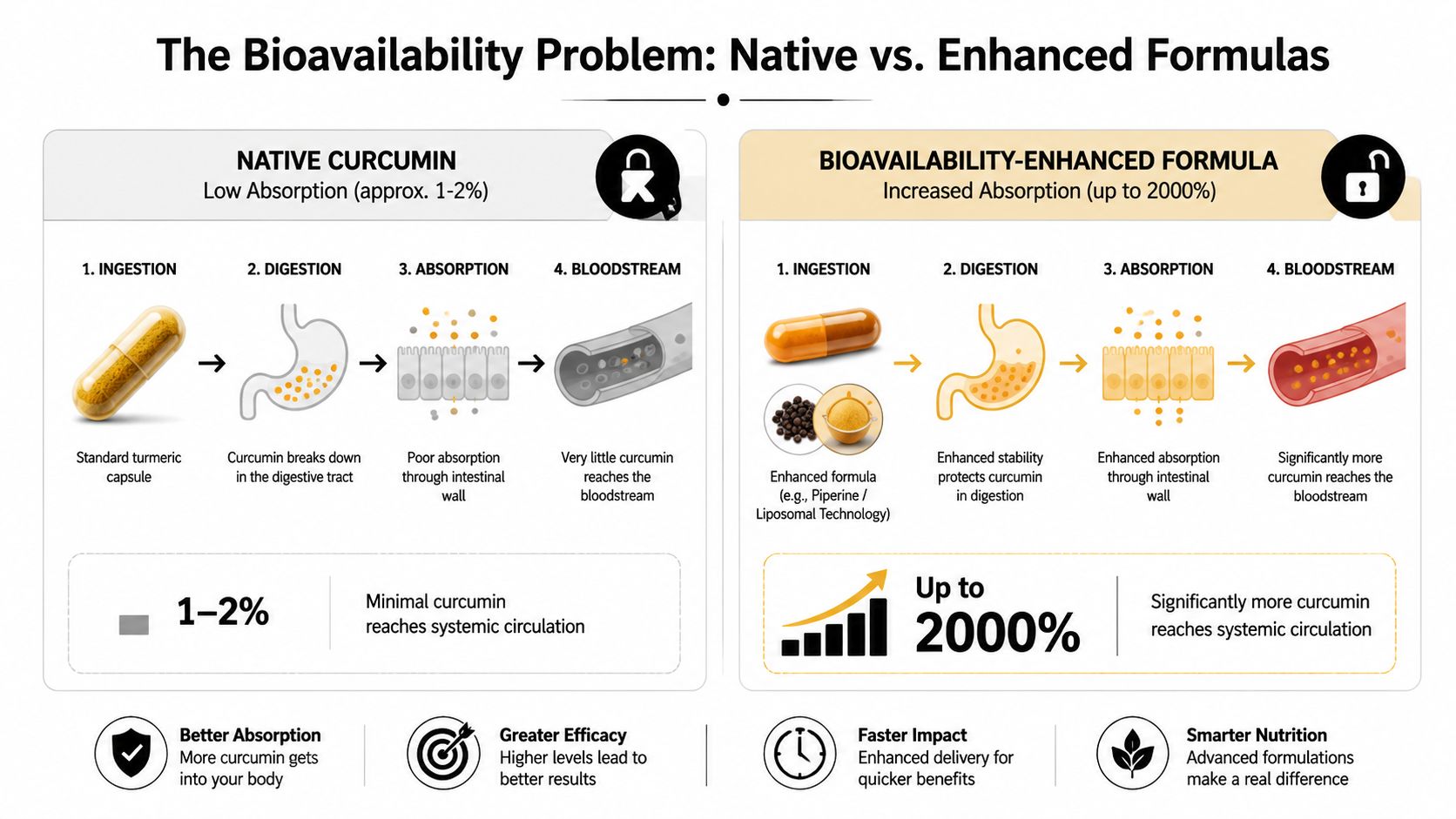
Curcumin's most serious formulation gap is absorption. Native curcumin shows interesting biological activity, yet oral use is limited by low absorption, rapid metabolism, restricted tissue distribution, and a short half-life, as discussed in the earlier review of curcumin pharmacokinetics and enhanced formulations.
A large turmeric number on the label does not prove meaningful exposure. The body uses the portion that survives digestion, enters circulation, and reaches relevant tissues. Delivery technology can therefore matter more than the raw ingredient weight.
What piperine changed
The 1998 piperine-curcumin pharmacokinetic study reported that adding 20 mg of piperine increased curcumin bioavailability by 2000% in humans and rats under the study conditions, as summarized in this review of piperine and curcumin absorption. Later reviews found a more conservative effect, with piperine co-administration roughly doubling curcumin absorption in some formulations.
Results vary with the product design and study conditions. The practical point remains clear: an absorption enhancer can materially change exposure. Black pepper extract became common in curcumin products for that reason, although piperine is only one delivery option and should not replace scrutiny of the full formulation.
How to read the label
Start with the ingredient panel, not the marketing claim.
Identify the active: Does the label specify turmeric powder, turmeric extract, curcumin, or curcuminoids? These terms describe different materials.
Look for standardization: The manufacturer should state what the extract contains, rather than listing only total botanical weight.
Check the delivery strategy: Look for piperine, a named lipid-based system, or another clearly identified enhancer.
Reject mystery blends: Hidden individual quantities prevent comparison with human research and make meaningful dosing impossible to assess.
Review quality controls: Prefer manufacturers that disclose manufacturing standards, batch information, and independent testing practices.
A high-dose plain powder may provide less usable exposure than a lower-dose enhanced extract. Compare raw material quantity versus usable exposure, not label size alone.
For a practical explanation of the black pepper approach, read this guide to curcumin with black pepper.
A visual walkthrough can clarify why the carrier system matters:
Why Multi-Ingredient Formulations Outperform Single Compounds
A single compound can be the right tool when you have a narrow objective and want to evaluate one variable. Individuals, however, aren't managing one isolated pathway. They're dealing with a combination of joint discomfort, exercise-related soreness, poor sleep, stress, diet, and inconsistent recovery.
That's where a well-designed multi-ingredient formula has an advantage. It can combine curcumin's delivery-enhanced inflammatory support with ginger's selective biomarker evidence, while using other ingredients for adjacent needs. The goal isn't to throw every fashionable botanical into one capsule. It's to build complementary coverage without turning the label into a proprietary guessing game.

Complementary roles are more useful than ingredient stacking
Curcumin is the anchor because it has the strongest supplied evidence for reductions in CRP, TNF-alpha, and IL-6. Ginger adds a different evidence profile, with significant findings for CRP, hs-CRP, and TNF-alpha but not for every measured marker. Bromelain is commonly selected for enzyme-focused support, although the supplied evidence doesn't establish a specific anti-inflammatory dose or biomarker outcome for it.
Ashwagandha belongs in a different lane. It's better understood as a stress-resilience ingredient than as a substitute for curcumin. If stress and poor sleep are part of the routine that aggravates discomfort, an adaptogenic component may fit the broader plan, but that doesn't turn it into a direct anti-inflammatory treatment.
The combination only makes sense if each ingredient has a defined job:
Curcumin with an enhancer: Addresses the main absorption bottleneck.
Ginger: Adds a botanical with human evidence for selected inflammatory markers.
Bromelain: Provides enzymatic support within the formula's intended design.
Ashwagandha: Supports the stress side of a broader wellness routine.
I'd rather see a transparent blend with sensible roles than a single oversized dose chosen for shelf appeal. More ingredients don't automatically mean better results. Complementarity, disclosed quantities, and tolerability are what make a combination defensible.
For an example of how turmeric and ginger are positioned together in a capsule formula, review ginger and turmeric capsules. Treat any branded formula as one option to evaluate, not as a replacement for checking the label or discussing interactions with a clinician.
How to Choose the Right Supplement and When to See a Clinician
Choose the product after defining the problem. “Inflammation” can refer to a diagnosed inflammatory condition, a temporary flare, joint stiffness, recovery discomfort, or a vague sense that something feels wrong. A supplement can support a plan, but it can't identify the cause of your symptoms.
A purchase checklist that filters out weak formulas

Use this checklist before you buy:
Match the goal: Choose a curcumin-led product for broad inflammatory support, consider ginger for a complementary botanical role, and don't use a general blend to self-manage a condition that needs diagnosis.
Read the active form: Distinguish turmeric powder from standardized curcumin or curcuminoids.
Verify the delivery system: Look for a named absorption enhancer instead of assuming every turmeric product absorbs equally.
Demand transparency: Individual ingredient amounts should be visible. Proprietary blends make meaningful comparison difficult.
Assess quality information: Look for clear manufacturing details, batch identification, and independent testing practices.
Choose a tolerable format: Vegan capsules, powders, and other forms can all be practical, but the one you can take consistently is the one most likely to receive a fair trial.
Don't let subscription pricing drive the decision. A recurring delivery can help with routine, but it shouldn't lock you into a product you haven't tolerated or assessed.
When self-testing isn't appropriate
Speak with a physician or pharmacist before starting a concentrated botanical formula if you take prescription medication, particularly medicines that affect clotting. Curcumin and fish oil may be relevant to bleeding-risk discussions, and medication-specific advice belongs with a qualified professional.
Get clinical guidance if you have an autoimmune condition, unexplained swelling, persistent or worsening pain, fever, significant weakness, or symptoms that interfere with normal function. A supplement shouldn't delay diagnosis or replace prescribed treatment.
You should also discuss supplementation during pregnancy, before surgery, or when managing chronic liver, gallbladder, kidney, or gastrointestinal problems. The correct choice may be no supplement until the underlying issue is clear.
Safety rule: A product can be natural, vegan, and well formulated while still being unsuitable alongside your medication.
Putting It All Together for Lasting Relief
If you want the direct recommendation, start with a transparent, bioavailability-enhanced curcumin formula when your goal is general inflammatory or joint support. Add ginger when its targeted role fits your needs. Treat bromelain and ashwagandha as supporting components with distinct purposes, not as proof that a product is automatically stronger.
Judge the product by what reaches your body, not by the biggest number on the label. The evidence supports curcumin across doses ranging from 60 to 2000 mg per day, curcuminoids from 150 to 1500 mg per day, and turmeric from 900 to 3000 mg per day, but the supplied research also shows uncertainty around the ideal dose and formulation. That makes transparent labeling and a credible delivery system more valuable than aggressive dose claims.
Track what you care about: stiffness, comfort during daily movement, exercise recovery, sleep, and whether your routine feels easier. Biomarker changes can be informative, but they don't guarantee better mobility or meaningful relief. If there's no noticeable benefit after a consistent, reasonable trial, stop reassessing the purchase through marketing language and discuss alternatives with a clinician.
River of Life offers a vegan capsule formula combining standardized turmeric extract with BioPerine black pepper, ginger, bromelain, and ashwagandha for a broader joint, recovery, and stress-support approach. Review the formulation and purchase options at River of Life, then confirm that its ingredients fit your medications, health history, and specific goal.