

Best Women's Vitamins Supplements: What You Actually Need

Most advice about the best women's vitamins supplements starts in the wrong place. It tells women to pick a multivitamin first, then figure out whether it helps, even though the key question is usually more specific: do you need iron, folate, vitamin D, B12, magnesium, or no supplement at all? A better approach is to match the supplement to the gap, the life stage, and the symptom, because a broad formula can't fix a problem it doesn't address.
That matters because women's supplement use is mainstream, not niche, with 63.8% of adult women in CDC/NCHS data reporting any dietary supplement use in the past 30 days, compared with 50.8% of men CDC/NCHS data on supplement use. Multivitamin use is common too, but common doesn't mean optimal. The strongest supplement strategy is usually the one that answers a real nutritional need instead of promising to cover everything.
Table of Contents
Why the Best Women's Vitamins Supplements Are Not Always Multivitamins
A multivitamin feels safe because it looks complete. One bottle, one habit, one box checked. The problem is that “complete” on a label doesn't always mean “useful” in real life, especially if your diet already covers many basics and your concern is something narrower like low iron, pregnancy planning, or poor sleep.
Practical rule: start with the nutrient you actually need, not the broadest label on the shelf.
Women's supplement use is widespread, and that wide adoption is one reason the category gets marketed as a one-size-fits-all fix. But the evidence base is more specific than the marketing. Guidance from the Council for Responsible Nutrition notes that supplement content online often overweights generic rankings while underexplaining when targeted nutrition is the better choice nutrient gaps and supplements.
What broad formulas do well, and where they fall short
A multivitamin can be useful as simple nutritional insurance, especially if your diet is inconsistent or your schedule makes meals chaotic. It's also convenient when you want a basic baseline and don't yet know which gap matters most. But it's a blunt tool.
The better analogy is this. A multivitamin is like carrying one spare key for a whole building. Helpful if you need general access, useless if the room you're trying to enter needs a code. If fatigue comes from iron deficiency, or if pregnancy planning makes folate the priority, a broad blend may not be the smartest first move.
That's why the “best women's vitamins supplements” conversation needs a reset. The goal isn't to collect more capsules. The goal is to correct the smallest number of nutrients that move the needle for you.
Nutrient Gaps Women Face at Every Life Stage
Women's nutrient needs shift over time, and the supplement plan should shift with them. Menstruation, pregnancy planning, active adulthood, and postmenopause each create different pressure points. A useful way to sort the “best women's vitamins supplements” question is to ask which gap fits your current stage, then address that gap directly.
Reproductive years bring different pressure points
For women who menstruate, iron often moves to the front because blood loss can make it harder to stay replete. Folate matters even before pregnancy, since nutrient needs change quickly once conception is on the table. CDC reporting in women of reproductive age in Michigan found 42.4% reported daily multivitamin or folic acid use, and use increased from 33.1% in women aged 18 to 24 to 48.1% in women aged 40 to 44 CDC MMWR report.
That pattern is easy to understand. Younger women often respond to immediate symptoms, while women closer to family-building years often think about planning and stability. Supplement choices usually follow that shift.
A nutrient that supports pregnancy planning can matter more than a trendy label on the bottle.
Pregnancy planning, midlife, and beyond
Pregnancy tends to center on folic acid, iron, and iodine, according to the CRN summary on nutrient gaps and supplements. That is why prenatal products are usually narrower than general women's multis. They are built around a specific set of needs, much like using the right key for a specific lock instead of a master key that only works part of the time.
Later in adulthood, attention often shifts toward vitamin D, calcium, and B12, especially when bone health, restricted diets, or reduced absorption become more relevant. Magnesium may also come up for sleep, muscle function, and stress support, but it does not act like a fix-all for low energy. It is one nutrient among several that may matter, depending on diet and symptoms.
Daily multivitamin use among women has also changed over time. In a U.S. study of women aged 18 to 44, daily multivitamin use declined from 32.7% in 2006 to 23.6% in 2016, while among Hispanic women of reproductive age, daily multivitamin use fell from 26.7% in 2013 to 17.6% in 2022, even as any multivitamin use rose from 39.3% to 54.7% CDC MMWR report. That points to a more segmented pattern, with women relying less on one daily catch-all and more on choices shaped by timing, symptoms, and life stage.
How to Evaluate Supplement Formulations Like an Expert
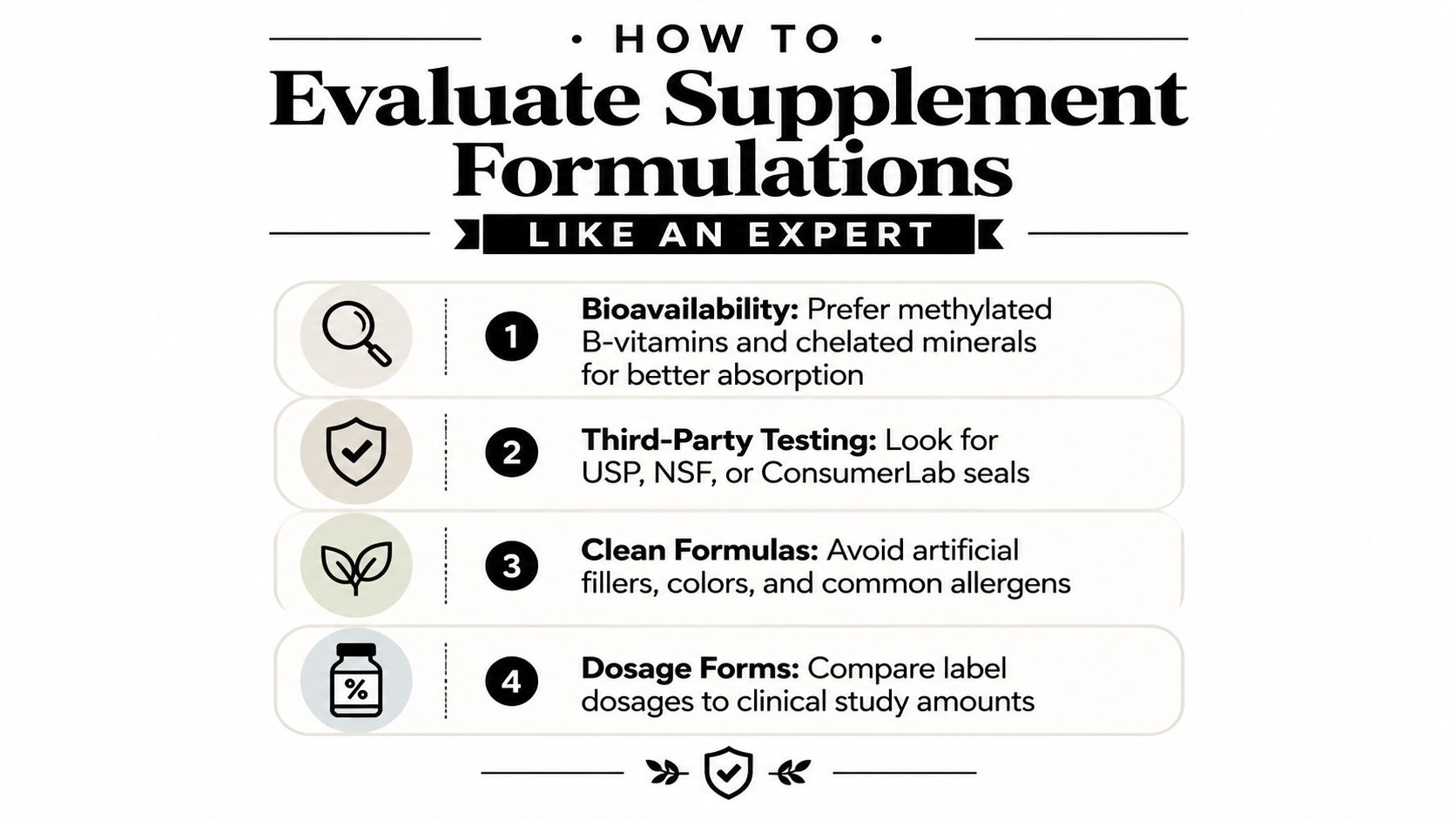
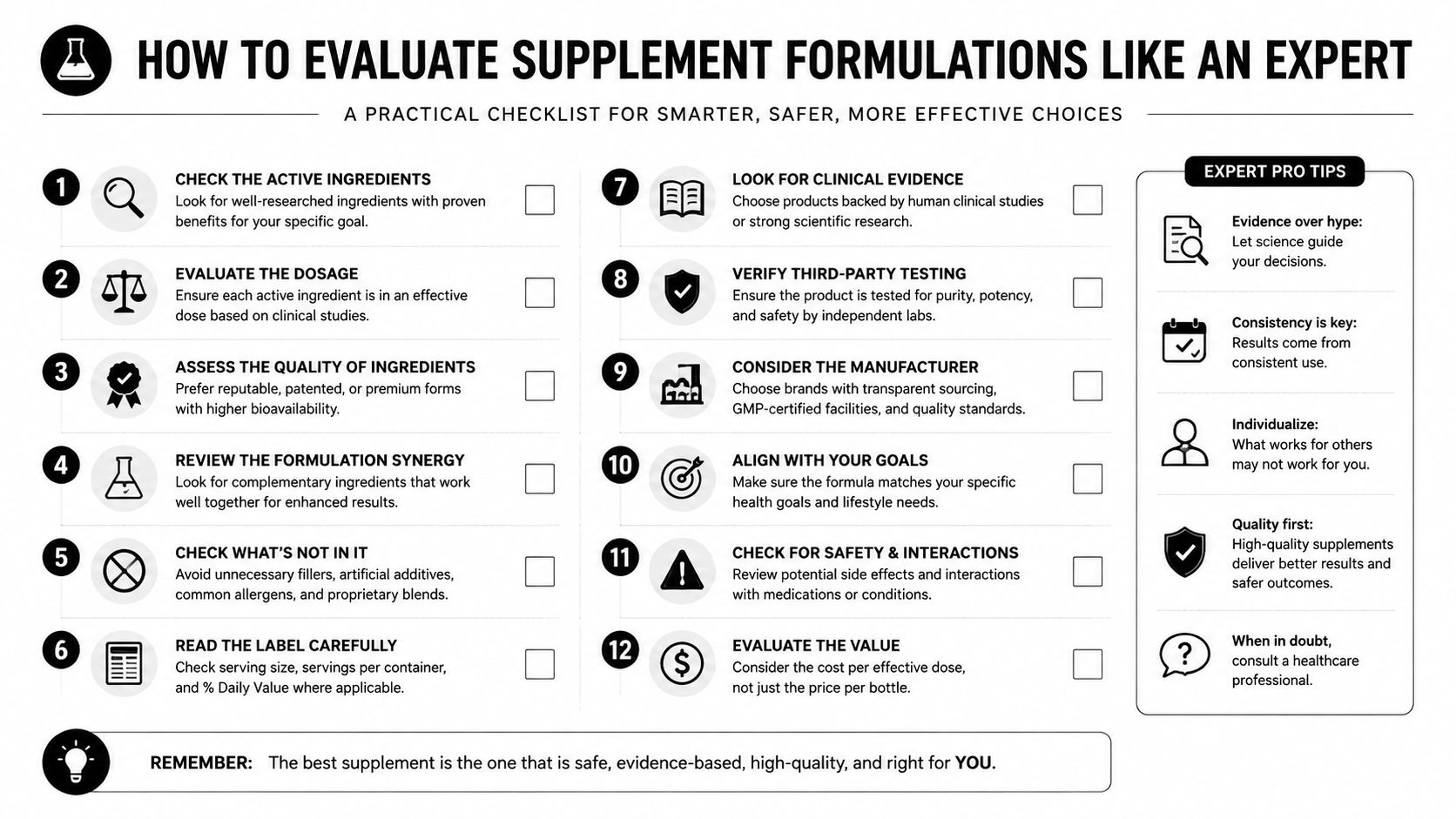
A good supplement label should read like a well-built plan, not a promise. The first question is absorption. The second is quality control. The third is whether the dose matches the problem. If a product fails any one of those, it may be expensive decoration.
Read the form, not just the ingredient list
Two products can contain the same nutrient and behave very differently. A chelated mineral may be easier for some people to tolerate than a cheaper form. Methylated B vitamins can matter for women who want a formulation that's easier to use biologically. These details aren't marketing flourishes, they're the mechanics of how the body handles the ingredient.
Check testing and dose against reality
Third-party testing matters because a polished label doesn't prove purity or consistency. Look for recognized verification such as USP, NSF, or ConsumerLab when they're available. Then compare the dose on the label with the purpose you have in mind. A token amount of a nutrient may look good in a blend but still be too small to matter.
A clean formula helps too. Fewer unnecessary fillers, colors, and common allergens usually means fewer reasons for the product to be irritating or confusing. That doesn't make every additive bad, but it does make the label easier to trust.
For a simple example of how absorption support gets discussed in supplement design, see this explanation of curcumin with black pepper. The same logic applies beyond turmeric. If the form isn't absorbable enough to matter, the label is doing more work than the ingredient.
Useful shortcut: if you can't explain why the form, dose, and testing matter, the product is probably built for shelf appeal rather than use.
Targeted Supplements Versus Broad Multivitamins
The clearest way to separate these two options is by purpose. Broad multivitamins try to cover many needs at once. Targeted supplements focus on one clear gap or symptom. For one woman, a general formula may be enough. For another, a more specific product will do the job better.
Criteria | Broad Multivitamin | Targeted Supplement |
|---|---|---|
Best for | General nutritional backup | A known gap or symptom |
Main strength | Convenience | Precision |
Main weakness | Can underdose the nutrient you actually need | Requires a clearer goal |
Typical use case | Busy routines, uncertain diet quality | Menstrual fatigue, pregnancy planning, low vitamin D, low B12, or a lab-confirmed need |
Evidence fit | Mixed for broad disease prevention | Stronger when tied to a specific deficiency or need |
A broad multivitamin can still be a reasonable starting point if your meals are inconsistent or you want a simple baseline while you sort out what matters most. It also makes sense as a short-term bridge when you do not yet have a clear target. The limits show up when people expect one bottle to do everything. As noted earlier, multivitamins are not proven shields against major disease outcomes, so the better question is what job you want the product to do.
Targeted supplementation fits better when the need is already clearer. A woman with menstrual fatigue may need iron support, not a full spectrum blend. Someone trying to conceive may benefit more from folate-centered support. A person with low energy linked to B12 may need a direct approach, such as methyl B-12 1000 mcg, instead of a general wellness formula that spreads the dose too thin.
The decision is often easier when you compare diagnostic-driven selection with shelf-driven selection. If you are matching a supplement to a lab result, a symptom pattern, or a known life-stage need, precision usually wins. If you are choosing from a store aisle without a clear reason, a basic multivitamin may be the simpler stopgap.
That difference matters because the body does not use every nutrient in the same way, or on the same timetable. A targeted product can act more like a specific tool in a medicine cabinet than a catch-all drawer of spare parts.
Adaptogens and Botanicals for Women's Wellness Goals
A woman looking at supplements does not always need another capsule for iron or folate. Sometimes the goal is steadier stress, better sleep, less soreness, or sharper focus. Botanicals can fit alongside basic nutrition when the goal is functional support.
Where botanicals can make sense
Curcumin from turmeric is often used for inflammation and joint comfort. Ashwagandha is commonly discussed for stress resilience and sleep quality. Ginger is familiar for digestion and recovery, while bromelain appears in formulas aimed at post-exercise soreness. These ingredients act differently, so the best choice depends on the reason you are taking them.
That matching matters. A woman with joint stiffness is solving a different problem than someone who wants a calmer mind before bed. One formula can cover more than one concern if it is designed carefully, but the purpose still needs to be clear.
Why formulation matters as much as the ingredient
Botanicals work better when the product design supports absorption and practical use. A standardized extract gives more consistency than a vague herbal blend. Support ingredients can help too, especially when the goal is to make the active compound easier for the body to use. Turmeric formulas that include black pepper extract show why ingredient pairing matters in this category.
For a practical read on stress-focused botanicals, The Rise of Adaptogens in 2025, and how ashwagandha can transform stress management, gives a useful example of how the category is being discussed.
The key is restraint. Botanicals should support a clear goal, and they work best when you choose them for a specific need rather than treating them like generic wellness extras. If sleep, stress, or recovery is the issue, a focused botanical blend can be more useful than another all-purpose tablet.
Building a Practical Daily Supplement Routine
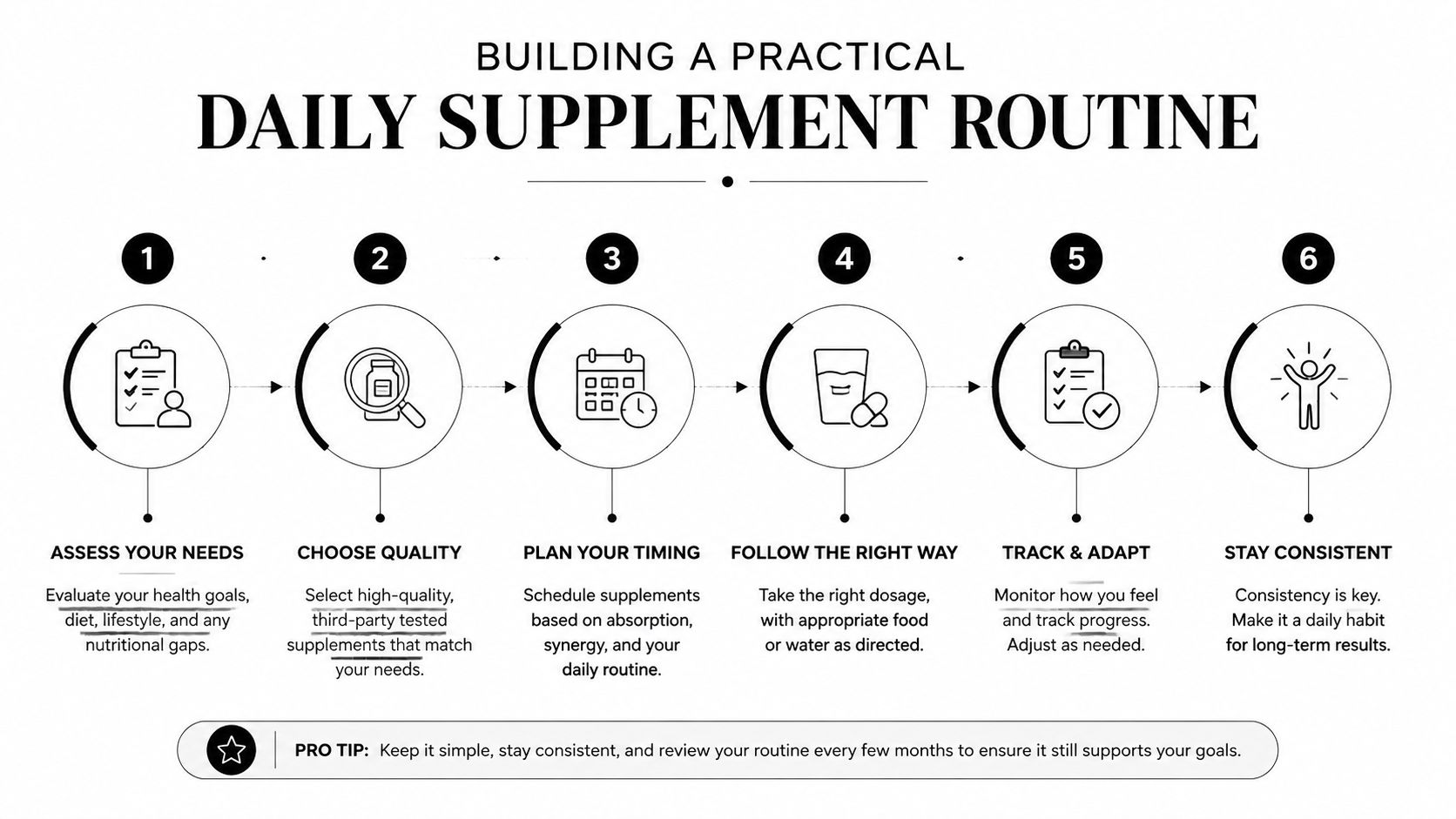
A good supplement routine is boring in the best way. It's easy to repeat, easy to remember, and built around the few things that matter most. Start with the highest-priority gap, not the longest product list.
Keep timing simple
Some supplements are easier on the stomach with food. Others are often taken on an empty stomach, depending on the ingredient and your tolerance. The practical goal is consistency, not perfection. If you can take a supplement every day at the same time, that usually beats an ideal schedule you never follow.
Build in layers
Start with the most likely gap, such as iron, folate, vitamin D, B12, or magnesium, rather than adding several products at once.
Add one new supplement at a time, so you can tell what helps and what doesn't.
Watch for medication interactions, especially if you take prescription drugs or already use multiple supplements.
Track changes in real life, like energy, sleep quality, or symptom patterns, instead of waiting for a dramatic feeling.
Pause and review if a supplement causes stomach upset, headaches, or anything that feels off.
Ask a clinician for guidance if you're pregnant, trying to conceive, managing a chronic condition, or unsure about a nutrient you may need.
A routine should support your life, not crowd it. Morning, afternoon, and evening can each have a purpose, but the schedule should stay flexible enough that you'll keep it. If a supplement isn't helping, the answer may be to change the ingredient, the dose, or the timing, not to take more of it.
Common Questions About Women's Vitamin Supplements
A reader often starts with a simple question and ends up with a lot of confusion. One woman wonders if a supplement can replace a balanced diet. Another wants to know whether a gummy is the same as a capsule. Someone else takes a product for two weeks, feels nothing, and assumes it failed.
A supplement can't replace real food, because food brings fiber, protein, and a broader nutrient pattern that pills don't deliver. Gummies can be convenient, but convenience doesn't automatically make them stronger than capsules. And results don't always show up as a dramatic “feeling,” especially when the supplement is correcting a subtle gap rather than chasing a quick symptom.
Practical answer: if the product doesn't match your need, don't blame the format first, blame the strategy.
If fatigue, mood, or sleep are your main concerns, start by asking whether the issue could be tied to an identifiable nutrient gap. If not, the supplement may be the wrong tool. That's the heart of the best women's vitamins supplements conversation, because the best choice is the one that fits the person, not the shelf.
If you want a cleaner way to think about women's supplements, visit River of Life and explore how a focused, ingredient-first approach can fit into a practical wellness routine. Their educational resources and capsule-based formulation philosophy are a useful example of how targeted support can feel simpler than a crowded supplement shelf.