


Best Supplement Anti Inflammatory

You wake up, swing your legs out of bed, and notice that your knees or fingers feel stiff before the day has even started. Maybe your back loosens after a shower, or your joints feel better once you move around. That pattern can make an anti-inflammatory supplement seem like an obvious next step, especially when product labels promise joint comfort, recovery, or calmer daily function.
The harder question is choosing well. A capsule can list turmeric, ginger, omega-3s, or other familiar ingredients and still deliver an inconsistent amount of the compounds that researchers study. The useful comparison isn't “Which ingredient is strongest?” It's Which formula provides a meaningful amount, in a form your body can absorb, for the problem you're trying to address?
Table of Contents
A Practical Checklist for Choosing the Best Anti-Inflammatory Supplement
Common Myths and Misconceptions About Anti-Inflammatory Supplements
Why Inflammation Matters and How Supplements Fit In
Inflammation is part of your immune system's repair process. After an injury or infection, the body sends signals and immune cells to the affected area. Heat, swelling, tenderness, and redness can be uncomfortable, but this short-term response helps protect tissue and begin healing.
The concern is persistent, low-grade inflammation. Instead of resolving after the original trigger has passed, immune signaling can remain active. People may experience ongoing stiffness, fatigue, reduced exercise tolerance, or a vague sense that recovery takes longer than it used to. These symptoms have many possible causes, so they shouldn't be treated as proof of one specific inflammatory condition.

Start with the foundations
Sleep, regular movement, a nutrient-dense eating pattern, and stress management do most of the foundational work. A supplement can help fill a specific gap or add targeted support, but it can't compensate for consistently poor sleep, inactivity, or an unbalanced diet.
People are paying closer attention to anti-inflammatory supplements because newer pooled research has produced a clearer, though still imperfect, picture of curcumin. A 2023 systematic review and dose-response meta-analysis found that curcumin supplementation significantly reduced C-reactive protein by 0.58 mg/L, tumor necrosis factor-alpha by 3.48 pg/mL, and interleukin-6 by 1.31 pg/mL. The review found no significant change for IL-1β. You can read the findings in the 2023 curcumin systematic review.
Those biomarkers matter because researchers commonly use CRP, IL-6, and TNF-α to assess measurable inflammatory activity. Still, a change in a blood marker isn't the same as a guaranteed improvement in pain, mobility, or energy for every individual.
Practical rule: Treat supplements as targeted support, not as a substitute for diagnosis or daily health habits.
This guide focuses on six compounds often compared in a best supplement anti-inflammatory search: turmeric or curcumin, piperine, ashwagandha, ginger, bromelain, and omega-3 fatty acids. The lens throughout is practical: evidence, dose, standardization, absorption, interactions, and fit for your personal goal.
The Core Anti-Inflammatory Ingredients Worth Knowing
A useful ingredient dossier starts by separating biological plausibility from human evidence. A compound may affect an inflammatory pathway in laboratory research, yet produce a smaller or less consistent result in people. Curcumin has the strongest evidence base in this group, but the broader research history is mixed. A 2019 review found no significant reductions versus control for several markers, including CRP, hsCRP, IL-6, and TNF-alpha, across the trials it evaluated. More recent pooled findings have been more favorable, which is one reason formulation and dose deserve attention.
Ingredient | Evidence strength | Typical researched dose | Primary role |
|---|---|---|---|
Turmeric or curcumin | Moderate, with newer pooled findings supporting measurable marker changes | Research uses vary by extract and formulation | Joint comfort and inflammatory signaling |
Piperine | Supporting ingredient rather than a standalone anti-inflammatory choice | Product-specific | Helps improve curcumin absorption |
Ashwagandha | Emerging to moderate for stress-related support | Extract-specific | Stress response and recovery support |
Ginger | Moderate for discomfort and recovery-related use | Preparation-specific | Botanical support for soreness and digestive comfort |
Bromelain | Emerging to moderate | Preparation-specific | Enzyme support around swelling and recovery |
Omega-3 fatty acids | Moderate, especially when EPA and DHA are clearly listed | Product-specific | Fatty-acid balance and inflammatory mediator production |
How the six compounds differ
Turmeric and curcumin are related but not interchangeable terms. Turmeric is the plant material, while curcumin refers to its main active compound group. Researchers often study standardized extracts because raw turmeric powder doesn't necessarily provide a predictable curcuminoid amount.
Piperine, from black pepper, is usually included to support curcumin uptake. It makes more sense as a delivery partner than as the main ingredient you buy for inflammation.
Ashwagandha is better understood as a stress-resilience botanical than a direct replacement for a joint-focused ingredient. Its relevance comes from the relationship between stress, sleep, recovery, and perceived discomfort. Extract identity matters, and labels should state whether they use root material or another plant part.
Ginger contains gingerols and related compounds. People often use it for occasional soreness, joint discomfort, and digestive support. The preparation can differ considerably between tea, powdered root, and concentrated extract.
Bromelain is a group of pineapple enzymes. It appears in formulas aimed at recovery and swelling, but its activity depends on how the product reports enzyme potency, not merely the weight of the powder.
Omega-3s provide EPA and DHA, which participate in the body's fatty-acid signaling network. A fish oil label that lists total oil without separately stating EPA and DHA makes comparison harder.
For a plain-language explanation of the first ingredient pair, see this guide to turmeric and curcumin supplements. The practical lesson is simple: don't rank ingredients without checking the form and the amount of the active compound.
Why Formulation and Bioavailability Change Everything
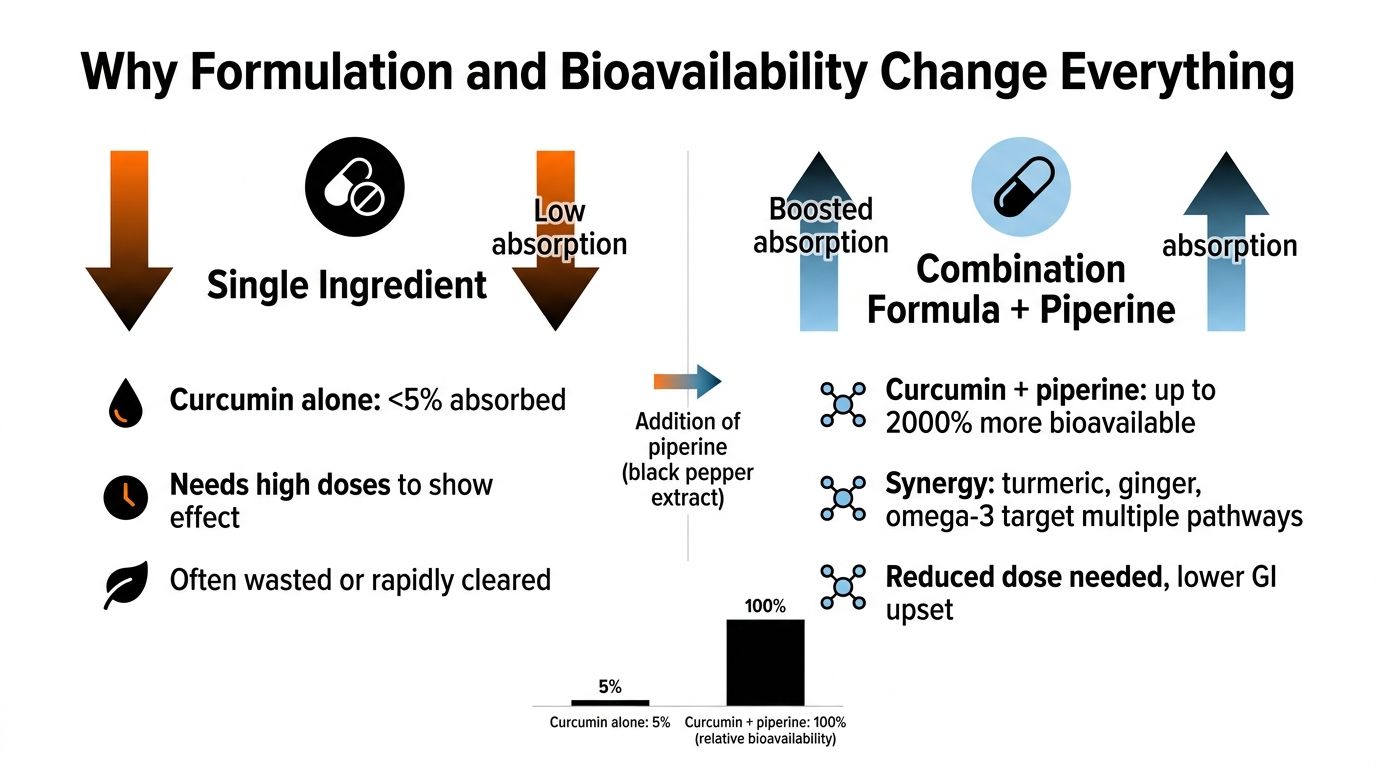
A label can show a large milligram number and still tell you very little about how much active compound reaches circulation. Bioavailability describes the portion that becomes available for the body to use. Curcumin is fat-soluble and is poorly absorbed on its own, so raw turmeric powder and a standardized, absorption-focused extract aren't equivalent choices.
A 2021 meta-analysis found that curcumin lowered CRP, IL-6, IL-8, and MCP-1, with greater effects reported for bioenhanced formulations than for non-bioenhanced forms. That finding supports a practical comparison: ask how the product delivers the ingredient, not only how much it contains. The curcumin meta-analysis in Nutrition Reviews provides the relevant evidence.
Compare delivery systems, not just ingredients
Raw plant powder offers a broad food-like profile but may provide less predictable active-compound exposure. Standardized extracts make the relevant compounds easier to identify. Enhanced formats may use piperine, phospholipid complexes, or micellar delivery to address absorption limitations.
The same reasoning applies beyond curcumin. With omega-3 products, compare the actual EPA and DHA listing and the oil form. With ashwagandha, check whether the label identifies the plant part and extract type. A full-spectrum product and a root-only product aren't automatically interchangeable.
Watch this short visual explanation before comparing labels:
A combination formula may be useful when its ingredients have distinct roles. Turmeric and ginger can address botanical inflammatory signaling, omega-3s contribute fatty-acid support, and ashwagandha targets stress-related factors that can affect recovery. That doesn't prove every blend will outperform a single ingredient. It does mean a thoughtful formula may be more rational than taking a very large amount of one poorly absorbed compound.
For a closer look at the pairing, read about curcumin with black pepper.
How to Read an Anti-Inflammatory Supplement Label
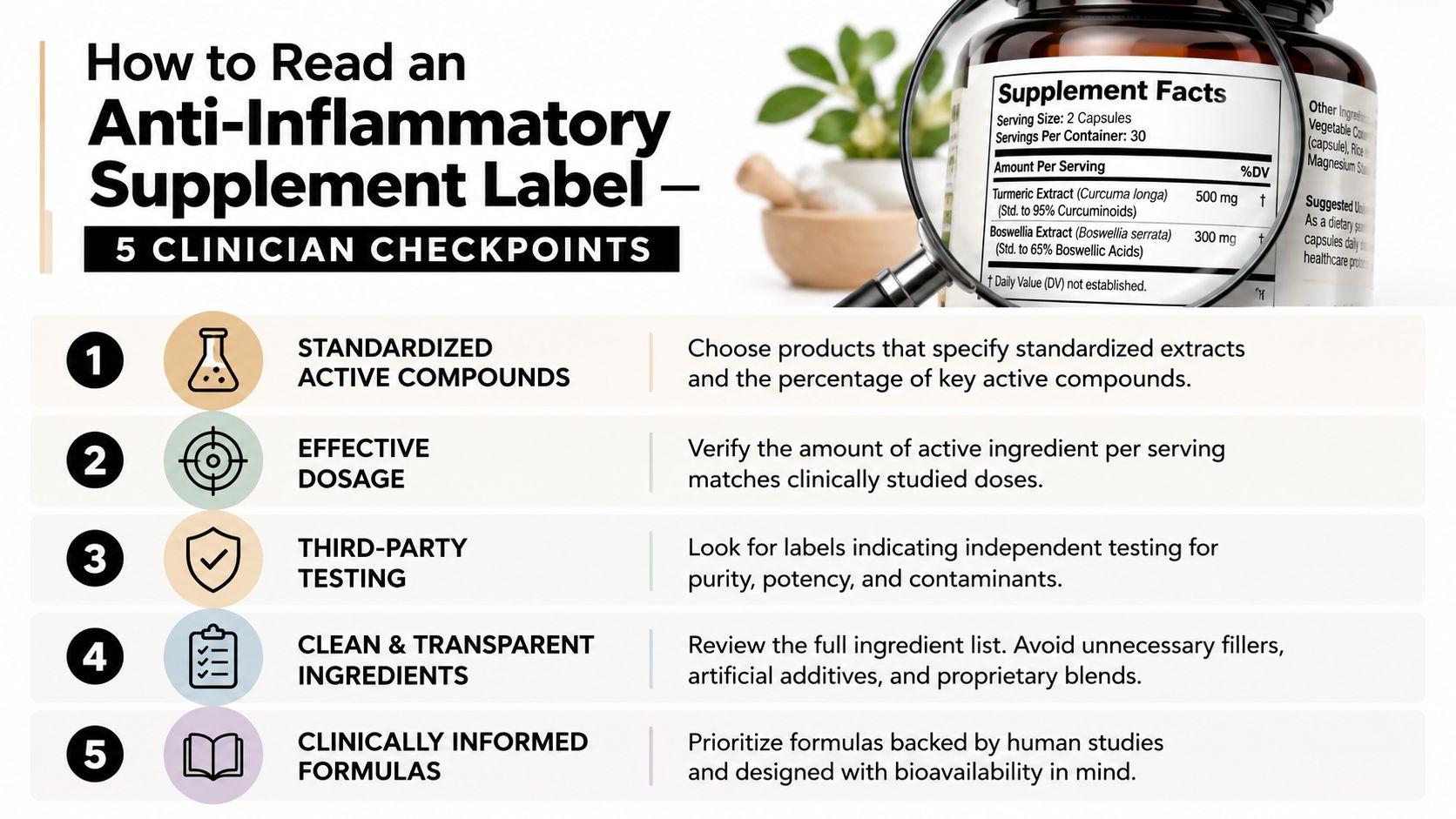
Read the Supplement Facts panel before reading the front of the bottle. Marketing language often highlights the plant name, while the panel tells you whether the formula provides a standardized active amount, a transparent serving size, and a meaningful delivery method.
Five checks that quickly reveal label quality
Find the standardized active. A turmeric capsule should identify its curcuminoid content or extract standardization when that information is central to the product's purpose. The same principle applies to withanolides in ashwagandha.
Confirm the exact amount per serving. “Turmeric 600 mg” doesn't tell you how much curcumin it contains. A transparent label separates the plant material from the active compound or clearly identifies the extract specification.
Look for a verifiable absorption strategy. Piperine, a phospholipid complex, or micellar delivery can explain how a product addresses poor uptake. Be cautious with vague phrases such as “maximum strength absorption” that don't identify the mechanism.
Check independent quality controls. Third-party testing can help verify identity, purity, and label accuracy. Look for a named testing program or accessible quality documentation rather than relying on a generic quality badge.
Scan the other ingredients. Excipients aren't automatically harmful, but a short, transparent list is easier to evaluate. Avoid products that conceal quantities inside proprietary blends, because you can't tell whether each component reaches a useful level.
A one-minute comparison
Write down the active amount, serving size, extract type, absorption support, testing information, and any proprietary blend. Then compare like with like. A standardized curcumin extract shouldn't be compared directly with an unstandardized turmeric powder because both labels use the word “turmeric.”
Label-reading shortcut: If you can't identify the active compound, the amount per serving, and the delivery method, you can't make a meaningful potency comparison.
Dosing, Safety, and Who Benefits Most
Dose isn't a universal prescription. Research products differ in extract concentration, formulation, and population, so a number printed on one bottle may not translate directly to another. The following reference reflects the ranges specified for this guide, but anyone taking medication or managing a condition should confirm a plan with a healthcare professional.
Ingredient | Typical daily dose | Standardization | Key cautions |
|---|---|---|---|
Turmeric or curcumin | 500 to 1,000 mg curcuminoids | Identify curcuminoid content and absorption support | Extra caution with blood thinners |
Omega-3 fatty acids | 1,000 to 3,000 mg EPA and DHA | Confirm EPA and DHA separately | Discuss use with a clinician if bleeding risk is relevant |
Ginger | 0.5 to 2 g extract | Identify extract type and amount | May require caution with hypoglycemics |
Ashwagandha | 300 to 600 mg standardized extract | Confirm extract identity and withanolide information | Extra caution with thyroid conditions and some medicines |
Bromelain | 200 to 900 mg between meals | Look for enzyme potency details | Ask a clinician about bleeding and medication interactions |
Match the formula to the person
A physically active adult may care most about post-workout soreness and recovery. Someone with a desk-based routine may prioritize stiffness and movement comfort. Another person may be more interested in stress, sleep continuity, and the way those factors affect recovery.
Pregnant people, those using anticoagulants, people with thyroid conditions, and anyone taking immunosuppressants need individualized advice before using a multi-ingredient formula. Curcumin can interact with blood-thinning medicines, and ginger may require caution with blood-glucose-lowering drugs. These aren't reasons to panic, but they are reasons to check first.
A supplement should also be reconsidered if it causes persistent stomach upset, unusual bruising, or other concerning symptoms. Stop and seek professional guidance when a reaction seems significant. For broader context on non-prescription approaches, see this resource on natural pain relief.
The right question isn't “What is the strongest dose?” It's “What dose and formulation fit my goal, health history, medications, and tolerance?”
A Practical Checklist for Choosing the Best Anti-Inflammatory Supplement
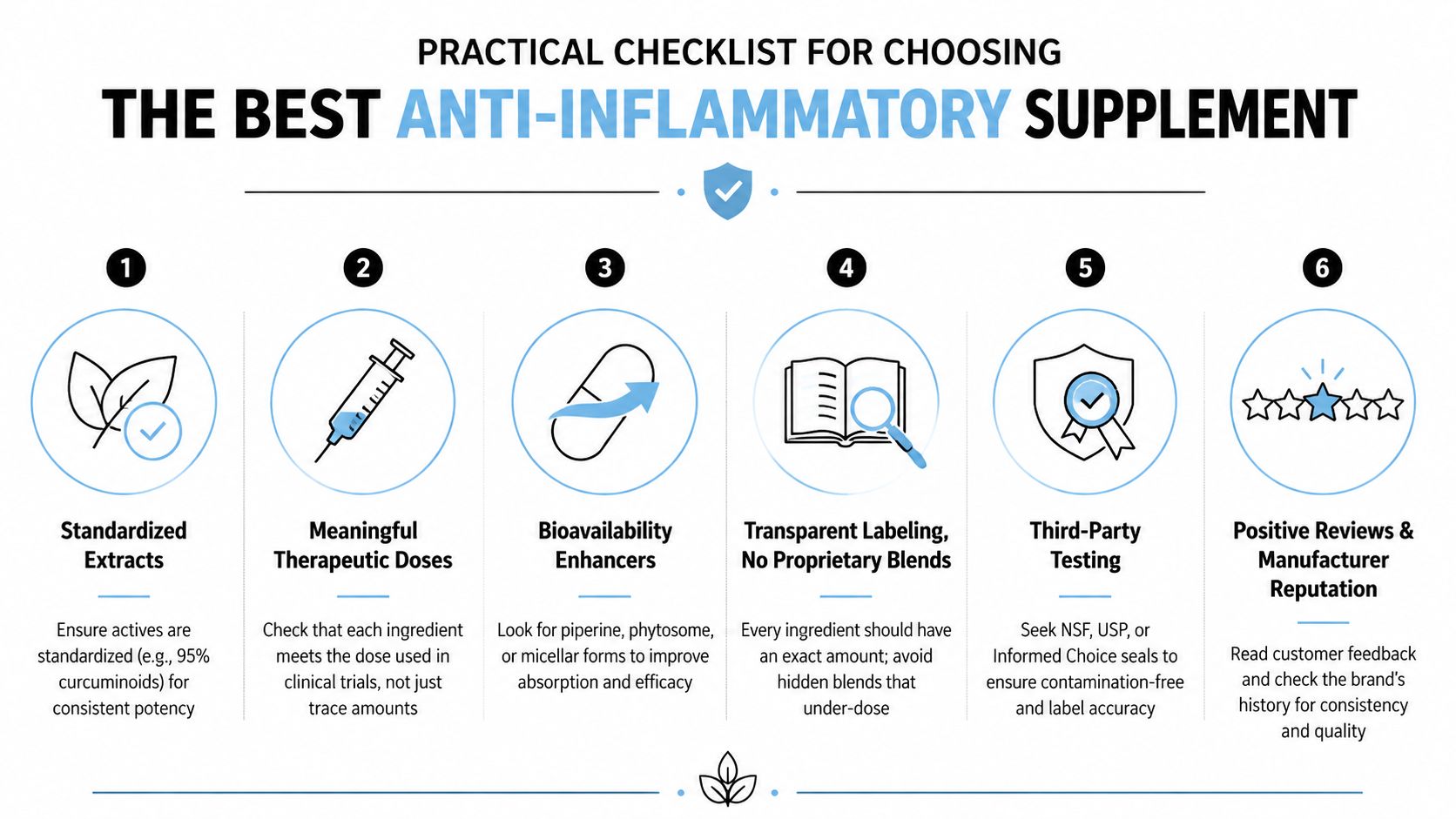
Use this checklist before buying any product. It helps you compare a single ingredient with a multi-ingredient formula without allowing a dramatic front-label claim to do the thinking for you.
Standardized extracts: Look for clearly identified active compounds. A named turmeric extract with stated curcuminoid content is easier to evaluate than an unspecified botanical powder.
Meaningful amounts: Check every ingredient's quantity per serving. A long ingredient list isn't useful if the manufacturer hides amounts or includes only trace quantities.
Absorption support: Determine whether the formula uses piperine, a phospholipid complex, micellar delivery, or another clearly described approach. The goal is to address the ingredient's known delivery limitation.
Transparent labeling: Proprietary blends make it difficult to compare products. A readable panel should show each ingredient and its amount.
Independent testing: Look for named third-party testing or certification. Documentation should relate to identity, purity, contamination control, or label accuracy.
Reasonable synergy: Choose combinations where each ingredient has a clear purpose. Turmeric and BioPerine can be paired for compound delivery, while ginger and bromelain are commonly positioned for botanical and enzyme support. Ashwagandha serves a different role around stress and recovery.
Applying the checklist to one formula
River of Life Capsules combine turmeric extract with BioPerine black pepper, ashwagandha root, ginger, and bromelain in a vegan capsule format. That ingredient profile gives the product a multi-pathway design, but you should still inspect its current Supplement Facts panel for exact quantities, standardization details, and available testing information before deciding whether it fits your needs.
A combination can reduce the practical burden of buying and timing several separate bottles. It doesn't remove the need to compare doses, check interactions, or ask whether each included ingredient is relevant to your goal. Convenience is valuable only when transparency stays intact.
Common Myths and Misconceptions About Anti-Inflammatory Supplements
Myth one says more is always faster
A larger dose does not guarantee greater benefit. Absorption can limit how much reaches the body, while higher amounts may cause digestive discomfort or complicate medication safety. Curcumin research also resists one universal dosing rule because formulation and study design affect results. A review of meta-analyses reported significant reductions in CRP in 7 of 10 meta-analyses, IL-6 in 5 of 8, and TNF-α in 6 of 9, as documented in the review of curcumin meta-analyses.
Myth two promises instant relief
A person may notice a subjective change quickly, especially when a supplement becomes part of a familiar post-exercise routine. Biomarker findings do not make every supplement an immediate pain reliever, and responses differ between individuals. Use a consistent routine long enough to judge it fairly, but stop promptly if a concerning reaction develops.
Myth three treats a capsule as a cure
A supplement cannot diagnose arthritis, repair an injury, or replace care for an autoimmune or metabolic condition. A 2025 dose-response meta-analysis in prediabetes and type 2 diabetes found improvements in inflammatory and oxidative stress markers, while rating overall certainty as low because of heterogeneity and publication bias, as described in the 2025 curcumin dose-response analysis.
The useful expectation is support, not a guaranteed outcome. Food quality, sleep, movement, stress regulation, and appropriate medical care remain the foundation. A capsule can be one tool in that plan, not the whole plan.
Your Next Three Steps Toward Calmer, Healthier Days
Step one, audit your current routine
For several days, note your sleep quality, movement, meals, stress level, stiffness, and recovery. You're not trying to create a perfect health score. You're looking for the clearest gap. If you rarely move during the workday, a walking and mobility habit may offer more value than immediately adding another capsule.
Also write down your medications, existing supplements, and relevant health conditions. This list gives a pharmacist or clinician the information needed to screen for interactions.
Step two, compare products by evidence and delivery
Return to the label checklist. Confirm the active compounds, exact serving amounts, extract details, absorption strategy, and testing information. If a formula combines several ingredients, ask whether each one has a clear role for your goal rather than treating a long ingredient list as proof of quality.
A 2025 review concluded that anti-inflammatory supplements are promising as adjuncts, not replacements, and identified continuing needs for better research on dose, duration, and formulation. That is a useful standard for shoppers: choose a transparent product, but keep your expectations proportionate to the evidence.
Step three, use one consistent routine and evaluate it
Take the product according to its label and track a small number of outcomes, such as morning stiffness, exercise recovery, or sleep continuity. A simple symptom journal helps you distinguish a real pattern from a single good or bad day.
A thirty-day evaluation window can provide a practical structure for reviewing consistency, tolerance, and perceived benefit, but it isn't a guarantee that every supplement will show a measurable effect in that time. Contact a healthcare provider sooner if symptoms worsen, if you take prescription medication, or if you're managing a diagnosed condition.
The best supplement anti-inflammatory option is the one you can evaluate: appropriate for your health profile, supported by a credible formulation, and used alongside habits that make calmer, healthier days more likely.
River of Life offers a vegan multi-ingredient capsule combining turmeric extract with BioPerine, ashwagandha root, ginger, and bromelain for people seeking a convenient formula focused on joint comfort, stress resilience, and recovery support. Review the current ingredients, safety information, and purchase options at River of Life before deciding whether it belongs in your routine.