
Clean Label Supplements Explained and How to Choose

You're standing in a supplement aisle, comparing two bottles that both promise a “clean” formula. One has a short ingredient list. The other mentions vegan capsules, standardized extracts, and third-party testing. Both sound reassuring, but the labels don't tell you whether the ingredients were tested by batch, whether the active dose is meaningful, or whether a “free-from” claim covers the concern you have.
That uncertainty is the core problem with clean label supplements. The phrase suggests simplicity, but simplicity alone doesn't prove identity, potency, safety, traceability, or absorption. A product can look natural and still provide limited information about how its raw materials were sourced or how its finished capsules were verified.
This guide turns clean-label language into practical questions. You'll learn what the term means, how to separate free-from claims from genuine certifications, why excipients matter, how lot-level testing works, and where bioavailability fits into the decision. A real product example will show how to apply the same checks to an actual multi-ingredient formula.
By the end, you won't need to guess from front-label design. You'll be able to ask what's included, why it's included, how the manufacturer controls it, and what evidence supports the finished product.
Table of Contents
Understanding What Clean Label Means in Supplements
Clean label began as part of a wider food-transparency movement. Shoppers wanted ingredient names they could recognize, clearer sourcing information, and fewer artificial colors, flavors, and preservatives. The idea became a recognizable supplement trend during the 2010s, with industry coverage describing it as a dominant theme during 2014–2020, as reported in the ADM clean-label supplement infographic.
In plain language, a clean label supplement aims to make the formula easier to understand and more deliberate. It usually emphasizes recognizable ingredients, fewer unnecessary additives, transparent quantities, and clear communication. That doesn't mean every product must have the shortest possible label. It means each ingredient should have a stated purpose, and the manufacturer shouldn't hide important details behind vague wording.
Think of a supplement like a pantry shelf. You'd probably feel more comfortable seeing “oat flour,” “ginger,” and “cinnamon” than a label that groups everything under “natural blend.” But a familiar pantry ingredient doesn't automatically prove freshness, correct quantity, or absence of contamination. The same principle applies to capsules and powders. Recognizable names improve clarity, but testing and documentation establish confidence.
The market context helps explain why brands use this language. One independent report values the global clean label supplements market at $9.8 billion in 2025 and projects it to reach $18.1 billion by 2034, implying a 7.8% CAGR over that period, according to Market.us's clean-label supplements market report. The same report says clean-label products represent about 31% of the global supplement market in 2026, with clean-label supplements growing at 7.8% CAGR compared with 3.8% for conventional supplements.
Practical rule: Treat “clean label” as a request for transparency, not as a safety certificate.
There's an important legal distinction behind that rule. Clean label isn't a formally protected definition, so one brand might use it to mean no artificial colors, while another might focus on vegan capsules, organic sourcing, or a short excipient list. Read the actual ingredient panel and quality documentation instead of assuming the phrase has the same meaning everywhere.
Common Claims and Certifications Decoded
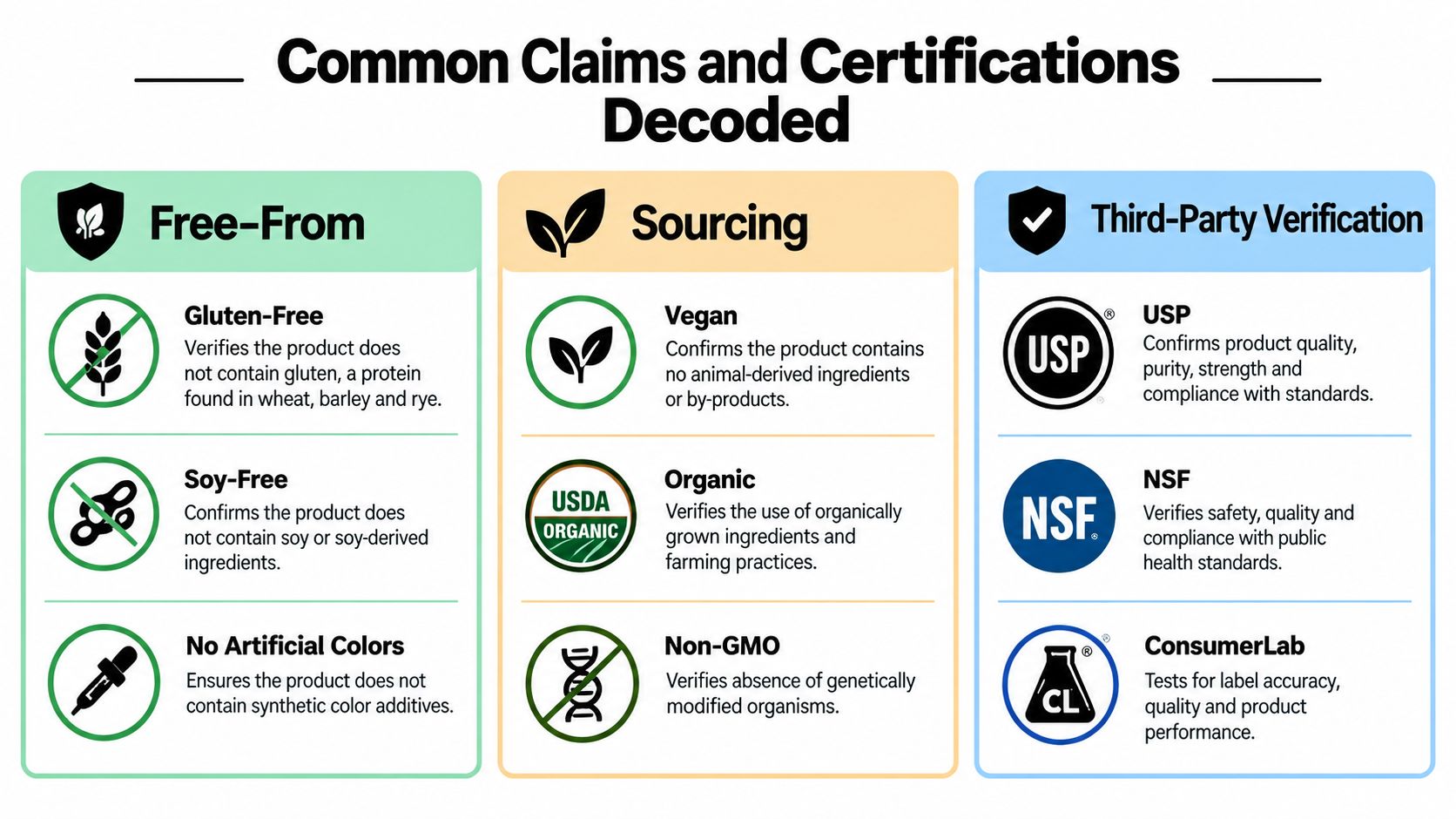
The easiest way to read supplement claims is to place them into three groups: what the product excludes, where ingredients come from, and who verified the finished product. These groups answer different questions, so one shouldn't substitute for another.
A free-from claim addresses a specific ingredient or category. “Gluten-free” may matter if you avoid gluten, while “soy-free” may matter because of an allergy or dietary preference. “No artificial colors” tells you something about formulation choices, but it doesn't tell you whether the product contains the declared amount of turmeric or passed a heavy-metal screen.
Sourcing claims describe origin or production standards. Vegan generally refers to the absence of animal-derived materials in the formula, while non-GMO addresses genetically modified organisms. Organic certification, where properly documented, concerns defined agricultural and processing requirements. None of these claims automatically proves potency, identity, or contaminant control.
Third-party verification focuses on testing or manufacturing standards. Programs associated with organizations such as USP, NSF, or ConsumerLab can involve different evaluation scopes, so check the exact seal and its accompanying documentation. A seal is meaningful only when you know what was tested, against which standard, and whether the evaluation covered the specific product or batch.
Claim or Seal | What It Verifies | What It Does Not Guarantee |
|---|---|---|
Gluten-free | The product meets the applicable gluten-free claim standard | That the formula is potent, organic, or free from every allergen |
Vegan | The declared formula avoids animal-derived ingredients | That raw materials are contaminant-free or clinically effective |
Non-GMO | The stated non-GMO sourcing or verification requirements | That the ingredient is natural, safe for everyone, or well absorbed |
Organic | Compliance with the relevant organic standard | That the formula contains no excipients or delivers a specific outcome |
No artificial colors | The manufacturer's stated approach to coloring ingredients | Batch identity, heavy-metal status, or active dosage |
Third-party testing | Testing or review by an outside organization, depending on the program | That every claim on the bottle has been independently confirmed |
The label itself deserves a second look. A clear panel lists ingredients individually, identifies serving size, and gives the amount of each active ingredient. A proprietary blend that reveals only a combined total makes it harder to judge the contribution of each component.
For a deeper look at how evidence and formulation choices relate, compare a product's transparency with the principles discussed in supplements backed by science. Use your own priorities to rank claims. Someone managing an allergy may start with allergen controls, while someone concerned about contamination may prioritize lot-specific laboratory reports.
Ingredient Sourcing and Transparency Standards That Matter
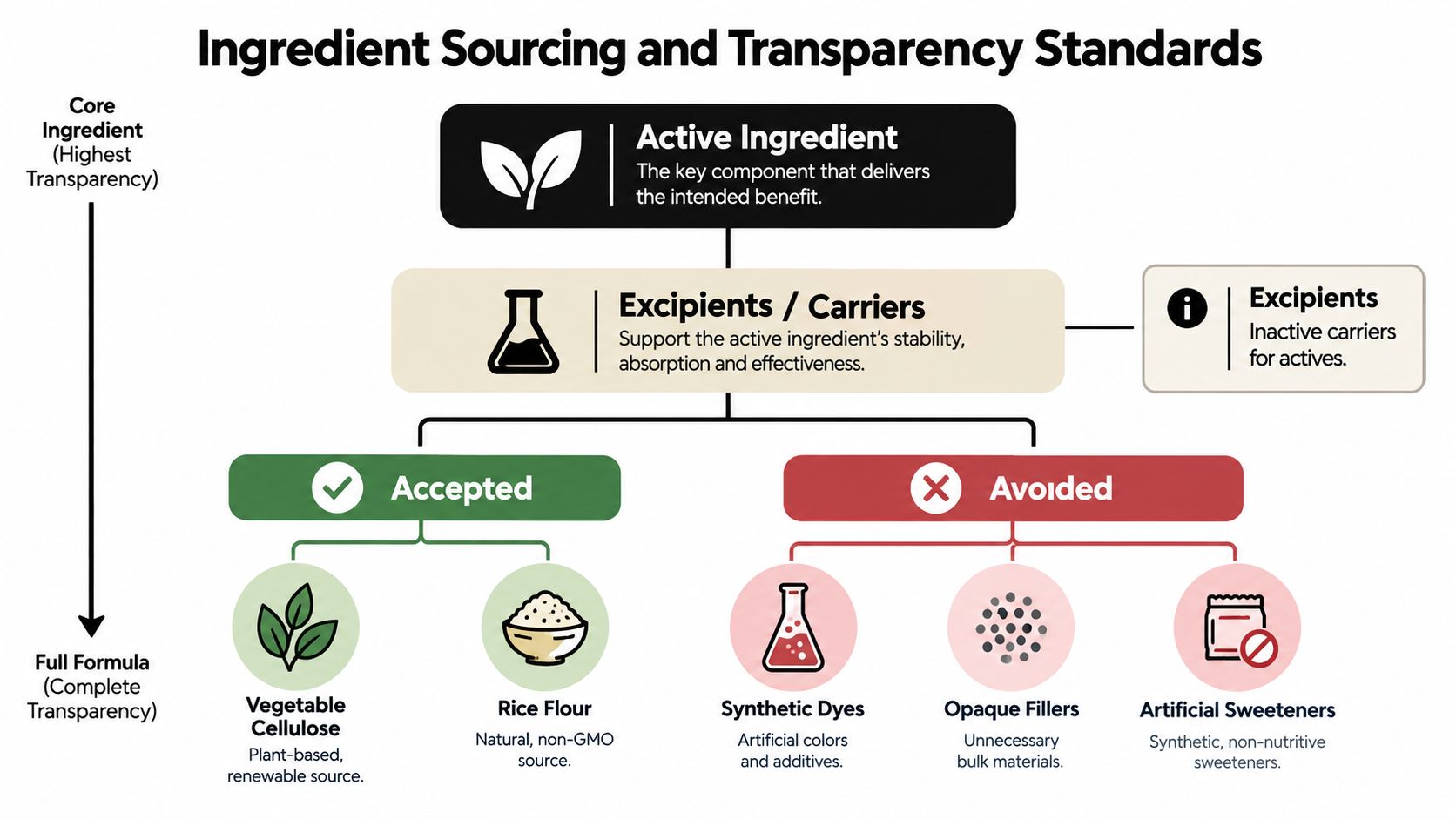
A clean-looking label can hide a complicated manufacturing challenge. Supplement formulas contain active ingredients, but they may also need excipients, which are inactive carriers that help move, blend, compress, or fill those actives consistently.
The clean-label approach usually minimizes artificial colors, sweeteners, preservatives, and opaque fillers. That goal can improve readability, but removing a conventional flow agent doesn't make the production problem disappear. Powders may flow less evenly, capsules may fill with greater variation, and moisture may affect stability. Manufacturers then need tighter controls over particle size, moisture, blending, and processing conditions.
This is why “fewer ingredients” and “better formulation” aren't identical ideas. A clearly named rice flour or vegetable cellulose carrier may serve a practical purpose that supports consistent dosing. The stronger question is whether the carrier is disclosed, necessary, and appropriate for the product, rather than whether every inactive ingredient sounds like a kitchen ingredient.
What transparent sourcing looks like
Traceability starts before the capsule reaches the bottling line. A responsible sourcing record can identify the plant part used, the supplier, the extract specification, and the controls applied during receiving and processing.
For botanical products, details such as root-only sourcing or a standardized extract can matter. “Turmeric” alone doesn't tell you whether the product uses a whole root, a concentrated extract, or an unspecified blend. “Ashwagandha” doesn't explain whether the formula uses root material, leaf material, or both. Those distinctions affect how precisely a reader can interpret the label.
Look for practical documentation rather than broad promises:
Ingredient identity: The botanical, plant part, extract type, and standardization should be stated clearly.
Supplier controls: The brand should be able to explain how it qualifies raw-material suppliers.
Lot information: A lot number should connect the bottle to manufacturing and testing records.
Accessible documentation: A QR code or customer-service process can make certificates and specifications easier to verify.
Purposeful excipients: Inactive ingredients should be named and linked to a functional role.
A detailed guide to reading Supplement Facts panels can help you connect serving size, active amounts, and inactive ingredients. Transparency works best when the information is specific enough for a reader to make a decision without needing a formulation scientist beside them.
Lab Testing and Bioavailability Expectations Explained
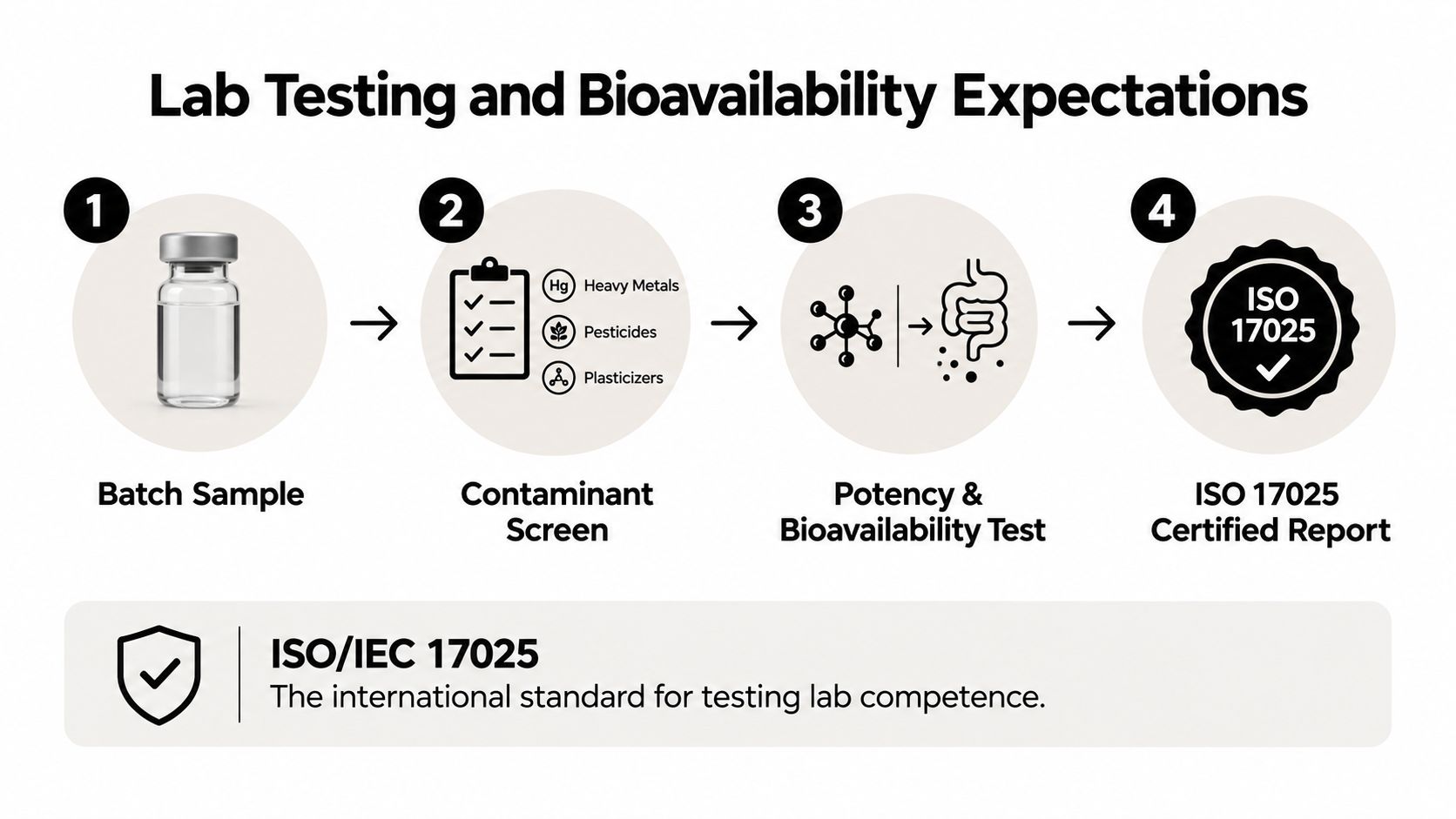
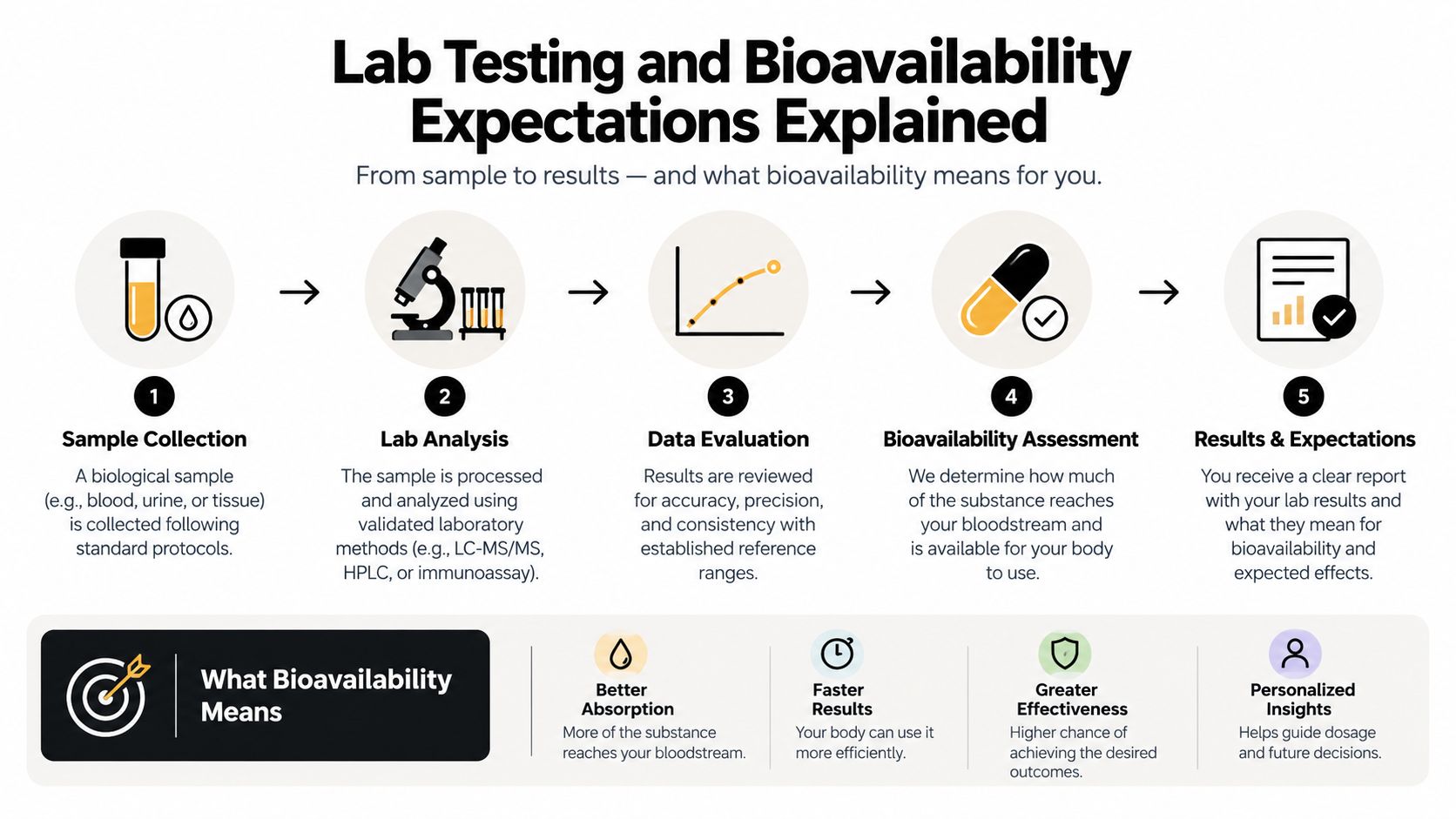
A short ingredient list doesn't answer the most important quality question: did the finished batch contain what the label says, and did it avoid relevant contaminants? Batch-level verification addresses that gap by connecting test results to a specific lot rather than relying only on a general company statement.
Independent certification programs may purchase products from retail channels and test them in ISO-accredited laboratories. The testing can examine heavy metals, pesticide residues, plasticizers, and other chemicals of concern, with some programs using more than 200 analytes and benchmarks linked to California Proposition 65 and other regulatory limits, as described by the BSCG explanation of clean-label supplement certification.
What a meaningful report can show
For trace metals, laboratories commonly use ICP-MS, a sensitive analytical method. An ISO/IEC 17025-accredited lab demonstrates competence through an established standard for laboratory testing and calibration work. The report should still identify the sample, methods, detection limits, results, and relevant acceptance criteria.
A lot-specific Certificate of Analysis, or COA, can provide evidence about:
Identity: Whether the raw material or finished product matches the declared ingredient.
Potency: Whether active compounds meet the stated specification.
Microbiology: Whether the product meets its microbial limits.
Contaminants: Whether testing addressed metals, pesticides, plasticizers, or other relevant risks.
Lot connection: Whether the document applies to the same lot number printed on your bottle.
Cleaner sourcing and packaging inputs can reduce the probability of failing contaminant screens, but no ingredient list can prove that outcome by itself. The evidence must come from a documented quality system and testing performed on an identified sample.
Why absorption belongs in the conversation
Safety and potency aren't the whole story. Bioavailability asks how much of an ingredient becomes available for the body to use after someone consumes it. A clean formula containing a poorly absorbed compound may look impressive on paper but provide less practical value than a formula that includes a clearly explained absorption strategy.
Turmeric illustrates the issue. A standardized turmeric extract can provide a defined composition, but the manufacturer may pair it with an absorption enhancer such as BioPerine. That added ingredient isn't automatically a contradiction of clean label. It may serve a clear technological or biological purpose.
Judge the claim carefully. Ask which ingredient was studied, what form was used, whether the cited evidence relates to the finished combination, and whether the label gives enough information to understand the serving. A functional processing aid or absorption enhancer can be justified when the brand explains its role instead of treating every additive as undesirable.
For a plain-language explanation of this topic, see supplement bioavailability. The clean-label decision is strongest when simplicity, verified quality, and useful delivery support one another.
Red Flags to Avoid and Myths That Mislead
The biggest clean-label mistake is treating appearance as evidence. A white bottle, green leaves, and a short ingredient list can create a health impression without showing how the product was tested or whether the active dose is clearly disclosed.
Myth versus reality
Myth: A shorter label is always safer.
Reality: A short list may reduce unnecessary ingredients, but it doesn't establish identity, potency, microbial quality, or contaminant status. A transparent carrier can be more reassuring than an unnamed “natural blend.”
Myth: “Natural” means standardized.
Reality: Natural describes a source or positioning, not necessarily the concentration of active compounds. Look for the extract type, plant part, and standardization details.
Myth: Free-from claims prove overall quality.
Reality: “No artificial colors” addresses coloring. It doesn't tell you whether the product passed heavy-metal testing or contains the declared amount of each active.
Myth: Every excipient is junk.
Reality: Excipients can help powders flow, capsules fill consistently, or products remain stable. The concern is unnecessary or undisclosed use, not the existence of inactive ingredients.
Myth: A proprietary blend protects a special formula.
Reality: Grouping ingredients under one total can prevent you from seeing the amount of each component. If the product makes an efficacy claim, hidden quantities make that claim harder to assess.
Warning signs that deserve a closer look
Be cautious when a product uses broad words such as “pure,” “clean,” or “detox” without defining them. Also question labels that omit serving-size context, hide quantities in blends, or display seals without explaining the testing program.
Verification habit: Move from the front panel to the back panel, then from the back panel to the lot documentation.
A product can also become less useful when a manufacturer removes a functional ingredient solely to preserve a short label. Standardized extracts and absorption enhancers may support consistency or delivery, so evaluate their purpose and evidence rather than judging them by category alone. The Biohealth discussion of clean-label trends describes this wider movement toward transparency, personalization, and bio-optimization.
Finally, remember that clean label isn't a guarantee of suitability. Allergies, medications, pregnancy, chronic conditions, and individual sensitivities require personal medical guidance. A clear label helps you ask better questions, but it doesn't replace advice from a qualified healthcare professional.
Your Clean Label Checklist and How River of Life Aligns
A practical checklist should take you from marketing language to evidence without turning every purchase into a laboratory investigation. Start with the label, then look for the documentation that supports it.
Read every ingredient: Confirm that active ingredients and excipients are named individually.
Check the serving: Make sure the product states how many capsules or scoops provide the listed amounts.
Ask why each inactive ingredient is present: A carrier may support flow or consistency, but the role should be understandable.
Look for botanical detail: Check plant part, extract form, and standardization where relevant.
Separate claims: Vegan, organic, non-GMO, and free-from claims answer different questions.
Find lot-level evidence: Prefer a COA or testing record connected to the lot on your bottle.
Review laboratory competence: Look for ISO/IEC 17025 accreditation or a clearly described independent testing program.
Evaluate absorption: Ask whether the active form is known to need delivery support and whether the rationale is documented.
Check practical fit: Consider capsule count, storage, return terms, and whether the routine is realistic for you.
Applying the checklist to one formula
River of Life Capsules offer a concrete example of how to inspect a multi-ingredient product. The vegan capsule formula combines standardized turmeric extract with BioPerine black pepper extract, alongside ashwagandha root, ginger, and bromelain. The product description states no fillers, and the formula uses a direct-to-consumer model with one-time and subscription purchase options.
The absorption question is visible rather than hidden. BioPerine is included to support turmeric absorption, so the formulation doesn't treat “clean” as a demand for removing every functional supporting ingredient. The ashwagandha positioning identifies root material, while the product's educational resources discuss the ingredients and their intended wellness context.
That information supports label review, but it shouldn't be stretched into a guarantee of individual results. A careful buyer would still check the serving details, confirm the current ingredient panel, ask for lot-specific quality documentation, and review possible interactions with a healthcare professional.
The company offers a 60-capsule bottle, flexible one-time or subscription purchasing, shipping to more than 40 countries, and a 30-day return policy for unopened bottles. Those logistical details matter because a transparent formula only helps if the product fits your routine and you can obtain the information needed to use it responsibly.
River of Life offers a vegan multi-ingredient capsule built around standardized turmeric, BioPerine, ashwagandha root, ginger, and bromelain, with direct online ordering and flexible purchase options. If you want to evaluate a clean-label formula through ingredient purpose, absorption support, and product transparency, visit River of Life and review the current product details.