

Aleve Dosage: A Complete Guide for 2026

One Aleve caplet contains 220 mg of naproxen sodium, and the standard adult dose is 1 caplet every 8 to 12 hours, with a maximum of 3 caplets in 24 hours. If needed, the first dose can be 2 caplets taken within the first hour, but that still doesn't change the daily limit.
You may be standing in the medicine cabinet with a headache, sore back, or aching knee, wondering whether one Aleve is enough and when you can safely take another. The answer depends on more than counting pills. Age, kidney function, heart history, ulcer risk, other medicines, and supplements can all change whether the standard label is appropriate for you.
Aleve contains naproxen sodium, a nonsteroidal anti-inflammatory drug, or NSAID. It can relieve pain, reduce inflammation, and lower fever, but taking more than directed can increase the chance of serious stomach, cardiovascular, and kidney problems. The safest approach is to use the lowest effective amount for the shortest practical period and ask a healthcare professional when your health history makes the label less straightforward.
Table of Contents
Standard Aleve Dosage for Adults
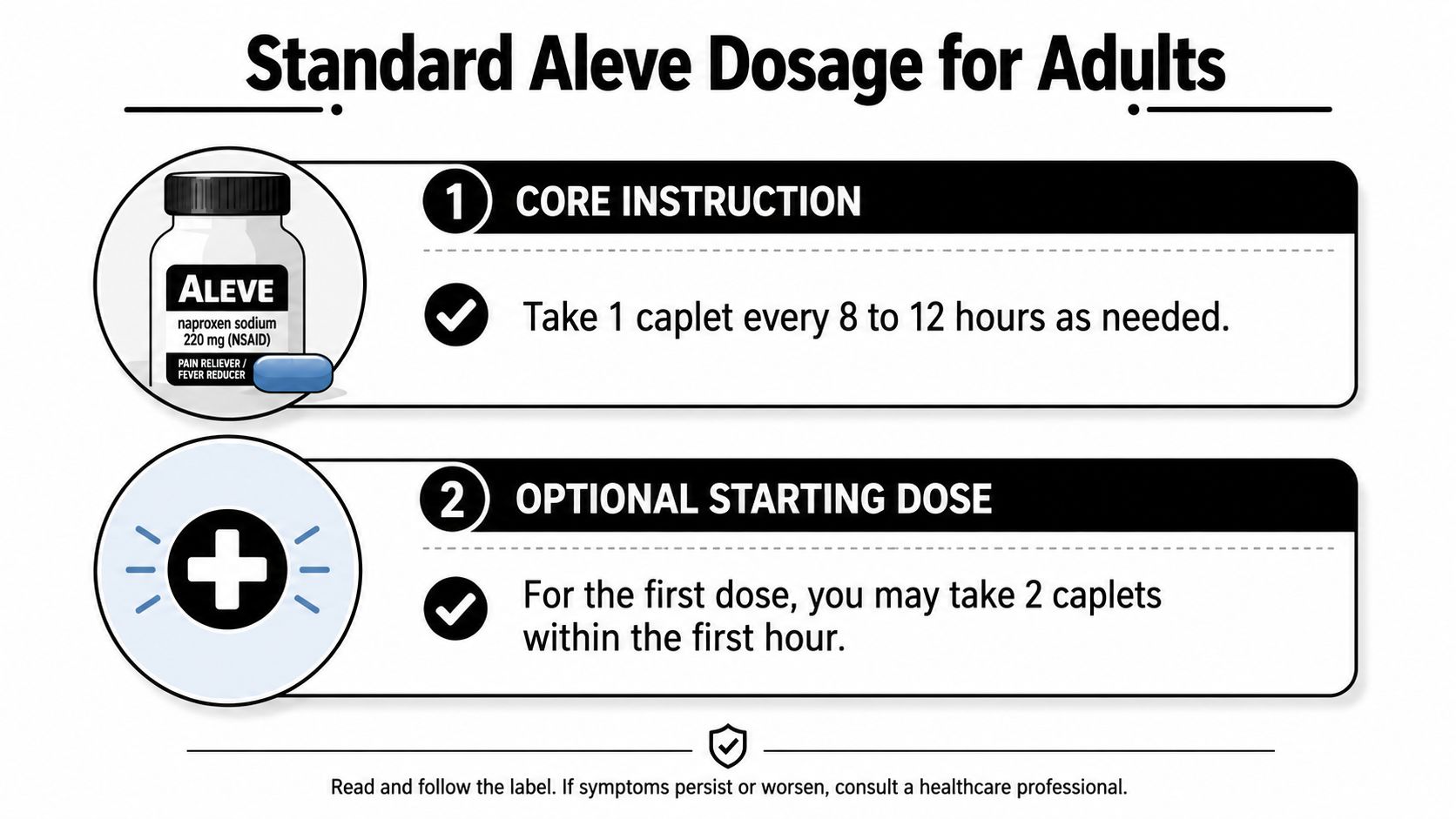
You're reaching for Aleve because you want relief without having to think about another dose soon. For adults and children 12 years and older, the consumer label directs you to take 1 caplet every 8 to 12 hours while symptoms last. Each caplet contains 220 mg of naproxen sodium, equivalent to 200 mg of naproxen. These instructions appear in the official Aleve labeling.
If your symptoms are especially uncomfortable at the start, the label allows an optional first dose of 2 caplets within the first hour. That option applies only to the initial dose. It doesn't give you permission to keep taking 2 caplets at each interval.
The label rules in plain language
Routine dose: Take 1 caplet, then wait 8 to 12 hours before taking another.
Optional starting dose: Take 2 caplets within the first hour if needed for the first dose.
Daily ceiling: Don't take more than 3 caplets in 24 hours.
Age boundary: These OTC directions apply to adults and children 12 years and older. Children younger than 12 need advice from a healthcare professional.
Think of naproxen as a long-distance runner rather than a short sprint. It stays active for an extended period, so taking another caplet after only a few hours doesn't make the first dose work faster. It mainly adds more NSAID exposure before the earlier dose has had time to wear down.
Taking Aleve with food or milk may help reduce stomach irritation. Food can slightly delay absorption, but official product information indicates that it doesn't change the overall extent of absorption, so eating with the dose doesn't remove the medication's expected exposure. If you're comparing options for a particular type of pain, this guide to pain relievers in Aleve can provide additional context, but the product label remains the dosing authority.
Understanding the 660 mg Daily Maximum
The OTC ceiling is easy to calculate. Three caplets multiplied by 220 mg of naproxen sodium equals 660 mg of naproxen sodium in 24 hours, which is equivalent to 600 mg of naproxen. The limit isn't a suggestion to reach every day. It marks the maximum amount for consumer self-treatment under the OTC label.
Naproxen can irritate the digestive tract and may contribute to serious gastrointestinal, cardiovascular, and kidney complications, especially in people with existing risk factors. Limiting both the interval between doses and the total daily amount helps separate ordinary self-care from treatment that requires clinical oversight.
Product Type | Single Dose | Dosing Interval | Maximum Daily Dose |
|---|---|---|---|
OTC Aleve | 220 mg naproxen sodium per caplet | Every 8 to 12 hours | 660 mg naproxen sodium in 24 hours |
Prescription-strength naproxen sodium, such as ANAPROX DS | Starting dose of 550 mg | 550 mg every 12 hours after the starting dose | No more than 1100 mg after the first day |
The prescription figures come from FDA-accessible ANAPROX DS labeling. Prescription dosing isn't just a stronger version of the OTC instructions. A clinician may choose it for a diagnosed condition, consider kidney and cardiovascular status, review other medicines, and monitor for adverse effects.
Safety boundary: Don't copy a prescription regimen by combining OTC caplets, and don't exceed the OTC ceiling because one dose didn't seem strong enough.
Taking more than the label permits can increase risk without addressing the reason your pain is continuing. If the maximum amount barely helps, the next step is evaluation, not an unsupervised increase.
Why the 8 to 12 Hour Interval Matters
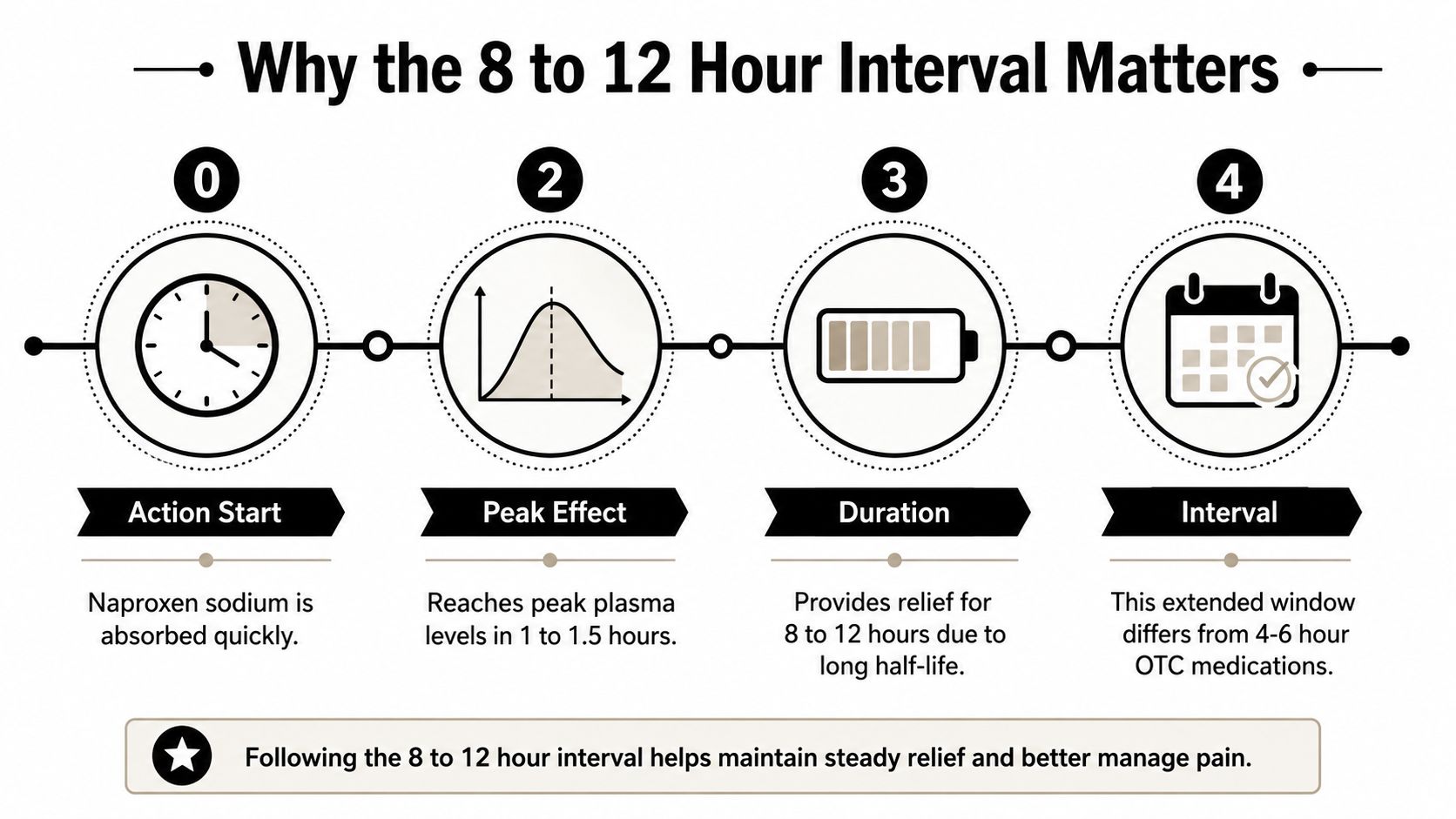
Naproxen sodium begins entering the bloodstream relatively quickly. Official product information reports plasma levels within about 20 minutes and peak levels around 1 to 1.5 hours after a dose, as described in official naproxen product information. The medicine's extended action is why the label uses an 8- to 12-hour interval.
A useful timeline looks like this:
After dosing: The caplet starts dissolving and naproxen sodium begins absorbing.
Around the peak: Blood levels reach their highest point around 1 to 1.5 hours.
During the extended window: The dose continues supporting pain relief while the body processes it.
At the next label interval: You assess symptoms and take another caplet only if needed and if you remain within the daily limit.
Food may make absorption occur a little more slowly, but it doesn't reduce the overall amount absorbed. That makes a meal or snack a reasonable choice if Aleve tends to bother your stomach, while still following the same timing instructions.
The interval isn't a promise that every person will feel identical relief for the same duration. It is a safety and dosing framework based on naproxen's sustained exposure. If pain returns early, don't respond by redosing immediately. Check the time of your last dose, review the label, and contact a pharmacist or clinician if the medication isn't lasting as expected.
Special Dosing Considerations for Older Adults
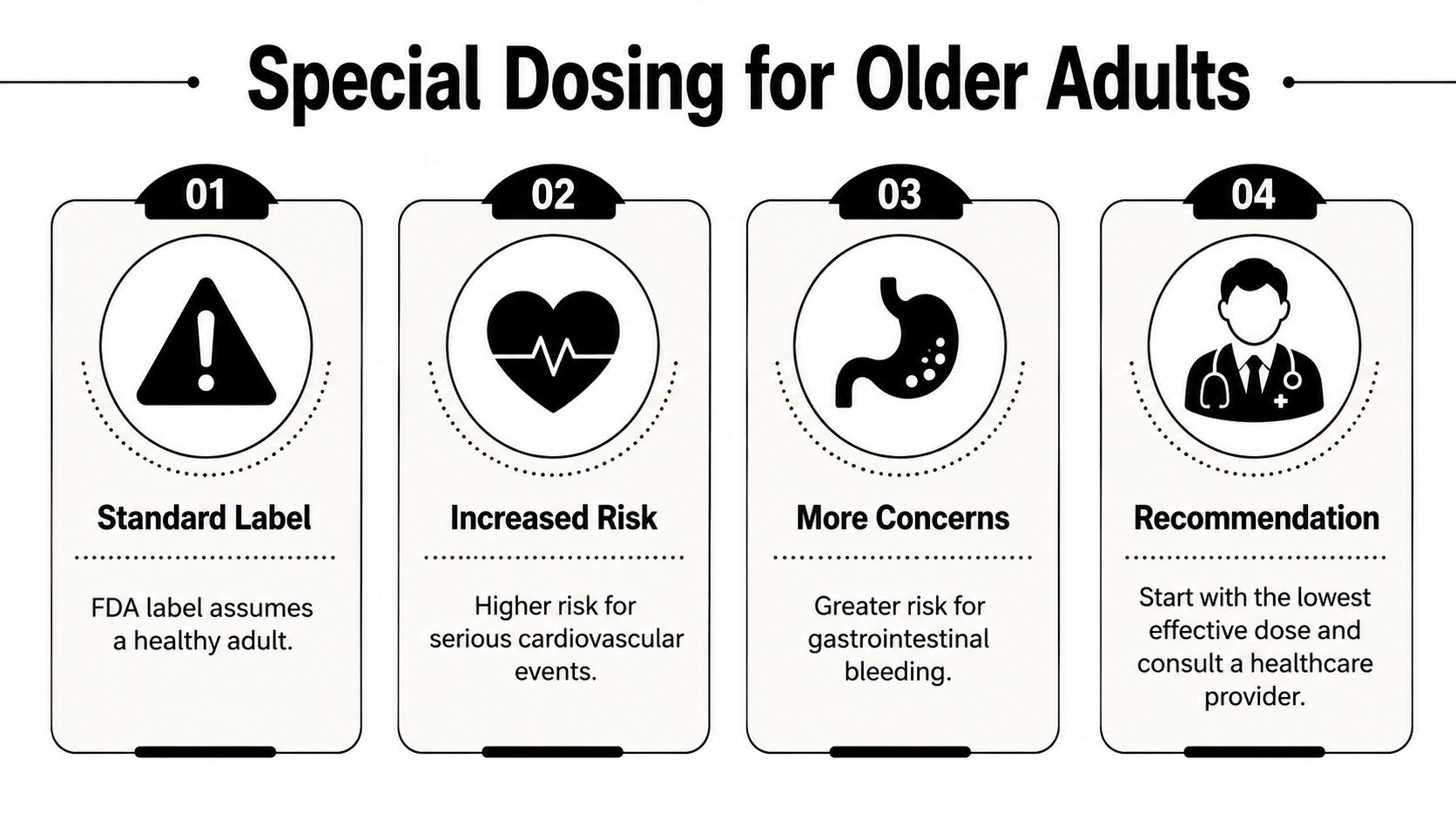
The standard Aleve label isn't a guarantee that the standard dose is suitable for every adult. The FDA warns that older adults face greater risk of serious cardiovascular, gastrointestinal, and renal adverse reactions from naproxen. For that reason, the FDA labeling advises starting at the low end when naproxen is used and monitoring the person carefully.
Kaiser Permanente's NSAID guidance adds a stricter practical limit for adults over 65: no more than 220 mg every 12 hours unless a clinician advises otherwise. That means an older adult shouldn't automatically follow the broadest adult schedule just because the package lists it.
Why age changes the decision
Several health factors can make ordinary OTC use riskier:
Kidney function: NSAIDs can place stress on the kidneys. Reduced kidney function may make naproxen a poor choice or require close supervision.
Cardiovascular history: A history of heart disease, stroke, high blood pressure, or fluid retention deserves a clinician's review before regular NSAID use.
Ulcer or bleeding history: Previous ulcers, gastrointestinal bleeding, or medicines that increase bleeding risk can change the safety calculation.
Multiple medicines: Older adults often use several prescriptions and OTC products, making accidental duplication or interactions easier to miss.
For adults over 65, the safer question isn't “How many caplets can I take?” It's “Is naproxen appropriate for me, and what dose has my clinician approved?”
A lower dose doesn't eliminate risk. It reflects the need to reduce exposure when the body may be less able to tolerate NSAID effects. Ask a healthcare professional before using Aleve regularly if you have kidney disease, heart problems, a history of ulcers, or complex medication needs.
How Aleve Compares to Other OTC Pain Relievers
Aleve's main practical advantage is its longer dosing window. That can suit recurring pain when you prefer fewer dosing decisions. Its limitation is flexibility. If you need to adjust treatment frequently for changing symptoms, a longer-acting NSAID may not be the most convenient choice.
Ibuprofen is also an NSAID and can reduce pain and inflammation, but it generally uses a shorter dosing interval than Aleve. Acetaminophen relieves pain and fever without acting as an anti-inflammatory, and aspirin has its own gastrointestinal and bleeding considerations. Those differences matter more than brand familiarity.
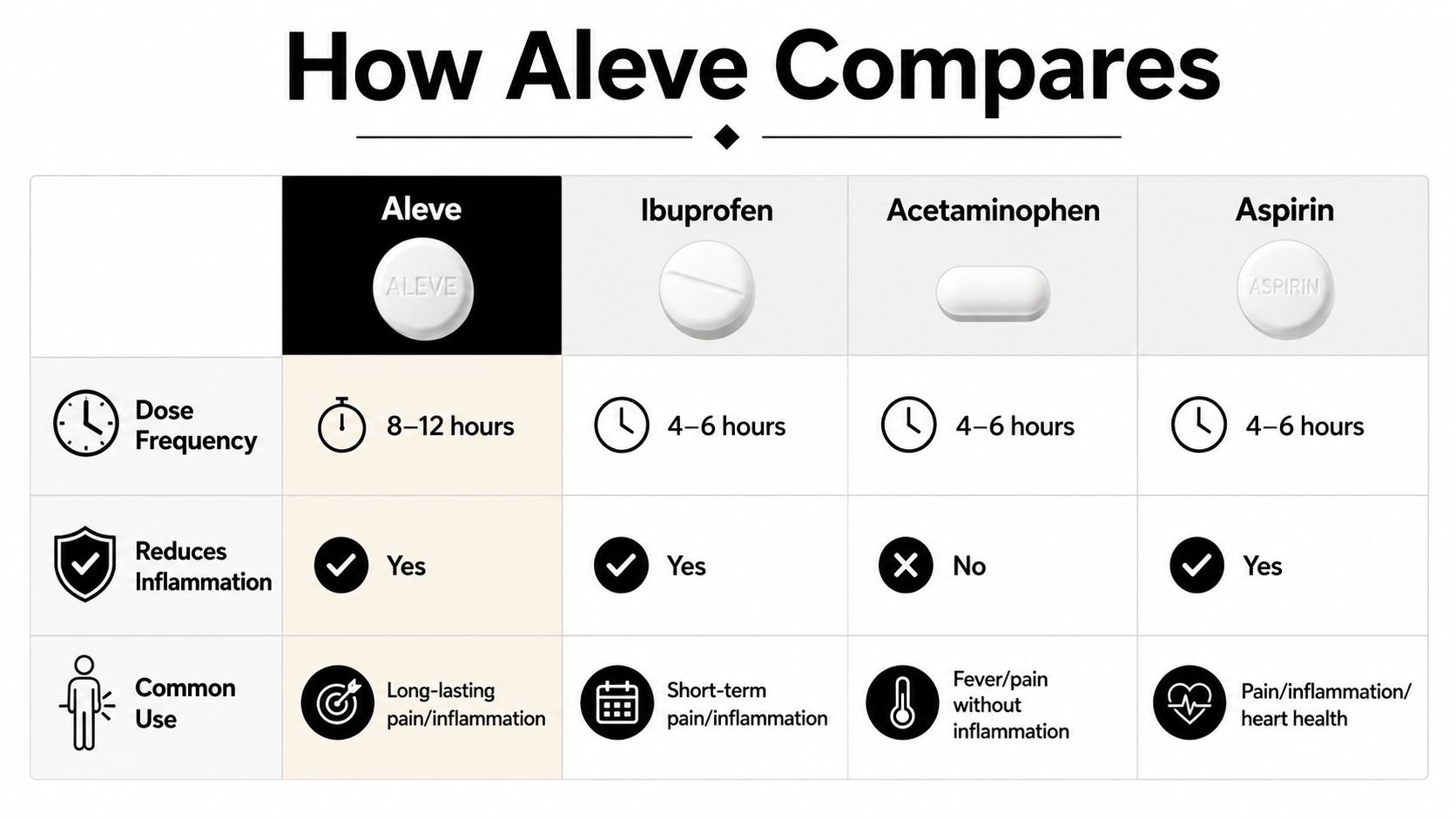
Option | Dosing Profile | Inflammation Relief | A practical consideration |
|---|---|---|---|
Aleve | Longer-acting, typically every 8 to 12 hours under the OTC label | Yes | Fewer doses, but less flexibility for early breakthrough pain |
Ibuprofen | Shorter-acting, commonly taken more frequently according to its own label | Yes | May offer more timing flexibility, but it remains an NSAID |
Acetaminophen | Follow the product label and avoid duplicate acetaminophen products | No | May be considered when NSAID-related stomach or cardiovascular concerns matter |
Aspirin | Follow its specific product directions | Yes | Has distinct bleeding and stomach considerations |
Don't combine Aleve with ibuprofen or another NSAID unless a healthcare professional specifically tells you to. If you're weighing naproxen against ibuprofen, this ibuprofen guide can help clarify why the products shouldn't be treated as interchangeable.
People with liver disease or substantial alcohol use need professional advice before choosing acetaminophen. People with ulcer, kidney, cardiovascular, or bleeding concerns need the same caution with NSAIDs. The right product depends on the pain, your health history, and every medicine you take.
Aleve and Supplement Interactions
A supplement can affect your medication routine even when it isn't a prescription drug. Turmeric, ginger, bromelain, garlic, and fish oil are commonly used for wellness purposes, but combining supplements with an NSAID may raise concerns about bruising or bleeding, depending on the person's health and other medicines.
Turmeric is especially relevant because many joint-support formulas combine turmeric extract with BioPerine, a black pepper extract intended to enhance absorption. Higher absorption can make it harder to predict how a botanical combination will behave alongside naproxen. That doesn't prove that every combination is unsafe, but it does mean you shouldn't assume that “natural” and OTC automatically means risk-free.
A safer review process
List every product: Include capsules, powders, herbal teas, and occasional remedies.
Check the formula: Look for turmeric, ginger, bromelain, garlic, fish oil, or other ingredients associated with bleeding concerns.
Ask before spacing doses: Taking products at different times may not remove an interaction, because the relevant effects can persist beyond the hour of ingestion.
Watch for warning signs: Unusual bruising, nosebleeds, dark stools, or other unexpected bleeding deserves prompt medical advice.
River of Life Capsules combine turmeric extract and BioPerine with ashwagandha, ginger, and bromelain, so anyone using the product should review the full ingredient list with a pharmacist before taking Aleve regularly. Readers can also consult this guide to ashwagandha interactions, but personalized advice is more appropriate when NSAIDs and supplements overlap.
When to Stop and Seek Medical Advice
Aleve is intended to manage symptoms, not explain why pain is happening. Stop self-treating and seek prompt medical advice if you develop stomach pain, black stools, chest pain, shortness of breath, leg swelling, or reduced urination. These symptoms can signal gastrointestinal bleeding, cardiovascular trouble, or kidney stress.
You should also contact a healthcare professional if pain lasts beyond 10 days or fever lasts beyond 3 days, as specified in consumer naproxen safety guidance. Needing the maximum labeled amount day after day is another reason to stop relying on self-treatment and ask for an evaluation.
Don't take another NSAID to compensate for poor relief, and don't increase the dose without guidance. Bring a list of your medicines and supplements, note when you took each Aleve dose, and mention any history of ulcers, kidney problems, heart disease, or bleeding.
River of Life offers capsules formulated with turmeric extract, BioPerine, ashwagandha, ginger, and bromelain for adults interested in a supplement approach to joint comfort and related wellness goals. Review the ingredients with a pharmacist before combining them with Aleve, then visit River of Life to learn more about the formulation and purchase options.