


Intimate Intimacy: Build Deeper Emotional and Physical Bonds

74% of adults across 31 countries said they feel loved in a 2024 Ipsos survey, yet only 62% said they're happy with their romantic or sex life (Ipsos survey). That gap is the story behind intimate intimacy. Feeling loved, feeling safe, feeling desired, and feeling physically connected overlap, but they don't always rise and fall together.
A lot of people use the word intimacy as if it means one thing. In real life, it usually means several things at once, emotional openness, reliable trust, shared meaning, affectionate touch, and sexual connection. When one layer thins out, couples often assume the whole relationship is failing, when the problem may be much narrower.
Table of Contents
What Intimate Intimacy Actually Means
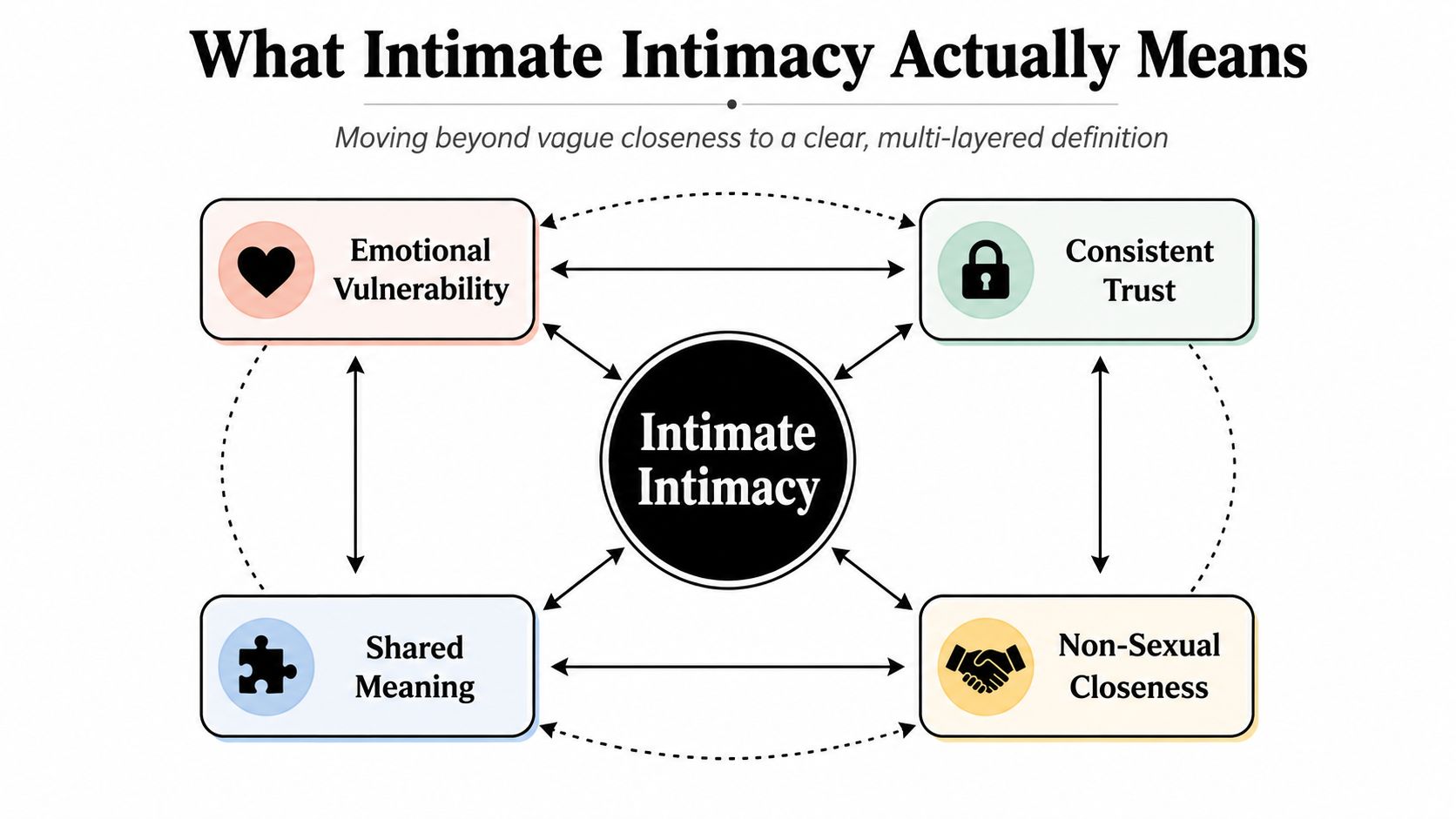
Intimate intimacy goes beyond closeness. It is the experience of being known, accepted, and connected across several layers of a relationship, and those layers do not always rise and fall together.
A clearer definition helps couples stop guessing
Treating intimacy as one feeling is where confusion starts. Research on intimacy shows that older work often blends affection, trust, and sexual behavior together, or looks at only one piece of the relationship (intimacy dimensions review). That is why one partner may say, “We're close,” while the other feels emotionally alone or physically untouched.
A better definition breaks the experience into parts. Emotional intimacy is the ability to share fear, grief, hope, or embarrassment without being shamed. Physical intimacy can include non-sexual touch, like sitting close on the couch. Intellectual intimacy shows up when two people exchange ideas. Sexual intimacy includes desire, pleasure, and erotic connection.
Practical rule: If you can name the missing layer, you can usually choose the right response instead of using the wrong fix.
The global Ipsos survey helps frame the gap. Many adults said they feel loved, and many partnered men and women said they are satisfied with their relationship with a partner or spouse (Ipsos survey). Yet happiness with a romantic or sex life is lower than the broader feeling of being loved, which shows that affection and sexual or relational fulfillment are not the same experience.
What thriving looks like and what neglect looks like
A thriving relationship does not need every dimension to be strong every day. It does need enough steadiness that each person can tell the difference between a temporary off day and a deeper disconnect.
Emotional vulnerability: thriving looks like sharing a worry without being dismissed, while neglect shows up as guarded small talk and hidden resentment.
Consistent trust: thriving means follow-through, while neglect means second-guessing promises and making assumptions.
Shared meaning: thriving includes inside jokes, rituals, and mutual goals, while neglect feels like living parallel lives.
Non-sexual closeness: thriving can be hand-holding or a hug after a hard day, while neglect means touch only appears when sex is expected.
Relationship closeness is shaped by daily life, not only by conversations about the relationship. Poor sleep, high stress, and a body that never gets to settle can make even caring partners feel less available, less patient, and less emotionally present. When that happens, the connection does not disappear all at once. It thins, like a rope fraying strand by strand.
The first step is naming which layer feels thin. That keeps couples from turning every problem into a sex problem, or every sex problem into a communication problem.
The Four Dimensions of Intimate Connection
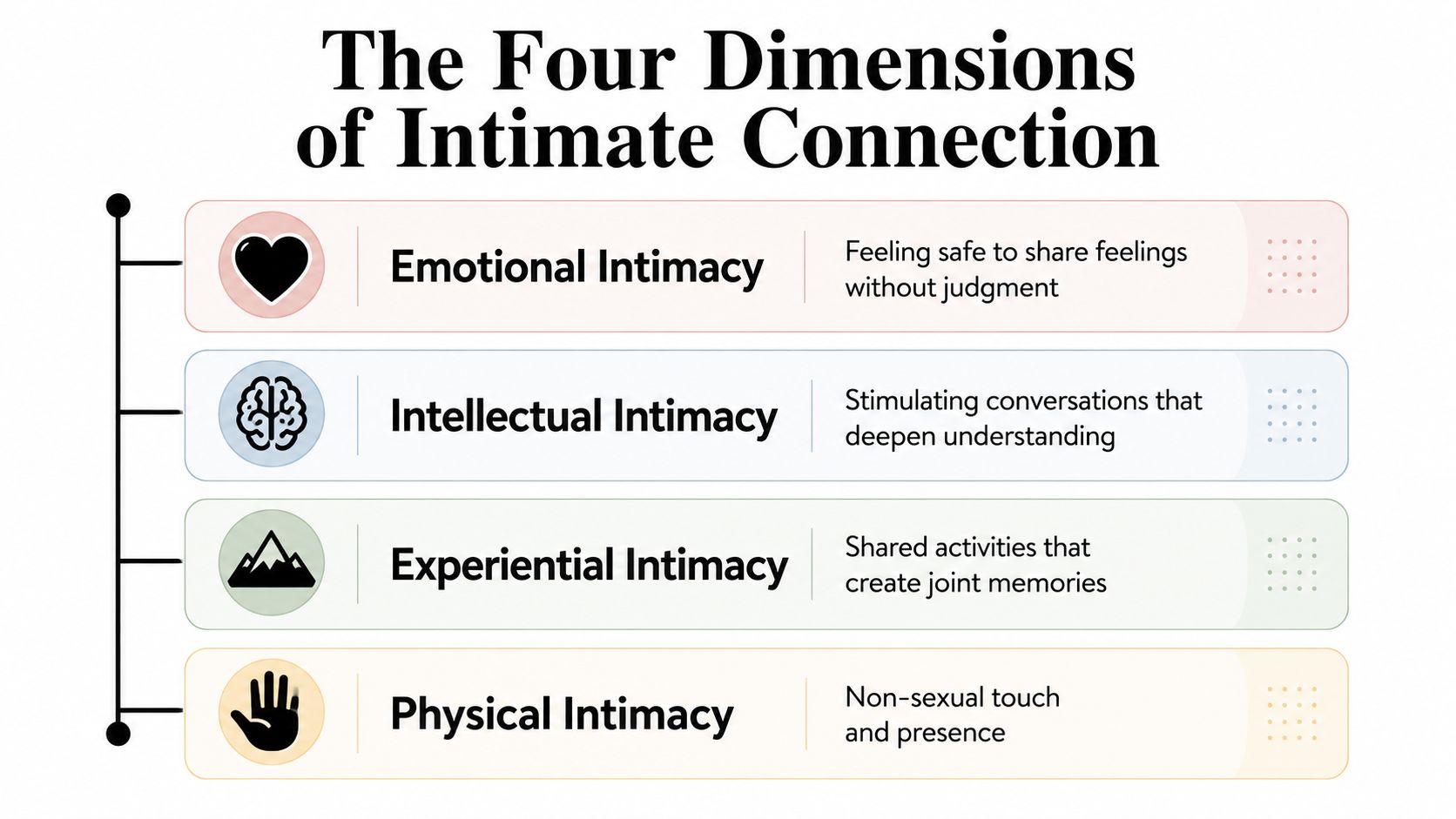
The strongest relationships usually have more than one kind of bond running at once. When people blur those layers together, they miss what needs care.
Emotional and intellectual intimacy give relationships depth
Emotional intimacy is the feeling of being able to say, “I'm not okay,” without being shamed or rushed past. When it is steady, partners can name fear, disappointment, or uncertainty without putting on a performance. When it is thin, people may still manage daily life together, but they stop offering anything tender or risky.
Intellectual intimacy works through curiosity about each other's mind. A couple can talk over dinner, disagree about politics, or swap book ideas and still feel close because each person leaves the exchange more understood than before. That kind of connection is less about agreement than about staying interested.
Experiential and physical intimacy keep connection embodied
Experiential intimacy grows through shared life, not just shared talk. A walk after dinner, an errand run together, or a small coffee ritual can build a sense of “we” because the relationship is being lived, not only discussed. When this layer fades, couples can start to feel more like housemates who coordinate logistics.
Physical intimacy includes non-sexual touch, closeness, and comfort in each other's presence. A hand on the back while passing in the kitchen can matter as much as a long conversation for some people. When that touch disappears, the body can begin to register distance even if the words still sound kind.
Emotional, intellectual, experiential, and physical closeness all reinforce one another over time, which is why neglect in one area often leaks into the others.
This is also where many readers get confused. They expect intimacy to move in a straight line, but relationship science points to two-way links between intimacy behaviors and both sexual and relationship satisfaction over time. What happens in one layer can strengthen or weaken another layer later, which is why a sleep-deprived week or a stretch of high stress can show up as emotional flatness, less patience, or less touch.
A practical diagnostic question helps here. Ask, “Are we disconnected because we do not talk openly, do not share daily life, do not touch enough, or do not feel sexual energy?” That answer shows where to begin, instead of trying to fix everything at once.
Why Intimacy Fades Even in Good Relationships
A couple can love each other and still drift. The drift usually starts, which is why it catches people off guard.
After the baby is asleep, one partner wants to talk while the other wants silence. One person reaches for touch, but the other is already overloaded by work and household decisions. Nothing explosive happened, yet the relationship starts to feel less reachable. Intimacy often fades through accumulation, not catastrophe.
The usual explanations miss the core friction
Recent qualitative evidence points to sex-drive mismatch, low emotional closeness, sexual dissatisfaction, restrictive gender stereotypes, and nostalgia for an earlier phase of the relationship as major barriers to closeness (intimacy decline evidence). Those are concrete, lived problems. Generic advice to “communicate more” falls short if the couple is already talking but still stuck.
The nostalgia piece matters more than people admit. Early relationships often feel easier because novelty provides its own momentum. Later, the relationship has more history, more responsibility, and more fatigue. Comparing the present to an energized beginning can make ordinary maintenance feel like failure.
Life rhythm can matter as much as affection
The same recent survey data found that many couples described intimacy mismatch alongside differing energy levels, sleep schedules, stress, or mental health concerns. That widens the problem beyond romance advice. If one person is exhausted and another is craving closeness, both can feel rejected without meaning to.
Small daily realities often shape the outcome more than grand gestures. A late bedtime, a stressful commute, or a week of poor recovery can reduce patience, appetite for touch, and willingness to be vulnerable. Once the body is running on reserve, closeness starts to feel like another demand.
Sleep and stress work like background weather. You may not notice them moment by moment, but they change the whole climate of the relationship. When recovery is poor, the nervous system has less room for warmth, curiosity, and touch.
The good news is that this kind of fading is not proof that love is gone. It usually means the conditions for closeness have been eroded. That difference matters, because conditions can be rebuilt.
Communication Exercises That Build Emotional Closeness
Good communication isn't just talking more. It's creating enough safety that both people can say what's true without bracing for a fight.
Use structure so vulnerability doesn't feel chaotic
A lot of couples try to be open only when they're already upset. That's the hardest time to do it. It helps more to schedule a short conversation when neither person is rushing, hungry, or half-asleep.
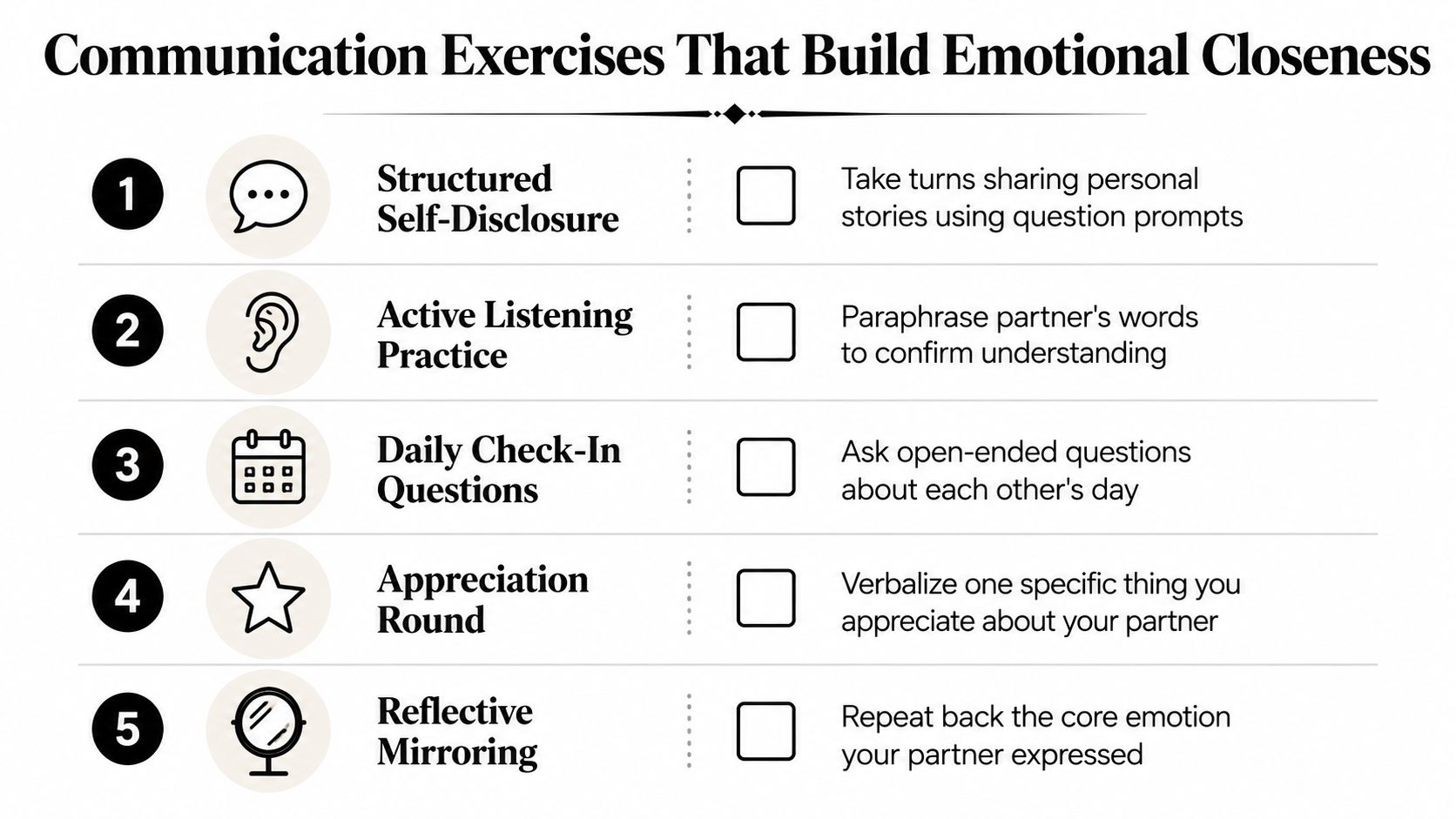
Try a simple daily check-in: “What felt heavy today, and what felt good?” Keep it under ten minutes. The point is not to solve everything. The point is to practice sharing and receiving without immediately moving into logistics.
The old habit to avoid is problem-solving too soon. If a partner says, “I felt lonely today,” the wrong first move is often advice. Start with witnessing instead.
Practical script: “That makes sense. I'm glad you told me. Do you want comfort, ideas, or just for me to listen?”
Make self-disclosure feel safer
Structured self-disclosure works best when the environment is low pressure. Turn off the TV, put the phones away, and pick a time with enough margin that the conversation can breathe. If you know one partner gets flooded easily, keep the first round short and agree to revisit it later.
The well-known 36 Questions framework can be useful here because it gradually moves from lighter prompts to more personal ones. You don't need to treat it like a test. Use the logic of it, which is paced openness, not emotional ambush.
A busy household can still do this. One parent might ask two questions while dishes are drying. The other can answer without needing the whole evening to be “the intimacy talk.”
Appreciation keeps risk from feeling one-sided
The quickest way to make vulnerable conversation feel exhausting is to only surface problems. Add one appreciation every day, and be specific. “I noticed how you handled bedtime with patience” lands better than a vague “you're great.”
When appreciation and reflective mirroring become habits, people feel heard before they feel judged. That lowers defensiveness, which makes the harder conversations possible. For readers who also want to reduce overall life stress, a gentle place to pair these habits with practical support is this guide on how to reduce stress naturally.
Rebuilding Physical and Sexual Intimacy
Physical closeness often returns when pressure goes down. Many couples need less “spark advice” and more permission to remove performance from the room.
Start with touch that doesn't have an agenda
Non-sexual touch rebuilds safety before it rebuilds desire. Holding hands on a walk, sitting shoulder to shoulder, or giving a long hug at the door can help the body relearn that contact isn't always a request. That matters because people are less likely to relax into sexual intimacy when every touch feels like a setup.
Sensate focus is useful for the same reason. In plain terms, it asks partners to explore touch without trying to achieve intercourse or orgasm right away. The focus shifts from performance to sensation, which helps lower anxiety and can make desire feel more available again.
Touch that has no hidden scorekeeping often does more for desire than touch that comes with an expectation attached.
Scheduling intimacy is practical, not unromantic
Busy couples often wait for the “right mood,” then keep missing each other. Scheduling time for intimacy can sound clinical, but it usually protects the relationship from exhaustion, childcare, conflicting schedules, and decision fatigue. A planned window is not a command. It's a container.
That container can be flexible. One week it might mean a quiet hour with no screens. Another week it might mean cuddling and talking instead of full sexual contact. The key is making room on purpose so the connection doesn't stay permanently at the bottom of the list.
If pain, hormonal shifts, or medication side effects are part of the picture, the right next move may be medical support or therapy, not more pressure. Sexual concerns can be discussed with a sex therapist, while broader relationship patterns often fit better with couples counseling. Many people need both kinds of help at different moments.
For readers who also want a broader stress-support routine while they work on closeness, this overview of ashwagandha for stress and anxiety may be a helpful companion read.
How Sleep Stress and Inflammation Quietly Undermine Connection
A tired, stressed body has a hard time being tender. That's not a character flaw, it's physiology.
When sleep continuity breaks down, people tend to become more reactive, less patient, and less available for nuance. Chronic stress adds another layer, because the nervous system stays in a protective posture instead of a receptive one. In that state, vulnerability can feel costly even when the relationship itself is good.
The body and the relationship move together
A diary study found that when intimacy increased from one day to the next, somatic symptoms tended to drop over the following days, even after controlling for concurrent change, with lagged effects remaining significant (diary study on intimacy and symptoms). The effect was asymmetric, meaning intimacy gains predicted symptom reduction, while intimacy decreases didn't produce the same rebound. That suggests closeness and physical wellbeing can reinforce each other, but not always in a simple back-and-forth way.
The practical lesson is simple. You can't always think your way into intimacy if the body is already overextended. Sleep, recovery, and stress regulation create the conditions where openness and desire have a chance to show up.
Build the background conditions first
Anti-inflammatory meals, consistent wind-down routines, and stress resilience practices don't replace emotional work. They make emotional work easier to do. That includes the ordinary basics, regular bedtime, lower evening stimulation, and enough recovery time to stop living in constant catch-up.
Some people also look at broader supplement support as part of a complete routine, especially when stress and sleep disruption are persistent. If you're exploring that lane, keep the focus on support, not promises. For sleep-specific context, this guide on a natural sleep aid without melatonin may help you think more clearly about options.
Your Weekly Intimacy Building Framework
The most sustainable plan is small enough to repeat. A week that mixes emotional, physical, and lifestyle support is often more realistic than a perfect daily routine nobody can maintain.
A simple seven-day rhythm works better than pressure
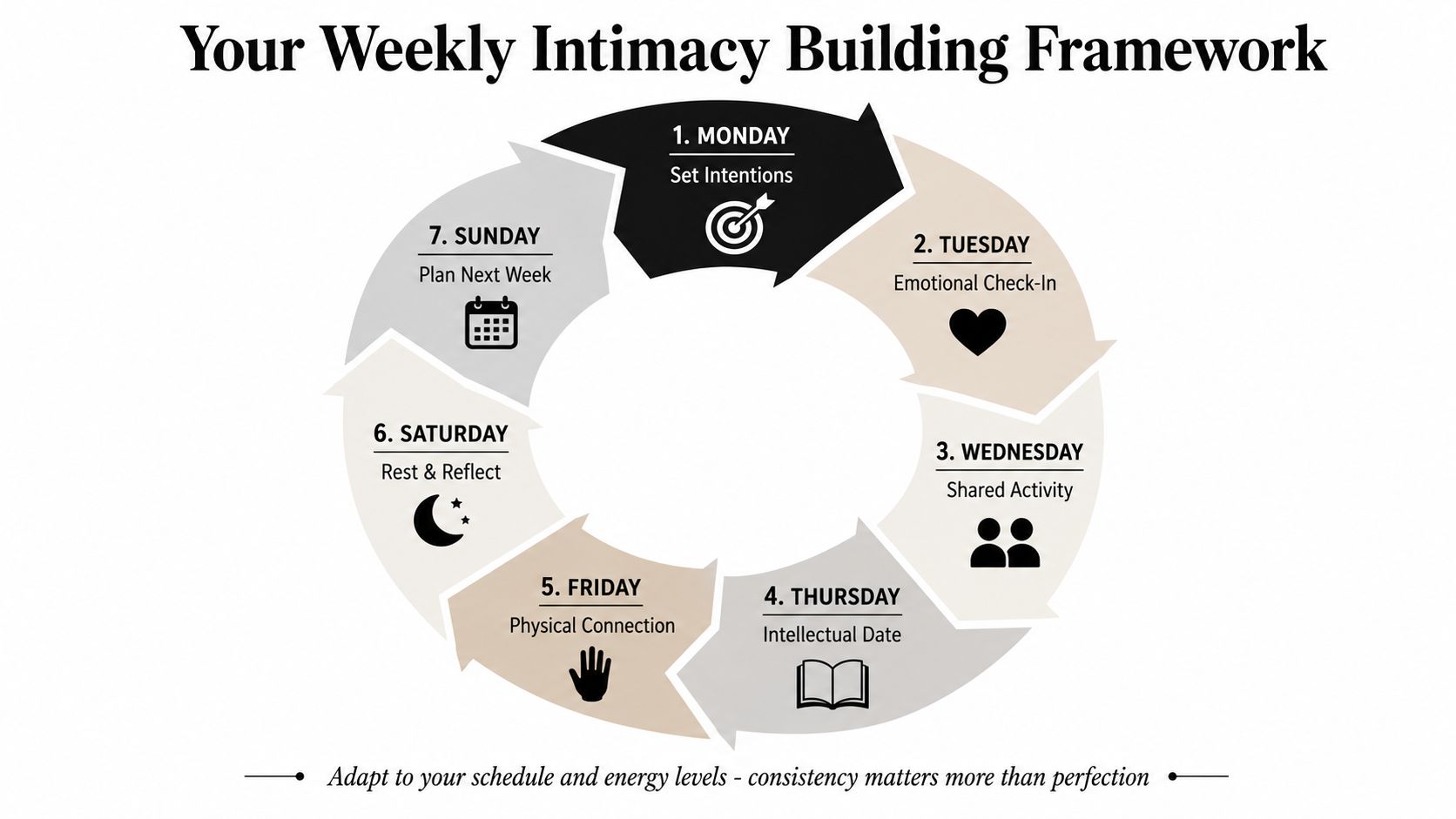
Monday can be for setting one intention together. Tuesday can hold an emotional check-in. Wednesday can be a shared activity that feels easy, not impressive. Thursday can be a conversation with some intellectual spark. Friday can focus on physical connection. Saturday can be for rest and reflection. Sunday can be for planning the week ahead.
The power of this rhythm is not in perfection. It's in repetition. A couple that touches base, shares life, and protects recovery time usually has a better chance of rebuilding closeness than a couple that waits for a perfect weekend.
Track patterns, not scores
Don't turn intimacy into a performance metric. Instead, notice what helps connection and what drains it. If Friday fails because everyone is exhausted, move the physical ritual earlier. If Tuesday feels too heavy, make the check-in shorter.
Consistency matters more than intensity when a relationship is trying to recover its rhythm.
If intimacy has been flat for a long time, give it a realistic timeline. Small shifts can show up in weeks. Deeper pattern change usually takes longer because the body, the habits, and the relationship each need time to settle into something new.
When the same barriers keep returning, outside support can help. A therapist can help untangle attachment patterns, stress loops, or sexual pressure that keeps derailing connection. The goal isn't to force closeness. It's to create the conditions where closeness can come back naturally.
If you want grounded support for the stress, sleep, and recovery pieces that shape connection, visit River of Life and explore resources that fit into real life, not idealized routines. You'll find practical wellness support and educational guidance that can complement the habits that rebuild intimate intimacy over time.