

Women's Wellness: Science-Backed Strategies for 2026

You're standing at the kitchen counter, one eye on the clock, one hand rubbing a stiff knee, while your phone tells you you slept badly again. Yesterday had a hot flash. Today feels like a mix of fatigue, irritability, and that vague sense that your body isn't quite working with you.
That's the part many women recognize but don't always name. Women's wellness isn't one problem or one stage of life, and it's not just about reproductive health. It's a whole-body system where hormones, sleep, stress, joints, mood, and connection keep tugging on each other, which is why one rough night can spill into a rough day.
The larger health picture backs that up. The World Economic Forum says women spend 25% more of their lives in poor health or with disabilities than men, equal to about 75 million years of life lost worldwide. It also reports that only 6% of roughly $2.9 trillion in private healthcare capital goes to conditions affecting women, with about 90% of that limited funding concentrated in just three categories, women's cancers, reproductive health, and maternal health, leaving many everyday concerns under-addressed (World Economic Forum analysis).
That's why a smarter approach starts with the full pattern, not the loudest symptom. A tired body might be asking for better sleep, steadier blood sugar, less stress overload, or more support during hormonal shifts. When you look at the whole system, you stop treating each complaint like a random fire and start asking what's driving the smoke.
Table of Contents
Why Women's Wellness Deserves a Bigger Picture
A midlife morning can look ordinary from the outside. The coffee is brewing, a toddler is tugging at your sleeve, and you're rubbing a knee that feels older than you are. The sleep tracker says you got five hours, and yesterday's hot flash is still hanging around in your memory like an unwelcome guest.
That is why treating symptoms one by one so often misses the point. The knee stiffness, broken sleep, short fuse, and brain fog are often overlapping signals from one body trying to adapt, not separate problems demanding separate panic.
A woman's day does not split neatly into boxes labeled hormones, mood, joints, and energy. She feels all of it at once, often before breakfast. A stressful meeting can show up as neck tension, a late night can make patience thinner, and a hormone shift can make both feel harder to handle.
Women's wellness deserves a systems view. The World Economic Forum's analysis shows a wider gap in how women's health needs are supported, which helps explain why many everyday concerns can feel under-addressed (World Economic Forum analysis). For a broader look at how plant-based support fits into that kind of whole-body approach, see this overview of turmeric and ashwagandha in plant-based wellness.
Practical rule: if three parts of your day feel off at once, do not assume you have three unrelated problems.
The better question is, “What is the pattern?” Poor sleep can make mood feel brittle. Stress can show up as a tight jaw or aching shoulders. Midlife hormone change can affect both rest and resilience.
Women also live longer than men, yet spend more years in poor health. Longevity alone does not guarantee better daily wellness. The goal is to understand how the whole system is behaving on a normal Tuesday afternoon.
The Six Pillars Every Woman Feels
Wellness rests on six interlocking supports, not a beauty checklist. If one support weakens, the others usually have to work harder. That is why a woman can feel “off” without pointing to one clear cause.
Hormones act like chemical weather
Hormones work like the body's weather system. Estrogen and progesterone shift across the cycle and again through perimenopause and menopause, changing sleep, energy, and how a woman feels in her own skin. Some days that weather feels calm, other days it feels like pressure building before she can explain why.
Stress resilience works like shock absorbers
Stress resilience helps a hard day stay a hard day instead of turning into a sore neck, a headache, or a sleepless night. When those shock absorbers are worn down, even a normal email chain can feel physically expensive. That is why some women notice tension in the body before they notice it in the mind.
Sleep is the overnight reset
Sleep is the body's nightly reset. It is when mood steadies and the brain clears out some of the day's clutter. When sleep is short or broken, everything feels less buffered. Food choices feel harder, emotions feel sharper, and small annoyances can land like big ones.
Mobility, mood, cognition, and connection hold the rest up
Mobility and joint comfort are the hinges. If stairs suddenly feel like a hill, daily life gets smaller.
Mood and cognition shape focus and emotional bandwidth, while intimacy and connection provide the sense of safety and closeness that keep stress from taking over. These pillars often show up in ordinary moments, like whether a woman can carry groceries, stay patient in traffic, or feel present in a conversation.
A woman does not need a perfect body to feel well. She needs enough support in each pillar to move through the day without feeling like she is constantly compensating.
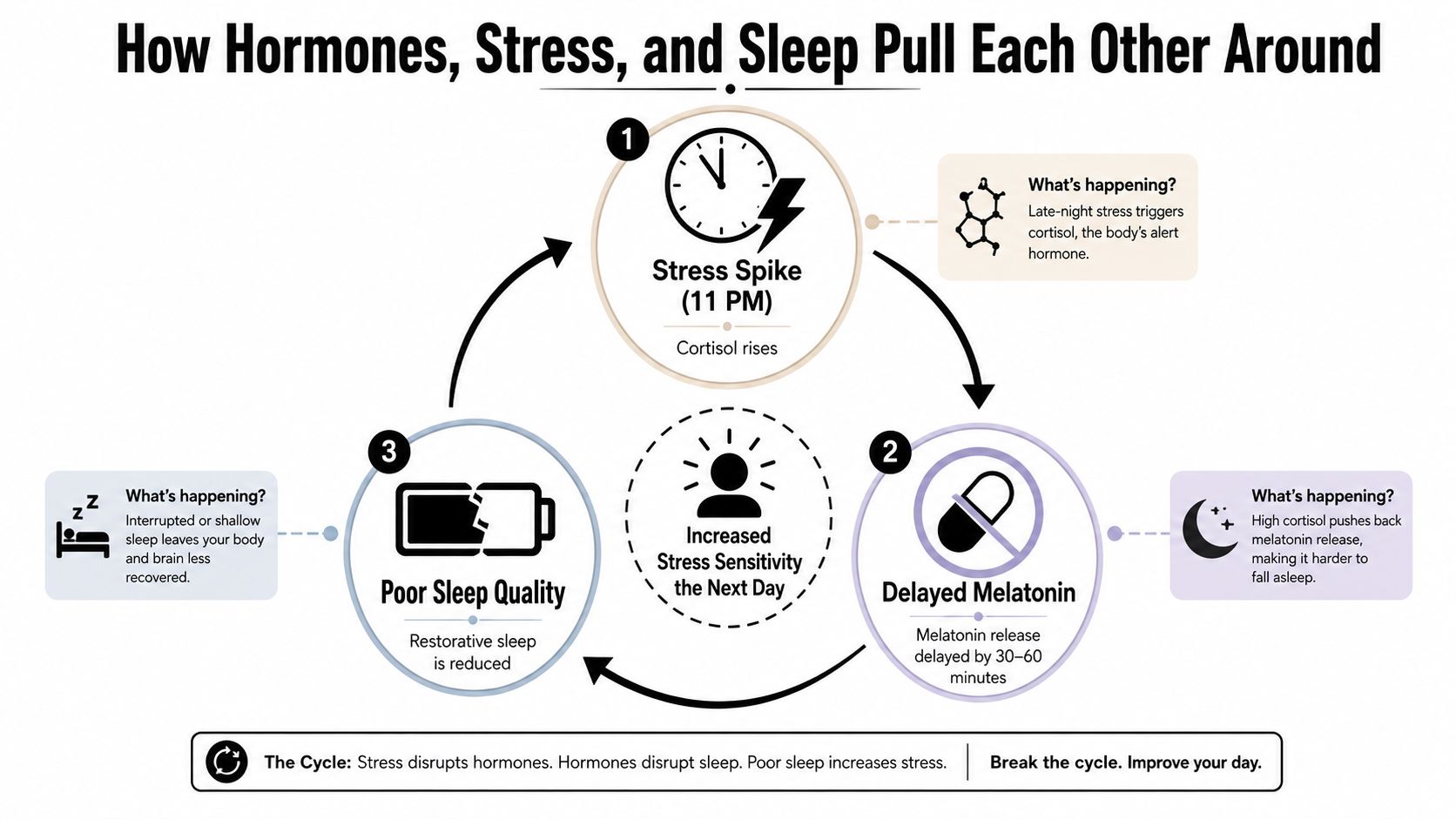
How Hormones, Stress, and Sleep Pull Each Other Around
A late-night stress spike can feel minor in the moment. You answer one more message, replay one conversation, and suddenly your body behaves like it is still in daytime mode. Stress, hormones, and sleep do not sit in separate corners. They keep tugging on each other.
The loop starts with activation
When stress rises late at night, cortisol can remain high when the body should be winding down. That makes it harder to settle into the quieter state that supports melatonin release and deeper rest. The result is familiar. You feel tired, but your body will not fully downshift.
Midlife can make that loop louder. A major review found that declining estradiol and rising FSH are linked with sleep disturbance, even after accounting for vasomotor and depressive symptoms (midlife sleep review). CDC data summarized in that review also show sleep shortfalls are common in perimenopause, with 56.0% of perimenopausal women sleeping less than 7 hours per day compared with 40.5% of postmenopausal and 32.5% of premenopausal women (CDC data summarized in the review).
Poor sleep changes the next day
One bad night does not just feel irritating. It can narrow the next day's margin for patience, focus, and physical comfort. In women with menopausal syndrome, odds of sleep disturbance rose with symptom severity, and anxiety plus perceived stress also predicted poorer sleep continuity.
That is why “just relax” misses the point. For many women, this is not a willpower problem. It is a loop that keeps pulling the body back into a more reactive state.
The body notices the pattern before the brain does
A woman may call it irritability, brain fog, or a short fuse. The pattern is usually bigger than one symptom. One disrupted pillar pushes the others around, and sleep problems are common enough in postmenopause to matter on a population level, with a 51.6% overall prevalence of sleep disorders in postmenopausal women in a 2023 meta-analysis (sleep disorder meta-analysis).

Daily Habits That Strengthen Every Pillar
Women's wellness works better as a connected system than as a checklist. A meal can steady mood and hormone shifts. A walk can ease stiffness and help stress settle. An evening routine can make sleep feel less like a battle and more like a rhythm the body recognizes.
Nourish with steadier inputs
Meals built around protein, leafy greens, healthy fats, and fiber-rich foods give the body a steadier base. That matters because a plate full of quick carbs can leave energy and mood feeling like a light switch that keeps flickering.
Fermented foods can also fit into that pattern, especially if digestion feels unpredictable. The goal is simple, keep feeding the body in a way that supports comfort, not one that sets up another crash an hour later.
Move in ways your joints can tolerate
Walking, swimming, gentle mobility drills, and light resistance work all support a body that wants to keep moving. The point is not punishment. It is repetition your joints can live with.
A short stretch after sitting, a few minutes of foam rolling, or an easy walk after lunch can seem minor, yet the body responds to patterns. That matters when stiffness and stress arrive together, because movement can help both at once.
Protect rhythm before trying to perfect sleep
A steady wind-down matters more than chasing the perfect sleep trick. Set caffeine aside early enough that it does not follow you into the evening, dim screens before bed, and get morning light on your face if you can. Those cues help the body separate day from night.
A woman who stays “on” long after the day ends often needs rhythm, not more pressure. For practical stress tools, the guide on how to reduce stress naturally can help when the body has trouble shifting out of alert mode.
When Food Is Not Enough and Supplements Make Sense
Food still sets the base. A plate with enough protein, color, fiber, and healthy fat can carry a lot of the load. Yet some patterns keep showing up anyway, like joints that stay achy, stress that feels too loud, PMS that arrives like clockwork, or afternoon fatigue that keeps returning. In those cases, a targeted supplement can sit beside food and habits as extra support, not as a replacement.
The clue is repetition. One rough week usually calls for rest, better meals, and a little patience. A pattern that keeps circling back asks for a more deliberate plan.
Match the ingredient to the need
Different ingredients fit different jobs. Turmeric is often chosen for everyday inflammatory comfort, while BioPerine is included to help curcumin absorb better. Ginger is commonly used in formulas for comfort and recovery, and bromelain is often paired with post-exercise support. Ashwagandha is usually used for stress resilience and a steadier daily pace.
Supporting nutrients matter too when the body feels out of sync. Magnesium is often linked with relaxation and muscle function, and vitamin D is commonly discussed as part of broader wellness support. The right choice depends on what feels most off, joints, stress, sleep, or recovery.
Wellness Need | Common Ingredients | How It Helps |
|---|---|---|
Joint comfort | Turmeric, ginger, bromelain | Supports everyday comfort and post-activity recovery |
Stress resilience | Ashwagandha, magnesium | Helps the body feel less overdriven |
Sleep quality | Ashwagandha, magnesium | Can support a calmer evening transition |
Absorption support | BioPerine | Helps curcumin get absorbed more efficiently |
General daily support | Vitamin D, magnesium | Supports the broader wellness baseline |
Single-ingredient or multi-ingredient
A single-ingredient product makes sense when you know exactly what you want to address. A multi-ingredient formula fits better when the same pattern touches several pillars at once. That happens often in women's wellness, where sleep, stress, comfort, and recovery tend to overlap instead of arriving in neat separate boxes.
A daily capsule can fit here if it has a clear purpose and realistic expectations. It should support the work food and habits are already doing, not pretend to replace them. For a busy body with more than one weak point, one well-chosen formula can be easier to keep up with than a stack of separate products.
If your wellness issue shows up in more than one place, your support plan usually needs more than one tool.
For a closer look at one botanical many women ask about, the article on ashwagandha interactions is worth reading before adding it to your routine.
A Realistic Day-in-the-Life Wellness Routine
A workable routine should survive a Tuesday, not resemble a wellness retreat. For women's wellness, that means building a few steady anchors that support the whole system, because energy, mood, sleep, and comfort tend to influence one another like gears turning in the same clock.
Start with light, food, and one steadying cue
Wake up and get outside for a little light if you can. Then eat a breakfast with protein, so your body is not starting the day already chasing energy. If mornings are messy, one anchor is still useful. Light, or breakfast, is better than trying to do everything perfectly.
Build movement and support into the middle of the day
A short mobility break before lunch can keep stiffness from piling up. At midday, choose a real meal, not just snacks, and take any daily supplement with food if that is part of your plan. The body usually handles routines better when they happen alongside meals instead of being squeezed in at random.
A useful standard: two or three reliable habits beat ten habits you cannot repeat.
That is also where one multi-ingredient capsule can fit for some women. If sleep feels off, stress runs high, and comfort is not where it should be, a single formula can support several overlapping needs at once without pretending to replace food, rest, or movement.
Make evening smaller, not more ambitious
Later in the day, lower the lights, cut back screens, and leave some breathing room between work and bed. A warm shower, a calm dinner, and a consistent sleep target can do more than an elaborate reset routine that gets abandoned by Thursday. If you are trying to improve women's wellness, consistency usually matters more than intensity.
The easiest version of this routine is the one you can keep. Add one new habit per week, then let your body show you what helps instead of guessing from a single good day.
Safety First and What to Ask Before You Start
A whole-body view of wellness also means being honest about safety. Heavy bleeding, sudden mood changes, chest pain, unexplained weight shifts, or persistent joint swelling deserve prompt medical attention, not a new supplement and a wait-and-see approach.
That stays true even when the problem feels hormonal. Hormones can shape how you feel, but they do not explain everything, and they do not rule out other causes. A good plan leaves room for medical evaluation, lab work, and follow-up when something feels off.
Bring a real checklist to your clinician
Before starting a supplement, ask what else is part of the picture. Current medications matter because botanicals can interact with prescriptions. Thyroid history, reproductive history, pregnancy or breastfeeding status, planned surgeries, and family history of hormone-sensitive conditions all matter too.
Look for third-party testing, clear labels, and allergen disclosure. Start one new ingredient at a time so you can tell what is helping and what is not. If a product hides the dose or buries the full ingredient list, pause and ask for more detail.
Know when to be more careful
Some botanicals call for extra caution. Ashwagandha may not be a good fit for people with autoimmune concerns, thyroid conditions, or pregnancy. Turmeric in high doses can also be an issue for some people, especially if gallstones or anticoagulant therapy are part of the picture. If you want a closer look at medication overlap, ashwagandha interactions is a useful place to start.
Supplements can complement care, but they do not replace prescribed treatment or ongoing monitoring.
The safest wellness plan is the one that respects both your goals and your medical history.
If daily joint comfort, stress resilience, sleep quality, and mental clarity are your priorities, one multi-ingredient capsule can offer a practical foundation. A formula built around turmeric extract, BioPerine, ashwagandha, ginger, and bromelain may fit that role, and River of Life offers that approach within a broader wellness routine.