
How to Reduce Stress Naturally: 6 Proven Ways for 2026

Your chest is tight. Your mind is running ahead of you. A simple email feels loaded. The phone keeps buzzing, your to-do list keeps growing, and even when you sit down to rest, your body doesn't seem to get the message.
That isn't a personal failure. It's what stress looks like when it stops being a short burst and starts becoming the background noise of everyday life.
The good news is that learning how to reduce stress naturally doesn't require turning your life upside down. It works better when you build a practical Resilience Toolkit. One layer helps you calm down fast. Another strengthens your body so stress hits less hard. Another changes the habits and thought patterns that keep stress switched on.
Table of Contents
Feeling Stressed and Overwhelmed Is Not Your Fault
A lot of people think stress means they're “not coping well enough.” That's usually not true. Many find themselves attempting to function within a setup that constantly activates the nervous system. Constant notifications. Work bleeding into home life. Family responsibilities. News overload. Pressure to stay productive even when you're running on fumes.
That kind of stress isn't dramatic. It's repetitive. You answer one message and three more appear. You finally sit down and remember the bill, the appointment, the laundry, the thing you forgot to say, the thing you should've done yesterday. Your body starts reacting before you even realize it. Tight shoulders. Shallow breathing. Poor sleep. Snapping at people you care about.
Stress also gets more frustrating when your body already feels limited. If your joints hurt, if you're exhausted, or if movement feels harder than it used to, a lot of standard advice can sound useless. “Just go for a long hike” doesn't help much when getting through the day already takes effort.
Stress management has to fit your real life, not an imaginary version of it.
That's why a Resilience Toolkit matters. Not one miracle trick. Not a giant morning routine. A set of tools you can reach for depending on what kind of stress you're dealing with.
Use one layer for fast relief when your body is revving up. Use another for daily habits that make you steadier over time. Add mental practices that help you stop feeding the stress loop. Then use outside support, including supplements or professional care, when it makes sense.
That approach is realistic. It's also what tends to work.
Immediate Relief for In-the-Moment Stress
Your stress response can spike in under a minute. An email lands. A symptom flares. Someone needs you right now. Your body reacts before your thoughts catch up, so the fastest relief usually starts with a physical cue you can control.
Use your breath to change your state
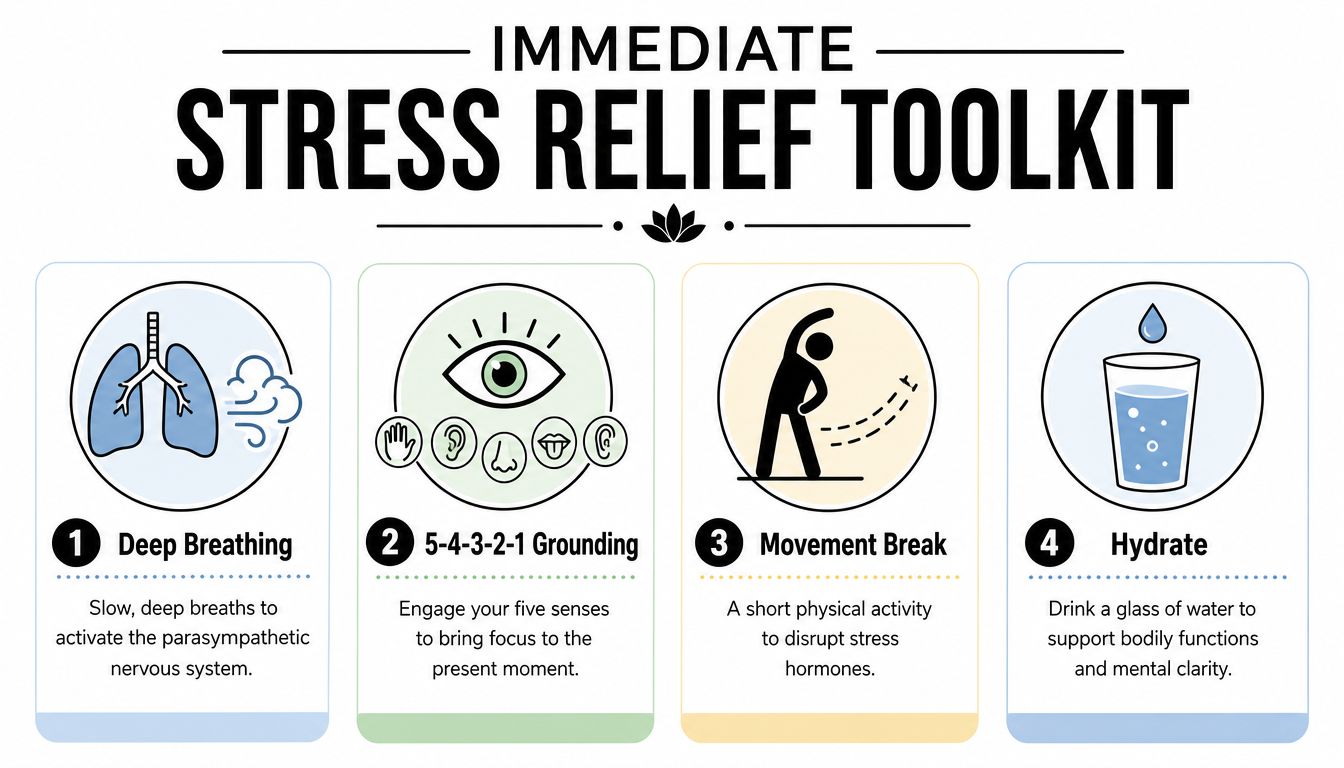
Slow breathing is one of the quickest tools in your Resilience Toolkit because you can use it almost anywhere. At your desk. In a waiting room. In bed at 2 a.m. If long breath holds make you feel strained, shorten them. The goal is a slower exhale, not a perfect performance.
A simple option is 4-7-8 breathing:
Sit back and let your shoulders drop.
Inhale through your nose for 4.
Hold gently for 7.
Exhale slowly for 8.
Repeat for 5 rounds.
Use it early. Before you open the hard message. Before the appointment. When you notice your jaw tightening.
If 4-7-8 feels too intense, switch to an easier rhythm such as inhaling for 4 and exhaling for 6. Longer exhales still help settle the body, and they are often more realistic when stress is already high.
Ground your mind in what is real
Once your body eases up a little, bring your attention back to the present. Grounding works because stress pulls you into prediction. Grounding pulls you back to what is happening right now.
Try the 5-4-3-2-1 method:
Name 5 things you can see. A lamp, the door, your sleeve, a cup, the floor.
Touch 4 things you can feel. The chair under you, your shirt, the table, your feet inside your shoes.
Notice 3 things you can hear. Air moving, traffic, birds, the hum of a fridge.
Identify 2 things you can smell. Soap, tea, fresh air, lunch nearby.
Recognize 1 thing you can taste. Water, mint, coffee, or the taste already in your mouth.
For people with limited mobility, this is one of the most useful tools because it does not depend on exercise. Visual grounding works too. Pick one calming place and study it in your mind for 30 seconds. A quiet river. A favorite chair by the window. A porch after rain. The more specific the image, the faster your mind has something steady to hold.
Stop the spiral before it gets louder
Stress gets sharper when your brain starts filling in worst-case stories. Catch that shift fast. Ask two questions: What is happening right now? and What am I adding to it?
That pause matters.
If the problem is real, you can choose the next useful step. If the story is running ahead of the facts, bring it back down to size. I often suggest writing one sentence on paper: “The issue is ____. My next step is ____.” Short. Concrete. No mental pile-on.
You can pair that reset with a small physical action. Drink a glass of water. Unclench your hands. Roll your shoulders. If movement is hard today, rest one hand on your chest and one on your belly for a few breaths. Small signals still count.
Some people also keep a supplement question in the background when stress is frequent, but immediate relief comes first. If you later want to review daily support options, this guide to ashwagandha daily dosage covers the basics.
The trade-off is simple. Quick tools will not solve the source of chronic stress. They do help you get out of the red zone so you can respond with a clearer head. That is exactly what this layer of a Resilience Toolkit is for.
Building Your Daily Resilience Foundation
Quick tools matter. But they won't carry the whole load if your baseline is depleted. If you want a steadier nervous system, build your routine around the basics that support it every day.

Make movement doable
Physical activity is one of the strongest natural stress tools available. Major health authorities recommend at least 150 minutes of moderate-intensity exercise per week for stress management, and the CDC notes that physical activity supports emotional health. The same guidance also points out that breaking it into 20 to 30 minutes daily can make the habit easier to sustain in real life, and that every bit counts for emotional well-being in this CDC guide on mental health and physical activity.
The mistake people make is going too big. They assume it only “counts” if it's a hard workout. That mindset usually leads to inconsistency.
A better approach:
Use the smallest repeatable version. A brisk walk, a short bike ride, gentle mobility work, or a few laps around the house still count.
Match movement to your body. If your joints are sensitive, choose lower-impact options you can repeat without dreading them.
Anchor it to an existing routine. After breakfast. After work. Before dinner. Make the cue obvious.
If you use herbal support as part of your routine, this guide to ashwagandha daily dosage can help you understand one common option in context.
Support stress resilience with food and sleep
Nutrition gets oversimplified. “Eat healthy” is too vague to be useful. Stress support is more practical than that.
Clinical evidence supports Ashwagandha root as a self-care strategy alongside Rhodiola, Passionflower, and Lavender, and that same review also notes a simple but important point: avoiding excess caffeine and sugar can reduce cortisol spikes, while magnesium-rich foods like spinach or almonds help calm the nervous system through glutamate receptor regulation in this clinical review of herbal and nutritional stress support.
That gives you a few concrete moves:
Cut back on stress amplifiers. Too much caffeine and sugar can make an already activated system feel worse.
Add calming nutrients. Magnesium-rich foods are a smart place to start.
Keep meals steady. Long gaps followed by erratic eating often make stress feel sharper.
Sleep is the third pillar. When sleep slips, everything feels louder. You're more reactive, less patient, and more likely to reach for quick fixes that don't help.
Better sleep often starts earlier than bedtime. Dim lights, reduce stimulating input, and give your brain a clear signal that the workday is done.
You do not need a perfect routine. You need a consistent one. A basic foundation often beats a stack of trendy stress hacks.
Adopt Behavioral Strategies for Lasting Calm
Some stress comes from biology. Some comes from how your day is structured. If your calendar is chaotic, your phone is always on, and every request gets an automatic yes, you'll keep feeling overloaded even with solid breathing techniques and better sleep.
Reduce open loops
A lot of overwhelm comes from unfinished mental tabs. Not necessarily huge problems. Just too many things floating around without a place to land.
Before: you keep ten tasks in your head, switch between them, and feel behind all day.
After: you put them in one list, choose the next two that matter, and stop trying to mentally rehearse everything at once.
Try this simple reset:
Write down every task pulling at your attention. Work, home, admin, all of it.
Circle what must happen today. Not what would be nice. What needs action.
Block one focused work window. Put the phone face down. Close extra tabs. Do one thing.
Leave space between commitments. Back-to-back scheduling keeps your body in chase mode.
You don't need fancy productivity systems. You need fewer mental loose ends.
Set boundaries before you're depleted
Boundary-setting sounds emotional, but it's often logistical. Every unnecessary obligation adds friction. More context-switching. More rushing. Less recovery.
A lot of people wait until they're already resentful to say no. That's too late. The calmer move is to decide earlier what you can realistically carry.
Useful scripts help:
At work: “I can do that, but I'll need to move this other task. Which is the priority?”
With family or friends: “I can't commit to that this week.”
When you need time: “Let me check my schedule and get back to you.”
These aren't rude. They're clear.
If saying yes leaves you tense for hours, it probably wasn't a real yes.
The goal isn't to become rigid. It's to stop volunteering your nervous system for every demand that comes your way. When people reduce overload at the source, stress often drops faster than they expect.
Use Mind-Body Practices for Mental Clarity
Your body can be sitting still while your mind keeps sprinting. You answer one message, remember three unfinished tasks, replay a hard conversation, and suddenly your shoulders are up by your ears. Mind-body practices help interrupt that loop.
Meditation works better when you stop grading yourself
People often quit meditation for a simple reason. They assume a busy mind means they failed.
It doesn't.
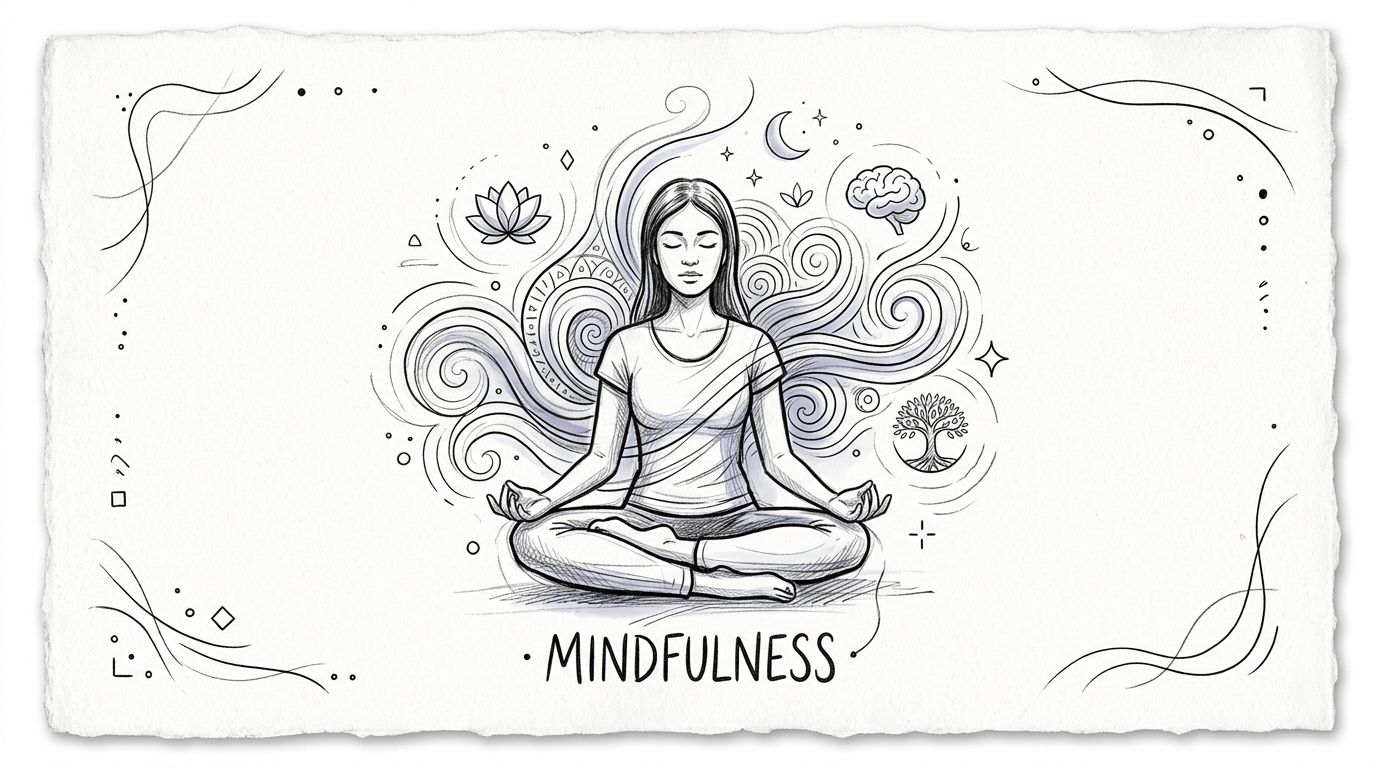
The practice is catching your attention drifting, then bringing it back without piling on more tension. I tell clients to treat that return as the rep. Every return trains steadier attention. Every harsh self-judgment adds more stress than the meditation removes.
Keep it simple:
Sit in a position you can maintain. A chair is fine.
Set a short timer. Two to five minutes counts.
Follow one anchor. Your breath, the feeling of your feet, or the sounds in the room.
Name distractions lightly. Thinking. Planning. Remembering.
Return to your anchor. Calmly and often.
Short practice done regularly beats one long session you dread. If stress is also hitting your sleep, these natural sleep aid options without melatonin can pair well with daytime calming work.
Use internal nature when going outside is not realistic
This is one of the most practical tools in a resilience toolkit, especially for River of Life readers dealing with limited mobility, pain, fatigue, or days when leaving the house takes too much out of you. You can still give your nervous system some of what nature offers.
A Psychology Today report on visualizing natural scenes and stress reduction describes research showing that mentally rehearsing scenes like forests, beaches, or lakes can lower stress markers, including cortisol and heart rate, in ways that resemble real nature exposure.
That trade-off matters. Real outdoor time can add sunlight, fresh air, and a break from screens. Visualization will not replace all of that. But it is useful on low-energy days, bad weather days, or any day your body needs a gentler option.
Try it this way:
Close your eyes or lower your gaze.
Choose one place. A quiet beach, pine trail, lake, or garden.
Add sensory detail. Notice the color of the sky, the sound of water, the smell of soil or salt air.
Let your breathing settle on its own. No need to force slow breaths.
Return to the scene each time your mind runs off.
Here's a guided option if you want support getting started.
This works because it is accessible. No equipment. No commute. No pressure to perform. For many people, that makes it easier to use consistently, and consistency is what turns a calming technique into a real resilience skill.
Consider Supplements and Adaptogens Wisely
Supplements can help. They can also disappoint people when expectations are off. The best way to use them is as support, not as a replacement for sleep, movement, food, boundaries, and stress skills.

What adaptogens can do
Adaptogens are typically used to help the body handle stress more steadily. Ashwagandha is one of the better-known options. An international taskforce from the World Federation of Societies of Biological Psychiatry and CANMAT has provisionally recommended 300 to 600 mg of standardized ashwagandha root extract for generalized anxiety disorder, and the same guidance stresses the importance of full-spectrum root-only extracts because that quality marker affects efficacy in this NIH Office of Dietary Supplements overview of ashwagandha.
That gives you a practical buying filter. Don't just look for the word ashwagandha on the label. Look for the form.
A few smart questions to ask before buying:
Is it root-only? This is a key quality detail.
Is it standardized? Standardization helps you know what you're taking.
Are you expecting support or a miracle? The second expectation usually leads to frustration.
One option in this category is River of Life's guide to herbal supplements for stress, which discusses ingredients commonly used for stress resilience, including ashwagandha.
Supplements work best when they support a system you're already caring for.
Natural stress support a quick comparison
Approach | Primary Mechanism | Best For |
|---|---|---|
Ashwagandha | Adaptogenic support for the stress response | People who want structured herbal support and pay attention to extract quality |
Rhodiola | Adaptogenic support | People exploring herbal options for stress resilience |
Passionflower | Herbal calming support | People looking for gentler plant-based support |
Lavender | Herbal calming support | People who prefer a familiar botanical option |
Breathing practices | Nervous system downshifting through breath control | Fast relief during acute stress |
Nature visualization | Mind-body relaxation through imagined natural settings | People with limited mobility or little access to outdoor space |
The trade-off is simple. Supplements are convenient, but they're not instant. Breathing and grounding are immediate, but they don't build your whole foundation. Use the right tool for the right job.
Know When to Seek Professional Help
Natural stress relief is useful. It's not always enough on its own.
If stress is affecting your ability to work, sleep, eat, think clearly, or function in daily life, it's time to speak with a doctor or therapist. The same is true if you feel persistently low, hopeless, panicky, emotionally numb, or unlike yourself for an extended stretch. Support matters even more if stress is fueling unhealthy coping habits or making relationships harder to manage.
Getting help isn't a failure of natural methods. It's a smart expansion of your toolkit.
Sometimes the most effective plan is layered. Daily habits. Breath work. Better boundaries. A thoughtful supplement. Professional support. Those can all belong in the same care plan.
The strongest approach is the one that helps you feel safe in your body again and able to live your life.
If you want a simple supplement option that fits into a broader natural stress routine, River of Life offers a capsule formula with turmeric extract, ashwagandha root, ginger, and bromelain for adults focused on stress resilience, sleep quality, mental clarity, and everyday comfort.