


Natural Supplement for Joint Pain and Stress: How It Works

You wake with a stiff knee, spend the morning rushing through messages, and reach for coffee while wondering why your body feels tense before the day has properly started. By evening, the joint still aches, your mind is restless, and sleep feels less restorative than it should.
Many people treat these concerns as separate shopping lists, one bottle for joint comfort and another for stress. A more practical approach is to ask whether a carefully designed natural supplement for joint pain and stress can support both needs without turning your daily routine into a cabinet of half-used products. The answer depends on the ingredients, their doses, absorption, safety profile, and whether you can take the formula consistently.
Table of Contents
The Daily Grind - Why Joint Pain and Stress Hit Together
A sore knee can change the way you move through an ordinary day. You avoid stairs, shorten your walk, hesitate before standing, and notice the discomfort each time you shift position. That reduced movement can make the body feel more restricted, while the ongoing discomfort keeps your attention focused on what might hurt next.
Stress works in the opposite direction but feeds the same experience. A demanding day can make it harder to relax muscles, maintain a regular sleep routine, or recover from physical activity. When sleep and recovery suffer, ordinary joint discomfort can feel more intrusive. This doesn't mean stress is the cause of every joint problem, or that calming down can repair damaged tissue. It means the two concerns can influence daily behaviour and symptom perception at the same time.

The pain and tension loop
Consider someone who works at a desk, exercises when time allows, and notices knee stiffness after sitting. The discomfort makes movement less appealing, but less movement removes one of the simplest ways to support mobility and manage daily tension. At night, concern about the knee combines with mental overactivity, making it harder to settle.
That person doesn't necessarily need a product marketed as a cure. They need a realistic routine that supports several relevant goals while leaving room for medical care, appropriate exercise, sleep habits, and dietary improvements.
Practical rule: A supplement should support your broader plan, not replace an assessment of persistent swelling, worsening mobility, or unexplained pain.
Why one routine can be easier to follow
Separate bottles can make sense when each ingredient has a clearly defined purpose and you need to adjust them independently. They can also create problems. You may forget one product, duplicate an ingredient, take incompatible combinations, or abandon the routine because it feels unnecessarily complicated.
A single multi-ingredient capsule offers a different trade-off. You gain convenience and a coordinated formula, but you lose some flexibility over individual doses. That makes label transparency especially important. The formula should identify each active ingredient, use meaningful amounts, and explain how the ingredients complement rather than merely decorate one another.
The practical objective isn't to promise that one capsule will solve every symptom. It's to make a consistent daily habit more achievable while addressing joint comfort, stress resilience, and sleep support through distinct ingredients.
The Science Behind the Synergy
Turmeric and ashwagandha don't perform the same job. That difference is the reason a combined formula can make sense. Curcumin-rich turmeric is generally selected for joint support, while ashwagandha is used primarily for stress and sleep support. A product that combines them should explain both roles instead of describing every ingredient as a vague anti-inflammatory.
A 2016 systematic review and meta-analysis of randomized trials found that standardized turmeric extracts, typically around 1,000 mg of curcumin per day for 8 to 12 weeks, reduced arthritis symptoms. The pooled results included a mean pain-score difference of −2.04 on a visual analog scale and a WOMAC improvement of −15.36. One analysis found no significant difference compared with pain medicines such as ibuprofen and diclofenac, although that doesn't make turmeric a substitute for prescribed treatment. The full review is available in this analysis of turmeric for arthritis.
Two pathways, one daily decision
Ashwagandha addresses a different part of the experience. A 2024 meta-analysis reported improvements versus placebo in perceived stress, anxiety, and serum cortisol, while another review found reductions in anxiety and stress. The evidence is most relevant to people seeking support for stress resilience and sleep quality, not to people expecting an adaptogen to directly correct structural joint damage.
This distinction matters. Joint discomfort may involve inflammation, mechanical strain, injury, or an underlying condition that needs diagnosis. Stress can affect sleep, muscle tension, activity patterns, and the way discomfort is experienced. Supporting both areas may help a person maintain a better routine, but it doesn't turn a supplement into a disease treatment.

The clinical evidence for ashwagandha is summarized in this review of ashwagandha and stress outcomes. Its value in a combined formula is logical when the product keeps expectations clear: turmeric is the joint-focused botanical, while ashwagandha supports the stress and sleep side of the routine.
Where the synergy has limits
The phrase “synergy” can become marketing shorthand. Combining ingredients isn't automatically superior to taking them separately. The advantage is practical when the ingredients have complementary purposes, the doses remain credible, and the daily schedule encourages adherence. The disadvantage appears when the capsule contains too little of each ingredient, hides the amounts inside a proprietary blend, or adds unnecessary components.
A combined formula also can't tell you whether pain comes from osteoarthritis, rheumatoid arthritis, an injury, or another condition. If the joint is persistently swollen, hot, unstable, or increasingly difficult to use, seek medical evaluation rather than relying on a wellness product.
For a visual explanation of how turmeric is used in joint support, see this guide to turmeric and curcumin for arthritis.
Turmeric and Ashwagandha - A Powerhouse Duo
A single multi-ingredient capsule can be practical when joint discomfort and stress affect the same daily routine. Instead of managing separate bottles, schedules, and ingredient decisions, one formula can bring together turmeric for joint support and ashwagandha for stress and sleep support. That convenience matters only if the product gives both ingredients credible roles and useful amounts.
Curcumin, the best-known active compound in turmeric, presents a formulation challenge. Taken alone, it has poor bioavailability because the body absorbs it inefficiently, metabolizes it rapidly, and removes it quickly. A capsule may therefore feature turmeric prominently while providing less exposure than the research formulas behind its proposed benefits.
Why absorption changes the calculation
Black pepper extract, often identified as piperine or BioPerine, is used to improve curcuminoid uptake. Independent reviews describe up to a 2,000% increase in curcuminoid bioavailability when combined with piperine, as detailed in this curcumin absorption study on NCBI. That figure describes an absorption-related finding, not a promise that joint discomfort will improve by the same amount.
The practical question is whether the formulation turns that science into a transparent product choice. Check whether it identifies the turmeric extract, states the amount, and explains its absorption approach. A basic turmeric powder and a modern multi-ingredient capsule may look similar on the front label while delivering very different information about how the formula is intended to work.
Ashwagandha brings a different benefit
Ashwagandha is commonly used as an adaptogenic herb for stress and sleep. Evidence reviews have reported improvements in perceived stress, anxiety, cortisol, sleeplessness, and fatigue compared with placebo. Those findings give it a reasonable place in a routine where mental tension or poor sleep makes physical discomfort harder to manage.
This is a support strategy, not a direct analgesic. Better sleep and lower feelings of overwhelm may make the day more manageable without changing joint stiffness directly. Turmeric may support joint comfort while leaving worry or disrupted sleep unresolved. Using both ingredients makes practical sense when the goal is to address connected parts of the routine, not to treat them as interchangeable or substitute a supplement for medical care.
A combined capsule also has a trade-off. It can simplify adherence, but separate bottles make it easier to adjust one ingredient, stop it, or identify which product affects you. The best choice depends on whether convenience or individual control matters more.
Ingredient | Primary role | Main formulation question |
|---|---|---|
Turmeric extract | Joint comfort and healthy inflammatory response | Is the extract standardized and paired with an absorption enhancer? |
Piperine or BioPerine | Supports curcuminoid uptake | Is the amount disclosed and appropriate for the full formula? |
Ashwagandha root | Stress resilience and sleep support | Does the label identify the extract and daily serving? |
Ginger or bromelain | Additional botanical or enzyme support | Are amounts listed separately rather than hidden in a blend? |
What to Look For on the Label
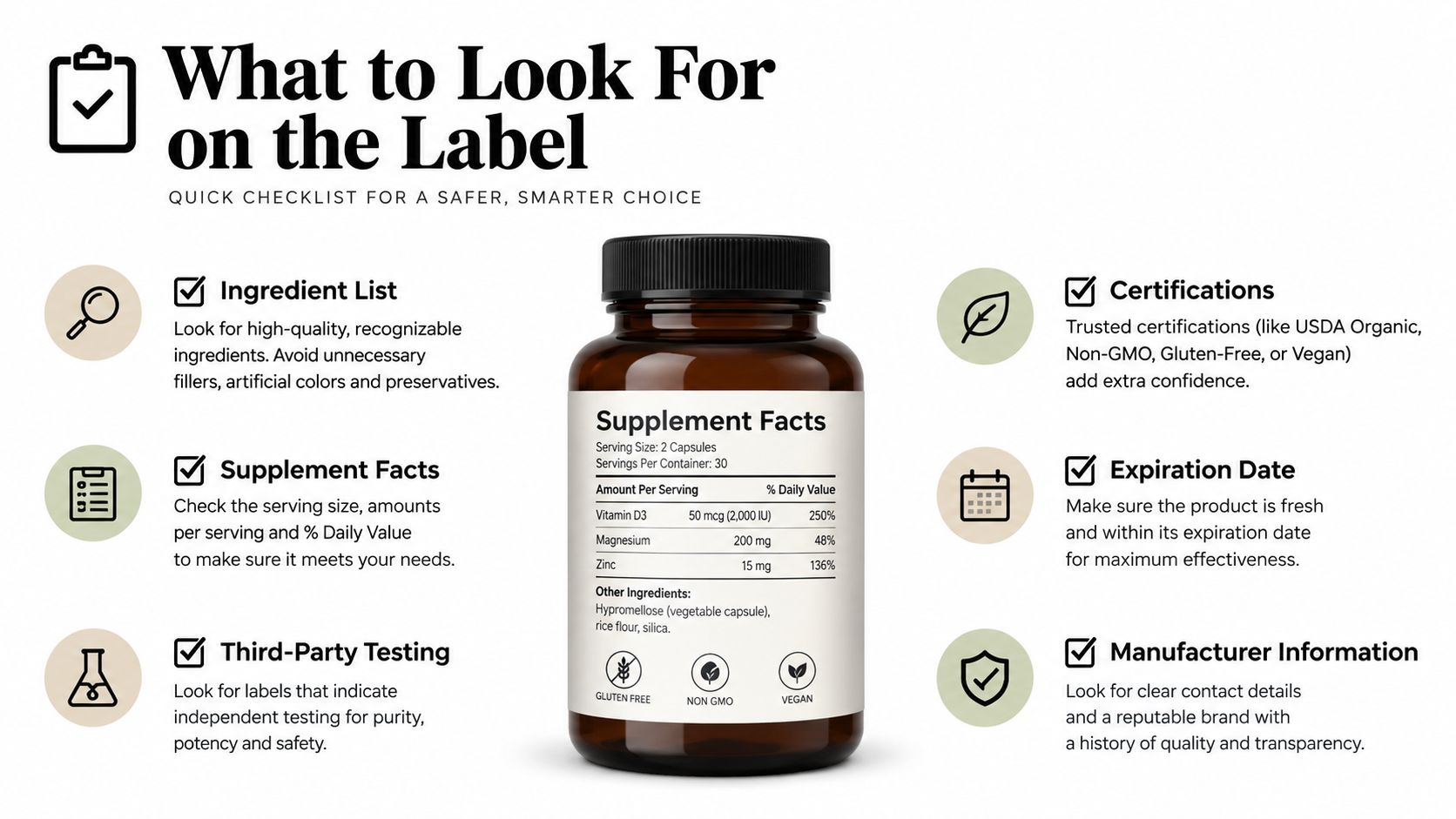
A label should let you judge a formula before you buy it. If you cannot find the serving size, the amount of each active ingredient, or clear directions, the product is difficult to assess. Broad promises about joint comfort or stress support are not a substitute for usable information.
Begin with the recommended daily serving, not the capsule count on the front of the bottle. A large bottle may still provide modest amounts per serving. For ashwagandha, controlled studies and evidence summaries report clearer stress and sleep effects around 600 mg per day or higher and after 8 or more weeks in several studies. That is a comparison point, not a universal prescription. The NIH Office of Dietary Supplements review of ashwagandha provides further context.
A simple label check
Use this checklist before choosing a daily formula:
Are the amounts visible? Each active ingredient should have its own quantity. A proprietary blend that lists only a combined weight prevents you from judging whether the formula is meaningfully dosed.
Is the turmeric specific? Look for turmeric extract or curcumin details, including the extract type when provided, rather than a generic spice reference.
Is absorption addressed? Piperine from black pepper is one option, but it can affect how some medicines are handled. Look for a clearly named absorption approach and read a deeper look at how curcumin absorption works. Increased absorption does not guarantee greater pain relief.
Is ashwagandha identified clearly? The label should name the plant part, extract details when available, and amount per serving.
Are unnecessary fillers minimized? A shorter, transparent ingredient list makes it easier to understand the formula and discuss it with a pharmacist.
Does the manufacturer provide third-party testing results, batch-specific COAs, and clear storage instructions? Those details give you practical ways to verify consistency, handling, and product identity.
One capsule versus separate bottles
Separate products give you more control. You can adjust turmeric without changing ashwagandha, stop one ingredient if it does not suit you, or select a different extract for each goal. The trade-off is a more demanding routine, extra labels to review, and a higher chance of overlapping ingredients.
A single multi-ingredient capsule reduces daily decisions and may make a stress and joint-support routine easier to maintain. That convenience only helps when the formula shows each active amount, serving size, absorption method, and use instruction clearly. Choose the capsule for a transparent formulation, not because the packaging calls it “complete.”
Safety, Timing, and Managing Expectations
“Natural” describes an origin, not a guarantee of safety. Turmeric, piperine, ashwagandha, ginger, and other botanicals can be unsuitable for some people or can complicate an existing medication routine. Speak with a doctor or pharmacist before starting a new formula if you take prescription medicines, manage a chronic condition, are pregnant or breastfeeding, or have an upcoming procedure.
Particular care is sensible with medicines that affect bleeding, immune activity, blood pressure, blood sugar, or sedation. Don't assume that separating products by a few hours removes an interaction. If you already take medication for pain, sleep, anxiety, or inflammation, provide the complete ingredient label to a qualified professional.
For a focused review of possible concerns, consult this guide to ashwagandha interactions.

Timing for a tolerable routine
Many people find botanical capsules easier to tolerate with a meal, particularly when taking more than one active ingredient. Food can also make the routine easier to remember. Follow the product's directions rather than assuming that an empty stomach is always better for absorption.
The most useful timing rule is consistency. If the product makes you nauseated at breakfast, try the meal you tolerate best, provided the label and your clinician's advice allow it. If ashwagandha makes you feel relaxed, an evening schedule may suit you. If it feels alerting, earlier use may be more comfortable. Individual response matters.
Set a fair trial period
Research on turmeric has measured outcomes over repeated use rather than a single dose. Ashwagandha reviews report clearer stress and sleep effects after sustained use, including benefits observed at 8 weeks in one review. That doesn't mean everyone needs the same period, but it does mean that judging a formula after one or two capsules isn't a useful test.
Track a few practical signals instead of relying on memory:
Joint function: Can you walk, climb stairs, or stand after sitting with less difficulty?
Comfort: Has the ordinary background ache become less intrusive?
Stress response: Do you recover from demanding moments more easily?
Sleep: Are you falling asleep or staying asleep more reliably?
Tolerance: Have you noticed stomach upset, unusual drowsiness, or another unwanted effect?
Stop and seek advice if symptoms worsen or a new reaction appears. A supplement shouldn't delay assessment of severe pain, marked swelling, loss of function, or symptoms that suggest an inflammatory or autoimmune condition.
Taking the Next Step Toward Natural Relief
A combined approach makes the most sense when your daily problem is also combined. Joint discomfort can discourage movement, while stress and poor sleep can make discomfort harder to manage. Turmeric and piperine address the formulation challenge of joint-focused curcumin, while ashwagandha supports the stress and sleep side. That doesn't make the ingredients identical, and it doesn't guarantee a result, but it gives a multi-ingredient capsule a defensible practical purpose.
Start with the label, not the promise. Look for individually disclosed amounts, a clear serving size, a standardized turmeric extract, a credible absorption strategy, and an ashwagandha dose aligned with the evidence. Then make the routine simple enough to follow, monitor your response, and review the plan with a healthcare professional if you're taking medication or managing a diagnosed condition.
River of Life Capsules offers a vegan, capsule-based formula combining turmeric extract with BioPerine, ashwagandha root, ginger, and bromelain, with one-time and subscription purchase options. Visit River of Life to review the ingredient details and decide whether its single-capsule approach fits your joint comfort and stress-support routine.