


Turmeric Supplement with Black Pepper: Absorption Benefits

Piperine can raise curcumin bioavailability by 2,000% at 45 minutes in one widely cited review, but that result isn't universal across every turmeric supplement with black pepper. The underlying reality is more useful than the slogan, because formulation, dose, and even your own body's response can change what happens next.
You've probably seen the pattern already. Someone buys turmeric for sore knees, uses it faithfully, and feels very little, while another person swears the same kind of capsule made a noticeable difference. That gap usually comes down to how much curcumin gets into the bloodstream, not whether the ingredient has value in the first place. For a deeper background on that absorption problem, see this explanation of curcumin bioavailability.

Table of Contents
Why Your Turmeric Might Not Be Working
You take the capsule every morning, maybe stir turmeric into warm milk, and weeks pass without much to show for it. That can feel disappointing, but it usually points to a delivery problem, not a worthless ingredient.
The absorption problem
Curcumin is useful on paper and stubborn in practice. Your body breaks it down quickly, so a supplement can look strong on the label and still act weak after you swallow it. That is why people often feel like they have done everything right and still notice very little.
The missing piece is often absorption. If curcumin does not reach the bloodstream in enough quantity, the body has less to work with, and the supplement can seem underwhelming even when the formula itself is sound.
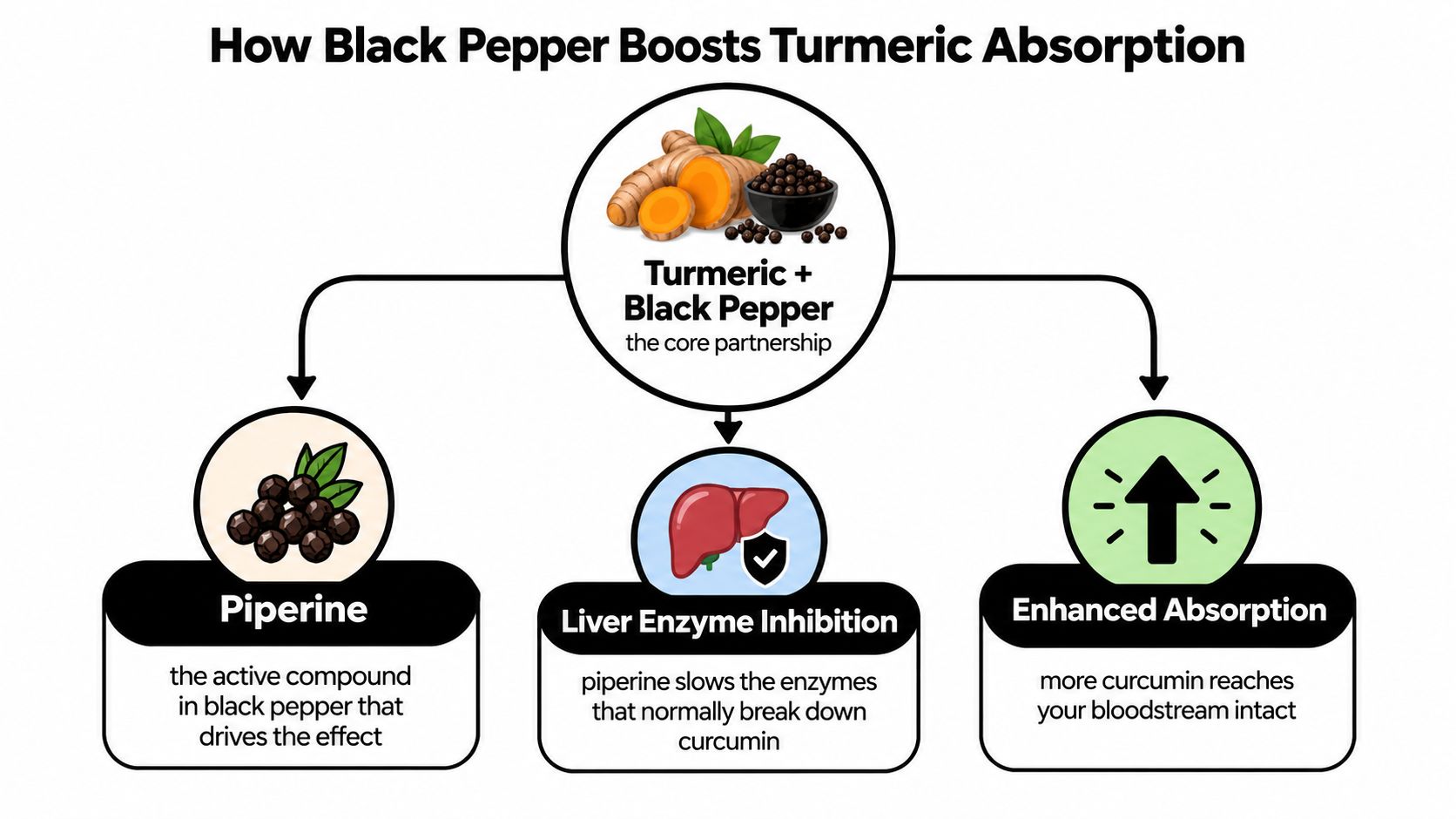
Black pepper changes that math because piperine slows the body's usual cleanup process. In a human pharmacokinetic study summarized in a 2021 review, 2,000 mg curcumin plus 5 mg piperine produced much higher exposure than curcumin alone, with one measured value rising from 8.44 to 15.55, and one review reported a 2,000% increase in bioavailability under specific conditions PMC review.
Practical rule: a turmeric product without any absorption strategy may look better on the shelf than it performs in your body.
Why the pairing matters
Plain turmeric powder and a well-designed turmeric supplement with black pepper do not behave the same way. Cooking spice is not the same as a standardized extract, and the delivery system matters as much as the ingredient list. A supplement can contain curcumin, but if the body clears it too fast, the effect may stay small.
For a useful product example and label context, see this turmeric and curcumin supplement overview, and for a fuller background on the absorption issue, see this explanation of curcumin bioavailability.
How Black Pepper Boosts Turmeric Absorption
Piperine, the main alkaloid in black pepper, slows the body's normal cleanup systems. In the gut and liver, those systems usually break down curcumin before much of it can circulate. With piperine present, more curcumin stays intact long enough to be used.
The mechanism in plain language
Curcumin faces a fast exit. Piperine slows that exit, so more of the compound can pass through before the body clears it.
One human pharmacokinetic study reported more than a fourfold increase in oral bioavailability when curcumin was taken with piperine, and other summaries of the same interaction have reported up to a 2,000% rise in measured bioavailability under particular dosing conditions PMC review. That helps explain why many products add a small amount of black pepper extract instead of relying on turmeric alone.
Why the result isn't universal
The effect does not show up the same way in every product. A 2025 pharmacokinetic study reported that adding piperine to 2,400 mg curcumin did not increase systemic uptake in that setting, and a 2025 critical reappraisal found no increase in AUC or total plasma levels in healthy volunteers with certain higher-dose formulations iScience critical reappraisal00836-3). That does not cancel the earlier evidence. It shows that formulation quality, dose, and context shape the result.
The simple takeaway is that black pepper can help, but only within the right setup. A carefully designed capsule may perform very differently from a generic blend, even if the label looks similar.
That gap is why some people notice real effects and others do not. The ingredient list matters, but the delivery system matters more. Curcumin has to survive long enough to be absorbed, and piperine can help with that only when the product is built to make use of it.
Real Benefits You Can Expect
The most credible reason to use this pairing is still everyday comfort, especially for joints. People shopping for curcumin usually want support that feels practical, not abstract, and that's where the formulation discussion becomes relevant. If more curcumin reaches the bloodstream, there's a better chance it can support the outcomes people actually care about.
Joint comfort is the clearest use case
Curcumin's reputation came from its role in inflammation-focused routines, and that's still where interest is strongest. Many readers use it for stiffness, post-workout soreness, or general movement support. A turmeric supplement with black pepper is often chosen because the piperine helps make the dose more usable.
There's also a broader pattern emerging. A 2025 meta-analysis reported improved antioxidant markers such as SOD and GSH, lower inflammatory markers such as IL-6, and reduced MDA with curcumin plus piperine, while another 2025 systematic review found beneficial effects on AST and some subgroup signals for ALT, but not consistent improvement in CRP or TNF-α PubMed 38561618. That's a more honest picture than the usual “helps inflammation” slogan.
Stress and sleep need a softer claim
For stress resilience and sleep support, the evidence is more indirect. Curcumin is often used as part of broader routines that may include other botanicals, and many consumers report they like having a calmer daily baseline when discomfort is better controlled. That's a reasonable practical goal, but it's not the same as saying turmeric acts like a sedative or a dedicated sleep aid.
Use the product for the job it can reasonably do, not the job you wish it could do.
The cleanest way to think about it is this. Better absorption can improve the odds that curcumin contributes to joint comfort and related wellness goals, but the result still depends on dose, product design, and your own situation. If your only goal is sleep, turmeric is better seen as support for the body's overall balance, not as a knockout remedy.
How to Dose and Use Turmeric with Black Pepper
A supplement works best when the label gives you real numbers. For many products, the practical range sits around 500 to 2,000 milligrams of curcumin with 5 to 20 milligrams of piperine, which is enough to show why a small amount of black pepper extract can matter. The exact formula still matters more than the headline claim.
What to look for on the bottle
Check whether the label names the turmeric extract and lists the piperine amount clearly. Standardized extract is easier to compare than vague “turmeric blend” wording, and a clearly identified pepper extract is more useful than a generic spice claim. If the label hides the dose, keep looking.
Take it with food, ideally with a meal that includes some fat. Curcumin is fat-soluble, so a meal can help your body handle it more effectively. Consistency matters too, because these supplements are usually part of a daily routine, not a one-time fix.
If you want a practical way to compare formulas, this turmeric supplement guide gives a simple checklist for label reading.
How long it usually takes
Do not expect a dramatic shift on day one. People usually judge this kind of routine over several weeks, especially for joint comfort, where steady use matters more than a single dose. That is also why a good routine feels a bit like watering a plant, you notice the result through repetition, not one splash.
If you combine turmeric with other supplements, space them sensibly instead of putting everything into one serving. That is even more important if your routine already includes several botanicals or recovery aids. Simplicity makes it easier to notice what is helping.
Safety Warnings Most Articles Skip
The same absorption boost that makes this pairing useful can also make it more complicated. Piperine does not only affect curcumin, it can also change how your body handles other compounds. A supplement that feels stronger can therefore be more likely to cause interactions.
Why enhanced absorption cuts both ways
Recent independent reviews and case reports have linked bioavailability-enhanced turmeric products to rare but real liver-injury signals, especially after 1 to 4 months of use, and a 2026 NIH NCCIH review notes that liver damage has been reported with bioavailable turmeric formulations NCCIH turmeric overview. A 2025 case report tied drug-induced liver injury to a turmeric and black pepper supplement and pointed to the large absorption increase as a plausible risk amplifier.
That does not mean everyone is at risk. It does mean people with liver disease, gallbladder issues, or medications that depend on liver metabolism should be more careful than the average shopper. The same caution applies to medicines with a narrow safety margin, because piperine can change exposure in ways you may not want.
Who should pause and ask first
People with liver concerns: Enhanced exposure may not be the right tradeoff if your liver is already under strain.
People on interacting medicines: A supplement that changes absorption can also change how a drug behaves.
People using long-term daily doses: More time on a product can mean more opportunity for a rare problem to surface.
The practical point is simple. A formula that helps one person with comfort might be the wrong choice for another person on a medication plan. If you are unsure, ask a clinician who knows your medicines and your history.
Choosing the Right Supplement and Where to Buy
A turmeric capsule looks simple on the shelf, but the label can hide important differences. Some brands use vague pepper wording, while others name the piperine source and show exactly how the formula is built. That matters here because absorption is part of the product's value, like the lens on a camera rather than just the camera body.
Compare the label, not just the price
Start with a standardized turmeric extract, a clearly identified black pepper extract, and dosing that makes sense on its own. Vegan capsules may matter to some buyers, and third-party testing is a useful sign that a brand is paying attention to quality. Fillers and oversized blends can make a bottle look more impressive without making it more useful.
A direct-to-consumer option can also be easier if you want steady refills and predictable delivery. River of Life sells a vegan, capsule-based formula with turmeric extract, BioPerine, ashwagandha root, ginger, and bromelain. It offers one-time and subscription purchases, international fulfillment to 40+ countries, and a 30-day return policy for unopened bottles. For shoppers comparing options, the formula details are laid out clearly rather than buried in marketing copy.
What makes one option more practical than another
Transparent dosing: You should be able to tell what is inside without decoding the label.
Recognized absorption support: A named piperine source is easier to evaluate than generic pepper.
Useful support materials: Educational resources can help you use the product more carefully.
If you want a side-by-side shopping checklist, this supplement comparison guide is a useful place to begin. The cheapest bottle is not always the smartest choice once absorption and interaction risk are part of the decision.